Rivian's Battery Warranty: What's Actually Covered?
When you're spending $70,000+ on a Rivian R1T or R1S, the high-voltage traction battery is the single most expensive component in the vehicle. Understanding the Rivian battery warranty — what it covers, how long it lasts, and what happens if capacity drops — is essential before signing the purchase agreement.
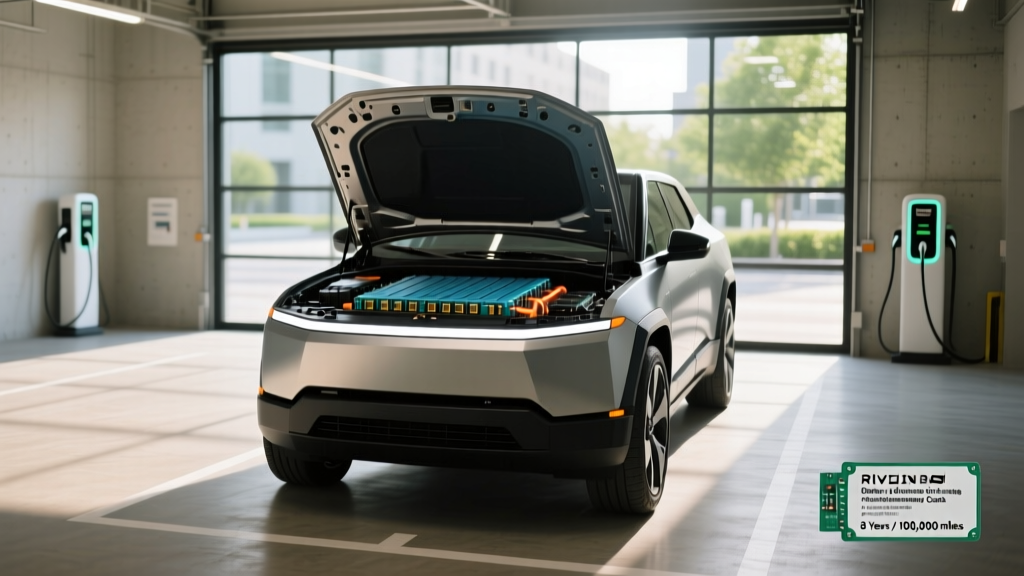
Rivian provides a battery and drive unit warranty that covers 8 years or 175,000 miles (whichever comes first) on both the R1T and R1S. The warranty guarantees that the battery will retain at least 70% of its original usable capacity over that period. If your pack degrades below that threshold within the warranty window, Rivian will repair or replace it to bring it back above 70%.
| Component | Duration | Mileage Limit | Capacity Retention Threshold |
|---|---|---|---|
| High-voltage battery pack | 8 years | 175,000 miles | ≥ 70% of original usable capacity |
| Drive unit(s) / electric motors | 8 years | 175,000 miles | N/A (defect coverage) |
| Basic vehicle limited warranty | 5 years | 60,000 miles | N/A |
This warranty covers manufacturing defects and abnormal degradation. It does not cover damage from accidents, flooding, improper modifications, or use of the vehicle outside its designed parameters (e.g., sustained operation in extreme conditions beyond Rivian's published specifications). Rivian also excludes "cosmetic" issues that don't affect function.
One important nuance: the 70% threshold is based on usable capacity, not total pack capacity. Rivian, like most automakers, builds in a buffer (typically 3–5 kWh) that the battery management system (BMS) holds in reserve to protect the cells from deep-discharge damage. You'll never see that buffer on your dashboard — the range estimate reflects only usable kWh.
For full warranty terms, always refer to your Rivian warranty documentation or contact Rivian Service directly, as terms can vary slightly by model year.
How Long Do Rivian EV Batteries Last?
The short answer: almost certainly longer than you'll own the truck. Modern lithium-ion traction batteries are engineered for 1,500–3,000+ full charge cycles before reaching 70–80% capacity, depending on chemistry. For a Rivian with an EPA range of 300+ miles, that translates to 450,000–900,000+ miles of potential battery life under normal use.
In practice, most EV batteries lose capacity gradually rather than failing catastrophically. Here's what the data shows for large-format NMC/NCA packs similar to those in Rivian vehicles:
Typical NMC/NCA Battery Degradation Curve (Industry Data)
| Time / Mileage | Average Capacity Retained | Notes |
|---|---|---|
| Year 1 / ~15,000 mi | 95–97% | Initial break-in loss; steepest part of the curve |
| Year 3 / ~45,000 mi | 91–94% | Degradation rate slows significantly |
| Year 5 / ~75,000 mi | 88–92% | Most owners still well above warranty threshold |
| Year 8 / ~120,000 mi | 84–89% | Approaching end of warranty; still above 70% |
| Year 10+ / 150,000+ mi | 80–86% | Beyond warranty; pack still functional |
Sources: Recurrent Auto battery degradation studies, Geotab fleet data (2023–2025 aggregate). Individual results vary based on charging habits, climate, and usage patterns.
The key takeaway: hitting the 70% warranty threshold is statistically uncommon under normal use. Recurrent Auto's research on thousands of EVs shows that only a small fraction of batteries fall below warranty thresholds within the coverage period. Most Rivian owners will trade in or sell the vehicle long before the battery becomes a concern.
LFP vs. NMC/NCA: Which Chemistry Powers Your Rivian?
Rivian has used NMC (nickel manganese cobalt) and NCA (nickel cobalt aluminum) lithium-ion chemistries in its Large-pack R1T and R1S vehicles, which offer the longest EPA range (up to ~410 miles for the R1T Dual-Motor Max Pack). The newer Standard pack and some upcoming platforms are expected to incorporate LFP (lithium iron phosphate) cells, following an industry-wide shift toward lower-cost, longer-lasting chemistries for non-maximum-range trims.
Understanding the trade-offs between these chemistries matters for long-term ownership:
| Attribute | LFP (Lithium Iron Phosphate) | NMC/NCA (Nickel-Based) |
|---|---|---|
| Energy density (Wh/kg) | 140–180 (lower) | 220–300 (higher) |
| Typical cycle life to 80% | 3,000–6,000+ cycles | 1,000–2,500 cycles |
| Cold-weather performance | Moderate — slower charge in freezing temps | Better — more tolerant of cold charging |
| Cost per kWh (cell level) | ~$60–80 (lower) | ~$100–130 (higher) |
| Thermal stability / safety | Excellent — less prone to thermal runaway | Good — requires more active thermal management |
| Charging to 100% regularly | Recommended — no degradation penalty | Not recommended — accelerates wear above 80% |
| Best for | Standard-range trims, daily commuting, fleet use | Max-range trims, towing, cold-climate drivers |
Which is better? It depends on your use case. If you want maximum range and tow frequently in cold weather, NMC/NCA is the stronger choice. If you prioritize longevity, lower replacement cost, and plan to charge to 100% daily for commuting, LFP offers a compelling advantage. Neither chemistry is universally "better" — they serve different buyer profiles.
How Much Does a Rivian Battery Replacement Cost?
This is the question that keeps prospective EV buyers up at night. Let's address it with actual numbers rather than fear.
| Pack Configuration | Usable Capacity | Estimated Replacement Cost | Typical Replacement Timeline |
|---|---|---|---|
| Standard Pack (LFP, where available) | ~105 kWh | $12,000–$16,000 | 12–15+ years (if ever) |
| Large Pack (NMC) | ~128 kWh | $16,000–$22,000 | 12–15+ years (if ever) |
| Max Pack (NMC) | ~149 kWh | $20,000–$28,000 | 12–15+ years (if ever) |
Costs include parts and labor at a Rivian Service Center. Prices reflect 2025–2026 estimates and are expected to decline as cell costs fall. Out-of-warranty replacements remain rare.
Context matters here. Battery cell prices have fallen roughly 90% since 2010, from over $1,000/kWh to approximately $100–130/kWh at the pack level in 2025, according to BloombergNEF tracking. By the time a Rivian battery actually needs replacement (15+ years from purchase, in most scenarios), pack costs will likely be substantially lower.
Also critical: most out-of-warranty battery issues involve individual module or cell failures, not full-pack replacement. Rivian's modular pack architecture allows service centers to replace individual modules at a fraction of the full-pack cost — typically $2,000–$5,000 per module depending on the fault.
What Factors Affect Rivian Battery Life?
Your battery doesn't degrade at a fixed rate — your habits and environment significantly influence how quickly capacity declines. Here are the primary factors, ranked by impact:
Battery Care Checklist for Rivian Owners
- Avoid frequent DC fast charging above 150 kW: Occasional road-trip fast charging is fine, but daily reliance on 200+ kW DCFC accelerates electrolyte breakdown. Aim for Level 2 home charging as your primary method.
- Limit sustained 100% State of Charge (NMC/NCA packs): For NMC chemistry, set your daily charge limit to 80–85%. Reserve 100% for road trips. LFP packs can be charged to 100% regularly without penalty.
- Don't let the pack sit at 0% or below 10% for extended periods: Deep discharge stresses cells. If storing the vehicle, leave it at 40–60% SoC.
- Use preconditioning before fast charging: Rivian's navigation system automatically preconditions the battery when you route to a charger. This warms the cells to optimal temperature, reducing charge time and stress.
- Minimize extreme-temperature parking: If you live in Arizona or Minnesota, garage parking helps. The BMS will protect the battery, but sustained 110°F+ heat or -20°F cold accelerates calendar aging.
- Keep firmware updated: Rivian pushes over-the-air BMS improvements that optimize charge curves and thermal management. Always install updates promptly.
- Don't obsess over range fluctuations: The BMS recalibrates periodically. A 5-mile range drop overnight doesn't indicate degradation — it's normal variance.
How to Check Your Rivian's Battery Health (SoH)
State of Health (SoH) is a percentage indicating how much capacity your battery retains compared to when it was new. A brand-new pack reads 100% SoH; a pack that's lost 8% of capacity reads 92%.
Through the Rivian app and vehicle: Rivian does not currently display a direct SoH percentage on the in-vehicle screen or app the way some competitors (like Tesla's service mode) do. However, you can infer SoH by tracking your vehicle's estimated full-charge range over time. If your R1T Max Pack originally showed 410 miles at 100% and now shows 385 miles under similar temperature conditions, that's roughly a 6% capacity loss — well within normal parameters.
Through Rivian Service: If you want a precise SoH reading, request a battery health diagnostic at a Rivian Service Center. Technicians can pull detailed cell-level data including individual module voltage variance, internal resistance, and precise capacity measurements.
Third-party tools: OBD-II dongles paired with apps like Car Scanner or EV Battery Health can read BMS data from the vehicle's CAN bus, though Rivian's data availability through these tools is more limited than some legacy automakers. Results should be treated as estimates.
DIY tracking method: The most practical approach for most owners is to log your full-charge range estimate once a month under consistent conditions (similar ambient temperature, same tire pressure). Plot it over time. A gradual, linear decline of 1–3% per year is normal. A sudden drop of 5%+ in a single month warrants a service visit.
Emerging Battery Tech: What's on the Horizon?
The battery landscape is evolving rapidly, though it's critical to separate lab announcements from production reality.
Solid-state batteries promise higher energy density (potentially 400+ Wh/kg at the cell level), faster charging, and improved safety by replacing the liquid electrolyte with a solid ceramic or polymer separator. Companies like QuantumScape, Samsung SDI, and Toyota have demonstrated prototypes, but mass production at automotive scale remains estimated for 2028–2032. No solid-state pack is currently available in a production vehicle sold in the U.S. as of 2026.
Silicon-dominant anodes (from companies like Sila Nanotechnologies and Group14) increase energy density by replacing graphite anodes with silicon composites. These are beginning to appear in limited production applications and could increase pack energy density by 10–20% within the next 2–4 years. Rivian has not announced a specific timeline for adoption, but the technology is compatible with existing cell form factors.
Sodium-ion batteries offer a low-cost alternative for standard-range vehicles, with CATL and others beginning production. Energy density is lower than LFP (~120–150 Wh/kg), making them better suited for smaller vehicles or stationary storage. Potential relevance to Rivian's smaller R2 platform is speculative.
For current Rivian owners, these technologies are forward-looking and will not affect your existing vehicle. For prospective buyers deciding whether to wait: the NMC and LFP packs available today are mature, well-understood technologies backed by robust warranties. Waiting for next-generation chemistry means waiting years with no guaranteed timeline.
Rivian Battery Warranty vs. Competitors
How does Rivian's coverage stack up against other EV truck and SUV makers?
| Vehicle | Warranty Duration | Mileage | Retention Threshold |
|---|---|---|---|
| Rivian R1T / R1S | 8 years | 175,000 mi | 70% |
| Tesla Cybertruck | 8 years | 120,000–150,000 mi | 70% |
| Ford F-150 Lightning | 8 years | 100,000 mi | 70% |
| Chevrolet Silverado EV | 8 years | 100,000 mi | 70% |
| Hyundai Ioniq 5 | 10 years | 100,000 mi | 70% |
Rivian's 175,000-mile limit is among the most generous in the segment, reflecting the truck's positioning for high-mileage and towing use. Tesla's Cybertruck warranty varies by drivetrain configuration (AWD vs. Cyberbeast). Ford and Chevrolet stick to 100,000 miles. Hyundai leads on duration at 10 years but with a lower mileage cap.
Frequently Asked Questions
Does the Rivian battery warranty transfer to a second owner?
Yes. Rivian's battery and drive unit warranty is tied to the vehicle, not the original owner. If you buy a used R1T or R1S within the 8-year/175,000-mile window, the remaining warranty coverage transfers automatically. Always verify the remaining warranty period through a Rivian Service Center before purchasing used.
Will using third-party DC fast chargers void my Rivian battery warranty?
No. Using Electrify America, EVgo, ChargePoint, or Tesla Superchargers (with adapter or NACS-equipped models) does not void your warranty. Rivian's warranty covers battery defects and abnormal degradation regardless of which charging network you use. However, if a specific charger malfunction causes physical damage to the charge port or onboard systems, that damage may not be covered under the battery warranty (it would fall under the charger operator's liability).
How much range will my Rivian lose in cold weather?
Expect a 15–30% range reduction in sustained freezing temperatures (below 32°F), with the higher end of that range applying to highway driving in sub-20°F conditions. This is temporary — the range returns as temperatures warm. It is not battery degradation. Rivian's heat pump (standard on recent models) helps mitigate cabin-heating energy draw, but battery chemistry inherently slows in cold conditions. Preconditioning while plugged in helps preserve range.
What happens if my Rivian battery degrades to 69% — do I get a brand-new pack?
Not necessarily. Rivian's warranty obligation is to restore capacity above the 70% threshold. This may involve replacing individual degraded modules rather than installing a brand-new pack. The result is a battery that meets the warranty standard, but it may not be a zero-mile unit. This is standard practice across the EV industry.
Can I upgrade my Rivian to a larger battery pack later?
As of 2026, Rivian does not offer a battery upgrade path for existing R1T or R1S vehicles. The pack is structurally integrated into the skateboard chassis, and swapping to a larger pack would require significant re-engineering of the vehicle's BMS, cooling system, and software calibration. Rivian has discussed the concept of future upgradeability, but no program exists today.
Is Rivian's LFP battery (Standard Pack) covered by the same warranty?
Yes. Regardless of chemistry, Rivian's 8-year/175,000-mile battery warranty with a 70% retention threshold applies. LFP chemistry generally degrades more slowly than NMC, so Standard Pack owners are statistically even less likely to approach the warranty threshold.