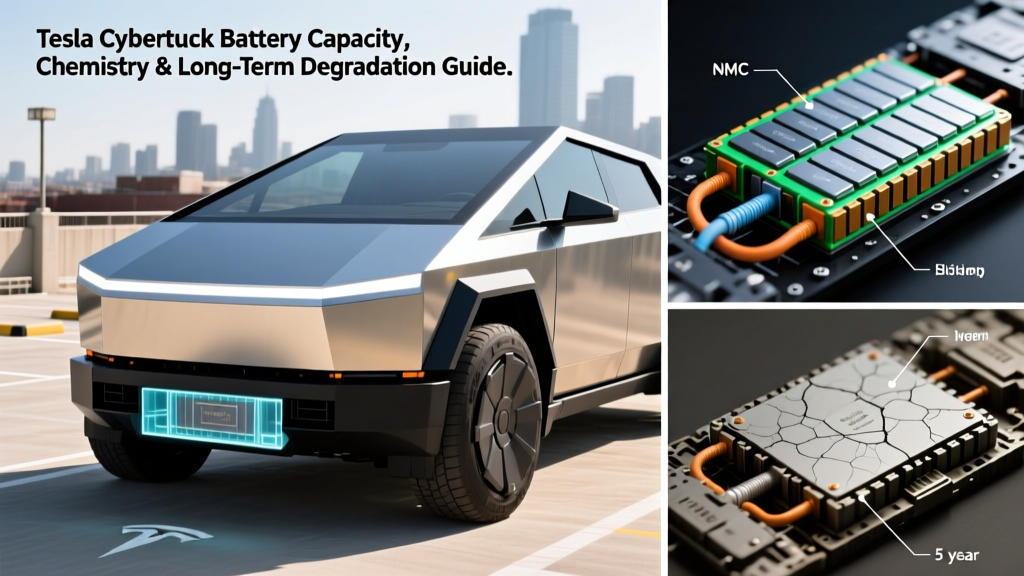
The Tesla Cybertruck's battery pack is one of the largest ever fitted to a consumer electric vehicle, and its structural 4680-cell architecture represents a departure from conventional EV battery design. For buyers evaluating the Cybertruck — or any large-format EV — understanding battery capacity, chemistry, degradation behavior, and long-term replacement economics is essential. This guide breaks down the Cybertruck's battery system in detail and places it in the broader context of EV battery technology as of 2026.
Cybertruck Battery Capacity: The Numbers
The Tesla Cybertruck uses a structural battery pack built around Tesla's 4680 cylindrical cells. Based on EPA filing data and teardown analysis, the pack holds approximately 123 kWh of usable energy (roughly 135 kWh gross). This is among the largest battery packs in any production passenger vehicle, necessary to move the Cybertruck's 6,600–6,800 lb curb weight across its EPA-rated range.
| Specification | AWD (Dual Motor) | Cyberbeast (Tri Motor) |
|---|---|---|
| Usable Battery Capacity | ~123 kWh | ~123 kWh |
| Cell Format | 4680 cylindrical | 4680 cylindrical |
| Chemistry | NMC (nickel manganese cobalt) | NMC (nickel manganese cobalt) |
| EPA Range | 340 miles | 320 miles |
| Real-World Highway Range | ~260–290 miles | ~245–275 miles |
| Peak DC Fast Charge Rate | ~350 kW (at V4 Supercharger) | ~350 kW (at V4 Supercharger) |
| 10–80% DC Fast Charge Time | ~18–22 minutes | ~18–22 minutes |
| Level 2 AC Charge Rate | 11.5 kW (48A) | 11.5 kW (48A) |
| EPA Efficiency | ~2.0 kWh/mile (50 MPGe combined) | ~2.1 kWh/mile (48 MPGe combined) |
Battery Chemistry: NMC in the Cybertruck (and Why Not LFP?)
Tesla uses two primary battery chemistries across its lineup: NMC (nickel manganese cobalt) for performance and long-range models, and LFP (lithium iron phosphate) for standard-range vehicles like the base Model 3 and Model Y. The Cybertruck exclusively uses NMC chemistry in its 4680 cells.
The reason is straightforward: energy density. A vehicle this heavy needs every kilowatt-hour it can pack into the structural floor. NMC cells offer roughly 20–30% higher energy density by weight than LFP, which directly translates to more range per pound of battery. For a truck already pushing 6,800 lbs, LFP would either reduce range significantly or require an even heavier pack.
| Characteristic | LFP (Lithium Iron Phosphate) | NMC (Nickel Manganese Cobalt) |
|---|---|---|
| Energy Density (Wh/kg, cell-level) | 160–180 | 220–260 |
| Typical Cycle Life (full cycles to 80% SoH) | 3,000–5,000+ | 1,500–2,500 |
| Cold-Weather Performance | Moderate (slower charge acceptance below freezing) | Better (more consistent low-temp operation) |
| Thermal Stability / Safety | Excellent (higher thermal runaway threshold) | Good (requires robust thermal management) |
| Cost per kWh (cell-level, 2025–2026) | ~$70–90 | ~$100–130 |
| Recommended Charging Habit | Can charge to 100% daily without significant harm | Best kept 20–80% daily; 100% for trips only |
| Tesla Vehicles Using This Chemistry | Model 3 RWD, Model Y RWD (Standard Range) | Model 3/Y Long Range, Model S/X, Cybertruck |
The trade-off is cycle life and cost. LFP cells can endure significantly more full charge-discharge cycles before degrading to 80% capacity. But for the Cybertruck's use case — where high energy density is non-negotiable — NMC is the correct engineering choice. Tesla's battery management system (BMS) and thermal management mitigate many of NMC's weaknesses, including thermal stability concerns.
How Long Do EV Batteries Last? Degradation Data
Based on fleet data from Tesla vehicles using earlier 2170 NMC cells (Model 3 Long Range, Model Y), typical degradation follows a predictable curve: approximately 5–8% capacity loss in the first 2 years or 30,000 miles, then a much slower linear decline of roughly 1–2% per year thereafter. Tesla's own 2024 Impact Report stated that Model 3/Y vehicles retained approximately 85% of original battery capacity at 150,000 miles. The 4680 cells in the Cybertruck are expected to perform similarly or slightly better due to improved manufacturing and thermal design, though long-term fleet data specific to the Cybertruck is still accumulating as of 2026.
Translating this to the Cybertruck's 123 kWh pack:
- Year 1–2 (0–30,000 mi): Expect ~115–118 kWh usable (5–7% loss) — range drops from 340 to ~315–325 miles EPA
- Year 5 (~75,000 mi): Expect ~108–112 kWh usable (~10–12% loss) — range ~295–310 miles
- Year 8 (~120,000 mi): Expect ~104–108 kWh usable (~12–16% loss) — range ~280–300 miles
- Year 10+ (~150,000+ mi): Expect ~98–105 kWh usable (~15–20% loss) — range ~265–290 miles
These figures assume typical use: a mix of Level 2 home charging with occasional DC fast charging, moderate climate, and adherence to recommended state-of-charge limits (20–80% daily). Owners who frequently DC fast charge, routinely charge to 100%, or operate in extreme heat without preconditioning may see accelerated degradation.
Factors That Affect Battery Longevity
Battery degradation is driven by electrochemical stress. The following factors have the most measurable impact on long-term state of health (SoH):
- Daily charge limit: Set to 80% for NMC chemistry. Use the Tesla app or in-car settings. Reserve 100% for road trips.
- Avoid deep discharge: Try not to let SoC drop below 15–20%. The Cybertruck's large buffer helps, but repeated deep cycles accelerate wear.
- DC fast charging frequency: Occasional Supercharging is fine. Daily DC fast charging (especially at peak 350 kW) increases thermal stress. Prefer Level 2 home charging for routine use.
- Precondition before fast charging: Navigate to a Supercharger using the car's built-in navigation — this triggers battery preconditioning, warming the pack to optimal charge temperature and reducing stress.
- Extreme heat: Avoid leaving the Cybertruck at high SoC (above 80%) in sustained heat above 95°F for extended periods. The BMS manages this actively, but parking in shade or a garage helps.
- Extreme cold: Cold doesn't cause permanent damage, but charging a frozen pack without preconditioning can cause lithium plating. Always precondition in sub-freezing weather.
- Storage: If storing for weeks, leave SoC at 50% and keep the vehicle plugged in so the BMS can maintain thermal management.
The Cybertruck's 4680 cells feature a tabless electrode design that reduces internal resistance, which in theory lowers heat generation during high-rate charging. Combined with Tesla's octovalve thermal management system — which routes heat between the battery, motors, and cabin — the pack is engineered to handle the thermal demands of 350 kW charging better than earlier architectures. But physics still applies: sustained high-C-rate charging generates heat, and heat degrades lithium-ion cells over time.
Tesla Battery Warranty: What's Covered
Tesla provides a battery and drive unit warranty for the Cybertruck that covers capacity degradation below a defined threshold, as well as manufacturing defects.
| Coverage Item | Terms |
|---|---|
| Battery Warranty Duration | 8 years or 120,000 miles (whichever comes first) |
| Minimum Capacity Retention | 70% of original usable capacity |
| What Triggers a Claim | Battery SoH drops below 70% as measured by Tesla diagnostics during the warranty period |
| Drive Unit Warranty | 8 years or 120,000 miles |
| Exclusions | Damage from accidents, modifications, flooding, fire, or use outside normal parameters |
| Remedy | Tesla may repair, replace, or recondition the battery at their discretion |
The 70% retention threshold is industry-standard — most manufacturers (Ford, GM, Hyundai, BMW) use the same benchmark. For the Cybertruck's 123 kWh pack, 70% means roughly 86 kWh usable, which would still deliver approximately 235–245 miles of real-world range. Based on current degradation data, reaching this threshold within 120,000 miles under normal use is unlikely for most owners.
It is worth noting that Tesla's warranty covers the battery against dropping below the threshold, not against any specific rate of degradation. If your pack loses 15% in year one but stabilizes, that alone doesn't trigger a claim. The warranty is a floor, not a guarantee of a specific degradation curve.
EV Battery Replacement Cost: Cybertruck and Beyond
If a battery does require replacement outside of warranty — whether due to age, damage, or degradation below acceptable levels — the cost is significant. For the Cybertruck, no out-of-warranty replacement pricing has been published by Tesla as of early 2026, but we can estimate based on known cell costs, pack complexity, and precedent from other Tesla models.
| Vehicle / Pack Size | Estimated Replacement Cost (Parts + Labor) | Typical Replacement Timeline |
|---|---|---|
| Tesla Model 3 / Model Y (~75–82 kWh, NMC) | $12,000–$16,000 | Rare before 200,000+ miles |
| Tesla Model 3 / Model Y (~60 kWh, LFP) | $9,000–$12,000 | Rare before 250,000+ miles |
| Tesla Model S / Model X (~100 kWh) | $15,000–$22,000 | Some replacements at 150,000–200,000 mi |
| Tesla Cybertruck (~123 kWh, 4680 NMC) | $18,000–$28,000 (estimated) | Projected rare before 200,000+ miles |
| Ford F-150 Lightning (~131 kWh extended range) | $20,000–$30,000 (estimated) | Too early for fleet data |
| GMC Hummer EV (~212 kWh) | $30,000–$42,000 (estimated) | Too early for fleet data |
The Cybertruck's structural battery pack — where cells are bonded directly into the vehicle's frame — may complicate replacement. Unlike older packs that could be swapped as a single unit, structural packs may require more labor-intensive procedures or partial module replacements. On the other hand, Tesla's 4680 cell design may allow module-level service, replacing only degraded sections rather than the entire pack. Actual service procedures will become clearer as the first Cybertrucks age past warranty.
The critical context: battery replacement is a last-resort event. According to data from NHTSA and manufacturer reports, the vast majority of EV batteries are never replaced. The cells degrade gradually, and most vehicles are retired or sold before the pack becomes functionally inadequate.
Monitoring Battery Health (State of Health)
Tesla does not expose a direct State of Health (SoH) percentage in the Cybertruck's interface the way some manufacturers do. However, owners can monitor battery health through several methods:
- Tesla App / Energy Screen: The in-car energy graph shows projected range at various charge levels. By tracking your 100% projected range over time (charge to 100% occasionally for calibration), you can estimate degradation. If your 100% range drops from 340 to 310 miles over two years, that's roughly 9% degradation.
- Third-Party OBD-II Tools: Devices like the OBDLink SX paired with apps such as Scan My Tesla or TeslaFi can read battery management data including nominal full-pack energy (kWh), which provides a more precise SoH reading.
- Tesla Service: During service visits, Tesla technicians can run a full battery health diagnostic. If you suspect abnormal degradation, request this specifically.
- Charging Behavior as an Indicator: If your Cybertruck suddenly shows reduced charge acceptance rates (e.g., no longer reaching peak kW at Superchargers when preconditioned), this may indicate cell imbalance or degradation worth investigating.
For warranty claim purposes, Tesla relies on its own internal diagnostics. Keeping records of your 100% range readings over time (TeslaFi is excellent for this) creates a data trail that supports any future warranty discussion.
Emerging Battery Technology: What's Next
The battery landscape is evolving rapidly, though timelines for next-generation technologies reaching production vehicles remain measured.
Silicon-dominant anodes: Tesla's 4680 cells already incorporate some silicon in the anode (replacing a portion of graphite), which increases energy density. Further silicon-anode advances from companies like Sila Nanotechnologies and Group14 could push cell-level energy density 15–25% higher within the next 3–5 years. This is an incremental improvement, not a revolution, and it's already partially here.
Solid-state batteries: Often cited as the next leap — replacing liquid electrolyte with a solid conductor for improved safety, energy density, and charge speed. Toyota, Samsung SDI, and QuantumScape have all demonstrated prototype cells. However, manufacturing scale-up remains the primary bottleneck. Realistic timelines for solid-state batteries in high-volume production vehicles are 2028–2032, not 2026. Early deployments will likely appear in limited-run or premium vehicles before reaching trucks like a future Cybertruck successor.
Sodium-ion batteries: CATL and other Chinese manufacturers have begun producing sodium-ion cells for low-cost, lower-energy-density applications. These are unlikely to appear in a vehicle like the Cybertruck (which demands high energy density) but may power future compact EVs or stationary storage.
For current Cybertruck buyers, the 4680 NMC pack represents the state of the art in 2026. It offers a strong balance of energy density, charge speed, and thermal management — and it will remain the standard for large-format EVs for the foreseeable future.
Frequently Asked Questions
How long do EV batteries last in years and miles?
Most modern NMC batteries, including the 4680 cells in the Cybertruck, are projected to retain 75–85% of original capacity at 150,000–200,000 miles (roughly 10–15 years of average driving). Complete failure is rare. The battery will likely outlast other major vehicle components.
How much does a Cybertruck battery cost to replace?
Estimated at $18,000–$28,000 out of warranty, based on 4680 cell costs and structural pack complexity. However, replacement is rarely needed — most packs remain functional well past 200,000 miles with gradual capacity loss.
What does the Tesla battery warranty cover?
8 years or 120,000 miles, with a guaranteed minimum of 70% capacity retention. If the battery drops below 70% SoH within that period, Tesla will repair or replace it. The warranty does not cover damage from accidents, misuse, or modifications.
How do I check my Cybertruck's battery health?
Track your 100% projected range over time via the Tesla app or energy screen. For more precise readings, use OBD-II tools like TeslaFi or Scan My Tesla to access BMS data. Tesla Service can run a full diagnostic on request.
LFP vs NMC — which is better for a truck like the Cybertruck?
NMC is the correct choice for the Cybertruck due to its higher energy density, which is critical for a 6,700+ lb vehicle needing 300+ miles of range. LFP offers longer cycle life and lower cost but is heavier per kWh — making it better suited for lighter, standard-range vehicles like the Model 3 RWD.
Does frequent Supercharging damage the Cybertruck battery?
Occasional Supercharging has minimal impact. Daily DC fast charging at peak rates (350 kW) increases thermal stress and can accelerate degradation over time. For daily use, Level 2 home charging (11.5 kW) is gentler on the pack. Always use the car's built-in navigation to Superchargers to trigger preconditioning.
Is the Cybertruck eligible for the federal EV tax credit?
The Cybertruck's eligibility under IRS §30D depends on current-year battery sourcing and critical mineral requirements, MSRP caps (trucks: $80,000), and buyer income limits. As of 2026, check the latest eligibility list at fueleconomy.gov and consult a tax professional. The point-of-sale transfer option is available if eligible. Rules change frequently — never assume eligibility without verifying current-year requirements on irs.gov.