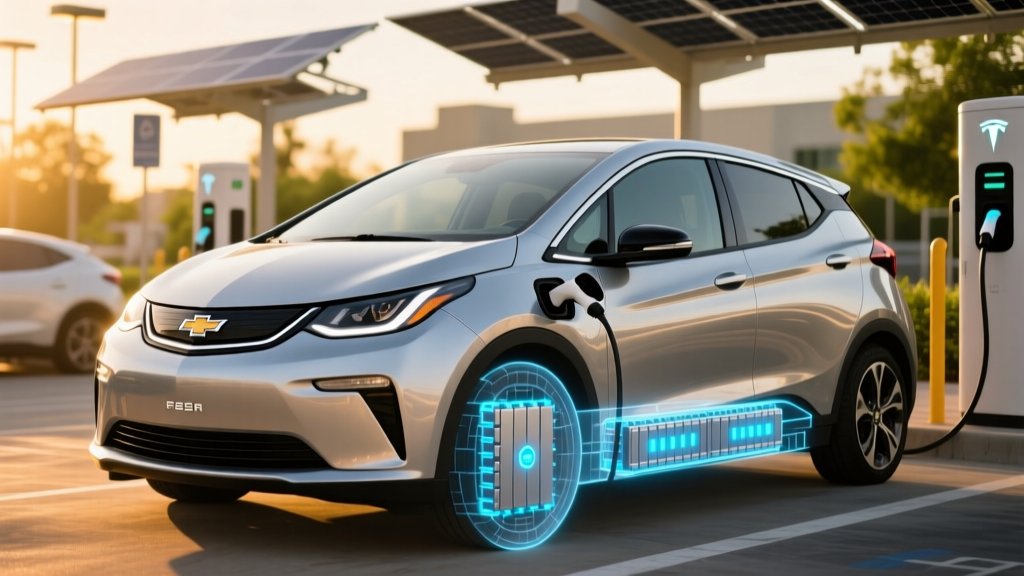
The Chevrolet Bolt EV and EUV remain benchmarks in affordable electric mobility. With the second-generation Bolt expected to arrive later this decade on GM's Ultium platform, thousands of current first-generation owners (2017–2023) are asking a practical question: what happens when the high-voltage traction battery degrades or fails? A Chevy Bolt battery replacement is rarely needed during normal ownership, but understanding the costs, chemistry, and care strategies behind the 65 kWh (or 60 kWh pre-2020) NMC pack is essential for anyone planning to keep their Bolt past the 8-year/100,000-mile warranty window.
Chevy Bolt Battery Specs at a Glance
Before discussing replacement, it helps to understand exactly what sits under the Bolt's floor. The first-generation Bolt uses a lithium-ion pack built by LG Energy Solution with NMC (nickel-manganese-cobalt) chemistry. Here are the key specifications:
| Specification | Bolt EV (2020–2023) | Bolt EUV (2022–2023) |
|---|---|---|
| Usable capacity | 65 kWh | 65 kWh |
| Chemistry | NMC (LG) | NMC (LG) |
| EPA range | 259 mi (EV) / 247 mi (EUV) | 247 mi |
| Peak DC charge rate | 55 kW | 55 kW |
| 10–80% DCFC time | ~60 min (at 50+ kW) | ~60 min |
| Level 2 rate | 11.5 kW | 11.5 kW |
| Battery warranty | 8 yr / 100,000 mi | 8 yr / 100,000 mi |
| Warranty threshold | < 60% capacity retention | < 60% capacity retention |
The Bolt's 55 kW peak DC charge rate is modest by 2026 standards — Hyundai Ioniq 5 and Tesla Model Y peak above 230 kW — but it actually has a hidden battery-health benefit: slower charging generates less heat, which reduces long-term degradation. We'll return to that point below.
NMC vs LFP Chemistry: What's in the Bolt and Why It Matters
The Bolt uses NMC (nickel-manganese-cobalt) cells, the dominant chemistry in Western-market EVs through the early 2020s. The alternative gaining ground — particularly in standard-range Teslas and the base Ford Mustang Mach-E — is LFP (lithium iron phosphate). Here's how they compare:
| Attribute | NMC (Bolt's chemistry) | LFP |
|---|---|---|
| Energy density | Higher (~200–260 Wh/kg cell-level) | Lower (~140–180 Wh/kg) |
| Cycle life | ~1,000–2,000 full cycles to 80% SoH | ~3,000–5,000+ full cycles |
| Cold-weather performance | Better low-temp discharge | Reduced range & slower charge in cold |
| Thermal stability | Good, but more sensitive to high heat | Excellent — less thermal runaway risk |
| Cost per kWh (2026) | ~$110–$130 | ~$80–$100 |
| Recommended daily SoC | 80% (for longevity) | 100% OK regularly |
| Typical use case | Long-range, cold-climate vehicles | Standard-range, fleet, warm-climate |
Which is better? Neither is universally superior. NMC gives the Bolt its 259-mile EPA range in a compact, lightweight package — an LFP pack of equivalent range would be heavier and bulkier. But LFP's superior cycle life and tolerance for 100% daily charging make it ideal for high-mileage drivers and warm climates. For Bolt owners, the NMC pack is well-suited to the vehicle's mission; the key is managing charge habits to maximize its lifespan.
How Long Do Chevy Bolt Batteries Actually Last?
Based on fleet data, owner reports, and GM's own warranty engineering, the Bolt's NMC pack is designed to retain meaningful capacity well beyond the warranty period.
Typical Bolt Battery Degradation Curve
- Year 1 / ~15,000 mi: ~2–4% capacity loss (initial SEI-layer formation)
- Year 3 / ~45,000 mi: ~6–9% total loss; most Bolts still show 91–94% SoH
- Year 5 / ~75,000 mi: ~9–13% total loss; range drops from 259 mi to roughly 225–235 mi EPA-equivalent
- Year 8 / ~100,000 mi: ~12–18% total loss; warranty covers replacement only if capacity falls below 60%
- Year 10+ / 150,000+ mi: ~15–22% loss typical; pack still functional but noticeably reduced range
Sources: Recurrent Auto fleet data (2024–2025 Bolt cohort), GM warranty engineering disclosures, owner-reported data on Chevy Bolt EV Forum.
The critical takeaway: most Bolt batteries will outlast the car itself as primary transportation. A Bolt with 150,000 miles and 80% State of Health still delivers roughly 207 miles of range — adequate for most daily driving. Total pack failure (not just degradation) is rare and typically covered under warranty when it occurs.
What the Chevy Bolt Battery Warranty Covers
GM's battery warranty for the Bolt is federally mandated at a minimum of 8 years / 100,000 miles (10 years / 150,000 miles in California Air Resources Board states, including CA, CO, CT, ME, MD, MA, NJ, NY, OR, RI, VT, WA, and others adopting CARB standards). Here's exactly what it covers:
| Parameter | Coverage |
|---|---|
| Duration | 8 years / 100,000 mi (whichever comes first) |
| CARB-state extension | 10 years / 150,000 mi |
| Capacity threshold | Below 60% of original usable capacity |
| What triggers a claim | GM dealer diagnostic confirms SoH < 60% |
| Remedy | Repair, module replacement, or full pack replacement at GM's discretion |
| Exclusions | Damage from collision, flood, fire, unauthorized modification, or improper charging equipment |
| Transferable? | Yes — to subsequent owners within the warranty period |
The 60% threshold is important context. GM will not replace a pack that has degraded to 65% or 70% capacity — only when it falls below 60%. This means a Bolt owner would need to see range drop below roughly 155 miles (from 259) to qualify. In practice, very few Bolts reach this threshold within the warranty window under normal use.
Note: GM issued a major battery recall (NHTSA Recall 21V-650 and subsequent campaigns) for 2017–2022 Bolt EVs and 2022 EUVs due to manufacturing defects that could cause short circuits and fire risk. Affected vehicles received new battery modules or full packs under the recall — separate from the capacity warranty. If you own a first-gen Bolt, confirm recall completion via NHTSA's recall lookup.
Chevy Bolt Battery Replacement Cost: Out-of-Warranty Reality
If your Bolt's battery fails or degrades below usable levels after the warranty expires, here's what replacement looks like in 2026:
| Scenario | Estimated Cost | Notes |
|---|---|---|
| Full pack replacement (new OEM 65 kWh) | $14,000–$16,500 | Parts + labor at GM dealer; includes diagnostic, coolant refill, programming |
| Remanufactured / refurbished pack | $8,000–$11,000 | Third-party suppliers (e.g., Greentec, EVD); 1–3 year warranty typical |
| Individual module replacement (1–2 bad modules) | $1,500–$4,000 | Only viable if degradation is localized; requires specialist diagnosis |
| Recall-related replacement | $0 to owner | Covered by GM under NHTSA recall campaigns |
For context, a 2019 Bolt EV with a clean title has a private-party resale value of roughly $12,000–$16,000 in early 2026 (per Kelley Blue Book). A full OEM pack replacement at $15,000 can approach or exceed the car's value — which is why most out-of-warranty owners opt for refurbished packs, module-level repairs, or simply trade in the vehicle.
When is replacement typically needed? For Bolts driven 12,000–15,000 miles per year, a full replacement due to degradation alone is unlikely before 150,000–200,000 miles (10–15 years). Most out-of-warranty replacements stem from manufacturing defects, physical damage, or coolant system failures rather than normal wear.
How to Check Your Bolt's Battery Health (SoH)
Unlike some EVs that display battery health directly on the dash, the Bolt does not have a built-in SoH percentage readout accessible to the driver. Here are the methods owners use:
- GM dealer diagnostic: A Chevy service center can run a battery health report using GDS2 (Global Diagnostic System) software. This provides module-level voltage, internal resistance, and estimated SoH. Cost: typically $100–$150 if out of warranty, free during warranty service visits.
- OBD-II scanner + app: Devices like the OBDLink MX+ paired with apps such as Torque Pro or EV-specific tools (e.g., EV Notify, ABRP-linked scanners) can read battery parameters including estimated capacity, cell voltage variance, and pack temperature. Accuracy is approximate but useful for trend tracking.
- Manual range tracking: Charge to 100%, note the displayed range estimate, and compare to the original 259 mi (EV) or 247 mi (EUV). A fully charged Bolt showing 220 mi after 5 years suggests roughly 85% SoH — consistent with normal degradation.
- Recurrent Auto or similar fleet services: If you enroll in a battery-monitoring program, you receive periodic SoH estimates based on charging data.
Check SoH at least annually, or before purchasing a used Bolt. A cell voltage variance above 0.1V between modules can signal imbalance requiring service.
Maximizing Bolt Battery Life: A Care Checklist
NMC chemistry is more sensitive to charge habits than LFP. Follow these evidence-based practices to minimize degradation:
- Daily charge limit: 80%. Use the Bolt's "Hilltop Reserve" mode (limits charge to ~80%) or set a custom target via the MyChevrolet app. Reserve 100% for road trips.
- Avoid prolonged storage above 90% or below 15% SoC. If leaving the car for 2+ weeks, aim for ~50% charge.
- Minimize DC fast charging frequency. The Bolt's 55 kW peak rate is gentle by design, but repeated DCFC sessions — especially in hot weather — accelerate degradation. Use Level 2 (240V, 11.5 kW) for daily charging.
- Precondition in extreme cold. Use the Bolt's remote start/conditioning while plugged in to warm the battery before driving. Cold NMC cells experience increased internal resistance and temporary range loss (15–30% at 20°F / -7°C).
- Park in shade or a garage when possible. Sustained pack temperatures above 95°F (35°C) accelerate calendar degradation. The Bolt's active thermal management (liquid cooling) mitigates this but works harder — and draws energy — in heat.
- Keep the 12V auxiliary battery healthy. A failing 12V battery can cause high-voltage system faults and unnecessary contactor cycling, which stresses the main pack indirectly.
- Update software promptly. GM has issued battery management system (BMS) updates — especially post-recall — that improve charge algorithms and thermal management. Confirm you're on the latest calibration at your dealer.
Factors That Accelerate Bolt Battery Degradation
Understanding what harms an NMC pack helps you avoid the worst pitfalls:
- Frequent DC fast charging: Each DCFC session at 50+ kW raises cell temperatures. Over hundreds of sessions, this compounds. Fleet data from Recurrent Auto shows vehicles that DCFC more than 3 times per week degrade ~2–3% faster over 5 years than those primarily using Level 2.
- Regular 100% charges: Holding NMC cells at maximum voltage (4.2V per cell) stresses the cathode. Daily 100% charges can add 1–2% annual degradation vs. 80% daily charging.
- Deep discharges to 0%: Dropping below 5% SoC risks copper dissolution in the anode. The Bolt has a buffer (~5 kWh reserved below the displayed 0%), but habitual deep discharges still stress the pack.
- Extreme heat exposure: Ambient temperatures above 100°F (38°C), especially when combined with high SoC, are the single largest degradation accelerant for NMC.
- High-mileage, high-cycle use: A Bolt driven 30,000+ miles per year will cycle the battery more frequently, naturally reaching end-of-life sooner by calendar years (though not necessarily by total energy throughput).
Emerging Battery Tech: What's Next (and When)
While the Bolt's NMC pack is proven technology, the industry is advancing rapidly. Here's what's on the horizon — with realistic timelines:
- GM Ultium (NCMA): The next-generation Bolt (announced, expected late 2020s) will use GM's Ultium platform with NCMA (nickel-cobalt-manganese-aluminum) chemistry, offering higher energy density and lower cobalt content. This is not a retrofit for current Bolts.
- Silicon-dominant anodes: Companies like Sila Nanotechnologies and Group14 are producing silicon-carbon anode materials that increase energy density by 20–40%. Expected in production EVs by 2027–2029. Not applicable to existing Bolts.
- Solid-state batteries: Toyota, Samsung SDI, and QuantumScape target 2028–2030 for initial solid-state production. These promise faster charging and improved safety but remain in pilot production as of 2026. No current EV uses a solid-state pack.
- Sodium-ion batteries: CATL and others are deploying sodium-ion packs in Chinese-market vehicles. Lower cost and excellent cycle life, but lower energy density limits them to short-range applications. Not expected in US-market Bolts.
None of these technologies will retrofit into a first-generation Bolt. For current owners, the practical path is maintaining the existing NMC pack — which, as the data above shows, is engineered for a long service life.
Frequently Asked Questions
How long do Chevy Bolt batteries last in real-world use?
Most Bolt batteries retain 80–88% capacity at 100,000 miles (roughly 7–8 years of average driving). At 150,000 miles, expect 78–85% State of Health. Total failure is rare; gradual range loss is the norm. The pack typically remains functional — with reduced range — beyond 200,000 miles.
How much does it cost to replace a Chevy Bolt battery out of warranty?
A new OEM 65 kWh pack costs $14,000–$16,500 installed at a GM dealer. Remanufactured packs range from $8,000–$11,000. Module-level repairs for localized issues cost $1,500–$4,000. Recall-related replacements are free to the owner.
What does the Bolt battery warranty actually cover?
GM covers the high-voltage battery for 8 years / 100,000 miles (10 years / 150,000 miles in CARB states) against capacity loss below 60% of original. The warranty also covers defects and is transferable to subsequent owners. It does not cover damage from accidents, floods, or unauthorized modifications.
How do I check my Chevy Bolt's battery State of Health?
The Bolt doesn't display SoH on the dash. Options include a GM dealer diagnostic ($100–$150 out of warranty), an OBD-II scanner with EV-compatible apps, or manual range tracking (compare your 100% charge range to the original EPA figure). Check annually or before buying a used Bolt.
Is NMC or LFP better for the Chevy Bolt?
NMC is the right choice for the Bolt because it delivers 259 miles of range in a compact, lightweight pack. LFP would require a heavier, larger pack for equivalent range. However, LFP has superior cycle life and can tolerate daily 100% charging — advantages that matter more for high-mileage fleet vehicles than for typical Bolt owners.
Does DC fast charging damage the Bolt's battery?
Occasional DC fast charging is fine and built into the battery's design. However, frequent DCFC (3+ times per week) combined with high ambient temperatures accelerates degradation by roughly 2–3% over 5 years compared to primarily Level 2 charging. The Bolt's modest 55 kW peak rate is actually gentler on cells than higher-rate competitors.
Should I be worried about the Bolt battery recall?
If you own a 2017–2022 Bolt EV or 2022 EUV, the recall (NHTSA campaigns 21V-650 and related) addressed a manufacturing defect that could cause internal short circuits. GM replaced affected modules or full packs at no cost. Verify your VIN at nhtsa.gov/recalls to confirm recall completion. Post-recall Bolts with updated BMS software show no elevated failure risk.
Can I upgrade my Bolt to a larger or newer battery?
No. The first-generation Bolt's battery compartment, cooling system, and BMS are specific to the 60 kWh (2017–2019) or 65 kWh (2020–2023) NMC pack. There is no OEM or certified aftermarket path to install a larger or different-chemistry pack. The upcoming Ultium-based Bolt will be an entirely new vehicle.
Sources: U.S. Department of Energy / fueleconomy.gov — EV battery technology overview; NHTSA Recall Lookup — Bolt recall campaign status; GM Owner Center — Bolt EV/EUV warranty documentation.