Charging a Battery With Another Battery: What EV Owners Need to Know
The phrase "how to charge a battery with a battery" covers a surprising amount of ground in the electric-vehicle world. It can mean using your EV's high-voltage traction pack to power a laptop, jump a dead 12V auxiliary cell in another car, or even push electrons back into a second EV through vehicle-to-vehicle (V2V) transfer. As of the 2026 model year, several mainstream EVs support these capabilities natively, while the underlying lithium-ion packs they draw from are lasting longer—and costing less to replace—than early adopters feared.
This guide walks through the practical methods for battery-to-battery charging, then zooms out to the chemistry, degradation science, warranty coverage, and replacement economics every EV owner or shopper should understand before plugging in.
Vehicle-to-Load (V2L): Using Your EV as a Portable Power Station
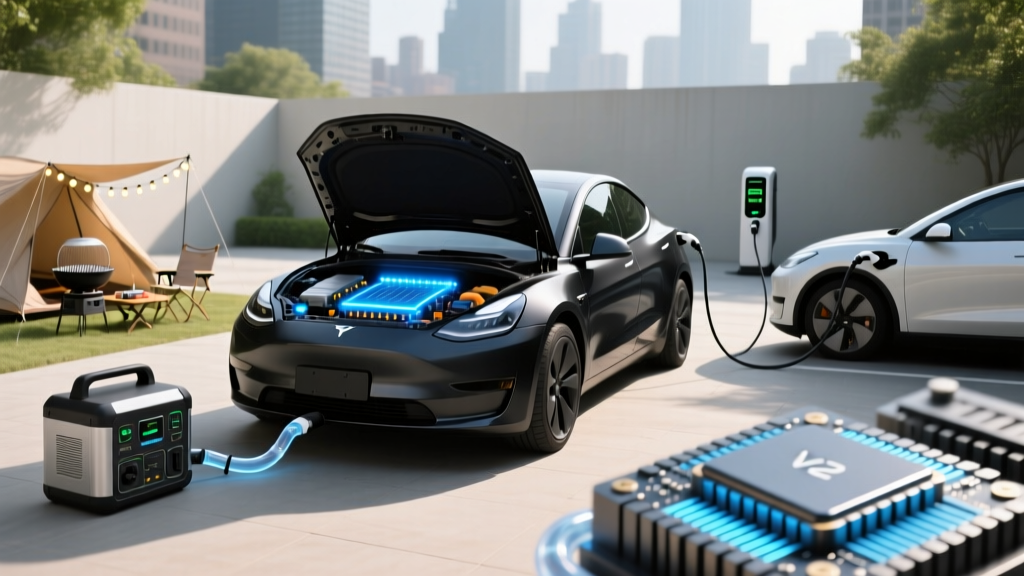
The most common way to charge a battery with a battery today is Vehicle-to-Load (V2L). V2L lets you plug standard 120V devices directly into an adapter connected to your EV's charge port or a dedicated cabin outlet, drawing energy from the high-voltage traction battery.
| Model | V2L Output | Adapter Type | Usable Battery (kWh) |
|---|---|---|---|
| Hyundai Ioniq 5 | 3.6 kW (120V/30A) | Charge-port dongle + interior outlet | 77.4 kWh (NMC) |
| Kia EV6 / EV9 | 3.6 kW | Charge-port dongle | 77.4 / 100.0 kWh (NMC) |
| Ford F-150 Lightning | 9.6 kW (Pro Power Onboard) | Bed outlets + cabin | 98 / 131 kWh (NMC) |
| Rivian R1S / R1T (Gen 2) | Up to 9.6 kW (camp kitchen / bed) | Integrated outlets | 92 / 141 kWh (NMC) |
| Tesla Cybertruck | Up to 11.5 kW (Powershare) | Bed & cabin outlets | 123 kWh (NMC) |
Real-world use cases: A 3.6 kW V2L outlet can fully recharge a Goal Yeti 3000X portable power station (3.07 kWh) in under an hour, run a 1,500W space heater for roughly 40 hours from an Ioniq 5's 77.4 kWh pack, or keep a full-size refrigerator running through a multi-day outage (typical fridge draw is 150–250 kWh/year, or ~0.5 kWh/day).
Limitations: V2L does not push power back into another EV at DC fast-charging speeds. You can trickle-charge a second EV via its Level 1 (120V) onboard charger—adding roughly 3–5 miles of range per hour—but this is an emergency measure, not a practical daily charging strategy.
Vehicle-to-Vehicle (V2V) and Vehicle-to-Home (V2H): The Next Frontier
Vehicle-to-Vehicle (V2V) DC transfer—plugging one EV directly into another to share charge at meaningful speeds—remains limited in the U.S. market as of 2026. The Ford F-150 Lightning's Pro Power Onboard can output 240V through a bed outlet, which, with the correct EVSE adapter, can feed a second EV at Level 2 speeds (~7–9 kW, adding 25–35 miles per hour of charge). Rivian's Gen 2 platform supports similar bidirectional capability.
Vehicle-to-Home (V2H), which powers your house during an outage, is available on the F-150 Lightning (via Ford's Charge Station Pro and Home Integration System), the Chevrolet Silverado EV, and the Cybertruck. These systems require a transfer switch installed by a licensed electrician—budget $2,500–$5,000 for the full V2H setup including hardware and labor.
Vehicle-to-Grid (V2G), which lets utilities draw from your battery during peak demand in exchange for credits, is in limited pilot programs (notably with NREL-backed studies and select California utilities). Widespread V2G tariff structures are not yet available nationally.
EV Battery Chemistry: LFP vs. NMC vs. NCA
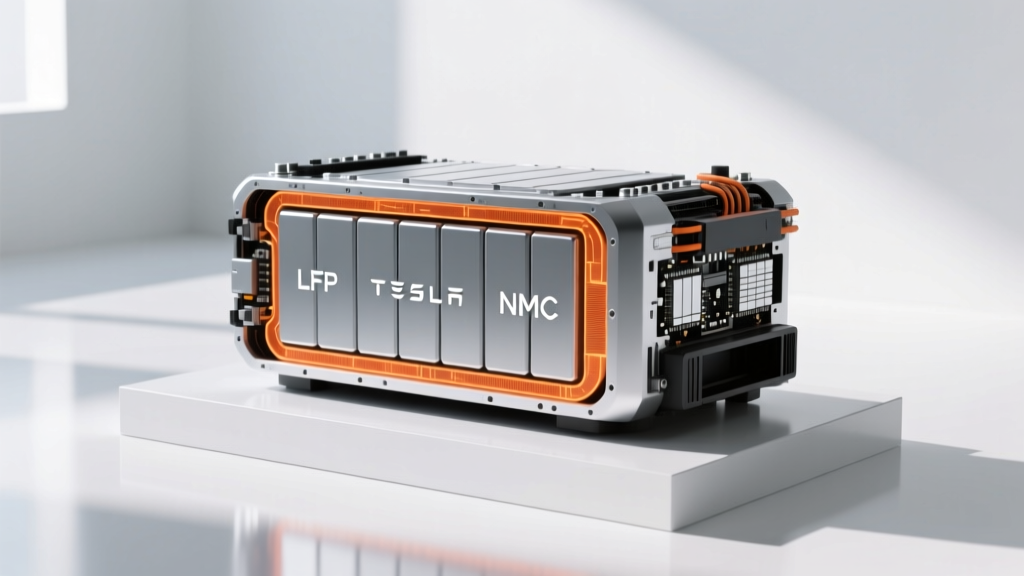
The traction battery inside your EV is not a single monolithic cell—it's a pack composed of hundreds or thousands of individual cells, and the chemistry of those cells determines range, longevity, cold-weather behavior, and cost. The two dominant chemistries in 2026 are LFP (Lithium Iron Phosphate) and NMC/NCA (Nickel Manganese Cobalt / Nickel Cobalt Aluminum).
| Attribute | LFP (LiFePO₄) | NMC / NCA |
|---|---|---|
| Energy Density (Wh/kg, cell-level) | 160–200 Wh/kg | 250–300 Wh/kg |
| Typical Cycle Life (80% retention) | 3,000–6,000 cycles | 1,000–2,000 cycles |
| Cold-Weather Range Loss (0°F vs 72°F) | ~30–40% loss | ~20–30% loss |
| Recommended Daily SoC | 100% is fine; periodic full charges help BMS calibration | 80% for daily; 100% for trips only |
| Cobalt Content | None (lower supply-chain risk) | Yes (geopolitical & ethical sourcing concerns) |
| Cost per kWh (pack-level, 2026) | ~$90–$110/kWh | ~$120–$150/kWh |
| Common In 2026 Models | Tesla Model 3/Y RWD, Ford Mustang Mach-E Select (base), BYD (non-US) | Hyundai Ioniq 5/6, Kia EV6/EV9, Ford F-150 Lightning, Rivian, Tesla Long Range/Performance |
Which is better? It depends on your use case. If you want maximum range in a lighter package and regularly drive in cold climates, NMC/NCA delivers higher energy density and better cold-weather performance. If you prioritize longevity, plan to keep the vehicle 10+ years, charge daily to 100%, and live in a moderate climate, LFP's superior cycle life and lower cost make it the pragmatic choice. Many automakers now offer both chemistries across their lineups—Tesla's RWD Model 3 uses LFP, while the Long Range variant uses NMC, for example.
How Long Do EV Batteries Last? Degradation Data
The most persistent fear among EV shoppers is catastrophic battery failure. Real-world data consistently shows this is rare. According to studies aggregated by Geotab's EV Battery Health dashboard, which tracks over 10,000 EVs in fleet operation, the average lithium-ion EV battery loses approximately 1.8% of its original capacity per year under typical use. At that rate, a battery retains roughly 82% of its original capacity after 10 years—well above the 70% threshold most warranties guarantee.
| Age (Years) | Average Capacity Retained | Notes |
|---|---|---|
| Year 1 | ~97–98% | Initial formation loss |
| Year 3 | ~93–95% | Linear degradation phase |
| Year 5 | ~89–92% | Most vehicles still under warranty |
| Year 8 | ~84–88% | Warranty expiration for many brands |
| Year 10 | ~80–85% | Noticeable range reduction but fully functional |
| Year 15 | ~72–78% | Projected; limited real-world data this far |
Key data points from specific models:
- Tesla Model 3/Y (NMC): Tesla's 2025 Impact Report states the average Model 3/Y battery retains ~88% capacity at 150,000 miles.
- Chevrolet Bolt EV (NMC): Early Bolt owners (2017–2019) have reported 85–90% retention at 80,000–100,000 miles, though the 2021–2022 recall for manufacturing-defect fire risk complicates the dataset.
- Tesla Model 3 RWD (LFP): Early LFP packs (2021–2023) show minimal degradation, with many owners reporting 95%+ retention at 50,000 miles—consistent with LFP's higher cycle-life rating.
Factors That Accelerate (or Slow) Battery Degradation
Not all miles are equal when it comes to battery wear. The following factors have measurable impacts on long-term State of Health (SoH):
What Hurts Your Battery
- Frequent DC fast charging above 150 kW: High C-rates generate heat, which accelerates electrolyte decomposition. Occasional fast charging is fine; daily 350 kW sessions will measurably increase degradation. Data from the Idaho National Laboratory showed that vehicles fast-charged exclusively had ~5% more capacity loss over 50,000 miles compared to Level 2–charged counterparts.
- Sustained high State of Charge (above 90%): NMC cells held at 100% SoC for days or weeks experience elevated stress. This is why automakers recommend 80% daily limits for NMC packs.
- Extreme heat exposure: Parking in 110°F+ ambient temperatures regularly, especially at high SoC, degrades cells faster. Active thermal management (liquid cooling) mitigates this—Tesla, Hyundai, and Ford all use liquid-cooled packs; the Nissan Leaf's passive air-cooled pack historically degraded faster in hot climates.
- Deep discharges to 0%: Letting the battery sit at or near 0% for extended periods can cause copper dissolution in the anode. Drive or charge promptly if you hit very low SoC.
What Helps Your Battery
- Level 2 home charging at moderate speeds (7–11 kW): Lower charge rates generate less heat.
- Maintaining 20–80% SoC for daily use (NMC): For LFP, regular 100% charges are recommended for BMS cell-balancing accuracy.
- Preconditioning before DC fast charging: Warming the battery to its optimal charge temperature (typically 85–105°F / 30–40°C) reduces internal resistance and stress. Most modern EVs do this automatically when you navigate to a charger.
- Garage parking in extreme climates: Keeping the pack out of sustained sub-zero or 100°F+ ambient conditions meaningfully extends life.
Battery Warranty Coverage: What's Protected and for How Long
Federal law mandates that EV battery warranties cover a minimum of 8 years / 100,000 miles (in California Air Resources Board states, the mandate is 10 years / 150,000 miles for certain components). Most automakers exceed the federal minimum. The warranty typically guarantees the battery will retain a specified percentage of its original capacity—commonly 70%—over the warranty period.
| Model | Warranty Term | Capacity Retention Guarantee | Chemistry |
|---|---|---|---|
| Tesla Model 3 RWD | 8 yr / 100,000 mi | ≥70% | LFP |
| Tesla Model 3 Long Range | 8 yr / 120,000 mi | ≥70% | NMC |
| Hyundai Ioniq 5 | 10 yr / 100,000 mi | ≥70% | NMC |
| Ford F-150 Lightning | 8 yr / 100,000 mi | ≥70% | NMC |
| Rivian R1T / R1S | 8 yr / 120,000 mi | ≥70% | NMC |
| Chevrolet Equinox EV | 8 yr / 100,000 mi | ≥60% | NMC |
| BMW i4 | 8 yr / 80,000 mi | ≥70% | NMC |
What's covered: Manufacturing defects, premature capacity loss below the guaranteed threshold, and cell/module failures. What's typically not covered: Damage from accidents, improper modifications, or use outside manufacturer specifications. Warranty claims for capacity loss require a dealer diagnostic showing SoH below the threshold—degradation to 75% at year 7, for instance, is considered normal and would not trigger a warranty replacement.
EV Battery Replacement Cost: How Much and When
Full battery pack replacement is uncommon—most packs outlast the vehicles they're installed in. When replacement is needed (typically due to manufacturing defects, physical damage, or very high mileage beyond 200,000+ miles), costs vary significantly by pack size and chemistry.
| Model | Pack Size | Chemistry | Estimated Replacement Cost |
|---|---|---|---|
| Tesla Model 3 RWD | ~60 kWh | LFP | $12,000–$15,000 |
| Tesla Model Y Long Range | ~75 kWh | NMC | $14,000–$18,000 |
| Hyundai Ioniq 5 | 77.4 kWh | NMC | $15,000–$20,000 |
| Ford F-150 Lightning Extended Range | 131 kWh | NMC | $25,000–$35,000 |
| Chevrolet Bolt EV | 65 kWh | NMC | $14,000–$16,000 |
| Rivian R1T Max Pack | 141 kWh | NMC | $28,000–$38,000 |
Context that matters: Pack-level battery prices have fallen from over $1,000/kWh in 2010 to approximately $120–$150/kWh for NMC and $90–$110/kWh for LFP in 2026, according to BloombergNEF. Module-level repairs (replacing individual failed modules rather than the full pack) can reduce costs by 50–70% on packs that support modular service. Additionally, the growing EV salvage and refurbishment market is making remanufactured packs available at 30–50% below new OEM pricing for out-of-warranty vehicles.
How to Check and Monitor Your EV's Battery Health
State of Health (SoH) is the metric that tells you how much of your battery's original capacity remains. Most modern EVs don't surface SoH directly in the dashboard, but there are several reliable ways to check it:
- In-app estimates: Tesla's service menu (accessible via the software screen) shows estimated battery degradation. Hyundai's Bluelink app provides a battery health indicator for the Ioniq lineup.
- OBD-II diagnostic tools: Devices like the OBDLink SX paired with apps such as LeafSpy (Nissan Leaf), Scan My Tesla, or Car Scanner ELM OBD2 can read SoH, cell voltage variance, and pack temperature directly from the BMS (Battery Management System).
- Dealer diagnostics: Any authorized service center can pull a full battery health report. Request one before purchasing a used EV—it's the single most important data point for a pre-owned electric car.
- Manual range-tracking: Charge to 100% on a regular basis (for LFP) or note your projected range at a consistent SoC (e.g., 80%). If your Ioniq 5 shows 230 miles at 80% when it originally showed 260, you're looking at roughly 12% degradation. Cross-reference this against your odometer for a per-mile wear rate.
Cell balance variance is another useful metric. Healthy packs show cell-to-cell voltage differences of less than 20–30 mV at rest. Variance above 50 mV may indicate a weak module that could benefit from service before it triggers a larger problem.
Emerging Battery Technology: Solid-State and Silicon Anodes
Next-generation battery chemistries promise step-change improvements, but realistic timelines matter:
- Solid-state batteries: These replace the liquid electrolyte with a solid material, potentially doubling energy density (400–500 Wh/kg at the cell level), enabling faster charging (10–80% in under 10 minutes), and eliminating flammability risk. Toyota has announced a solid-state EV for 2027–2028 with a projected 600+ mile range, but mass production at competitive pricing is not expected before 2029–2030. Samsung SDI and QuantumScape are also in advanced prototype stages. As of 2026, no production vehicle on sale in the U.S. uses a solid-state pack.
- Silicon-dominant anodes: Replacing graphite anodes with silicon can increase energy density by 20–40%. Companies like Sila Nanotechnologies and Group14 are supplying early production cells, and the Mercedes-Benz G-Class EV (announced for 2025–2026) is expected to use silicon-anode cells from Group14. This is closer to market than solid-state but still limited to premium applications due to cost.
- Sodium-ion batteries: Cheaper and free of lithium and cobalt, sodium-ion cells are entering production in China (CATL, BYD) for low-cost city EVs. Energy density (~120–150 Wh/kg) limits them to shorter-range applications, and they are not expected in U.S.-market vehicles before 2027 at the earliest.
These technologies are genuinely promising, but current NMC and LFP chemistries are mature, well-understood, and sufficient for the vast majority of drivers today. Waiting for solid-state means waiting at minimum 3–5 years for limited availability at premium pricing.
Frequently Asked Questions
Can I use my EV to jump-start another car's 12V battery?
Yes, with caution. Using a V2L adapter and a standard 120V-to-12V battery charger/maintainer, you can recharge a dead 12V auxiliary battery in another vehicle. However, do not connect jumper cables directly between an EV's high-voltage system and a conventional car's 12V system—this can cause severe damage. Use the V2L outlet as an AC power source for a proper battery charger.
How long do EV batteries last in real-world use?
Fleet data from Geotab tracking over 10,000 EVs shows an average capacity loss of ~1.8% per year. At that rate, expect 80–85% capacity retention at 10 years, meaning a vehicle with an EPA-rated 300-mile range would still deliver roughly 240–255 miles when new-equivalent conditions are met. Most batteries outlast the vehicle's useful economic life.
How much does an EV battery cost to replace?
Full pack replacement ranges from approximately $12,000 for a 60 kWh LFP pack (Tesla Model 3 RWD) to $35,000+ for a 131 kWh NMC pack (F-150 Lightning Extended Range). Module-level repairs can cut costs by 50–70%. Pack prices continue to decline, and the refurbished/salvage market offers lower-cost alternatives for out-of-warranty vehicles.
What does the EV battery warranty actually cover?
Federal law requires a minimum of 8 years / 100,000 miles of coverage. The warranty guarantees the battery will retain a specified capacity percentage—typically 70%—over the term. Manufacturing defects and premature cell failures are covered; damage from accidents, abuse, or modifications is not. CARB-state vehicles may have extended 10-year / 150,000-mile mandates.
How do I maximize my EV battery's lifespan?
For NMC packs: charge to 80% daily, use Level 2 home charging when possible, precondition before DC fast charging, avoid sustained storage above 90% or below 10%, and garage-park in extreme heat. For LFP packs: charge to 100% regularly for accurate BMS calibration, and follow the same thermal-management and fast-charging moderation guidelines.
LFP vs. NMC — which battery chemistry is better for me?
Choose LFP if you want maximum cycle life (3,000–6,000 cycles), plan to own the vehicle 10+ years, live in a moderate climate, and don't mind slightly lower range per kWh. Choose NMC/NCA if you need maximum range in a lighter package, regularly drive in cold weather, or want the longest single-charge road-trip capability. Both chemistries are proven and reliable in 2026 production vehicles.
Does fast charging damage my EV battery?
Occasional DC fast charging has a minimal impact on battery health. However, exclusive reliance on high-power DC charging (150–350 kW daily) has been shown by Idaho National Laboratory testing to increase degradation by roughly 5% over 50,000 miles compared to Level 2 charging. Modern battery management systems actively limit charge rates when the pack is cold or near full to protect cells—preconditioning and charging to 80% rather than 100% further reduces stress.