Why CATL's Sodium-Ion Battery Matters in 2026
For years, the EV battery conversation has been a two-horse race: lithium iron phosphate (LFP) for affordability and durability, or nickel manganese cobalt (NMC/NCA) for maximum range. In 2026, a third chemistry is entering production vehicles at scale — sodium-ion — led by CATL, the world's largest battery manufacturer. CATL's first-generation sodium-ion cells, announced in 2021 and refined through 2025, are now appearing in budget-focused Chinese-market EVs and energy-storage systems, with global automakers evaluating the chemistry for entry-level models.
Sodium-ion doesn't aim to outperform NMC on energy density or beat LFP on cycle life. Instead, it targets the one vulnerability that haunts both lithium chemistries: raw-material supply risk and cost. Sodium is roughly 1,000× more abundant in Earth's crust than lithium, doesn't require mining from concentrated brine or spodumene, and can use aluminum current collectors instead of copper — cutting cell cost by an estimated 20–30% at scale.
This guide breaks down exactly where sodium-ion fits among LFP and NMC, what the degradation and warranty data show, replacement-cost realities, and how to monitor and maximize whichever chemistry powers your EV.
Battery Chemistry Showdown: Sodium-Ion vs LFP vs NMC
Each chemistry involves trade-offs across energy density, cycle life, cold-weather performance, cost, and safety. Here's how they compare on the metrics that matter to buyers:
| Attribute | Sodium-Ion (CATL Gen 1) | LFP (LiFePO₄) | NMC 811 / NCA |
|---|---|---|---|
| Cell-level energy density | ~160 Wh/kg | ~170–185 Wh/kg | ~250–300 Wh/kg |
| Pack-level energy density | ~120–130 Wh/kg | ~140–160 Wh/kg | ~180–220 Wh/kg |
| Typical cycle life (to 80% SoH) | ~3,000–5,000 cycles | ~3,500–6,000 cycles | ~1,500–2,500 cycles |
| Cold performance (capacity at −20°C) | ~90% retention | ~70–80% retention | ~75–85% retention |
| Fast-charge capability | ~15 min 10–80% (est.) | ~20–25 min 10–80% | ~18–22 min 10–80% |
| Raw-material cost risk | Low (abundant Na, Al collectors) | Moderate (Li price volatility) | High (Ni, Co, Li exposure) |
| Estimated cell cost (2026) | ~$50–60/kWh | ~$65–80/kWh | ~$90–110/kWh |
| Thermal stability / safety | Excellent | Excellent | Good (requires robust BMS) |
| Current EV availability (US market) | None (China-market only) | Tesla Model 3/Y RWD, Ford Mustang Mach-E SR, others | Most long-range / performance EVs |
Key takeaway: Sodium-ion's energy density is roughly 30–40% lower than NMC and ~15% lower than LFP. That means a sodium-ion pack would need to be heavier or physically larger to deliver equivalent range. For a 300-mile EPA-rated sedan, you'd need roughly 75–80 kWh with NMC, 85–95 kWh with LFP, and an estimated 100–110 kWh with current sodium-ion — a significant weight and packaging penalty. This is why CATL positions sodium-ion for city EVs, micro-cars, and plug-in hybrids where 150–250 miles of range suffices.
How Long Do EV Batteries Actually Last?
The fear that EV batteries need replacement every few years is not supported by fleet data. Modern lithium packs routinely outlast the vehicles they power.
Real-World Degradation Data
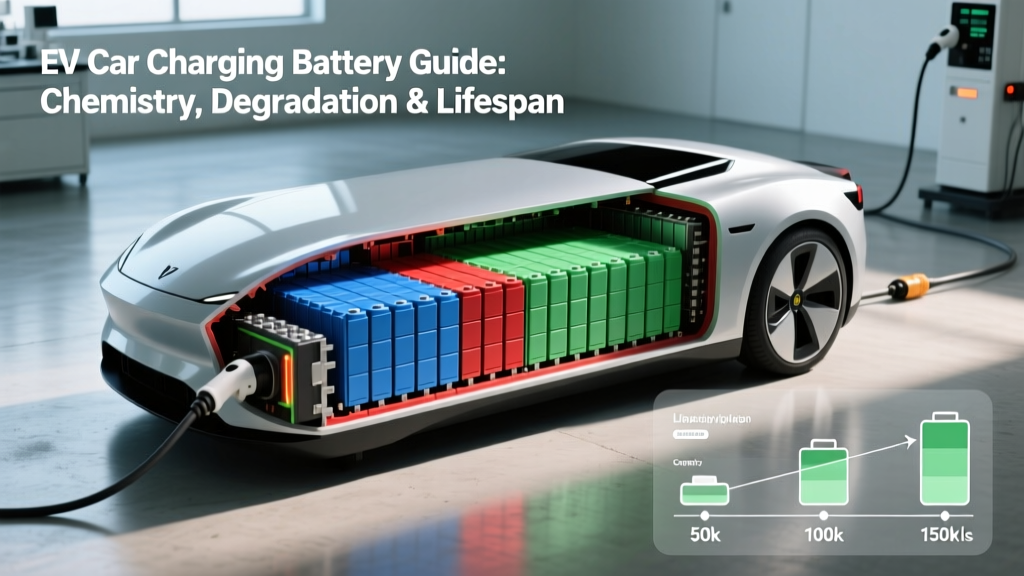
Battery degradation follows a curve: the steepest loss occurs in the first 12–24 months (typically 2–5%), then slows to a nearly linear decline of roughly 1–2% per year. Here's what large-scale data shows:
- Tesla Model 3/Y (NMC/NCA, 2018–2023): Average degradation of ~12% at 150,000 miles, based on Tesla's 2023 Impact Report fleet data. Most packs retain 85–90% State of Health (SoH) at 100,000 miles.
- Tesla Model 3 RWD (LFP, 2021–2024): Early data suggests ~5–8% degradation at 80,000 miles, consistent with LFP's superior cycle life.
- Nissan Leaf (passive-cooled NMC/LMO, 2011–2017): Notable outlier — early Leafs without active thermal management showed 20–30% degradation at 80,000 miles, underscoring the importance of liquid cooling.
- Chevrolet Bolt EV (NMC, 2017–2023): Post-recall replacement packs show minimal degradation (~3–5% at 50,000 miles); original packs averaged ~10% at 100,000 miles before the recall.
- Hyundai/Kia E-GMP platform (NMC, 2022–2025): Limited long-term data; early reports show ~4–6% loss at 40,000 miles.
For sodium-ion, CATL claims its Gen 1 cells retain 80% capacity after 3,000+ full charge-discharge cycles. At an average of 250 miles per cycle, that translates to roughly 750,000 miles before hitting the 80% threshold — far more than any vehicle's mechanical lifespan. However, independent fleet validation is not yet available, as the chemistry has only been in production vehicles since late 2023 (primarily in Chery and JAC city cars sold in China).
Factors That Accelerate Degradation
Battery Care Checklist — Minimize Degradation
- Avoid sustained 100% SoC: For NMC/NCA, charge to 80–90% daily; reserve 100% for road trips. LFP tolerates 100% better — most manufacturers recommend a full charge weekly for BMS cell-balancing.
- Limit DC fast-charging frequency: Occasional DCFC is fine; daily 150+ kW sessions accelerate wear. A DOE study found that exclusive DCFC use over 50,000 miles added ~2–4% extra degradation vs. Level 2 charging.
- Manage extreme temperatures: Precondition the battery before fast-charging in cold weather. Avoid leaving the car at 100% SoC in sustained 100°F+ heat.
- Don't store at 0% or 100%: If parking for weeks, leave NMC at ~50% SoC and LFP at ~50–60%.
- Use regenerative braking wisely: High regen settings in cold weather can stress a cold battery; many EVs automatically limit regen until the pack warms.
What Does the EV Battery Warranty Cover?
Federal law (via EPA/CARB requirements) mandates a minimum 8-year/80,000-mile warranty on EV battery packs in the US. Most automakers match or exceed this, and California-emissions states often get 10-year/100,000-mile coverage.
| Manufacturer | Warranty Period | Capacity Retention Threshold |
|---|---|---|
| Tesla (Model 3/Y NMC) | 8 yr / 120,000 mi | 70% SoH |
| Tesla (Model 3 RWD LFP) | 8 yr / 100,000 mi | 70% SoH |
| Hyundai / Kia (E-GMP) | 10 yr / 100,000 mi | 70% SoH |
| Ford (Mach-E, F-150 Lightning) | 8 yr / 100,000 mi | 70% SoH |
| GM (Ultium platform) | 8 yr / 100,000 mi | 70% SoH (some models 60% for commercial) |
| Rivian | 8 yr / 175,000 mi | 70% SoH |
| BMW (i4, iX) | 8 yr / 100,000 mi | 70% SoH |
What "70% SoH" means in practice: If your 75 kWh pack degrades to below 52.5 kWh usable capacity within the warranty period, the manufacturer must repair or replace it — typically by swapping in a refurbished pack with at least 70% capacity, not necessarily a brand-new unit. Warranty claims for degradation alone remain rare; most battery replacements under warranty stem from manufacturing defects (bad cell groups, BMS faults, coolant leaks) rather than normal wear.
EV Battery Replacement Cost: What You'd Actually Pay
Out-of-warranty battery replacement is the single biggest cost fear among EV shoppers. Here are real-world figures from 2024–2026 service data:
| Vehicle | Pack Size (kWh) | Chemistry | Replacement Cost (parts + labor) |
|---|---|---|---|
| Tesla Model 3 RWD | ~60 kWh | LFP | $12,000–$15,000 |
| Tesla Model Y LR | ~75 kWh | NMC | $14,000–$18,000 |
| Ford Mustang Mach-E ER | ~91 kWh | NMC | $18,000–$22,000 |
| Hyundai Ioniq 5 | ~77.4 kWh | NMC | $14,000–$18,000 |
| Chevrolet Bolt EV | ~65 kWh | NMC | $14,000–$16,000 (post-recall pack) |
| Ford F-150 Lightning ER | ~131 kWh | NMC | $25,000–$32,000 |
| Nissan Leaf (40 kWh) | ~40 kWh | NMC/LMO | $8,000–$10,000 (remanufactured) |
When is replacement actually needed? Based on current degradation curves, most liquid-cooled EV packs won't fall below 70% SoH until 200,000–300,000 miles — well beyond the average vehicle lifespan. The vehicles most likely to need out-of-warranty replacements are high-mileage fleet vehicles, early-generation EVs with passive cooling (2011–2017 Nissan Leaf, early Fiat 500e), or packs damaged by collisions or flooding.
For sodium-ion, CATL's lower cell cost ($50–60/kWh vs. $65–80 for LFP) suggests future replacement packs could be 25–35% cheaper per kWh — but this assumes sodium-ion reaches sufficient US-market volume for third-party suppliers to stock packs, which is unlikely before 2028–2030 at the earliest.
How to Check and Monitor Your Battery's State of Health
State of Health (SoH) is the percentage of original usable capacity your pack retains. A new 75 kWh pack at 92% SoH holds ~69 kWh. Here's how to check it:
OEM Apps and In-Car Displays
- Tesla: No built-in SoH readout. Use the Tesla app's "Battery Health" test (added in 2024 software updates) or third-party tools like Tessie or Stats (iOS).
- Hyundai/Kia: The infotainment system's EV diagnostics page shows SoH percentage directly.
- Ford: FordPass app includes a battery health indicator on newer model years.
- GM (Ultium): myChevrolet/myCadillac app provides a battery health summary.
- BMW: iDrive includes a battery-condition readout under the service menu.
OBD-II Diagnostic Tools
For more granular data, an OBD-II dongle paired with an app like Car Scanner (iOS/Android) or Leaf Spy (Nissan-specific) can read individual cell voltages, pack temperature, and precise SoH from the BMS. This is particularly useful when evaluating a used EV — a 2022 Model 3 showing 94% SoH at 35,000 miles is in excellent shape, while one at 88% may have been frequently DC-fast-charged or exposed to extreme heat.
Manual Range Test
Charge to 100%, note the displayed range, and compare it to the original EPA sticker. A Model 3 LR that originally displayed 358 miles at 100% but now shows 320 miles has roughly 89% SoH (accounting for variables like temperature and tire condition). This method is imprecise but requires no tools.
Where Sodium-Ion Fits: CATL's Strategy and EV Availability
CATL's sodium-ion cells are not a replacement for NMC in long-range EVs. The chemistry's ~160 Wh/kg cell density (vs. 250–300 for NMC) makes it impractical for vehicles targeting 300+ miles of EPA range without excessive weight. Instead, CATL and its partners are deploying sodium-ion in three niches:
- Budget city EVs (150–250 mi range): The Chery QQ Ice Cream EV and JAC Sehol E10X sodium-ion variants, sold in China, target the sub-$15,000 segment. Range is ~200–250 km (125–155 mi) on a ~30 kWh pack.
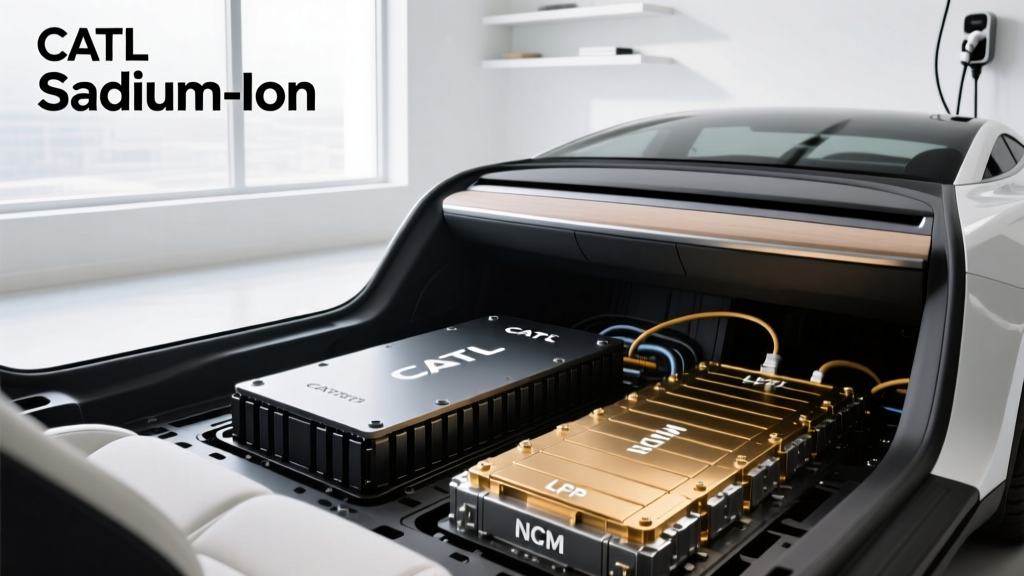
- AB battery packs (sodium-ion + LFP hybrid): CATL's innovative "AB pack" integrates sodium-ion and LFP cells in a single pack, with the BMS managing each chemistry's strengths — sodium-ion handles cold-weather starts and fast-charge absorption, while LFP provides bulk energy storage. This approach may appear in PHEVs and EREVs.
- Stationary energy storage: Grid-scale and residential battery systems where weight and volume matter less than cost and cycle life.
For US buyers, sodium-ion EVs are not currently available. If CATL or a partner (such as Ford, which has a technology-licensing agreement with CATL) brings sodium-ion packs to a US-market model, expect it in an entry-level trim of an affordable compact — potentially a future Ford or a Stellantis city car — no earlier than 2027–2028.
Emerging Battery Tech: What's Next Beyond Sodium-Ion
Sodium-ion is one of several next-generation chemistries in development. Here's a realistic timeline for technologies that could reshape EV batteries:
- Solid-state batteries: Toyota, Samsung SDI, and QuantumScape target limited production in 2027–2029. Promise: 350–500 Wh/kg cell density, 10-minute fast charging, improved safety. Reality: manufacturing scale-up remains the primary bottleneck; expect solid-state in premium models first (likely $60,000+), with mass-market trickle-down post-2030.
- Silicon-dominant anodes: Companies like Sila Nanotechnologies and Group14 are replacing graphite anodes with silicon composites, boosting energy density by 15–25%. Already appearing in limited applications (Mercedes G-Class EV uses a silicon-anode pack from Group14). Expect broader adoption by 2027.
- LMFP (lithium manganese iron phosphate): An LFP evolution adding manganese for ~15–20% higher energy density while retaining LFP's safety and cost advantages. CATL and BYD are targeting LMFP production for 2026–2027 vehicles.
- Sodium-ion Gen 2: CATL has indicated its second-generation sodium-ion cells will target ~200 Wh/kg, narrowing the gap with LFP. If achieved, this could make sodium-ion viable for 250–300 mile EVs by 2028–2030.
None of these technologies are currently available in US-market production vehicles. Buyers choosing an EV today are selecting between mature, proven chemistries — LFP and NMC — with sodium-ion as a future budget option.
Frequently Asked Questions
How long do EV batteries last in years and miles?
Most modern liquid-cooled EV batteries (LFP or NMC) retain 80–90% of original capacity at 100,000–150,000 miles and 8–12 years of age. Based on current fleet data, reaching the 70% warranty threshold typically requires 200,000+ miles. Sodium-ion batteries, based on CATL's cycle-life claims, could theoretically last 500,000+ miles before reaching 80% SoH, though long-term real-world data does not yet exist.
How much does it cost to replace an EV battery?
Out-of-warranty replacement costs range from roughly $8,000 (small packs like the Nissan Leaf 40 kWh) to $32,000 (large packs like the F-150 Lightning Extended Range). Most mainstream EVs (Model 3, Ioniq 5, Mach-E) fall in the $12,000–$18,000 range including labor. In practice, most EV batteries outlast the vehicle — replacement is rare outside of collision damage or early-generation models with poor thermal management.
What does the EV battery warranty actually cover?
Federal minimum is 8 years/80,000 miles; most automakers offer 8–10 years and 100,000–175,000 miles. The warranty guarantees the pack will retain at least 70% of original capacity (some commercial applications use 60%). It covers degradation, manufacturing defects, and BMS failures. It does not cover damage from accidents, flooding, or improper modification. Warranty replacement typically uses a refurbished pack, not a new one.
LFP vs NMC — which battery chemistry is better?
Neither is universally better; it depends on your priorities. Choose LFP if you want maximum longevity (5,000+ cycles), lower cost, excellent safety, and don't need 300+ miles of range — ideal for daily commuters who charge at home. Choose NMC/NCA if you need maximum range per charge, faster highway road-trip charging, or all-wheel-drive performance — the trade-off is higher cost and somewhat shorter cycle life. Sodium-ion, once available in the US, will target buyers who prioritize lowest cost and cold-weather performance over range.
Does fast charging damage the battery?
Occasional DC fast charging has minimal impact. A DOE/Idaho National Lab study found that vehicles charged exclusively with DCFC showed only ~2–4% additional degradation over 50,000 miles compared to Level 2-only charging. The bigger risk is frequent fast-charging combined with high ambient temperatures and sustained high SoC. Modern BMS systems actively manage charge rates and temperatures to mitigate damage.
Is CATL's sodium-ion battery available in US EVs?
Not as of 2026. CATL's sodium-ion cells are in production for China-market vehicles from Chery, JAC, and select commercial applications. Ford's technology-licensing agreement with CATL covers LFP production for the US market, but sodium-ion has not been announced for any US-bound model. Expect potential US availability no earlier than 2027–2028, likely in a budget compact or PHEV application.
Can I upgrade my EV to a sodium-ion or solid-state battery later?
No. Battery packs are engineered for specific vehicle architectures — cell dimensions, BMS software, cooling systems, and structural integration are all chemistry-specific. Retrofitting a different chemistry would require a complete pack redesign and new homologation. When next-gen batteries arrive, they will debut in new vehicle models, not as upgrades for existing ones.