Tesla Battery Capacity by Model: The Full Breakdown
When buyers search for the capacity of Tesla battery packs, they're usually asking two different questions: how much energy the pack stores (measured in kilowatt-hours, or kWh), and how much of that capacity remains after years of driving. Both matter enormously for range, charging cost, and long-term ownership economics.
Tesla currently offers several battery pack sizes across its lineup, paired with two distinct chemistries. Here's what's in each model as of the 2025–2026 model years:
| Model | Trim | Usable Capacity (kWh) | Chemistry | EPA Range (mi) |
|---|---|---|---|---|
| Model 3 | Rear-Wheel Drive | ~60 kWh | LFP | 272 |
| Model 3 | Long Range AWD | ~82 kWh | NMC | 341 |
| Model 3 | Performance | ~82 kWh | NMC | 315 |
| Model Y | Long Range AWD | ~82 kWh | NMC | 320 |
| Model Y | Performance | ~82 kWh | NMC | 285 |
| Model S | Long Range | ~100 kWh | NMC | 402 |
| Model S | Plaid | ~100 kWh | NMC | 396 |
| Model X | Long Range | ~100 kWh | NMC | 348 |
| Cybertruck | AWD | ~123 kWh | NMC | 340 |
Important distinction: kWh (kilowatt-hours) measures energy capacity — the size of the "tank." kW (kilowatts) measures power — the rate of charging or acceleration. These are never interchangeable. A 82 kWh battery charged at 11 kW (Level 2) takes roughly 7.5 hours from empty; at 250 kW (DC fast charging), the same battery adds significant range in minutes, though charging speed tapers above 80% state of charge due to the charge curve.
LFP vs NMC: Which Tesla Battery Chemistry Is Right for You?
Tesla uses two battery chemistries across its lineup, and the choice affects everything from daily charging habits to long-term degradation. Understanding the difference is essential before you buy.
| Factor | LFP (Lithium Iron Phosphate) | NMC (Nickel Manganese Cobalt) |
|---|---|---|
| Energy density | Lower (~160 Wh/kg cell-level) | Higher (~250–280 Wh/kg cell-level) |
| Typical Tesla use | Model 3 RWD (Standard Range) | Model 3 LR, Model Y, S, X, Cybertruck |
| Cycle life | 3,000–5,000+ full cycles | 1,000–2,000 full cycles |
| Daily charging to 100% | Recommended by Tesla | Not recommended; 80% daily limit advised |
| Cold-weather performance | More range loss in freezing temps | Better low-temp energy delivery |
| Cost | Lower (no cobalt or nickel) | Higher (commodity-linked) |
| Thermal stability | Excellent (higher runaway threshold) | Good (managed by BMS and cooling) |
The practical takeaway: If you drive a Model 3 RWD with an LFP pack, Tesla's onboard software recommends charging to 100% regularly — this helps the battery management system (BMS) accurately calibrate state of charge. For NMC packs in Long Range and Performance models, Tesla recommends a daily charge limit of 80%, reserving 100% for road trips. This isn't arbitrary; NMC cells experience accelerated degradation when held at high states of charge for extended periods.
LFP's lower energy density means Tesla needs more cells (or accepts less range) to match an NMC pack. That's why the Model 3 RWD tops out at 272 miles EPA while the Long Range hits 341 — the larger NMC pack stores roughly 36% more usable energy.
How Long Do Tesla Batteries Last? Degradation Data
Tesla batteries are engineered for longevity, but all lithium-ion cells lose capacity over time. The question isn't whether degradation happens — it's how fast, and what it means for your daily driving.
Based on Tesla's own Impact Reports and third-party fleet data aggregated by sources like Tesla's Impact Report, here's what real-world degradation looks like:
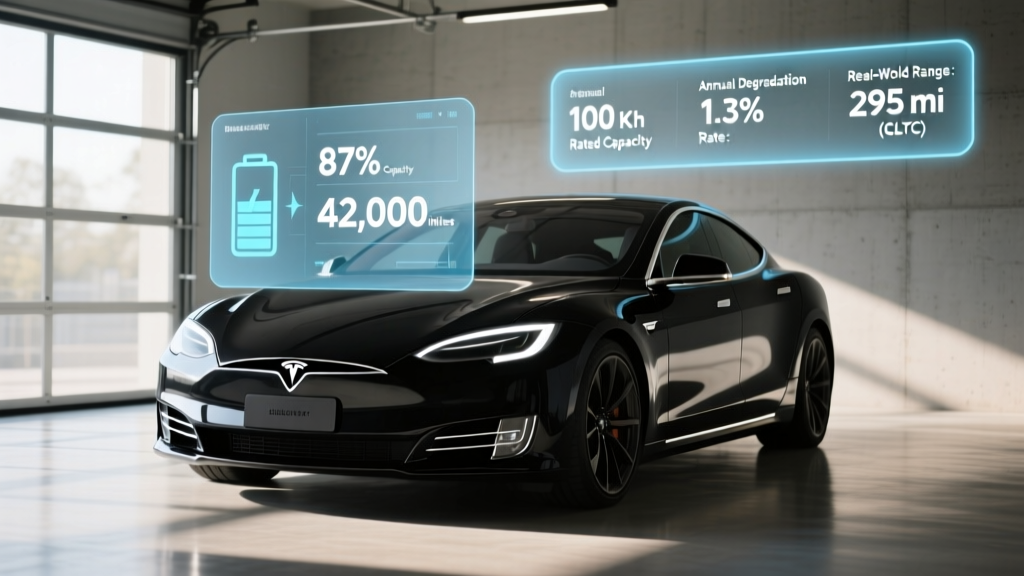
- Year 1 / ~15,000 mi: 2–4% capacity loss (initial formation drop)
- Year 3 / ~45,000 mi: 5–7% total capacity loss
- Year 5 / ~75,000 mi: 7–10% total capacity loss
- Year 8 / ~120,000 mi: 10–14% total capacity loss (fleet average)
- 200,000 mi (projected): 12–18% total capacity loss for NMC; 8–12% for LFP
Note: Degradation is non-linear — the steepest loss occurs in the first year, then the curve flattens significantly. Individual results vary based on charging habits, climate, and Supercharger frequency.
For a Model 3 Long Range with 82 kWh usable and a 341-mile EPA range, 12% degradation at 120,000 miles means roughly 300 miles of range remaining — still eminently usable for daily driving and road trips with Supercharger access.
Tesla has stated that their data shows Model 3 and Model Y drive units and batteries retaining over 85% capacity at 150,000 miles on average. LFP packs, with their superior cycle life, are tracking even better in early fleet data, though the chemistry has only been in high-volume Tesla production since late 2021.
Tesla Battery Warranty: What's Covered and for How Long
Tesla's battery warranty is one of the strongest in the industry, but the specific terms vary by model and trim. Here's the current coverage:
| Model | Battery Warranty | Minimum Capacity Retention |
|---|---|---|
| Model 3 RWD (LFP) | 8 years / 100,000 miles | 70% |
| Model 3 LR / Performance | 8 years / 120,000 miles | 70% |
| Model Y (all trims) | 8 years / 120,000 miles | 70% |
| Model S / Model X | 8 years / 150,000 miles | 70% |
| Cybertruck | 8 years / 120,000 miles | 70% |
What this means in practice: If your battery drops below 70% of its original usable capacity within the warranty period (whichever comes first — years or miles), Tesla will replace or refurbish the pack at no cost. The replacement pack will have at least 70% capacity; Tesla does not guarantee a brand-new pack.
The warranty covers manufacturing defects and abnormal degradation. It does not cover damage from accidents, flooding, or modifications. Importantly, using third-party chargers or non-Tesla DC fast chargers does not void the warranty — though Tesla can access charging logs remotely if a claim is disputed.
Tesla Battery Replacement Cost: What Owners Actually Pay
Out-of-warranty battery replacement is the scenario that generates the most anxiety among prospective EV buyers. Here are the realistic costs based on service center data and owner reports through 2025–2026:
| Model | Battery Size | Estimated Replacement Cost | Typical Trigger |
|---|---|---|---|
| Model 3 RWD (LFP) | ~60 kWh | $10,000–$13,000 | Physical damage; rare failure |
| Model 3 LR / Model Y | ~82 kWh | $13,000–$16,000 | Physical damage; rare failure |
| Model S / Model X | ~100 kWh | $18,000–$22,000 | Older vehicles, high mileage |
| Cybertruck | ~123 kWh | $20,000–$25,000 (est.) | Too new for out-of-warranty data |
Critical context: The vast majority of Tesla owners never need an out-of-warranty battery replacement. Catastrophic pack failures are rare — most degradation is gradual, and packs routinely exceed 200,000 miles before approaching the 70% threshold. The vehicles most likely to need out-of-warranty replacement are early Model S and Model X vehicles (2012–2016) with the original 85 kWh packs.
Tesla's module-level repair capability (replacing individual modules within a pack rather than the entire assembly) can reduce costs for localized cell failures, though this depends on the specific failure mode and pack architecture.
Maximizing Tesla Battery Health: Owner Best Practices
Battery degradation is inevitable, but the rate is largely within your control. These practices are supported by lithium-ion electrochemistry research and Tesla's own engineering recommendations:
- NMC owners: Set daily charge limit to 80%. Use 100% only for trips where you'll drive soon after reaching full charge.
- LFP owners: Charge to 100% at least once per week for BMS calibration. Daily 100% is acceptable.
- Minimize DC fast charging frequency: Supercharging is fine for road trips, but daily reliance on 150–250 kW DC charging accelerates degradation vs. Level 2 home charging at 7–11 kW.
- Avoid prolonged low SoC: Don't let the car sit below 10% for days. If storing, set to 50% and plug in.
- Precondition before Supercharging: Navigate to a Supercharger in the Tesla app or nav — the car will warm the battery for optimal charge acceptance and reduced cell stress.
- Park in shade or a garage in extreme heat: Sustained battery temperatures above 95°F (35°C) accelerate calendar degradation even when not driving.
- Use Scheduled Charging: Set your Tesla to charge during off-peak hours and finish close to departure time, minimizing time spent at high SoC.
How to Check Your Tesla Battery's State of Health (SoH)
Tesla does not expose a direct State of Health percentage in the vehicle UI. However, there are several reliable methods to estimate remaining capacity:
- Tesla App Energy Graph: Track your rated range at 100% SoC over time. Compare current rated range at full charge to the original EPA figure — the percentage difference approximates degradation.
- OBD-II Scan Tools: Devices like the OBDeleven or Tesla-specific tools (e.g., Scan My Tesla via OBD-II dongle) can read BMS-reported nominal full-pack energy (kWh), giving a direct SoH calculation.
- TeslaFi or Tessie (third-party apps): These log charging sessions and estimated capacity over time, building a degradation trend line.
- Service Center Request: Tesla service can pull a detailed battery health report on request, though this is typically only done during warranty claims.
What's Next: Solid-State and Silicon-Anode Batteries
The battery landscape is evolving rapidly, but it's essential to separate laboratory milestones from production-ready technology.
Solid-state batteries promise higher energy density (potentially 400+ Wh/kg at the cell level), faster charging, and improved safety by replacing the liquid electrolyte with a solid conductor. Companies like QuantumScape, Toyota, and Samsung SDI have demonstrated working prototypes, but no solid-state pack is in mass production for any consumer EV as of 2026. Realistic timelines for commercial availability in affordable vehicles remain 2028–2032, with initial deployment likely in premium or limited-production models.
Silicon-anode batteries (using silicon to replace graphite in the anode) offer incremental energy density gains of 10–20% and are closer to production. Sila Nanotechnologies and Group14 are supplying silicon-dominant anode materials to automakers, with initial vehicles expected by 2027–2028. Tesla's own 4680 cell design incorporates some silicon in its anode, though the current implementation is modest.
For today's buyers: current NMC and LFP chemistries are mature, well-understood, and backed by substantial real-world longevity data. Waiting for next-generation chemistry is a valid strategy for some buyers, but it means forgoing years of EV ownership savings.
Frequently Asked Questions
How long do Tesla batteries last in years and miles?
Based on fleet data, Tesla batteries typically retain 85–90% of original capacity at 150,000 miles. At a degradation rate that flattens over time, most packs will remain above 70% capacity well past 200,000 miles — meaning 15–20+ years of usable service for average drivers covering 10,000–15,000 miles annually. The battery is very likely to outlast the vehicle's body and interior.
How much does it cost to replace a Tesla battery?
Out-of-warranty replacement costs range from approximately $10,000 for a Model 3 RWD LFP pack to $22,000+ for a Model S/X 100 kWh pack. However, most Tesla owners never pay this — the 8-year/100,000–150,000-mile warranty covers abnormal degradation below 70%, and catastrophic failures outside the warranty window are statistically rare.
What does the Tesla battery warranty actually cover?
Tesla's warranty guarantees the battery will retain at least 70% of its original usable capacity for 8 years or 100,000–150,000 miles (depending on model). If capacity falls below this threshold, Tesla replaces or refurbishes the pack at no charge. The warranty covers manufacturing defects and degradation but excludes accident damage, flooding, or unauthorized modifications.
Is LFP or NMC better for a Tesla battery?
Neither is universally "better" — they serve different priorities. LFP (Model 3 RWD) offers longer cycle life, lower cost, and the ability to charge to 100% daily, but sacrifices energy density and cold-weather range. NMC (Long Range, Performance, S, X) delivers more range per kWh and better cold-weather performance, but requires an 80% daily charge limit for longevity. For urban commuters who charge at home nightly, LFP is ideal. For road-trip-heavy drivers in cold climates, NMC is the stronger choice.
Does frequent Supercharging damage a Tesla battery?
Frequent DC fast charging (150–250 kW) generates more heat and places higher electrochemical stress on cells compared to Level 2 home charging (7–11 kW). Tesla's thermal management system mitigates much of this, but fleet data consistently shows that vehicles charged primarily at home on Level 2 degrade more slowly than those reliant on daily Supercharging. The recommendation: Supercharge freely on road trips, but use Level 2 for daily charging whenever possible.
Can I check my Tesla battery health myself?
Yes, with caveats. Tesla doesn't display a direct SoH percentage, but you can approximate it by comparing your rated range at 100% charge to the original EPA figure. For more precision, OBD-II tools like Scan My Tesla can read BMS-reported nominal full-pack kWh. Third-party apps like TeslaFi track capacity estimates over time, building a reliable degradation trend.