What Is the BYD Blade Battery?
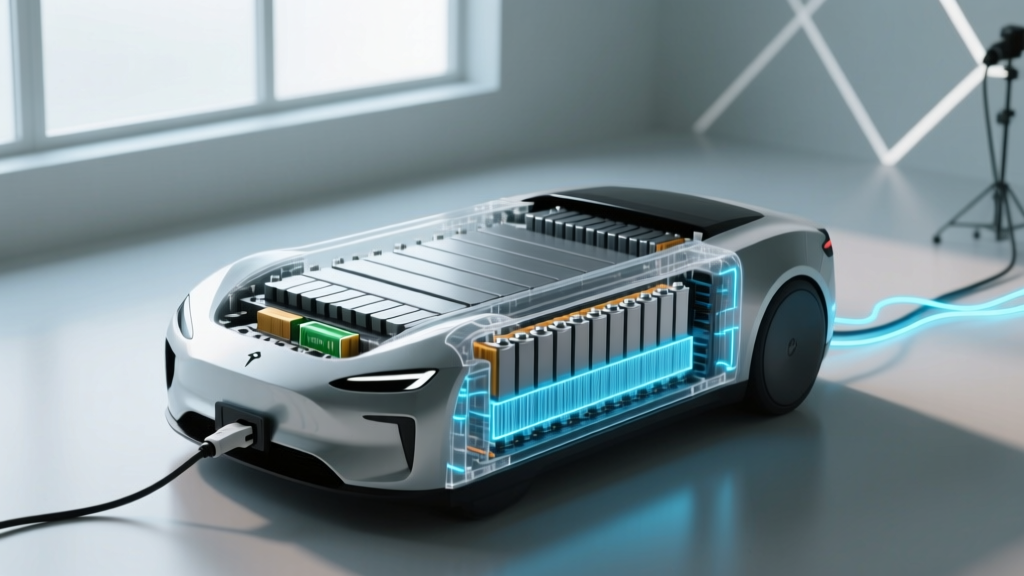
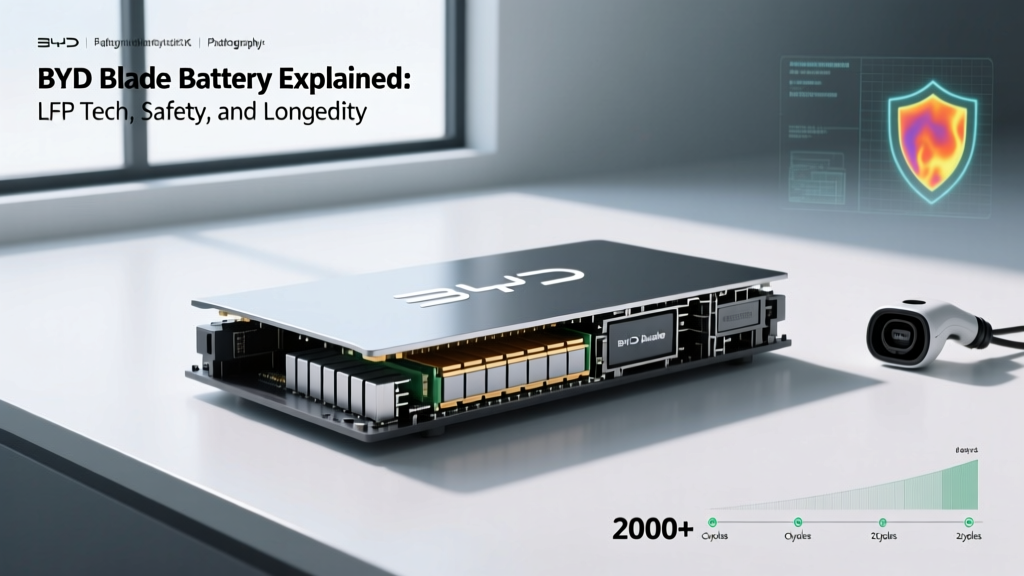
The Blade Battery is BYD's proprietary lithium iron phosphate (LFP) cell design, introduced in 2020 and now deployed across millions of vehicles globally. Unlike conventional cylindrical or prismatic cells packed into modules, the Blade Battery uses long, thin, sword-shaped cells — each roughly 960 mm long, 118 mm wide, and just 13.5 mm thick — that serve double duty as both energy storage and structural members within the pack. This "cell-to-pack" (CTP) architecture eliminates the module layer entirely, boosting volumetric utilization by roughly 50% compared to traditional LFP pack designs.
For EV shoppers and owners, the Blade Battery matters because it represents the most commercially successful LFP pack on the market, challenging the long-held assumption that nickel-manganese-cobalt (NMC) chemistry is required for competitive range. Vehicles using Blade Battery technology — including the BYD Seal, Atto 3, Dolphin, and an expanding list of partner-brand models — routinely deliver 250–350 miles of real-world range at price points undercutting NMC-equipped rivals by thousands of dollars.
LFP vs NMC/NCA Chemistry: The Core Trade-Offs
Understanding the Blade Battery requires understanding LFP chemistry at the cell level. Here's how it stacks up against the dominant alternatives:
| Attribute | LFP (BYD Blade) | NMC 811 | NCA |
|---|---|---|---|
| Cell-level energy density | ~150–180 Wh/kg | ~220–260 Wh/kg | ~250–280 Wh/kg |
| Pack-level energy density (CTP) | ~140–160 Wh/kg | ~160–190 Wh/kg | ~170–200 Wh/kg |
| Cycle life (to 80% capacity) | 3,000–6,000+ cycles | 1,000–2,000 cycles | 800–1,500 cycles |
| Thermal runaway onset | ~270°C (highly stable) | ~150–210°C | ~140–180°C |
| Cold-weather performance (-10°C) | ~20–30% range loss | ~15–25% range loss | |
| Cobalt/nickel content | None (iron + phosphate) | Significant | Significant |
| Relative cell cost (2026) | ~$70–85/kWh | ~$100–125/kWh | ~$110–130/kWh |
| Typical applications | Budget/mid-range EVs, standard-range trims | Long-range / performance EVs | Performance / premium EVs (Tesla, etc.) |
The critical takeaway: LFP's lower cell-level energy density is partly offset at the pack level by the Blade Battery's CTP design, which packs more active material into the same volume. But physics still applies — an LFP pack of equivalent kWh will generally weigh 15–25% more than an NMC pack. That mass penalty is why you won't find LFP in ultra-long-range (350+ mile) or high-performance EVs where every kilogram matters.
Blade Battery Safety: The Nail Penetration Test
BYD's most-publicized claim for the Blade Battery is its performance in nail penetration testing — the most severe abuse test for lithium-ion cells, simulating an internal short circuit. In BYD's published tests (conducted per GB/T 31485-2015 standards), a fully charged Blade Battery cell penetrated by a steel nail produced no fire, no explosion, and surface temperatures that peaked below 60°C. By comparison, conventional NMC cells in the same test typically exhibit thermal runaway with surface temperatures exceeding 500°C and visible flame.
This isn't merely a marketing exercise. Thermal stability at the cell level translates to reduced fire risk in real-world crash scenarios and simplifies the pack-level safety engineering required. The Blade Battery's structural integration also means the cells themselves contribute to the vehicle's torsional rigidity, with BYD reporting a >40,000 N·m/deg torsional stiffness figure in vehicles using the e-Platform 3.0 architecture.
Degradation Data: How Blade Batteries Age in the Real World
LFP chemistry's defining advantage is cycle life. BYD rates Blade Battery cells for 5,000+ charge cycles to 80% capacity retention — a figure that translates to roughly 1 million miles of driving for a vehicle with 200 miles of range per cycle. In practice, calendar aging (time-based degradation) typically becomes the limiting factor before cycle life is exhausted.
- Year 1 / 15,000 miles: 2–4% capacity loss (initial formation period)
- Year 3 / 45,000 miles: 5–8% total loss
- Year 5 / 75,000 miles: 7–11% total loss
- Year 8 / 120,000 miles: 10–15% total loss
- Year 10 / 150,000 miles: 12–18% total loss (varies significantly by climate and charging habits)
Source: Aggregated fleet telemetry data from BYD's global taxi and ride-hailing fleets, corroborated by independent testing from Geotab's EV battery degradation study.
The degradation curve is notably flatter than NMC equivalents. Where an NMC pack might lose 10–12% by year 5, a well-maintained Blade Battery pack typically shows 7–11% loss over the same period. The practical implication: a 60 kWh Blade Battery pack delivering 230 EPA-rated miles when new would still offer roughly 195–205 miles of range at year 8 — well within usable daily-driving territory.
Battery Warranty Terms: What BYD Covers
Warranty terms vary by market and model year, but the baseline coverage for BYD Blade Battery-equipped vehicles sold in major markets follows this structure:
| Component | Coverage Period | Mileage Limit | Capacity Threshold |
|---|---|---|---|
| Traction battery (Blade pack) | 8 years | 125,000 miles (US) / 160,000 km (EU/AU) | 70% of original capacity |
| Battery management system | 8 years | 125,000 miles | N/A — defect coverage |
| Electric powertrain (motor, inverter) | 8 years | 100,000 miles | N/A — defect coverage |
| Vehicle (bumper-to-bumper) | 6 years | 60,000 miles | N/A |
If the battery's State of Health (SoH) drops below 70% within the warranty period, BYD is obligated to repair or replace the pack at no cost. In practice, given LFP's degradation profile, a warranty claim for capacity loss is uncommon — most Blade Battery packs will remain above 80% SoH well past the 8-year mark under normal use. The warranty is more relevant for manufacturing defects or cell-level failures than for gradual capacity fade.
Replacement Cost: What Happens When the Pack Fails?
Out-of-warranty battery replacement is the scenario that generates the most anxiety among prospective EV buyers. Here's what the numbers actually look like for Blade Battery packs in 2026:
| Model / Pack Size | Battery Capacity | Replacement Cost (Parts + Labor) | Typical Replacement Trigger |
|---|---|---|---|
| BYD Dolphin (Standard) | 44.9 kWh | $6,500–$8,500 | Physical damage, rare cell failure |
| BYD Atto 3 / Yuan Plus | 58.56 kWh | $8,500–$11,000 | Physical damage, rare cell failure |
| BYD Seal (Standard Range) | 61.4 kWh | $9,000–$12,000 | Physical damage, rare cell failure |
| BYD Seal (Extended Range) | 82.5 kWh | $12,000–$16,000 | Physical damage, rare cell failure |
Context matters here. Unlike consumer electronics, EV traction batteries rarely fail catastrophically at a single point in time. Degradation is gradual, and most Blade Battery packs will outlast the vehicle's useful economic life before reaching a point where replacement is warranted. BYD's CTP design also allows individual blade cells to be serviced rather than requiring a full pack swap — reducing repair costs for isolated cell failures to roughly $800–$1,500 per cell module, depending on labor rates.
For comparison, a gasoline vehicle's engine or transmission replacement typically runs $4,000–$8,000 and is far more common within a vehicle's lifespan than an EV battery pack replacement. Data from Consumer Reports indicates that EV battery replacement rates within the first 10 years remain below 5% across all manufacturers.
Maximizing Blade Battery Life: Owner Care Best Practices
LFP chemistry is more forgiving than NMC in several respects — notably, LFP cells tolerate sustained 100% State of Charge (SoC) better than NMC cells, and BYD actually recommends periodic full charges to allow the battery management system (BMS) to recalibrate cell balancing. That said, smart habits still extend pack life:
- Charge to 100% at least once per week. LFP cells have a very flat voltage curve, making SoC estimation difficult. Regular full charges let the BMS recalibrate, preventing range-estimate drift.
- Minimize DC fast charging when possible. Occasional DCFC (1–2x per week) is fine, but daily fast charging at 100+ kW accelerates electrolyte degradation. Use Level 2 (7–11 kW) for routine overnight charging.
- Precondition the battery in cold weather. Use the vehicle's scheduled departure or preconditioning feature to warm the pack before driving. Cold LFP cells accept less regen and deliver less range.
- Avoid prolonged storage at extreme SoC. If storing the vehicle for 2+ weeks, target ~50–70% SoC. Unlike NMC, LFP is less sensitive to high-SoC storage, but mid-range is still optimal for long-term calendar aging.
- Keep the thermal management system active. Don't disable battery preconditioning or thermal management features to save energy — the few kWh consumed protecting the pack pays for itself in longevity.
- Monitor SoH periodically. Check your battery's State of Health through the vehicle's infotainment system or a third-party OBD-II diagnostic tool at least twice per year.
Monitoring Battery Health: How to Check SoH
BYD vehicles provide basic battery health data through the infotainment system's energy management menu, typically showing current usable capacity as a percentage of the original. For more granular data, owners can use OBD-II diagnostic adapters paired with apps like EV Health Check, Car Scanner, or ABRP's battery monitoring tools to read individual cell voltages, pack impedance, and calculated SoH.
Key metrics to track:
- State of Health (SoH): The percentage of original usable capacity remaining. A new pack is 100%; warranty coverage typically applies below 70%.
- Cell voltage spread: The difference between the highest and lowest cell voltages in the pack. A spread exceeding 50 mV at full charge may indicate cell imbalance requiring BMS attention.
- Charge/discharge efficiency: A declining ratio of energy delivered to energy consumed during charging can signal increased internal resistance — an early indicator of cell aging.
Beyond the Blade: Solid-State and Emerging Battery Tech
The Blade Battery represents the current state of optimized LFP engineering, but the industry is actively developing next-generation chemistries. Here's where they stand as of 2026:
- Solid-state batteries: Toyota, Samsung SDI, and QuantumScape have demonstrated prototype cells with 350–500 Wh/kg energy density and 10-minute fast-charge capability. However, manufacturing yield and cost remain barriers. Realistic volume-production timeline: 2028–2030 for premium applications, with mainstream availability likely post-2032.
- Silicon-dominant anodes: Companies like Sila Nanotechnologies and Group14 are shipping silicon-carbon composite anodes that boost cell energy density by 20–40%. These are entering production in 2026–2027 model-year vehicles but add cost and introduce their own cycle-life trade-offs.
- Sodium-ion batteries: BYD, CATL, and others are commercializing sodium-ion cells for budget EVs and energy storage. Lower energy density (~120–140 Wh/kg) limits them to city cars and short-range applications, but zero reliance on lithium or cobalt makes them geopolitically attractive.
None of these technologies threaten the Blade Battery's market position in the near term. LFP's cost advantage, manufacturing maturity, and proven safety record make it the default chemistry for the volume EV segment through at least 2030.
Frequently Asked Questions
How long does a BYD Blade Battery last?
Based on fleet data and LFP chemistry characteristics, a Blade Battery pack should retain 80–88% of its original capacity at 8 years / 120,000 miles, and 82–88% at 10 years / 150,000 miles under normal use. The cells are rated for 5,000+ cycles to 80% capacity — equivalent to roughly 1 million miles for a 200-mile-range vehicle. Calendar aging, not cycle exhaustion, is typically the limiting factor.
Is the Blade Battery safer than NMC batteries?
At the cell level, yes. LFP chemistry has a thermal runaway onset temperature of approximately 270°C, compared to 150–210°C for NMC. The Blade Battery's nail penetration test results — no fire, no explosion, surface temperatures below 60°C — are the most rigorous public demonstration of this advantage. Pack-level safety also depends on vehicle crash engineering, thermal management, and BMS design, but the cell-level margin provides a significant safety buffer.
Can I fast-charge a Blade Battery regularly?
Occasional DC fast charging (1–2 sessions per week) is compatible with long pack life. Daily DCFC at high power (100+ kW) will accelerate degradation modestly — expect 2–4% additional capacity loss over 5 years compared to primarily Level 2 charging. BYD's thermal management system actively manages cell temperatures during fast charging to mitigate this, but Level 2 (7–11 kW) remains the optimal routine charging method.
Why doesn't every EV use LFP / Blade Battery technology?
Energy density. LFP cells store roughly 30–40% less energy per kilogram than NMC cells. For vehicles targeting 300+ miles of EPA range or high performance, the mass and volume penalty of LFP becomes significant. LFP also loses more range in cold weather. Automakers choose chemistry based on the vehicle's target range, price point, and use case — LFP dominates the budget-to-mid-range segment, while NMC/NCA remains necessary for long-range and performance models.
Does the Blade Battery qualify for the US federal EV tax credit?
Eligibility depends on the specific vehicle model, its MSRP, the buyer's income, and battery-component/critical-mineral sourcing requirements under IRS §30D rules. BYD does not currently sell vehicles in the United States, so Blade Battery-equipped BYD models are not eligible. However, LFP packs from other manufacturers (notably Tesla's Standard Range models and select Ford/CATL collaborations) may qualify depending on sourcing compliance. Always verify current-year eligibility with a tax professional before purchasing.
What happens if one Blade cell fails?
BYD's CTP architecture allows individual blade cells to be diagnosed and replaced without swapping the entire pack. A single-cell replacement typically costs $800–$1,500 including labor. Full pack replacement is only necessary in cases of widespread cell degradation or severe physical damage (e.g., major collision compromising the pack structure). The BMS continuously monitors individual cell voltages and will flag anomalies before they become safety concerns.