The BYD Blade Battery has become one of the most discussed energy-storage designs in the global EV market since its 2020 debut. Now appearing in a growing number of vehicles sold across Europe, Asia, and select other markets — and increasingly referenced by competing automakers — this cell-to-pack architecture has reshaped how the industry thinks about lithium iron phosphate (LFP) technology. But what exactly makes a Blade Battery different from a conventional LFP pack, and what does it mean for range, longevity, and real-world ownership? This guide breaks down the chemistry, the engineering, and the hard numbers.
What the Blade Battery Actually Is
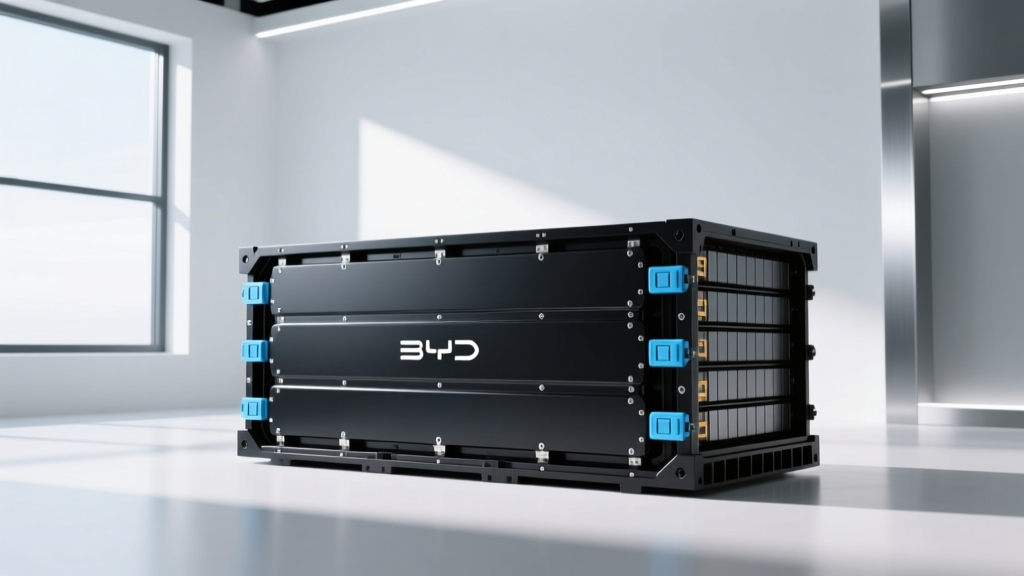
The Blade Battery is not a new chemistry — it is a structural innovation applied to existing LFP (lithium iron phosphate) cells. BYD's engineers elongated the prismatic cells into thin, blade-like strips (up to 960 mm long) and inserted them directly into the pack housing, eliminating the intermediate module layer that traditional packs use to group cells. This "cell-to-pack" (CTP) approach yields several measurable benefits:
- Higher volumetric utilization: BYD claims ~50% more pack volume is occupied by active cell material compared to a conventional modular LFP pack, partially closing the energy-density gap with NMC chemistries.
- Structural rigidity: The long, flat cells act as structural beams, increasing torsional stiffness of the pack — and, when integrated into the vehicle chassis, the body itself.
- Thermal stability: LFP chemistry is inherently more thermally stable than NMC/NCA, and the Blade form factor improves heat dissipation across the cell surface area. BYD's widely publicized nail-penetration test showed the Blade cell did not emit fire or smoke, while a conventional NMC cell under the same test reached surface temperatures exceeding 500°C.
The result: a pack that retains LFP's safety and longevity advantages while delivering pack-level energy densities in the range of approximately 140–150 Wh/kg — competitive with earlier-generation NMC packs, though still below the 170–200+ Wh/kg that modern NMC/NCA packs achieve.
LFP vs NMC vs NCA: The Chemistry Trade-Offs
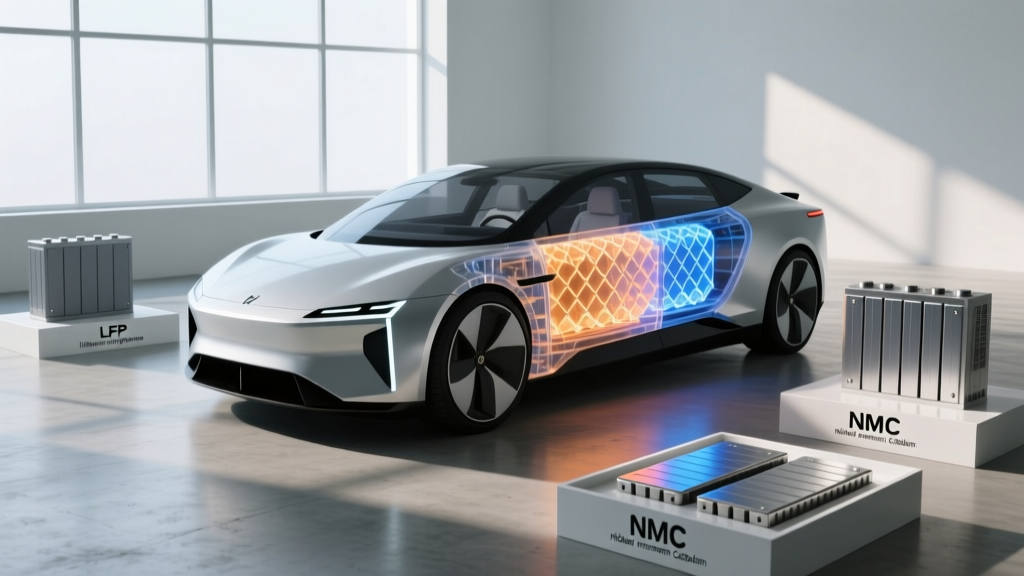
Understanding the Blade Battery requires understanding where LFP sits in the broader EV battery landscape. Here is how the three dominant chemistries compare on the metrics that matter to buyers:
| Attribute | LFP (incl. Blade Battery) | NMC (Nickel Manganese Cobalt) | NCA (Nickel Cobalt Aluminum) |
|---|---|---|---|
| Cell-level energy density | 150–180 Wh/kg | 220–300 Wh/kg | 250–300 Wh/kg |
| Pack-level energy density | ~140–150 Wh/kg (Blade CTP) | ~160–200 Wh/kg | ~170–210 Wh/kg |
| Cycle life (to 80% capacity) | 3,000–5,000+ cycles | 1,000–2,000 cycles | 1,000–1,500 cycles |
| Thermal runaway risk | Very low | Moderate | Moderate-High |
| Cold-weather performance (–10°C) | Greater range loss (~30–40%) | Less range loss (~20–30%) | Less range loss (~20–30%) |
| Raw material cost sensitivity | Low (iron, phosphate — no cobalt/nickel) | High (nickel, cobalt price swings) | High (nickel, cobalt) |
| Optimal daily charging | 100% SoC acceptable (even recommended periodically for BMS calibration) | 80% SoC for daily use; 100% for trips | 80% SoC for daily use; 100% for trips |
| Notable adopters (2025–2026) | BYD (all models), Tesla Model 3/Y RWD, some Volvo/Polestar trims | Hyundai/Kia E-GMP, VW MEB, GM Ultium, most long-range models | Tesla (historically), Rivian |
The bottom line: LFP — and the Blade Battery specifically — wins on cycle life, safety, cost stability, and daily-use convenience (no need to babysit state of charge). NMC/NCA wins on energy density, which translates to more range per kilogram and better cold-weather performance. For a compact or midsize EV where total range requirements are 250–350 miles, LFP is increasingly the pragmatic choice. For long-range flagship models pushing 400+ miles, NMC still dominates.
Real-World Degradation: What the Data Shows
LFP's cycle-life advantage is not just a lab curiosity — it shows up in fleet data. Here is what we know from published testing and owner reporting:
Typical LFP (Blade-Type) Degradation Curve
- Year 1 / 15,000 miles: ~2–3% capacity loss (initial calibration settling)
- Year 3 / 45,000 miles: ~4–6% total loss
- Year 5 / 75,000 miles: ~5–8% total loss
- Year 8 / 120,000 miles: ~8–12% total loss
- Projected 15 years / 200,000+ miles: ~12–18% total loss (well within warranty threshold for most OEMs)
Compare this to typical NMC degradation: ~3–5% in Year 1, ~10–15% by Year 8 / 120,000 miles. The gap widens significantly under high-mileage or high-temperature usage patterns.
Sources: BYD internal lifecycle testing (published 2021); Geotab fleet battery health data (2024 report covering 10,000+ EVs); independent testing by P3 Group and Recurrent Auto.
A few important caveats: degradation is not linear. LFP cells tend to lose capacity quickly in the first few hundred cycles, then plateau into a very gradual decline. Temperature matters enormously — a Blade Battery in Phoenix will degrade faster than one in Seattle due to sustained high ambient heat, even though LFP handles heat better than NMC at the cell level. And DC fast-charging frequency plays a role, though less so for LFP than for nickel-based chemistries.
What the Battery Warranty Covers — and What It Doesn't
Every EV sold in the US is required to carry a minimum battery warranty of 8 years / 100,000 miles (in CARB states like California, it extends to 10 years / 150,000 miles). Most automakers using LFP/Blade-type packs offer similar or better terms. Here is how typical warranties break down:
| Term | BYD (Blade / LFP) | Tesla Model 3 RWD (LFP) | Hyundai Ioniq 5 (NMC) |
|---|---|---|---|
| Duration | 8 years / 100,000 mi (160,000 km in EU) | 8 years / 100,000 mi | 10 years / 100,000 mi |
| Capacity retention threshold | 70% of original capacity | 70% of original capacity | 70% of original capacity |
| Covers defects? | Yes — materials, workmanship | Yes | Yes |
| Covers normal degradation? | Only if below 70% threshold | Only if below 70% threshold | Only if below 70% threshold |
| Transferable to second owner? | Yes (varies by market) | Yes | Yes |
Critical nuance: The 70% threshold means a warranty claim only triggers if your battery loses more than 30% of its original capacity. Given the degradation data above, a Blade-type LFP pack would need to perform far worse than fleet averages to hit that threshold within the warranty period. The warranty protects against catastrophic failure and severe defects — it is not a guarantee of peak performance.
How Much Does EV Battery Replacement Cost?
This is the question that generates the most anxiety — and the most misinformation. Here are the actual numbers as of 2025–2026:
| Vehicle / Pack Size | Chemistry | Estimated Replacement Cost | Typical Replacement Trigger |
|---|---|---|---|
| BYD Dolphin (~60 kWh) | Blade LFP | $8,000–$12,000 | Rare before 200,000+ mi; accident damage more common cause |
| Tesla Model 3 RWD (~60 kWh) | LFP | $10,000–$14,000 | Rare before 200,000+ mi |
| Hyundai Ioniq 5 (~77 kWh) | NMC | $12,000–$18,000 | Rare before 150,000+ mi |
| Ford F-150 Lightning Extended (~131 kWh) | NMC | $20,000–$30,000+ | Rare before 150,000+ mi |
| GMC Hummer EV (~212 kWh) | NMC | $30,000–$40,000+ | Rare before 150,000+ mi |
The reality most buyers miss: EV battery replacements are exceedingly rare within the first 10–15 years of ownership. According to data from Recurrent Auto, fewer than 1.5% of EVs in their studied fleet (over 15,000 vehicles) required a full pack replacement outside of warranty-covered defects. When replacements do occur, they are more often due to physical damage (collision, flood) than degradation. For context, a conventional automatic transmission replacement on a gas car runs $4,000–$8,000 — and those fail far more frequently than EV battery packs.
Maximizing Blade Battery Life: A Practical Care Guide
While LFP chemistry is more forgiving than NMC, smart habits still extend useful life and maintain range. Here is a checklist based on OEM guidance and fleet data:
Battery Care Checklist — LFP / Blade Battery
- Charge to 100% at least once per week. Unlike NMC, LFP cells benefit from periodic full charges. The battery management system (BMS) uses the top-of-charge voltage to recalibrate its state-of-charge estimate. Skipping full charges leads to inaccurate range displays and potential cell imbalance.
- Don't fear DC fast charging, but don't rely on it exclusively. Occasional DC fast charging (1–2 times per week) shows negligible impact on LFP degradation. Daily DC fast charging, particularly at rates above 1C (where charge power in kW exceeds battery capacity in kWh), does accelerate wear over multi-year timeframes.
- Precondition before fast charging in cold weather. LFP cells accept charge more slowly at low temperatures. Use your vehicle's navigation-based preconditioning (or manually activate it) to warm the pack before arriving at a DC charger. This protects the cells and dramatically improves charge speed — a cold LFP pack may peak at 20–30 kW where a preconditioned one can hit 80–120+ kW depending on the model.
- Avoid prolonged storage at 0% or 100% SoC. While LFP tolerates 100% SoC better than NMC, storing a vehicle for weeks at full charge in high ambient heat (e.g., an outdoor lot in July) still accelerates calendar aging. For long-term storage (2+ weeks), aim for 50–70% SoC in a cool environment.
- Use regenerative braking in moderation on cold packs. A cold LFP battery cannot accept high regen current without stress. Most vehicles automatically limit regen when the pack is cold, but being gentle on the throttle for the first 5–10 minutes of a cold-soak drive reduces micro-stress on the cells.
- Keep the vehicle plugged in during extreme heat or cold. The thermal management system can maintain pack temperature using grid power, preventing both heat-accelerated degradation and cold-induced lithium plating (less of a concern for LFP than NMC, but still a factor at extreme temperatures below –20°C).
How to Monitor Your Battery's State of Health (SoH)
State of Health (SoH) is the percentage of original capacity your battery currently holds. A new battery is at 100% SoH; a battery that has degraded to 55 kWh from its original 60 kWh is at ~92% SoH. Here is how to check it:
- In-vehicle displays: Some manufacturers (notably BYD and Tesla) provide a battery health readout in the vehicle settings menu, though the granularity varies. Tesla shows a "Battery Health" percentage under Service mode on some software versions.
- OBD-II diagnostic tools: Third-party apps like OBDeleven, Leaf Spy (for Nissan), and manufacturer-specific scan tools can read the BMS-reported SoH directly from the CAN bus. This is the most accurate consumer-accessible method.
- Charge-to-full method: Charge to 100%, note the displayed range or kWh added, and compare to the original EPA-rated capacity. If your 60 kWh pack consistently accepts only 54 kWh from 5% to 100% (accounting for charging losses of ~5–8%), your SoH is approximately 90–92%. This method requires some math but costs nothing.
- Third-party services: Companies like Recurrent Auto offer free battery health reports that benchmark your vehicle against a fleet of identical models. You share anonymized telematics data; they return a SoH estimate and percentile ranking.
What Comes After the Blade Battery?
The Blade Battery represents a mature optimization of LFP chemistry — but it is not the final word in EV energy storage. Several technologies are in active development with implications for the next 3–10 years:
- Sodium-ion batteries: BYD, CATL, and others are building sodium-ion production lines for entry-level EVs and energy storage. Sodium-ion offers lower energy density (~120–140 Wh/kg at the cell level) but dramatically lower raw material costs and excellent cold-weather performance. Expected in sub-$25,000 EVs by 2027–2028.
- Semi-solid-state batteries: NIO's 150 kWh semi-solid pack (available in China since 2024) demonstrates ~360 Wh/kg at the cell level. Mass-market adoption remains cost-prohibitive; realistic timeline for affordable vehicles is 2028–2030.
- Silicon-dominant anodes: Companies like Sila Nanotechnologies and Group14 are replacing graphite anodes with silicon composites, boosting energy density 20–40% without changing cathode chemistry. Already appearing in limited applications (e.g., Mercedes G-Class 580e PHEV); broader EV adoption expected 2026–2028.
- LMFP (lithium manganese iron phosphate): An evolution of LFP that adds manganese to raise cell voltage from ~3.2V to ~3.8V, yielding ~15–20% more energy density while retaining LFP's safety and cost advantages. CATL and BYD are both developing LMFP cells; production vehicles expected 2026–2027.
Forward-looking note: None of these technologies are currently available in production vehicles at scale in the US market as of early 2026. Announced timelines shift frequently. The Blade Battery and conventional LFP remain the benchmark for cost-effective, long-life EV energy storage for the foreseeable future.
Frequently Asked Questions
How long do EV batteries actually last?
Based on fleet data from Recurrent Auto and Geotab, the average EV battery retains 85–92% of its original capacity at 100,000 miles (roughly 7–8 years of average US driving). LFP packs, including Blade-type designs, typically perform better — often retaining 90–95% at the same mileage. At 200,000 miles, most LFP packs are projected to hold 80–88% of original capacity. In practical terms, the battery will likely outlast the vehicle's body, suspension, and interior.
Is the Blade Battery available in vehicles sold in the United States?
As of early 2026, BYD does not sell passenger vehicles in the US market, though the company has announced plans for a Mexico-based manufacturing facility that could eventually supply North American markets. However, Blade-type LFP technology is used in Tesla's Model 3 and Model Y Rear-Wheel-Drive variants (sourced from CATL and BYD for various markets), and the fundamental LFP chemistry and cell-to-pack engineering principles are identical. US buyers can access LFP technology through Tesla's standard-range models and select other offerings.
Should I choose LFP or NMC for my next EV?
Choose LFP if: you want maximum cycle life, you prefer charging to 100% daily without worry, you live in a moderate climate, your daily driving is under 250 miles, and you prioritize cost. Choose NMC if: you need maximum range (300–400+ miles), you regularly drive in sub-freezing temperatures, or you tow heavy loads that demand high energy density. For most commuters and suburban drivers, LFP is the pragmatic choice.
Does DC fast charging damage the Blade Battery?
Occasional DC fast charging has minimal impact on LFP degradation. BYD's own testing showed less than 2% additional capacity loss over 2,000 cycles when comparing 100% DC fast charging to 100% Level 2 charging — a far smaller gap than what NMC cells exhibit under the same conditions. That said, exclusive reliance on DC fast charging (multiple times daily for years) will accelerate wear on any chemistry. A mix of ~80% Level 2 home charging and ~20% DC fast charging is a practical real-world pattern.
What happens if my Blade Battery degrades below 70% during the warranty period?
If diagnostic testing confirms your battery has fallen below the warranty's capacity retention threshold (typically 70% of original capacity), the manufacturer is obligated to repair or replace the pack at no cost to you. In practice, this almost always means replacing defective modules or cells rather than swapping the entire pack — LFP's cell-to-pack design can make module-level service more complex, but BYD and its service partners have developed procedures for targeted cell replacement.
Can the Blade Battery be recycled?
Yes. LFP batteries are recyclable, though the economics are less favorable than NMC recycling because LFP contains no cobalt or nickel — the high-value materials that make recycling profitable. BYD and third-party recyclers use hydrometallurgical processes to recover lithium, iron, and phosphate. As recycling infrastructure scales (the US DOE has funded multiple LFP recycling initiatives under the Battery Materials Processing grants), recovery rates are expected to improve significantly by 2028–2030.