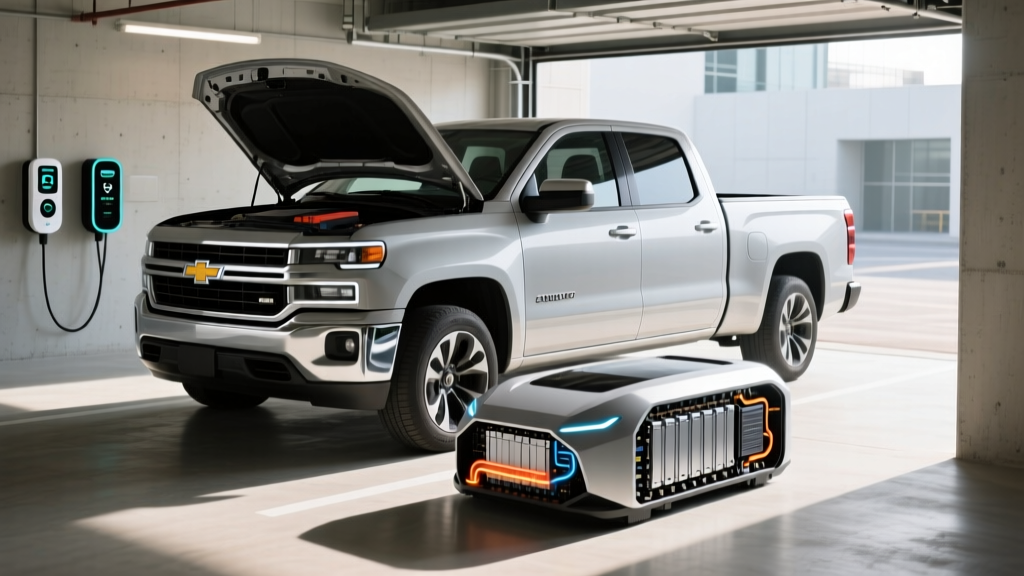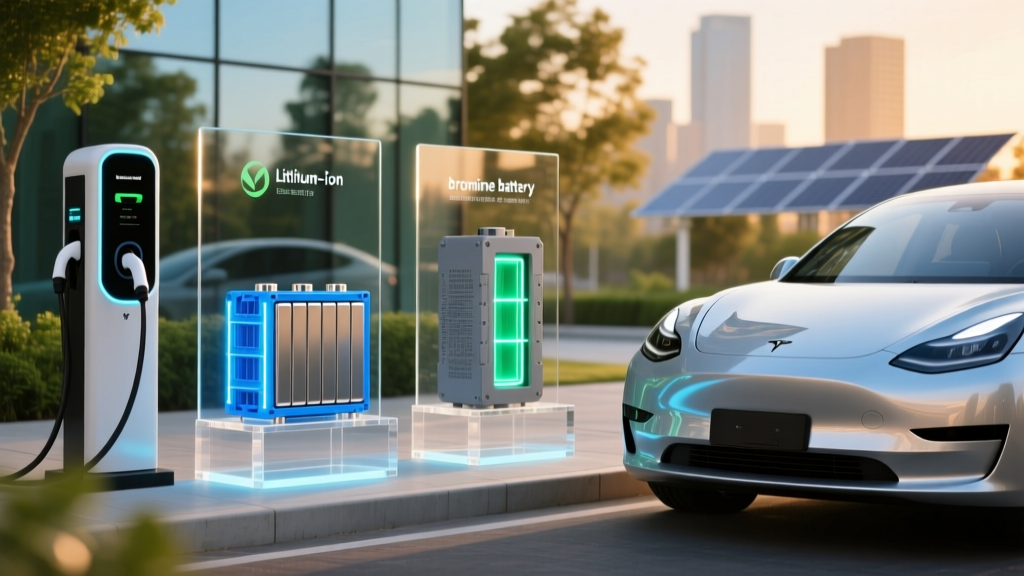
If you have been browsing EV forums or battery-tech headlines lately, you may have encountered the term bromine battery — specifically, zinc-bromine or hydrogen-bromine flow battery concepts promoted for energy storage. The promise sounds compelling: abundant raw materials, low cost per kilowatt-hour, and long cycle life. But how does bromine battery technology actually stack up against the lithium-ion chemistries powering every mainstream EV on the road today?
This guide cuts through the speculation. We will break down what bromine batteries are, why they are generating interest, how they compare to LFP and NMC/NCA lithium-ion cells on the metrics that matter for EV owners, and what the realistic timeline is for any of this reaching your driveway.
What Is a Bromine Battery — and Why Is It in EV Conversations?
A bromine battery is a type of flow battery that uses bromine (a halogen element) as one of its active electrochemical materials. The most common variants under development are:
- Zinc-bromine (ZnBr) flow batteries: Energy is stored in liquid electrolyte tanks containing zinc and bromine solutions. Pumps circulate the fluid through a cell stack where electrochemical reactions occur.
- Hydrogen-bromine flow batteries: Use hydrogen gas and bromine in a similar flow architecture, with companies like EnSync Energy (formerly ViZn Energy) having explored this path for grid-scale storage.
The appeal is straightforward. Bromine is cheap and globally abundant — it is extracted from brine wells and seawater, with no geopolitical supply-chain bottleneck comparable to lithium, cobalt, or nickel. Flow batteries also offer inherent safety advantages: the electrolyte is stored in separate tanks, reducing thermal runaway risk, and the system can be scaled by simply adding larger tanks rather than more cells.
However, flow batteries were designed for stationary grid storage, not for the demanding power-density and packaging requirements of passenger vehicles. Understanding why requires a side-by-side look at the numbers.
Bromine vs. Lithium-Ion: The Chemistry Comparison That Matters
Every EV sold in the US market today uses some variant of lithium-ion chemistry — either NMC/NCA (nickel-manganese-cobalt / nickel-cobalt-aluminum) or LFP (lithium iron phosphate). Here is how those established chemistries compare to bromine flow batteries on the dimensions that affect EV ownership.
| Attribute | Zinc-Bromine Flow | NMC/NCA (Lithium-Ion) | LFP (Lithium-Ion) |
|---|---|---|---|
| Energy Density (cell-level) | 35–75 Wh/kg | 200–300 Wh/kg | 140–200 Wh/kg |
| System-Level Energy Density | ~25–50 Wh/kg (tanks + pumps + stack) | 130–180 Wh/kg (pack) | 100–140 Wh/kg (pack) |
| Cycle Life | 5,000–10,000+ cycles | 1,000–2,000 cycles | 3,000–6,000+ cycles |
| Calendar Lifespan | 20+ years (electrolyte does not degrade) | 10–15 years typical | 15–20+ years typical |
| Raw Material Cost | Very low (zinc, bromine abundant) | High (nickel, cobalt, lithium) | Moderate (iron, phosphate, lithium) |
| Cold-Weather Performance | Poor (electrolyte viscosity, pump requirements) | Good with thermal management | Moderate — slower charging below 32°F |
| Fast-Charging Capability | Limited by flow rate and stack area | Up to 250–350 kW peak | Up to 175–250 kW peak |
| Thermal Runaway Risk | Very low (aqueous electrolyte) | Moderate (requires BMS and cooling) | Very low |
| Weight for 75 kWh Usable | ~1,500–3,000 kg (est.) | ~400–550 kg (pack) | ~550–750 kg (pack) |
| Current EV Applications | None (stationary/grid only) | Tesla, Hyundai, Kia, BMW, Ford, GM, VW, etc. | Tesla Model 3/Y Standard Range, Ford F-150 Lightning Standard, Rivian Standard, BYD |
The critical takeaway: energy density disqualifies bromine flow batteries from passenger EV use with current technology. A 75 kWh zinc-bromine system could weigh 1,500 kg or more just for the battery — roughly the curb weight of an entire compact car. For context, the 82 kWh NMC pack in a Tesla Model Y Long Range weighs approximately 480 kg. You cannot package a bromine flow system into a vehicle without sacrificing most of the cargo space, payload capacity, and efficiency.
LFP vs. NMC: The Real EV Battery Decision in 2026
Since bromine batteries remain a stationary-storage technology, the chemistry choice that actually affects your next EV purchase is LFP vs. NMC/NCA. Both are proven, both are widely available, and the trade-offs are well understood after years of real-world deployment.
NMC/NCA batteries dominate in long-range and performance vehicles. Their higher energy density (200–300 Wh/kg at the cell level) means more range in a lighter, more compact pack. The Tesla Model 3 Long Range (82 kWh NMC), Hyundai Ioniq 5 (77.4 kWh NMC), and Chevrolet Silverado EV (200+ kWh Ultium NMC) all rely on this chemistry to deliver 300–400+ miles of EPA range. The trade-off is higher raw material cost, somewhat faster degradation, and a recommended daily charge limit of 80% to maximize longevity.
LFP batteries have become the standard for entry-level and mid-range trims. Tesla's Model 3 and Model Y Standard Range variants, the Ford F-150 Lightning Standard Range, and the base Rivian R1S/R1T all use LFP packs. LFP offers lower energy density but exceptional cycle life (3,000–6,000+ cycles), very low thermal runaway risk, and the ability to charge to 100% daily without accelerated degradation. Tesla explicitly recommends periodic 100% charges for LFP packs to support battery management system (BMS) calibration.
For most buyers in 2026: if your daily driving is under 60 miles and you want maximum battery lifespan with minimal babysitting, LFP is the pragmatic choice. If you need 300+ miles of highway range for road trips, NMC/NCA remains essential.
EV Battery Degradation: What the Real Data Shows
Battery degradation — the gradual loss of usable capacity over time and charge cycles — is the single most common concern among prospective EV buyers. Fortunately, the real-world data is reassuring, particularly compared to early-generation EVs.
According to longitudinal fleet data compiled by Recurrent Auto (which tracks over 15,000 EVs in real-world conditions), here is what typical degradation looks like across popular models:
| Mileage | Average Capacity Retention (NMC) | Average Capacity Retention (LFP) | Real-World Impact |
|---|---|---|---|
| 0–30,000 miles | 95–97% | 97–99% | Unnoticeable in daily driving |
| 30,000–60,000 miles | 92–95% | 95–98% | ~5–8 mi range loss on a 300-mi EPA vehicle |
| 60,000–100,000 miles | 88–93% | 92–96% | ~20–35 mi range loss; still very usable |
| 100,000–150,000 miles | 85–90% | 90–94% | Noticeable but manageable; rarely triggers warranty |
| 150,000–200,000+ miles | 80–87% | 87–92% | Approaching warranty threshold; replacement consideration begins |
Key observations from the data: degradation is non-linear. Most lithium-ion packs lose 2–5% capacity in the first year or two (the "break-in" period), then the curve flattens considerably. A Tesla Model 3 Long Range owner who starts with 330 miles of EPA range can reasonably expect roughly 290–310 miles at 100,000 miles — still far more than most daily commutes require.
It is also worth noting that this is where bromine flow batteries hold a theoretical advantage: their electrolyte does not chemically degrade with cycling the way lithium-ion anodes and cathodes do. A zinc-bromine system rated for 10,000 cycles could theoretically operate for 30+ years at one cycle per day with minimal capacity loss. But again, this advantage applies to stationary storage where weight and volume are not constrained.
EV Battery Warranties: What Is Actually Covered
Every EV sold in the United States carries a federally mandated minimum battery warranty of 8 years or 100,000 miles (whichever comes first). California Air Resources Board (CARB) states extend this to 10 years or 150,000 miles. Most manufacturers meet or exceed these thresholds.
| Manufacturer | Warranty Period | Capacity Retention Threshold | Chemistry |
|---|---|---|---|
| Tesla (Model 3/Y Standard Range — LFP) | 8 yr / 100,000 mi | 70% | LFP (CATL) |
| Tesla (Model 3/Y Long Range — NMC) | 8 yr / 120,000 mi | 70% | NMC (Panasonic/LG) |
| Hyundai / Kia (Ioniq 5, EV6, EV9) | 10 yr / 100,000 mi | 70% | NMC (SK On) |
| Ford (F-150 Lightning, Mustang Mach-E) | 8 yr / 100,000 mi | 70% | LFP / NMC by trim |
| GM (Ultium-based: Equinox EV, Blazer EV, Silverado EV) | 8 yr / 100,000 mi | 70% (60% for commercial) | NMC (Ultium) |
| Rivian (R1S, R1T) | 8 yr / 175,000 mi | 70% | LFP (Standard) / NMC (Max) |
| BMW (i4, iX, i7) | 8 yr / 100,000 mi | 70% | NMC (Samsung SDI/CATL) |
The 70% capacity retention threshold is the industry standard. If your battery drops below 70% of its original usable capacity within the warranty period, the manufacturer will repair or replace it — typically by swapping in a refurbished pack that meets the threshold, not necessarily a brand-new unit. In practice, warranty claims remain rare: fueleconomy.gov data and fleet studies consistently show that fewer than 2% of modern EV batteries require warranty replacement.
EV Battery Replacement Cost: The Honest Numbers
If your battery degrades beyond the warranty threshold — or if you plan to keep your EV past 200,000 miles — replacement cost becomes relevant. Here is what the market looks like in 2026:
| Vehicle | Pack Size (Usable kWh) | Chemistry | Estimated Replacement Cost |
|---|---|---|---|
| Tesla Model 3 Standard Range | 57.5 kWh | LFP | $8,000–$12,000 |
| Tesla Model Y Long Range | 75 kWh | NMC | $12,000–$16,000 |
| Hyundai Ioniq 5 | 77.4 kWh | NMC | $11,000–$15,000 |
| Ford F-150 Lightning Extended Range | 131 kWh | NMC | $18,000–$25,000 |
| Chevrolet Silverado EV | 200 kWh | NMC (Ultium) | $25,000–$35,000 |
| Rivian R1T Max Pack | 149 kWh | NMC | $20,000–$28,000 |
| BMW iX xDrive50 | 105.2 kWh | NMC | $16,000–$22,000 |
These costs include the pack and labor but vary by region, dealership, and whether you use OEM-new, refurbished, or third-party remanufactured units. The trend is downward: battery pack prices have fallen from roughly $1,200/kWh in 2010 to approximately $110–$140/kWh in 2026 at the cell level, though installed pack costs (including BMS, cooling, structural integration, and labor) remain higher.
The critical context most coverage omits: the vast majority of EV owners never replace their battery. The average American keeps a vehicle for 8.4 years and drives roughly 14,000 miles per year, totaling about 117,000 miles — well within warranty coverage and the point where most packs retain 85–90% capacity. Battery replacement is primarily a concern for high-mileage drivers, fleet operators, and second or third owners of older vehicles.
Maximizing Battery Health: A Practical Care Checklist
Whether your EV uses LFP or NMC chemistry, daily habits measurably affect long-term capacity retention. These recommendations are based on manufacturer guidance and peer-reviewed lithium-ion aging research.
NMC/NCA Battery Care
- Daily charge limit: Set to 80% for routine use. Charge to 100% only when you need full range for a trip.
- Avoid prolonged storage above 90% SoC: If leaving the car for a week+, set the charge limit to 50–60%.
- DC fast charging: Use sparingly — frequent 150+ kW DCFC sessions accelerate degradation. Reserve for road trips; rely on Level 2 home charging daily.
- Cold-weather preconditioning: Use your car's navigation to a Supercharger/DCFC station to trigger battery preconditioning, which warms the pack for faster, safer charging.
- Extreme heat: Avoid leaving the car at high SoC in direct summer sun for extended periods. Garage parking helps.
LFP Battery Care
- Charge to 100% regularly: Tesla and Ford recommend at least one full charge per week for BMS calibration. LFP chemistry tolerates full SoC far better than NMC.
- DC fast charging: Still best minimized, but LFP is somewhat more tolerant of frequent fast charging due to its stable olivine crystal structure.
- Cold-weather caveat: LFP charges noticeably slower below 32°F. Preconditioning is essential — expect 30–50% slower charge rates in winter without it.
- Storage: LFP is more tolerant of high-SoC storage than NMC, but 50–80% is still ideal for multi-week parking.
How to Check Your Battery's State of Health (SoH)
State of Health (SoH) represents your battery's current maximum capacity as a percentage of its original capacity. Here is how to monitor it:
- In-car displays: Some vehicles (notably Tesla via the service menu, and Hyundai/Kia via the infotainment engineering menu) show estimated SoH or battery health percentage.
- OBD-II diagnostic apps: Tools like Scan My Tesla, LeafSpy (for Nissan Leaf), or Carista can read BMS-reported SoH data through the OBD-II port.
- Third-party services: Companies like Recurrent Auto offer free battery health reports that compare your pack's degradation to a fleet of identical vehicles.
- Manual calculation: Charge to 100%, note the displayed range, and compare it to the original EPA range adjusted for your driving style. This is imprecise (displayed range varies with recent driving) but gives a rough SoH estimate.
Where Bromine Batteries Could Actually Matter for EV Owners
While bromine flow batteries will not be powering your next EV, they could indirectly benefit EV owners in a meaningful way: grid-scale energy storage.
As EV adoption scales, electricity grids need massive, low-cost stationary storage to buffer renewable energy (solar and wind) and manage peak demand. Zinc-bromine and hydrogen-bromine flow batteries are competitive in this space precisely because of their long cycle life (10,000+ cycles), low material cost, and scalability. If bromine flow batteries succeed in displacing lithium-ion for grid storage, that frees up lithium supply for EV batteries and could contribute to lower pack prices over time.
Companies like Redflow (zinc-bromine) and others continue to deploy flow battery systems for commercial and utility-scale projects. The US Department of Energy has funded advanced battery research including flow battery chemistries, recognizing that no single technology will serve both mobile and stationary applications optimally.
Emerging Battery Tech: Solid-State, Silicon Anode, and Realistic Timelines
For EV buyers looking beyond today's LFP and NMC options, here is where the most promising next-generation technologies actually stand as of 2026:
Solid-state batteries: These replace the liquid electrolyte with a solid ceramic or polymer, promising higher energy density (potentially 400–500 Wh/kg), faster charging, and near-zero thermal runaway risk. Toyota has announced solid-state prototypes targeting 2027–2028 production, and QuantumScape (backed by Volkswagen) continues testing with OEM partners. However, manufacturing yield challenges and cost remain significant hurdles. Realistic mass-market timeline: 2029–2032 at the earliest.
Silicon-dominant anodes: Companies like Sila Nanotechnologies and Group14 are replacing graphite anodes with silicon-based composites, boosting energy density by 20–40% without changing the cathode chemistry. Mercedes-Benz's next-generation AMG models and select Panasonic cells are incorporating early silicon-anode technology. Realistic timeline: limited production now, broader adoption 2027–2029.
Sodium-ion batteries: CATL and BYD have begun producing sodium-ion packs for budget EVs in China, offering lower cost and excellent cold-weather performance at the expense of energy density (~120–160 Wh/kg). US-market availability remains uncertain but is being watched closely. Realistic US timeline: 2027–2029 for entry-level models.
None of these technologies are currently available in US-market EVs at scale, and none should factor into a purchase decision today. Today's LFP and NMC batteries are mature, well-warrantied, and demonstrably long-lasting.
Frequently Asked Questions
How long do EV batteries actually last?
Modern lithium-ion EV batteries typically last 150,000–200,000+ miles before degrading to 80% capacity, which translates to 12–18 years at average US driving rates (~14,000 miles/year). LFP packs generally outlast NMC packs due to superior cycle life. Most EV batteries outlive the vehicle they are installed in.
How much does it cost to replace an EV battery?
Out-of-warranty replacement costs range from approximately $8,000 for a compact LFP pack (Tesla Model 3 Standard Range, 57.5 kWh) to $25,000–$35,000 for large NMC packs (Ford F-150 Lightning Extended Range at 131 kWh, Chevrolet Silverado EV at 200 kWh). Costs have declined steadily and are expected to continue falling. However, fewer than 2% of EV batteries require replacement during the warranty period.
What does the EV battery warranty cover?
Federal law requires a minimum 8-year/100,000-mile battery warranty on all EVs sold in the US (10 years/150,000 miles in CARB states). The warranty guarantees the battery will retain at least 70% of its original usable capacity. If it falls below this threshold, the manufacturer repairs or replaces the pack at no cost to the owner. Coverage typically excludes damage from accidents, misuse, or unauthorized modifications.
Is a bromine battery the same as a lithium-ion battery?
No. Bromine batteries (zinc-bromine or hydrogen-bromine) are flow batteries that store energy in liquid electrolyte tanks. They are fundamentally different from lithium-ion cells in architecture, chemistry, and application. Bromine batteries are used for stationary grid-scale energy storage and are not suitable for electric vehicles due to their low energy density and heavy, bulky system requirements.
LFP or NMC — which battery chemistry should I choose?
Choose LFP if: your daily driving is under 80 miles, you want maximum cycle life and minimal degradation worry, you prefer charging to 100% daily without guilt, and you prioritize safety and lower cost. Choose NMC/NCA if: you need 300+ miles of EPA range for frequent road trips, you regularly carry heavy loads or tow, and you are willing to manage charge limits (80% daily) for optimal longevity. Both chemistries are proven and well-warrantied in 2026.
How do I check my EV battery health?
Use your vehicle's built-in battery health display (available on Tesla, Hyundai/Kia, and others), an OBD-II diagnostic app like Scan My Tesla or LeafSpy, or a third-party service like Recurrent Auto. For a rough estimate, charge to 100% and compare the displayed range to the original EPA range — noting that displayed range fluctuates with driving style and temperature.
Will solid-state batteries make current EVs obsolete?
Not in the near term. Solid-state batteries remain in limited prototype and early production stages as of 2026, with mass-market availability realistically projected for 2029–2032. Today's LFP and NMC batteries offer proven performance, comprehensive warranties, and declining costs. Buying an EV now does not mean missing a critical technology leap — solid-state adoption will be gradual and initially limited to premium models.