BMW i7 High Voltage Battery: Core Specifications
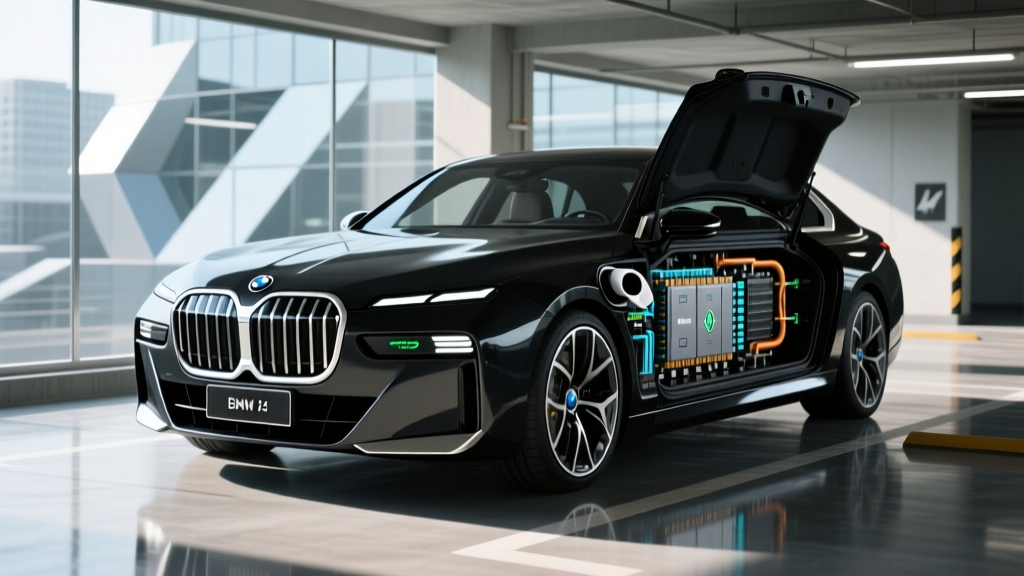
The BMW i7 xDrive60 and i7 M70 are built on BMW's CLAR platform with a fifth-generation eDrive powertrain. Understanding the BMW i7 2024 high voltage electrical system battery specifications requires separating the traction battery from the 12V auxiliary system — this guide focuses exclusively on the high-voltage pack that propels the vehicle.
| Specification | i7 xDrive60 | i7 M70 |
|---|---|---|
| Battery chemistry | NMC (Nickel Manganese Cobalt) | NMC |
| Gross battery capacity | 105.7 kWh | 105.7 kWh |
| Usable battery capacity | 101.7 kWh | 101.7 kWh |
| System voltage | ~400V architecture | ~400V architecture |
| EPA range | 318 mi (20" wheels) / 295 mi (21") | 274 mi |
| Peak DC fast charge rate | 195 kW | 195 kW |
| 10–80% DC charge time | ~34 minutes | ~34 minutes |
| Level 2 AC charge rate | 11 kW (optional 22 kW) | 11 kW (optional 22 kW) |
| Combined output | 536 hp / 549 lb-ft | 650 hp / 749 lb-ft |
| 0–60 mph | 4.5 seconds | 3.5 seconds |
| Battery warranty | 8 yr / 100,000 mi | 8 yr / 100,000 mi |
| Base MSRP (2024) | $119,300 | $168,800 |
The roughly 4 kWh buffer (gross minus usable) protects the cells from deep discharge and overcharge extremes — a standard practice that directly contributes to long-term longevity. The EPA's official figures confirm the xDrive60's efficiency at 82 MPGe combined, though real-world highway driving at 75+ mph in cold weather will reduce range by 15–25%.
NMC Chemistry in the i7: Why BMW Chose It Over LFP
The i7 uses NMC (nickel manganese cobalt) lithium-ion cells, which is the dominant chemistry for premium long-range EVs. To understand why, it helps to compare NMC against LFP (lithium iron phosphate), the other major EV battery chemistry.
| Attribute | NMC (i7's chemistry) | LFP |
|---|---|---|
| Energy density | 200–260 Wh/kg (cell level) — higher range per kg | 140–180 Wh/kg — heavier pack for same range |
| Cycle life | 1,000–2,000 full cycles to 80% capacity | 2,500–5,000+ full cycles to 80% capacity |
| Cold-weather performance | Better low-temp discharge and charge acceptance | Significantly reduced charge speed below 32°F |
| Cost per kWh | Higher — uses cobalt and nickel | Lower — abundant iron and phosphate |
| Thermal stability | Good, requires active thermal management | Excellent — inherently more stable |
| Typical applications | Premium long-range EVs (i7, iX, Taycan, Model S) | Standard-range models (Model 3 RWD, Mustang Mach-E SR) |
For a flagship sedan like the i7, BMW prioritized energy density and cold-weather usability. A 101.7 kWh usable LFP pack would weigh significantly more, compromising the i7's handling dynamics and efficiency. NMC's superior charge acceptance in cold weather also matters for a vehicle sold across North America and Northern Europe.
The trade-off is cycle life: NMC cells degrade faster per cycle than LFP. However, with 101.7 kWh usable, the i7's battery undergoes fewer full charge-discharge cycles than a smaller pack covering the same annual mileage, partially offsetting this disadvantage.
Degradation Data: What the Numbers Actually Show
EV battery degradation follows a non-linear curve: a steeper initial drop in the first 1–2 years (typically 2–5%), followed by a long, gradual decline. Based on aggregated fleet data from Geotab's analysis of over 10,000 EVs, here is what NMC-equipped premium EVs typically experience:
- Year 1: ~2–4% capacity loss (initial formation period)
- Year 2–3: ~1–2% per year
- Year 4–5: ~1–1.5% per year
- Year 6–8: ~0.5–1% per year
- Projected Year 8 average: ~8–14% total loss (86–92% State of Health)
- Projected Year 10 average: ~12–18% total loss (82–88% SoH)
These figures assume mixed usage including some DC fast charging. Vehicles that primarily charge at Level 2 and avoid extreme SoC levels often outperform these averages.
For the i7 specifically, a 10% loss at year 8 would mean roughly 91.5 kWh usable — still enough for ~285 miles of EPA-equivalent range in the xDrive60. Given that the average American drives ~13,500 miles per year, most i7 owners will accumulate roughly 108,000 miles over 8 years, at which point the battery should retain well above the warranty threshold.
How Long Do EV Batteries Last?
Based on current degradation data, most modern NMC batteries retain 70–85% of original capacity at 150,000–200,000 miles. The i7's large 101.7 kWh pack provides substantial buffer: even at 75% SoH, you'd still have ~76 kWh usable and roughly 235 miles of range. In practical terms, the high-voltage battery in an i7 should outlast the vehicle's typical first-ownership period and likely the car itself, barring manufacturing defects.
Battery Warranty Terms: What BMW Covers
| Term | Coverage |
|---|---|
| Duration | 8 years or 100,000 miles (whichever comes first) |
| Capacity retention threshold | 70% of original net capacity |
| What triggers a claim | State of Health drops below 70% during warranty period |
| Remedy | BMW will repair or replace modules/pack to restore above 70% |
| Defect coverage | Manufacturing defects covered regardless of capacity level |
| Exclusions | Damage from accidents, misuse, unauthorized modifications, or flooding |
| Transferability | Warranty transfers to subsequent owners |
The 70% threshold is industry-standard, matching warranties from Mercedes-Benz, Audi, and most legacy automakers. Tesla uses the same 70% threshold but extends coverage to 8 years / 120,000 miles on Model S/X (and 150,000 miles on Model 3/Y Long Range). BMW's 100,000-mile limit is adequate for most i7 buyers given the vehicle's price point and typical annual mileage patterns.
Note that BMW's warranty covers the high-voltage traction battery specifically. The separate 12V auxiliary battery — which powers accessories, lights, and control modules — has its own warranty terms and a much shorter typical lifespan (3–5 years).
Battery Replacement Cost: When and How Much
| Vehicle / Pack Size | Estimated Replacement Cost | Typical Need Timeline |
|---|---|---|
| BMW i7 (105.7 kWh gross, NMC) | $22,000–$32,000 (full pack) | Rarely before 200,000+ mi; most packs outlive the car |
| BMW iX xDrive50 (111.5 kWh gross) | $23,000–$34,000 | 200,000+ mi |
| Tesla Model S/X (~100 kWh) | $18,000–$25,000 | 150,000–250,000 mi |
| Tesla Model 3/Y Long Range (~82 kWh) | $14,000–$20,000 | 200,000+ mi |
| Hyundai Ioniq 5 (77.4 kWh) | $13,000–$18,000 | 200,000+ mi |
| Ford Mustang Mach-E ER (91 kWh) | $16,000–$22,000 | 200,000+ mi |
These figures include the battery pack and estimated labor. Module-level repair — replacing only degraded cell modules rather than the entire pack — can reduce costs by 40–60%. BMW's fifth-generation eDrive uses a modular pack architecture, meaning individual modules can be swapped if only a subset degrades abnormally.
The critical context: full battery replacement due to age-related degradation alone is rare. Most warranty claims involve manufacturing defects (bad welds, faulty cell batches, coolant leaks into the pack) rather than gradual wear. Fleet data shows fewer than 2% of modern EVs require full battery replacement outside of collision damage.
Factors That Accelerate or Slow Degradation
The i7's battery management system (BMS) actively manages temperature and charge limits, but owner behavior still meaningfully affects long-term State of Health.
- Daily charge limit: Set to 80–90% for routine use. Use the iDrive charging menu to set a max SoC. Reserve 100% charges for road trips.
- Avoid prolonged low SoC: Don't leave the i7 sitting below 10% for days. If storing for extended periods, aim for ~50% SoC.
- DC fast charging: Occasional use is fine — the BMS handles thermal management. But daily 195 kW DC charging accelerates degradation versus Level 2 home charging. If you have home L2 access, use it as your primary method.
- Precondition before fast charging: Use the i7's navigation-based preconditioning. When you route to a DC fast charger, the BMS warms the battery to optimal temperature (~95°F), enabling faster charging and reducing cell stress.
- Extreme heat: Parking in direct sun in 100°F+ heat with a full battery accelerates calendar aging. Use garages or shade when possible. The i7's active thermal management mitigates this, but it can't fully eliminate the effect.
- Extreme cold: Cold doesn't damage cells permanently, but charging a cold battery at high power causes lithium plating. Always precondition before charging in sub-freezing temperatures.
- Regenerative braking: The i7's adaptive regen is gentle on the battery. No need to limit regen use — it's far less stressful than DC fast charging.
Charging Habits by the Numbers
Data from Geotab's fleet study shows that EVs charged primarily on Level 2 (240V) lose approximately 1.5% less capacity over 3 years compared to vehicles that rely heavily on DC fast charging (3+ sessions per week). For the i7, which peaks at 195 kW DC, each fast charge session from 10–80% delivers roughly 72 kWh into the pack in about 34 minutes. The charge curve tapers significantly above 80% — charging from 80–100% at DC can add another 20+ minutes while delivering only ~20 kWh. This taper protects the cells but makes topping off above 80% inefficient in terms of time.
Monitoring Battery Health: How to Check SoH
BMW provides several methods for i7 owners to monitor their high-voltage battery's State of Health:
My BMW App and iDrive
The My BMW app displays estimated range and charging behavior but does not directly show a SoH percentage. Within iDrive, the charging menu shows current SoC and estimated range, but not long-term capacity retention. This is a deliberate choice by BMW — they position SoH diagnostics as dealer-level assessments.
Dealer Diagnostic Report
Any BMW dealer can run a high-voltage battery diagnostic that reports SoH as a percentage. Request this during routine service visits. For warranty purposes, BMW documents SoH readings, and a reading below 70% within the warranty period triggers coverage.
Third-Party OBD-II Tools
Tools like BimmerCode and BimmerLink (paired with a compatible OBD-II adapter) can read battery management data including individual cell voltages, pack temperature, and estimated SoH. These readings are not officially certified by BMW but provide useful trend data for owners who want granular visibility.
DIY Range Tracking
The simplest method: track your real-world range per 100% charge over time. If your i7 xDrive60 consistently delivered 300 miles at 100% in year one but now delivers 275 miles under identical conditions, that suggests roughly 8% degradation. Log conditions (temperature, tire pressure, driving style) for accurate comparison.
Emerging Battery Technology: What's Next After NMC
While the i7's NMC pack represents current production technology, several advances are in development:
Solid-State Batteries
Solid-state cells replace the liquid electrolyte with a solid material, potentially offering 30–50% higher energy density, faster charging, and improved safety. BMW has partnered with Solid Power and has announced plans for a solid-state demonstrator vehicle. However, mass-production solid-state EVs are not expected before 2028–2030 at the earliest, with widespread availability likely in the 2030s. The i7's current NMC pack is not upgradable to solid-state.
Silicon Anode Cells
Replacing graphite anodes with silicon can boost energy density by 10–25%. Companies like Sila Nanotechnologies and Group14 are supplying early-production silicon anode materials. BMW has indicated interest in this technology for next-generation models. Expect initial deployments in limited-production vehicles around 2026–2027, with broader rollout by 2028–2029.
LFP Advancement
LFP chemistry continues to improve in energy density. CATL's latest LFP cells approach 180 Wh/kg, narrowing the gap with NMC. For future BMW models positioned below the i7, LFP could become viable as a cost-reduction option, though the i7's flagship positioning makes NMC the likely choice for the foreseeable future.
Frequently Asked Questions
How long do EV batteries last in years and miles?
Modern NMC batteries, like the 101.7 kWh pack in the BMW i7, typically retain 70–85% of original capacity at 150,000–200,000 miles (roughly 10–15 years at average US driving). The i7's large pack means fewer full cycles per mile driven, which supports longevity. Most high-voltage packs outlive the vehicle's first ownership period. According to Geotab's fleet study, the average EV loses about 1.8% capacity per year, meaning at year 10, roughly 82% SoH is typical.
How much does a BMW i7 battery cost to replace?
A full high-voltage battery replacement for the i7 is estimated at $22,000–$32,000 including labor. However, module-level repairs can cost 40–60% less. In practice, full replacements due to degradation are extremely rare — most warranty claims involve manufacturing defects. The 8-year/100,000-mile warranty covers any drop below 70% capacity, and BMW's modular pack design allows targeted module replacement rather than full-pack swaps in most cases.
What does the BMW i7 battery warranty cover?
BMW covers the high-voltage battery for 8 years or 100,000 miles against capacity loss below 70% and manufacturing defects. The warranty transfers to subsequent owners. It does not cover damage from accidents, flooding, unauthorized modifications, or misuse. The separate 12V auxiliary battery has different warranty terms. Check BMW's official warranty page for current terms.
How do I check my i7's battery health?
The most reliable method is requesting a high-voltage battery diagnostic at a BMW dealer, which reports State of Health as a percentage. Third-party tools like BimmerLink can read BMS data via OBD-II for trend monitoring. You can also track your real-world range at 100% SoC over time — declining range under consistent conditions indicates degradation.
LFP vs NMC — which chemistry is better for the i7?
For the i7's use case, NMC is the better choice. The i7 is a heavy flagship sedan requiring maximum energy density to deliver 300+ miles of range without excessive weight. NMC also performs better in cold weather, which matters for a vehicle sold across North America. LFP offers superior cycle life and lower cost but at the expense of energy density and cold-weather charge speed. LFP is better suited to standard-range, cost-sensitive vehicles where the weight penalty is manageable.
Does frequent DC fast charging damage the i7's battery?
Occasional DC fast charging is well within the battery's design parameters — the i7's BMS actively manages cell temperature during fast charging to minimize stress. However, fleet data shows that vehicles relying on DC fast charging 3+ times per week experience slightly higher degradation (~1.5% more over 3 years) versus primarily Level 2 charging. If you have access to a home Level 2 charger (11 kW or 22 kW in the i7), using it for daily charging and reserving DC fast charging for road trips is the optimal approach.
Is the BMW i7 eligible for the federal EV tax credit?
Under current IRS §30D rules, the i7 does not qualify for the $7,500 federal tax credit. The credit has an MSRP cap of $55,000 for sedans, and the i7 starts at $119,300. Additionally, buyer income caps ($300,000 joint / $150,000 single) and battery sourcing requirements apply. Always verify current eligibility on IRS.gov and consult a tax professional for your specific situation.