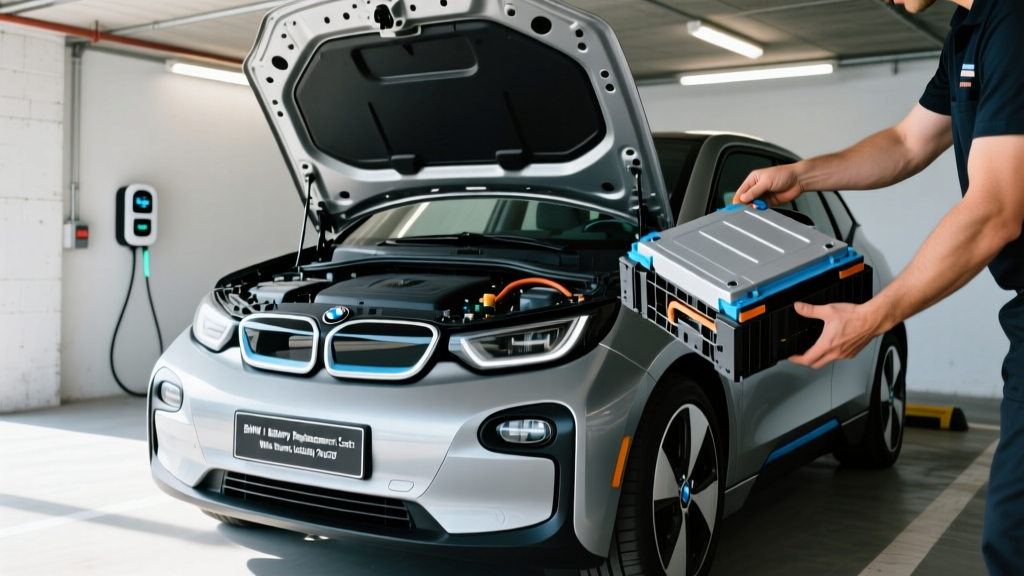
The BMW i3 remains one of the most distinctive electric vehicles ever sold — a carbon-fiber-reinforced plastic (CFRP) city car with a quirky design and surprisingly usable electric range. But as early 2014–2016 models push past the 10-year mark, owners are confronting a critical question: what happens when the high-voltage traction battery degrades below usable capacity, and what does a BMW i3 battery replacement cost in the real world?
This guide breaks down exact replacement pricing by battery generation, real-world degradation data from i3 fleets worldwide, BMW's warranty terms, and practical steps to maximize the pack you already have. We also cover the broader EV battery landscape — chemistry trade-offs, health monitoring, and what's coming next — so you can make an informed decision whether you drive an i3 or are simply evaluating long-term EV ownership costs.
BMW i3 Battery Replacement Cost by Generation
The i3 was sold in the U.S. from 2014 through 2021 with three distinct battery packs. Replacement cost depends heavily on which generation you own, whether you source a new pack from BMW or a refurbished unit from an independent EV shop, and current labor rates.
| Battery Generation | Model Years | Usable Capacity | Chemistry | New OEM Pack (Parts + Labor) | Refurbished / Used Pack |
|---|---|---|---|---|---|
| 60 Ah (Gen 1) | 2014–2016 | ~18.8 kWh | NMC (Samsung SDI) | $12,000–$16,000 | $5,000–$8,000 |
| 94 Ah (Gen 2) | 2017–2018 | ~27.2 kWh | NMC (Samsung SDI) | $16,000–$20,000 | $7,000–$11,000 |
| 120 Ah (Gen 3) | 2019–2021 | ~37.9 kWh | NMC (Samsung SDI) | $20,000–$25,000 | $10,000–$14,000 |
Key cost factors:
- OEM availability: BMW has reduced production of 60 Ah and 94 Ah replacement packs as the i3 ages. Some dealers now quote refurbished or reconditioned packs rather than brand-new units.
- Labor: High-voltage battery replacement requires BMW-certified EV technicians. Expect 6–10 hours of labor at $150–$220/hour, adding $900–$2,200 to the bill.
- Module-level repair: Some independent EV shops (such as those specializing in BMW high-voltage systems) can replace individual degraded modules within the pack for $2,000–$5,000 rather than swapping the entire assembly. This is viable when only one or two of the eight modules show abnormal voltage deviation.
- Range Extender (REx) models: The small 647cc two-cylinder gasoline engine in REx variants does not change the battery replacement cost — the traction pack is identical to the BEV version for each generation.
How Long Do BMW i3 Batteries Actually Last?
EV battery lifespan is measured in two ways: chronological age and charge cycles. The i3's Samsung SDI NMC cells were engineered for approximately 2,500–3,000 full charge cycles before reaching 80% state of health (SoH) — which translates to roughly 150,000–200,000 miles of typical driving for the 120 Ah model.
Real-World Degradation Data
Data aggregated from i3 owner communities, fleet operators, and independent testing provides a clearer picture than manufacturer estimates alone:
| Time / Mileage | Average SoH Retained | Typical Range Impact (120 Ah) |
|---|---|---|
| Year 1 / 12,000 mi | 97–99% | EPA 153 mi → ~150 mi real-world |
| Year 3 / 36,000 mi | 93–96% | ~140–145 mi real-world |
| Year 5 / 60,000 mi | 88–93% | ~133–142 mi real-world |
| Year 7 / 84,000 mi | 84–90% | ~127–137 mi real-world |
| Year 10 / 120,000 mi | 78–87% | ~118–132 mi real-world |
What this means in practice: A 2016 i3 60 Ah with an original EPA range of 81 miles (BEV) that now shows 82% SoH will deliver roughly 65–70 miles of real-world range. For city commuting, this remains functional. For the 120 Ah model, even at 80% SoH, you're looking at approximately 120 miles — still adequate for most daily driving.
Degradation is not linear. The steepest capacity loss occurs in the first 12–18 months (roughly 3–5%), after which the curve flattens considerably. Calendar aging — chemical changes that occur regardless of mileage — becomes the dominant factor after year 6 or 7, particularly in hot climates.
BMW i3 Battery Warranty: What's Covered
BMW provides a high-voltage battery warranty that covers defective batteries and excessive capacity loss. Here are the exact terms:
| Coverage Element | Specification |
|---|---|
| Duration | 8 years / 80,000 miles (whichever comes first) |
| Capacity retention threshold | 70% of original usable capacity |
| What triggers a claim | SoH drops below 70% as measured by BMW diagnostic tools |
| Remedy | Repair, module replacement, or full pack replacement at BMW's discretion |
| Exclusions | Damage from accidents, flooding, unauthorized modifications, or use outside normal parameters |
| Transferable | Yes — warranty follows the vehicle, not the original owner |
Warranty reality for 2026: All i3 model years (2014–2021) have now either exited or are exiting their 8-year battery warranty window. A 2017 model's warranty expired in 2025; the final 2021 models lose coverage in 2029. If your i3 is still under warranty and showing below 70% SoH, file a claim immediately through a BMW dealer — the diagnostic scan is free, and BMW has historically honored valid claims with module-level repairs or full replacements.
For context on federal battery standards and consumer protections, the U.S. Department of Energy's EV technology overview provides baseline information on battery durability expectations across the industry.
LFP vs. NMC: Understanding Your i3's Battery Chemistry
The BMW i3 uses NMC (Nickel Manganese Cobalt) lithium-ion cells supplied by Samsung SDI. This was the dominant EV chemistry during the i3's production run, offering a strong balance of energy density and performance. But the EV industry has shifted significantly since 2021, with LFP (Lithium Iron Phosphate) gaining major market share. Here's how they compare:
| Attribute | NMC (Your i3's Chemistry) | LFP (Tesla Model 3 RWD, BYD, others) |
|---|---|---|
| Energy density | Higher (~200–260 Wh/kg cell-level) | Lower (~150–180 Wh/kg cell-level) |
| Cycle life | ~1,500–3,000 cycles to 80% SoH | ~3,000–5,000+ cycles to 80% SoH |
| Cold-weather performance | Better low-temp discharge and charge acceptance | Reduced performance below 32°F; preconditioning critical |
| Thermal stability | Good, but more prone to thermal runaway at high SoC/temperature | Excellent — inherently more stable chemistry |
| Cost (per kWh) | Higher (cobalt and nickel content) | Lower — no cobalt, abundant iron/phosphate |
| Optimal daily SoC | 20–80% recommended for longevity | Can be charged to 100% regularly without significant degradation |
| Typical applications | Long-range EVs, performance models, space-constrained packs | Standard-range models, fleet vehicles, energy storage |
Why this matters for i3 owners: Your NMC pack benefits from higher energy density (critical in the i3's compact underfloor packaging) and better cold-weather usability. However, NMC cells degrade faster when routinely charged to 100% or deeply discharged to near 0%. The i3's battery management system (BMS) includes a top and bottom buffer — roughly 2–3 kWh of the gross capacity is inaccessible — which helps protect the cells. Still, daily charging habits significantly impact long-term SoH.
Factors That Accelerate i3 Battery Degradation
Not all i3 batteries age equally. The spread in SoH data (e.g., 78% to 87% at year 10) reflects real differences in how owners use and store their vehicles. Here are the primary degradation accelerators, ranked by impact:
- Avoid sustained 100% SoC: Charge to 80–85% for daily use. Use the i3's built-in charge limit setting (iDrive → Charging → Max charge level). Reserve 100% for planned long trips.
- Minimize DC fast charging: The i3 supports up to 50 kW DCFC (CCS on 2015+ models). Occasional fast charging is fine, but daily DCFC sessions — especially in hot weather — accelerate cell wear. Prioritize Level 2 home charging (7.4 kW) whenever possible.
- Don't store at extremes: If the car will sit unused for more than a week, aim for 40–60% SoC. Avoid leaving the i3 at 100% or below 10% in a hot garage or cold driveway for extended periods.
- Precondition before fast charging: The i3's BMS will warm the battery when you navigate to a DCFC station via the built-in navigation. This preconditioning step is essential for both charging speed and cell health — cold cells charged at high power suffer lithium plating damage.
- Park in shade or a garage: Sustained high battery temperatures (above 95°F / 35°C ambient) are the single largest calendar-aging factor. Arizona and Texas i3s typically show 3–5% more degradation at year 5 than Pacific Northwest examples.
- Drive it regularly: Lithium-ion cells prefer regular, moderate cycling over long periods of inactivity. A daily 20-mile commute is gentler on the pack than letting the car sit for weeks at a time.
How to Check Your BMW i3 Battery Health (SoH)
Unlike some EVs that display battery health prominently on the dash, the i3 requires a few extra steps to access SoH data:
Method 1: BMW Service Menu (Hidden Menu)
On iDrive-equipped i3s, you can access a service-level battery readout:
- Turn on the vehicle (ready to drive, not just accessory mode).
- Navigate to My Vehicle → Vehicle Information → Battery (path varies slightly by iDrive version).
- Some model years display a capacity bar graph; others require dealer-level diagnostics for a precise SoH percentage.
Method 2: OBD-II Scanner with EV Capability
For precise SoH readings, use an OBD-II adapter paired with an EV-focused app:
- Carly for BMW: Reads high-voltage battery SoH, individual module voltages, and cell balancing data. Subscription-based (~$50/year).
- BimmerCode / BimmerLink: Can access battery management module data including current capacity in Ah and SoH percentage.
- Leaf Spy-style alternatives: While Leaf Spy is Nissan-specific, tools like EVScan or ENET cables with BMW-standard diagnostic software provide similar granular cell-level data.
Method 3: BMW Dealer Diagnostic
Any BMW dealer can run a high-voltage battery health check as part of a service visit. This produces a printout with SoH percentage, individual module voltage spread, and insulation resistance. Request this specifically — it's often included free with scheduled maintenance or can be done as a standalone check for $50–$100.
What to look for: A healthy i3 pack should show module voltage spread (the difference between the highest and lowest cell group) of less than 50 mV at rest. Spread exceeding 100 mV suggests one or more modules are degrading faster than the rest — a candidate for targeted module replacement rather than a full pack swap.
The Broader EV Battery Replacement Cost Picture
While the i3 is a specific case, replacement costs across the EV market follow predictable patterns based on pack size and chemistry:
| Vehicle | Battery Size (Usable) | Chemistry | Est. Full Replacement Cost |
|---|---|---|---|
| Nissan Leaf (40 kWh) | ~38 kWh | NMC | $8,000–$12,000 |
| Chevrolet Bolt EV | ~60 kWh | NMC (LG) | $14,000–$18,000 |
| Tesla Model 3 (LR) | ~75 kWh | NCA/NMC | $16,000–$22,000 |
| Hyundai Ioniq 5 (LR) | ~74 kWh | NMC (SK On) | $15,000–$20,000 |
| Ford F-150 Lightning (ER) | ~115 kWh | NMC | $25,000–$35,000 |
| BMW i3 120 Ah | ~37.9 kWh | NMC (Samsung) | $20,000–$25,000 |
The i3's replacement cost is disproportionately high relative to its small battery size. This reflects BMW's premium parts pricing, the specialized labor required for the CFRP chassis, and declining OEM parts availability as the model ages. By contrast, a Nissan Leaf 40 kWh replacement is often cheaper despite a similar pack size, thanks to broader aftermarket support and simpler construction.
For detailed guidance on federal warranty requirements for EV batteries, the IRS clean vehicle credit page references the minimum 8-year/80,000-mile battery warranty standard that all qualifying EVs must meet — useful context when evaluating any used EV purchase.
Emerging Battery Tech: What's Next (and When)
While current i3 owners are working with proven NMC technology, the battery industry is advancing rapidly. Here's a realistic look at what's coming — and critically, when it will actually reach production vehicles:
Solid-state batteries: These replace the liquid electrolyte with a solid material, promising higher energy density (potentially 400+ Wh/kg), faster charging, and improved safety. Toyota, Samsung SDI, and QuantumScape are leading development. Realistic timeline: limited production in premium models starting 2027–2028; mainstream availability not expected before 2030. This technology will not retrofit into existing i3 packs.
Silicon-dominant anodes: Replacing graphite anodes with silicon can boost energy density by 20–40%. Companies like Sila Nanotechnologies and Group14 are in early commercial production. Realistic timeline: appearing in 2025–2027 model-year vehicles from select manufacturers; broader adoption by 2028–2029.
Sodium-ion batteries: Using abundant sodium instead of lithium, these offer lower cost and excellent cycle life at the expense of energy density. CATL and BYD are deploying them in Chinese-market vehicles. Realistic timeline: U.S. market entry in budget/fleet EVs around 2027–2028. Not applicable to the i3's form factor.
LFP improvements: Enhanced LFP formulations (such as CATL's Shenxing cells) are narrowing the energy-density gap with NMC while maintaining cost and longevity advantages. Expect LFP to become the default chemistry for standard-range EVs across most brands by 2027.
None of these technologies will help a current i3 owner avoid a battery replacement — but they do mean that your next EV will likely have a longer-lasting, cheaper-to-replace battery pack.
Is It Worth Replacing the Battery in an Aging BMW i3?
This is ultimately a financial decision. Here's a practical framework:
- Replace (full OEM pack) if: Your i3 is a 2019–2021 120 Ah model in excellent condition, you plan to keep it 5+ more years, and the replacement cost is justified by your attachment to the car or local used-EV pricing. A refurbished pack at $10,000–$14,000 makes this more viable.
- Repair (module-level) if: Diagnostics show one or two weak modules with the rest of the pack healthy. At $2,000–$5,000, this is often the sweet spot for 2014–2018 models where a full replacement exceeds vehicle value.
- Retire / trade in if: The car has high mileage, other mechanical issues, or you need more range than even a fresh pack can provide (the i3's max EPA range tops out at 153 miles). The i3's used values are declining; putting $15,000+ into a car worth $10,000 rarely makes financial sense.
Frequently Asked Questions
How long do BMW i3 batteries last before needing replacement?
Most i3 batteries retain 80%+ of original capacity at 100,000 miles and 8–10 years. Full replacement is rarely needed before 150,000 miles unless the pack has been subjected to extreme heat, frequent DC fast charging, or physical damage. Module-level repairs are more common than full pack replacements.
How much does a BMW i3 battery cost to replace in 2026?
A new OEM battery pack for the i3 ranges from $12,000 (60 Ah) to $25,000 (120 Ah) including labor. Refurbished packs are available for $5,000–$14,000 depending on generation. Individual module repairs cost $2,000–$5,000.
What does the BMW i3 battery warranty cover?
BMW's high-voltage battery warranty covers 8 years / 80,000 miles with a 70% capacity retention threshold. If SoH drops below 70% within the warranty period, BMW will repair or replace the pack. As of 2026, most i3s have exited their warranty window.
Can I upgrade my i3's battery to a larger capacity?
BMW does not officially support cross-generation battery upgrades (e.g., putting a 120 Ah pack in a 60 Ah car). While some European shops have performed unofficial upgrades with custom BMS programming, this voids any remaining warranty, may cause iDrive display errors, and is not recommended for most owners.
How do I check my BMW i3 battery health at home?
Use an OBD-II adapter with the Carly for BMW app or BimmerLink to read SoH percentage and individual module voltages. A BMW dealer can also perform a formal battery health check for $50–$100.
Does DC fast charging damage the i3 battery?
Occasional DC fast charging (50 kW CCS) does not cause significant harm. However, daily DCFC use — especially in hot weather without preconditioning — accelerates degradation. For optimal battery longevity, rely on Level 2 home charging (7.4 kW) for daily needs and reserve DCFC for road trips.
Is LFP better than the NMC battery in my i3?
It depends on priorities. LFP offers longer cycle life, lower cost, and the ability to charge to 100% regularly. NMC provides higher energy density (more range in a smaller package) and better cold-weather performance. For the i3's compact design and the climates where most U.S. examples live, NMC was the right engineering choice at the time.