As Ford scales its electric lineup through the mid-2020s, much of the company's battery strategy hinges on a joint venture few consumers have heard of by name but whose products are already under the floors of vehicles on American roads. BlueOval SK — the partnership between Ford and South Korea's SK On — operates gigafactories in Kentucky and Tennessee producing nickel-manganese-cobalt (NMC) lithium-ion cells destined for the F-150 Lightning, Mustang Mach-E, and future Ford EVs. Understanding what comes out of these factories, and how NMC chemistry behaves over a decade of ownership, is essential for any buyer weighing a Ford EV or comparing it against competitors using different cell chemistries.
What BlueOval SK Actually Produces
BlueOval SK is a joint venture announced in 2021 and brought online through 2025–2026, with three planned battery plants: two in Glendale, Kentucky (BlueOval SK Battery Park) and one in Stanton, Tennessee (co-located with Ford's BlueOval City assembly complex). Combined, these facilities target roughly 129 gigawatt-hours (GWh) of annual cell capacity at full ramp — enough to supply hundreds of thousands of EVs per year.
The cells rolling off these lines are large-format NMC pouch and prismatic cells, engineered for high energy density to maximize range in heavy vehicles like the F-150 Lightning (which requires up to 131 kWh of usable battery capacity in its extended-range configuration). SK On supplies the cell-level manufacturing expertise, while Ford integrates the packs into its vehicle platforms.
For buyers, the significance is twofold: first, domestic production helps Ford models qualify for the IRS §30D federal clean vehicle credit, provided the buyer meets income caps and the vehicle stays under MSRP thresholds ($80,000 for trucks/SUVs, $55,000 for sedans). Second, knowing your battery's origin and chemistry lets you set realistic expectations for range retention, charging behavior, and long-term cost of ownership.
NMC Chemistry: Energy Density, Trade-Offs, and How It Compares to LFP
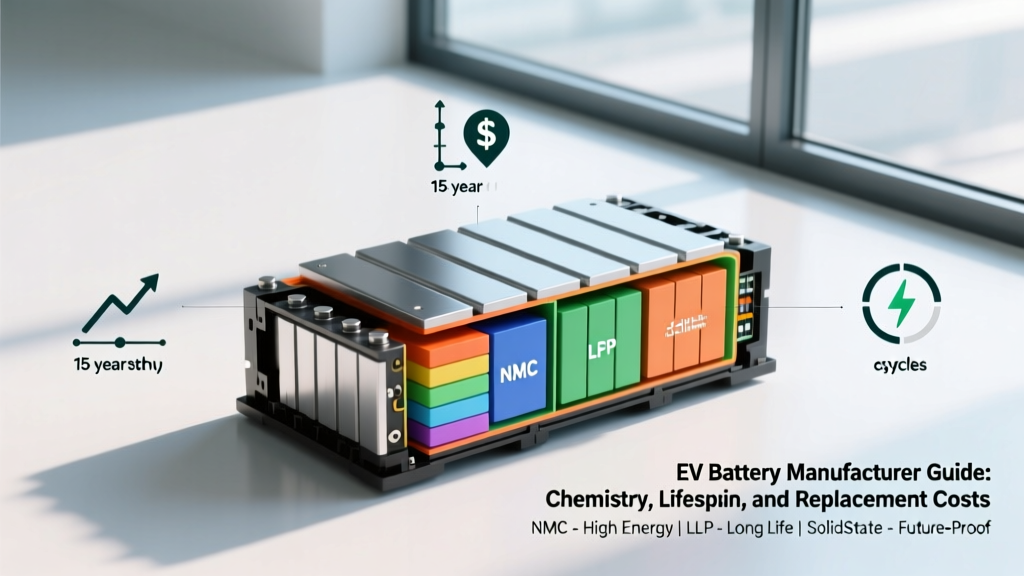
BlueOval SK's NMC cells use a cathode blend of nickel, manganese, and cobalt — typically in ratios like NMC 811 (80% nickel, 10% manganese, 10% cobalt) or NMC 622. The high nickel content pushes energy density higher, which is why NMC dominates in long-range, heavy-duty applications where packing more kilowatt-hours (kWh) into a limited physical space is paramount.
But NMC is not the only game in town. Many competitors — including Tesla's standard-range Model 3 and Model Y, and the base-trim Ford Mustang Mach-E Select — use lithium iron phosphate (LFP) chemistry instead. Here is how the two compare on the metrics that matter to owners:
| Attribute | LFP (Lithium Iron Phosphate) | NMC (Nickel Manganese Cobalt) |
|---|---|---|
| Energy density | Lower (~160–180 Wh/kg cell-level) | Higher (~220–260 Wh/kg cell-level) |
| Typical range application | Standard-range, city-focused trims | Extended-range, long-haul, heavy vehicles |
| Cycle life (to 80% SoH) | 3,000–5,000+ cycles | 1,500–2,500 cycles |
| Cold-weather performance | Greater range loss below freezing (~30–40%) | Better low-temp discharge (~20–30% loss) |
| Charging to 100% regularly | Recommended for accurate BMS calibration | Best kept at 80% daily; 100% for trips only |
| Thermal stability / safety | Higher thermal runaway threshold | Lower threshold; requires robust BMS/cooling |
| Cost per kWh (cell) | Lower (no cobalt or nickel) | Higher (commodity-linked metals) |
| Cobalt content | None | Present (supply-chain and ethical considerations) |
Which is better? Neither is universally superior. If you drive an F-150 Lightning extended-range and need 320 miles of EPA range while towing or hauling, NMC's energy density is non-negotiable — an LFP pack of equivalent capacity would be too heavy and bulky. If you commute 30 miles a day in a Mach-E Select and can charge at home nightly, LFP's superior cycle life and lower cost make it the pragmatic choice. BlueOval SK's NMC production targets the first use case: vehicles where range-per-kilogram is the engineering priority.
How Long Do EV Batteries Last? Degradation Data and Real Expectations
The single most common question from prospective EV buyers is: how long until I need a new battery? The data, across hundreds of thousands of vehicles tracked by researchers and fleet operators, tells a reassuring story — but with caveats that depend heavily on chemistry and usage.
Typical NMC Degradation Curve (based on fleet data and OEM testing):
- Year 1 / 15,000 miles: ~2–4% capacity loss (initial formation loss)
- Year 3 / 45,000 miles: ~6–9% cumulative loss
- Year 5 / 75,000 miles: ~8–12% cumulative loss
- Year 8 / 120,000 miles: ~12–18% cumulative loss
- Year 10 / 150,000 miles: ~15–22% cumulative loss (highly usage-dependent)
Source: Aggregate data referenced by fueleconomy.gov EV technology overview and third-party fleet analyses (Geotab, Recurrent Auto).
For a BlueOval SK NMC pack in an F-150 Lightning extended-range (131 kWh usable), a 15% loss at 150,000 miles would reduce usable capacity to roughly 111 kWh — translating from an original EPA 320-mile range to approximately 272 miles. That is still a highly functional daily driver, not a vehicle requiring battery replacement.
LFP packs degrade more slowly. Fleet data consistently shows LFP cells retaining 90%+ capacity at 150,000 miles under moderate use, which is why manufacturers like Tesla and BYD lean on LFP for high-cycle, high-mileage applications.
Factors That Accelerate Degradation
- Frequent DC fast charging above 150 kW: High C-rates generate heat. Occasional road-trip fast charging is fine; daily reliance on 350 kW chargers without adequate preconditioning accelerates wear.
- Regularly charging to 100% and storing at full SoC: NMC cells experience elevated stress above 80% state of charge. Daily charging to 80% and only hitting 100% before long trips is the recommended practice.
- Deep discharges below 10% SoC: Repeatedly draining the pack to near-empty stresses the anode. Keep a 10–80% daily operating window where possible.
- Extreme heat exposure: Sustained ambient temperatures above 95°F (35°C), especially combined with high SoC parking, accelerate calendar aging. Garage parking and preconditioning help.
- Extreme cold charging without preconditioning: Charging an NMC pack below freezing without thermal preconditioning can cause lithium plating on the anode — a permanent degradation mechanism. Always use your vehicle's navigation-based preconditioning feature when routing to a charger in winter.
Battery Warranty: What Ford (and BlueOval SK Cells) Actually Covers
Federal law mandates a minimum 8-year / 100,000-mile warranty on EV battery packs for emissions-related compliance, but most manufacturers — Ford included — match or exceed this for the high-voltage traction battery. Here is what you can expect:
| Component | Coverage Period | Capacity Retention Threshold | What's Covered |
|---|---|---|---|
| High-voltage battery pack | 8 years / 100,000 miles (whichever comes first) | 70% of original usable capacity | Repair or replacement if SoH drops below 70% |
| Battery management system (BMS) | 8 years / 100,000 miles | N/A (functional failure) | Defects in monitoring/control electronics |
| Thermal management system | 5 years / 60,000 miles (powertrain warranty) | N/A | Coolant pumps, heaters, associated plumbing |
| 12V auxiliary battery | 3 years / 36,000 miles (bumper-to-bumper) | N/A | Standard lead-acid or lithium 12V — separate from traction pack |
The 70% capacity retention threshold at 8 years is the industry standard, shared by Hyundai, Volkswagen, and most legacy OEMs. Tesla's threshold is identical, though its warranty extends to 120,000 miles on Model S/X and 100,000 miles on Model 3/Y. Importantly, warranty replacement does not mean a brand-new battery — OEMs may install a refurbished or remanufactured pack that meets the 70% minimum. In practice, very few EVs require warranty battery replacement; most degradation curves flatten after year 3, and packs routinely outlast the vehicle's structural and cosmetic life.
EV Battery Replacement Cost: What It Actually Costs and When It's Needed
For the small percentage of owners who need an out-of-warranty replacement — typically at 12–15+ years of age or 200,000+ miles — costs remain significant but have been declining as cell prices fall and the refurbishment market matures.
| Vehicle / Pack Size | Chemistry | New OEM Pack (parts + labor) | Refurbished / Independent | Typical Replacement Trigger |
|---|---|---|---|---|
| F-150 Lightning Extended Range (131 kWh) | NMC (BlueOval SK) | $22,000–$28,000 | $14,000–$18,000 | SoH below 60–65%, ~200k+ mi |
| Mustang Mach-E Extended Range (91 kWh) | NMC | $16,000–$20,000 | $10,000–$14,000 | SoH below 60–65%, ~180k+ mi |
| Tesla Model 3 Standard Range (60 kWh) | LFP | $12,000–$15,000 | $7,000–$10,000 | Rarely needed; LFP cycle life exceeds 300k mi |
| Hyundai Ioniq 5 (77.4 kWh) | NMC | $14,000–$18,000 | $9,000–$12,000 | SoH below 60–65%, ~200k+ mi |
These figures include labor, which typically adds $1,500–$3,000 to the parts cost. Independent shops and battery refurbishers are an emerging option, though OEM dealerships remain the default for most owners. The key context: most EV batteries never need replacement during typical ownership. Data from Recurrent Auto (tracking over 15,000 EVs) shows that fewer than 1.5% of EVs have required battery replacement through 2025, and the vast majority of those were due to manufacturing defects covered under warranty, not end-of-life degradation.
Monitoring Your Battery's State of Health (SoH)
State of Health (SoH) is expressed as a percentage of original usable capacity. A new pack is 100% SoH; a pack that originally held 91 kWh but now holds 80 kWh is at ~88% SoH. Here is how owners can track it:
- In-vehicle displays: Ford's SYNC system (and most modern EV infotainment platforms) provides a battery health estimate, though it may not show a precise SoH percentage. Check under Settings → Vehicle → Battery or consult your owner's manual.
- OBD-II diagnostic apps: Third-party tools like OBDeleven, LeafSpy (Nissan-focused but illustrative), or Car Scanner can read BMS-reported SoH data via the OBD-II port. Results vary by vehicle and app compatibility.
- Charging-data analysis: Apps like Tessie (Tesla-specific) or general EV loggers can estimate SoH by comparing actual kWh accepted during a 10–100% charge cycle against the pack's original rated capacity. This is the most accurate owner-accessible method.
- Dealer diagnostic reports: Ford dealers can pull a full BMS health report during service visits. Request this proactively at annual inspections, especially as you approach the 8-year / 100,000-mile warranty boundary.
For BlueOval SK NMC packs specifically, Ford has committed to over-the-air (OTA) software updates that refine BMS algorithms and can adjust usable buffer zones over time — potentially recovering a small amount of apparent capacity as the pack ages and the BMS learns its actual degradation profile.
Emerging Battery Technologies: Solid-State, Silicon Anodes, and Realistic Timelines
While BlueOval SK's current production is firmly rooted in liquid-electrolyte NMC cells, the broader battery industry is investing heavily in next-generation chemistries. Here is where things stand as of 2026 — with realistic availability timelines, not concept-car promises:
- Silicon-dominant anodes: Replacing graphite anodes with silicon can boost energy density by 20–40%. Companies like Sila Nanotechnologies and Group14 are in early commercial production, with cells appearing in limited premium applications (e.g., Mercedes-Benz G-Class electric). Expect broader availability in mainstream EVs by 2028–2030.
- Semi-solid-state cells: These use a gel or polymer electrolyte rather than a liquid, improving safety and potentially energy density. NIO in China has deployed a 150 kWh semi-solid pack in limited fleet use. Mass production for US-market vehicles remains 2028+ at the earliest.
- True solid-state batteries: Fully solid electrolytes promise step-change improvements in energy density, charge speed, and safety. Toyota, Samsung SDI, and QuantumScape all have pilot lines running, but manufacturing yield, cost, and scale challenges persist. Realistic volume production for consumer EVs: 2030–2033. Do not delay a current EV purchase waiting for solid-state.
- Sodium-ion batteries: CATL and BYD are producing sodium-ion cells for low-cost, short-range applications in China. Energy density is lower than LFP, but raw materials are abundant and cheap. Possible in US-market budget EVs by 2028–2029.
The practical takeaway: NMC cells from BlueOval SK and competitors represent mature, well-understood technology that will power the majority of long-range EVs through at least 2030. Next-generation chemistries will arrive incrementally, starting in premium segments, and will take years to reach the price points and production volumes of today's NMC and LFP cells.
Maximizing the Life of Your BlueOval SK NMC Battery: An Owner's Playbook
- Set your daily charge limit to 80%. Use the FordPass app or vehicle settings to cap charging at 80% for routine use. Only increase to 90–100% when you need maximum range for a specific trip.
- Precondition before DC fast charging. Enter your charging stop into the vehicle's navigation system. The thermal management system will warm or cool the pack to the optimal temperature window (roughly 77–95°F / 25–35°C) before you arrive, enabling faster charging and reducing stress on the cells.
- Favor Level 2 home charging for daily use. A 240V Level 2 charger at 32–48 amps (7.7–11.5 kW) is the gentlest regular charging method for NMC chemistry. It generates minimal heat and avoids the high C-rates of DC fast charging.
- Avoid prolonged storage at extreme SoC. If your EV will sit unused for more than a week, leave it plugged in with a charge limit set to 50–60%. Storing at 100% or below 10% for extended periods accelerates calendar aging.
- Use scheduled charging in hot climates. If you live where summer temperatures exceed 95°F, schedule charging to complete in the early morning hours rather than mid-afternoon. This reduces the time the pack sits at high SoC in peak heat.
- Drive it. Batteries that see regular use (moderate discharge and recharge cycles) age more gracefully than those that sit at high SoC for weeks. A daily-driven EV with an 80% charge limit is in a healthier state than a garage-kept EV sitting at 100%.
Frequently Asked Questions
How long do EV batteries last in real-world use?
Most modern NMC packs — including those from BlueOval SK — retain 80–88% of original capacity at 150,000 miles (roughly 10 years of average driving). LFP packs often exceed 90% at the same mileage. Complete failure requiring replacement is rare and typically occurs well beyond 200,000 miles, if at all. The vehicle's body, suspension, and interior are more likely to reach end-of-life before the battery does.
How much does it cost to replace a Ford EV battery?
Out-of-warranty replacement for an F-150 Lightning extended-range pack (131 kWh, NMC) runs $22,000–$28,000 at an OEM dealer, or $14,000–$18,000 through independent refurbishers. A Mustang Mach-E extended-range pack (91 kWh) costs $16,000–$20,000 OEM. However, fewer than 1.5% of EVs have required battery replacement through 2025, and most replacements occur under warranty at no cost to the owner.
What does Ford's battery warranty actually cover?
Ford covers the high-voltage traction battery for 8 years or 100,000 miles (whichever comes first), guaranteeing at least 70% of original usable capacity. If State of Health drops below 70% within that window, Ford will repair or replace the pack (potentially with a refurbished unit meeting the threshold). The BMS electronics are covered under the same terms. The 12V auxiliary battery is covered separately under the 3-year / 36,000-mile bumper-to-bumper warranty.
How do I check my EV battery's State of Health?
Check your vehicle's SYNC infotainment system for battery health indicators, use an OBD-II diagnostic app to read BMS-reported SoH, or analyze charging data (kWh accepted during a full charge vs. original pack capacity). For the most authoritative reading, request a BMS health report from your Ford dealer at each service visit.
LFP vs NMC — which battery chemistry should I choose?
Choose NMC (like BlueOval SK cells) if you need maximum range in a heavy or large vehicle — F-150 Lightning, extended-range Mach-E, or any application where energy density is the engineering priority. Choose LFP if you drive a standard-range commuter vehicle, want maximum cycle life (3,000–5,000+ cycles), prefer lower cost, and can charge to 100% regularly without concern. Neither chemistry is universally superior; the right choice depends on your vehicle class and driving pattern.
Does frequent DC fast charging damage my NMC battery?
Occasional DC fast charging (road trips, a few times per month) has a negligible impact on long-term health when the pack is properly preconditioned. Daily reliance on high-power DC charging (150+ kW) without preconditioning, especially in extreme temperatures, does accelerate degradation. For daily use, Level 2 home charging at 7.7–11.5 kW is the recommended standard for NMC longevity.