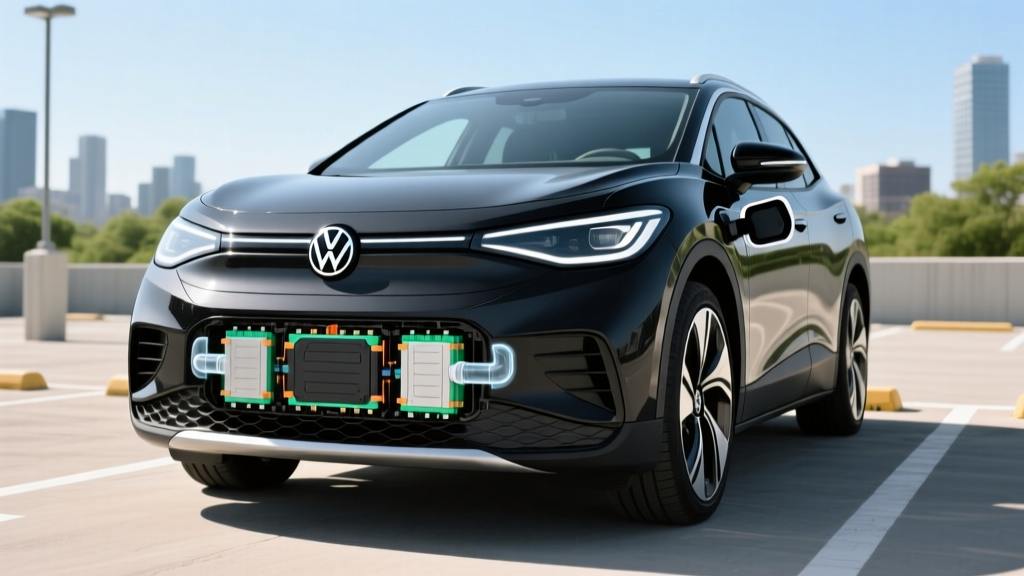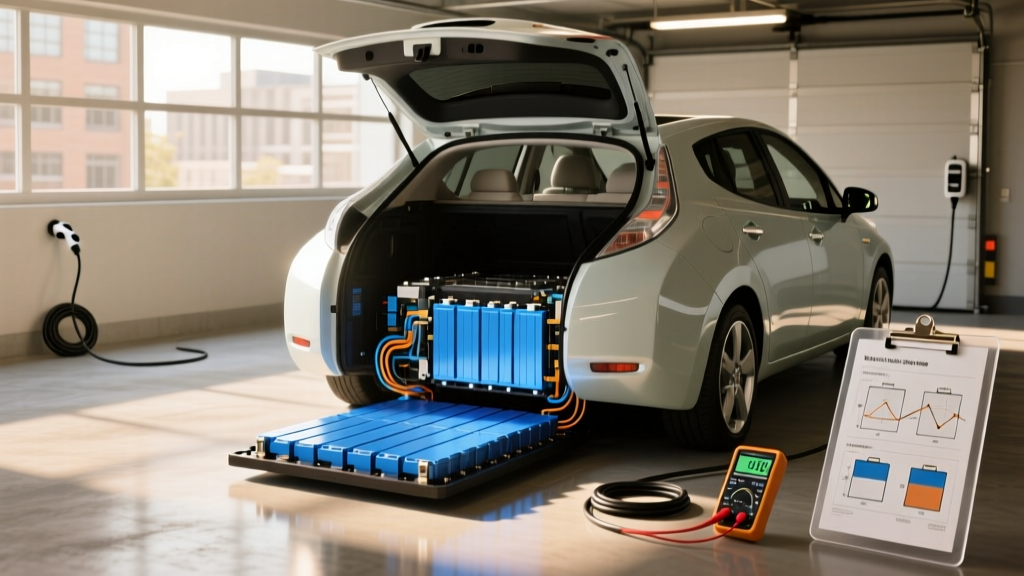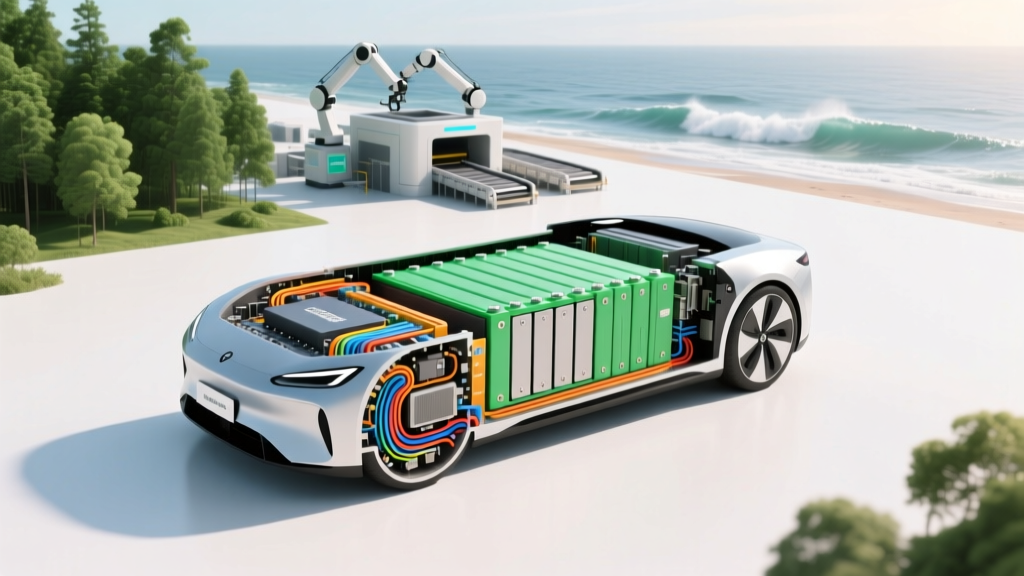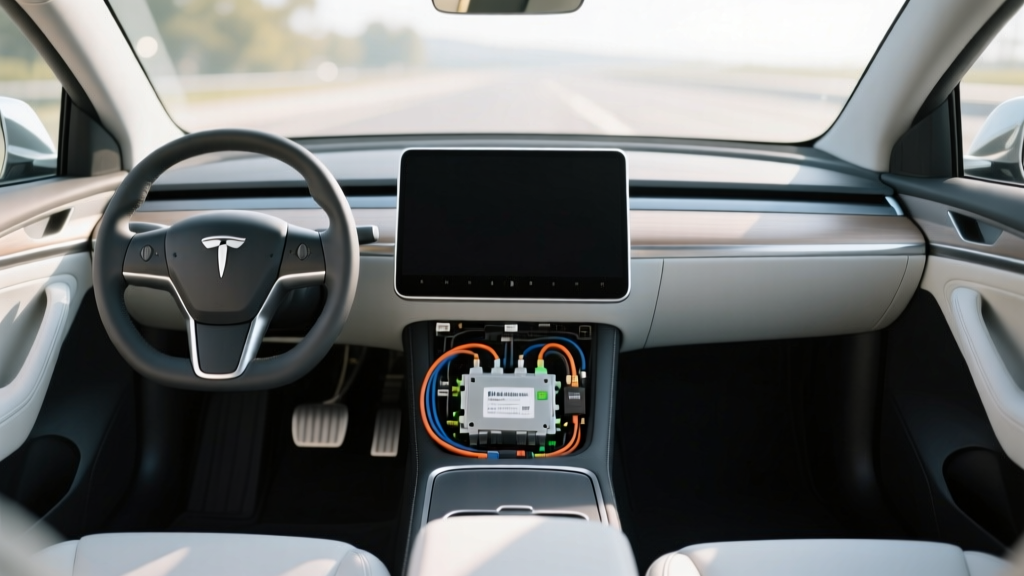
If you've searched for the best battery for car stereo upgrades, you've likely found guides written for gas-powered cars. EV owners face a different reality: your vehicle has two batteries serving very different purposes. The high-voltage traction battery (40–100+ kWh) propels the car, while a smaller 12V auxiliary battery runs your infotainment, lights, computers — and yes, your stereo. Understanding both systems is essential before you add an amplifier or swap in a premium audio setup.
This guide covers the 12V auxiliary battery considerations unique to EVs, then dives deep into the high-voltage traction battery — its chemistry, degradation, warranty, replacement cost, and how to maximize its lifespan. Whether you're planning a stereo upgrade or simply want to understand the most expensive component in your EV, you'll find exact figures and real-world data below.
The EV's Two-Battery System: 12V Auxiliary vs. High-Voltage Traction
Every modern EV — from the Tesla Model 3 to the Hyundai Ioniq 5 to the Ford F-150 Lightning — carries two distinct battery systems:
- 12V auxiliary battery: Typically 45–70 Ah lead-acid or, increasingly, lithium iron phosphate (LiFePO4/LFP). It powers the vehicle's computers, door locks, lighting, infotainment, and stereo. It does not drive the wheels.
- High-voltage traction battery: Ranges from ~40 kWh (Nissan Leaf) to 131 kWh (GMC Hummer EV). This is the NMC or LFP pack that stores energy for propulsion and DC fast charging.
When EV owners ask about the best battery for car stereo upgrades, they're almost always talking about the 12V system. Adding a high-power amplifier (say, 1,000W RMS) places significant demand on the 12V battery, especially when the vehicle is parked and the DC-DC converter isn't actively replenishing it.
Choosing the Best 12V Battery for Car Stereo Upgrades in an EV
In a gas car, the alternator continuously charges the 12V battery while the engine runs. In an EV, a DC-DC converter steps down high-voltage pack energy to maintain the 12V battery — but only when the vehicle is "on" (ready to drive) or actively charging. If you're sitting in a parked EV listening to music with the car powered down, you're draining the 12V battery directly, with no replenishment.
Here's what EV owners should prioritize when selecting the best battery for car stereo use:
- ✅ Choose an AGM (Absorbent Glass Mat) or LiFePO4 12V battery for higher cycle life and vibration resistance.
- ✅ Verify physical group size compatibility — many EVs use non-standard 12V battery sizes (e.g., Tesla Model 3 uses a small LiFePO4 pack).
- ✅ Ensure your EV's DC-DC converter output (typically 100–200A) can replenish the battery between heavy stereo draws.
- ✅ Add a secondary dedicated audio battery or capacitor if your amplifier exceeds ~800W RMS.
- ✅ Never tap the high-voltage traction battery directly — this requires specialized equipment and voids warranties.
- ✅ Consider a smart battery isolator to protect the starting/auxiliary circuit from deep audio discharge.
Popular 12V upgrades for EV audio builds include the XS Power D3400 (AGM, 67 Ah, ~$330) and the Antigravity ATX-30 (LiFePO4, 60 Ah, ~$550). LiFePO4 units weigh roughly 70% less than lead-acid equivalents and tolerate deeper discharge cycles, making them the best battery for car stereo applications where weight and longevity matter.
High-Voltage EV Battery Chemistry: LFP vs. NMC vs. NCA
While the 12V battery handles your stereo, the high-voltage traction battery is the component that defines your EV's range, charging speed, and long-term value. The two dominant chemistries in 2026 are LFP (lithium iron phosphate) and NMC/NCA (nickel manganese cobalt / nickel cobalt aluminum).
| Attribute | LFP (LiFePO4) | NMC / NCA |
|---|---|---|
| Energy Density | Lower (~160 Wh/kg cell-level) | Higher (~250–300 Wh/kg cell-level) |
| Typical Cycle Life | 3,000–5,000+ cycles | 1,000–2,000 cycles |
| Cold-Weather Performance | Weaker — slower charging > range loss below 32°F | Better — more consistent cold-weather output |
| Cost (per kWh, 2026) | ~$90–$110/kWh (pack-level) | ~$120–$150/kWh (pack-level) |
| Charging to 100% Daily | Recommended — no degradation penalty | Not recommended — accelerates wear above 80% |
| Thermal Stability | Excellent — very low thermal runaway risk | Good — requires more active thermal management |
| Common In (2026 Models) | Tesla Model 3/Y RWD, Ford Mustang Mach-E Select, BYD models | Tesla Long Range, Hyundai Ioniq 5, Rivian, most AWD/LR trims |
The bottom line: LFP is the better choice if you want maximum cycle life, lower cost, and the simplicity of daily 100% charging — at the trade-off of slightly less range per kilogram and weaker cold-weather fast-charging. NMC/NCA delivers higher energy density (more range in a lighter pack) and better cold performance, but benefits from the 20–80% state-of-charge habit for longevity.
How Long Do EV Batteries Last? Real-World Degradation Data
The single most common question from prospective EV buyers: how long will the battery actually last? The answer, backed by fleet data and owner reports, is reassuring — most EV batteries outlast the vehicles they're installed in.
Based on data from sources like Recurrent Auto and manufacturer telemetry:
- Average degradation at 100,000 miles: ~5–10% capacity loss across major manufacturers (Tesla, Hyundai, Chevrolet, BMW).
- Tesla fleet data (2025 report): Model 3/Y packs retain ~88% capacity at 150,000 miles on average.
- Chevrolet Bolt EV/EUV: GM reported >90% capacity retention at 100,000 miles in warranty claim data.
- Nissan Leaf (air-cooled, pre-2019): Higher degradation — 15–25% loss at 80,000–100,000 miles in hot climates. A cautionary tale for thermal management importance.
- LFP packs (Tesla Model 3 RWD): Early fleet data shows <5% degradation at 80,000 miles, consistent with LFP's superior cycle life.
Most EV batteries will deliver 15–20 years of service before degrading to 70–80% of original capacity — the threshold at which you'd notice meaningful range reduction but the pack still functions. Catastrophic failure (sudden death) is rare; gradual capacity loss is the norm.
EV Battery Warranty Terms: What's Actually Covered
Federal law mandates that EV battery warranties cover at least 8 years / 100,000 miles (10 years / 150,000 miles in CARB states like California, New York, and Massachusetts). Here's how major manufacturers structure their coverage in 2026:
| Manufacturer | Warranty Term | Capacity Threshold | Notes |
|---|---|---|---|
| Tesla (Model 3/Y LFP) | 8 yr / 100,000 mi | 70% retention | Standard for RWD LFP packs |
| Tesla (Long Range/Performance) | 8 yr / 120,000 mi | 70% retention | NMC packs, higher mileage coverage |
| Hyundai / Kia | 10 yr / 100,000 mi | 70% retention | Among the best terms in the industry |
| Ford (Mach-E, F-150 Lightning) | 8 yr / 100,000 mi | 70% retention | Covers battery and hybrid/electric components |
| General Motors (Ultium-based) | 8 yr / 100,000 mi | 70% retention | Covers capacity below threshold |
| BMW | 8 yr / 100,000 mi | 70% retention | Transferable to second owners |
| Rivian | 8 yr / 175,000 mi | 70% retention | Higher mileage cap — strong for high-mileage drivers |
What's covered: Capacity loss below the stated threshold (typically 70%), manufacturing defects, and cell/module failures. What's not covered: Degradation from abuse (repeated 100% fast-charging, deep discharge storage), accident damage, or unauthorized modifications. Always review your specific warranty booklet — terms vary by model year and trim.
EV Battery Replacement Cost: What to Expect
Most EV owners will never need a full battery replacement. The pack typically outlasts the vehicle's economic life. But for buyers of older used EVs or high-mileage fleet vehicles, replacement cost is a legitimate concern.
| Vehicle | Battery Size | Replacement Cost (Parts + Labor) | Notes |
|---|---|---|---|
| Chevrolet Bolt EV | 65 kWh (NMC) | $14,000–$16,000 | GM reduced pack costs post-recall |
| Tesla Model 3 (LFP) | 60 kWh (LFP) | $12,000–$15,000 | LFP packs cheaper; third-party options emerging |
| Tesla Model 3/Y (NMC LR) | 75–82 kWh (NMC) | $16,000–$20,000 | Out-of-warranty; Tesla service centers only |
| Hyundai Ioniq 5 | 77.4 kWh (NMC) | $15,000–$18,000 | Module-level repair may reduce cost |
| Ford F-150 Lightning (Ext. Range) | 131 kWh (NMC) | $25,000–$32,000 | Largest consumer pack; highest replacement cost |
| Nissan Leaf (40 kWh) | 40 kWh (NMC) | $8,000–$10,000 | Older platform; refurbished packs available ~$6,500 |
Prices are trending downward. Pack-level costs have fallen from ~$200/kWh in 2020 to approximately $110–$130/kWh in 2026, according to BloombergNEF. Module-level repairs (replacing only degraded cells rather than the full pack) are increasingly available through independent EV shops, cutting costs by 40–60%.
Factors That Affect EV Battery Life — and How to Maximize It
Your driving and charging habits meaningfully influence how quickly your traction battery degrades. Here are the primary factors, ranked by impact:
- Limit DC fast charging frequency. Occasional road-trip fast charging is fine, but daily 150+ kW sessions accelerate degradation. Use Level 2 home charging as your primary method.
- Maintain 20–80% state of charge (NMC/NCA). For NMC packs, avoid routinely charging to 100% or discharging below 10%. LFP packs are the exception — manufacturers recommend periodic 100% charges for cell balancing.
- Avoid extreme temperature storage. Don't leave your EV sitting at 100% SoC in 110°F heat or at 5% SoC in sub-zero cold for extended periods.
- Use preconditioning. Preconditioning the battery before fast charging (most EVs do this automatically when you navigate to a charger) protects the cells from thermal stress.
- Drive smoothly. Aggressive acceleration and frequent high-speed driving generate excess heat in the pack. Moderate driving extends battery life.
Monitoring Your Battery's State of Health (SoH)
State of Health (SoH) measures your battery's current maximum capacity as a percentage of its original capacity. Here's how to check it:
- Tesla: No native SoH display in the app, but third-party tools like TeslaFi or Tessie estimate SoH from charge/discharge data. Service centers can run a diagnostic.
- Hyundai/Kia: The EV Connect app and dealer diagnostics provide SoH readings on request.
- OBD-II scanners: Tools like the OBDLink MX+ paired with apps such as EVNotify or LeafSpy (for Nissan Leaf) can read SoH directly from the BMS (Battery Management System).
- Manual calculation: Charge to 100%, note the displayed range, and compare it to the original EPA-rated range. Adjust for temperature — cold weather temporarily reduces displayed range without indicating permanent degradation.
Emerging Battery Technology: Solid-State and Silicon Anodes
Looking ahead, two technologies promise to reshape EV batteries — but neither is available in consumer vehicles as of 2026:
Solid-state batteries replace the liquid electrolyte with a solid ceramic, polymer, or sulfide material. Benefits include higher energy density (~400+ Wh/kg projected), faster charging, and near-zero fire risk. Toyota has announced a solid-state battery targeting 2027–2028 production, and Samsung SDI is piloting cells for 2028 vehicles. However, manufacturing scalability and cost remain unsolved challenges. Expect limited premium-model availability no earlier than 2028, with mainstream adoption likely in the 2030s.
Silicon anode batteries replace graphite anodes with silicon, which can store roughly 10× more lithium ions per gram. Companies like Sila Nanotechnologies and Group14 are shipping silicon-dominant anode cells to select manufacturers. The Mercedes-Benz G-Class electric SUV (2025–2026) is among the first vehicles to incorporate silicon-anode cells. Expect incremental adoption through 2027–2029 as costs decrease.
Both technologies are real and progressing — but if you're buying an EV today, LFP and NMC remain your proven, warrantied, and increasingly affordable options.
Frequently Asked Questions
Can I upgrade my EV's 12V battery for a better car stereo?
Yes. Upgrading to a high-capacity AGM or LiFePO4 12V battery is the most common approach. Ensure the battery fits your EV's designated tray (many EVs use compact or proprietary sizes), and verify your DC-DC converter can maintain it. For amplifiers exceeding ~800W RMS, add a dedicated secondary audio battery with an isolator to protect your EV's critical 12V systems.
Does using my car stereo drain the EV's main driving battery?
Indirectly, yes. When the vehicle is powered on (ready to drive), the DC-DC converter draws from the high-voltage traction battery to maintain the 12V system — including your stereo. The energy draw from audio equipment is negligible compared to propulsion (a 500W amplifier uses roughly 0.5 kWh per hour of listening — about 1–2 miles of range). When the vehicle is fully off, the stereo draws only from the 12V battery.
How long do EV batteries last in years and miles?
Most modern EV traction batteries are designed to last 15–20 years or 150,000–200,000+ miles before degrading below 70–80% of original capacity. Real-world fleet data from Tesla, Hyundai, and GM shows 5–10% degradation at 100,000 miles on average. LFP chemistries are tracking even better, with some fleets showing <5% loss at 80,000 miles.
How much does it cost to replace an EV battery?
Full pack replacement ranges from approximately $8,000 (Nissan Leaf 40 kWh) to $32,000 (Ford F-150 Lightning 131 kWh), including parts and labor. However, most owners never need a replacement — the battery typically outlasts the vehicle. Module-level repairs and refurbished packs are increasingly available at 40–60% lower cost.
LFP vs. NMC — which battery chemistry is better?
Neither is universally better; it depends on your priorities. Choose LFP if you want maximum cycle life (3,000–5,000+ cycles), lower cost, the simplicity of daily 100% charging, and superior thermal safety. Choose NMC/NCA if you need maximum range per charge, better cold-weather fast-charging performance, and lighter pack weight. For most commuters in moderate climates, LFP offers the best long-term value.
What does the EV battery warranty actually cover?
Federally mandated minimum coverage is 8 years / 100,000 miles (10 years / 150,000 miles in CARB states). The warranty covers capacity loss below a stated threshold (typically 70% of original capacity) and manufacturing defects. It does not cover damage from accidents, abuse, or unauthorized modifications. Check your manufacturer's specific warranty booklet for exact terms.