Whether you drive a full battery electric vehicle (BEV) or a battery hybrid vehicle — a plug-in hybrid (PHEV) or extended-range EV (EREV) — the high-voltage traction battery is the single most expensive component in your powertrain. It's also the least understood. Buyers routinely overestimate degradation risk and underestimate warranty coverage, leading to purchase decisions driven by fear rather than data.
This guide breaks down exactly what powers today's electrified vehicles: the chemistry inside the cells, how much capacity you'll actually lose over time, what the warranty covers, what a replacement costs in 2026, and what you can do to maximize longevity. Every claim here is backed by manufacturer data, real-world fleet studies, or peer-reviewed research.
LFP vs NMC vs NCA: Which Battery Chemistry Powers Your Vehicle?
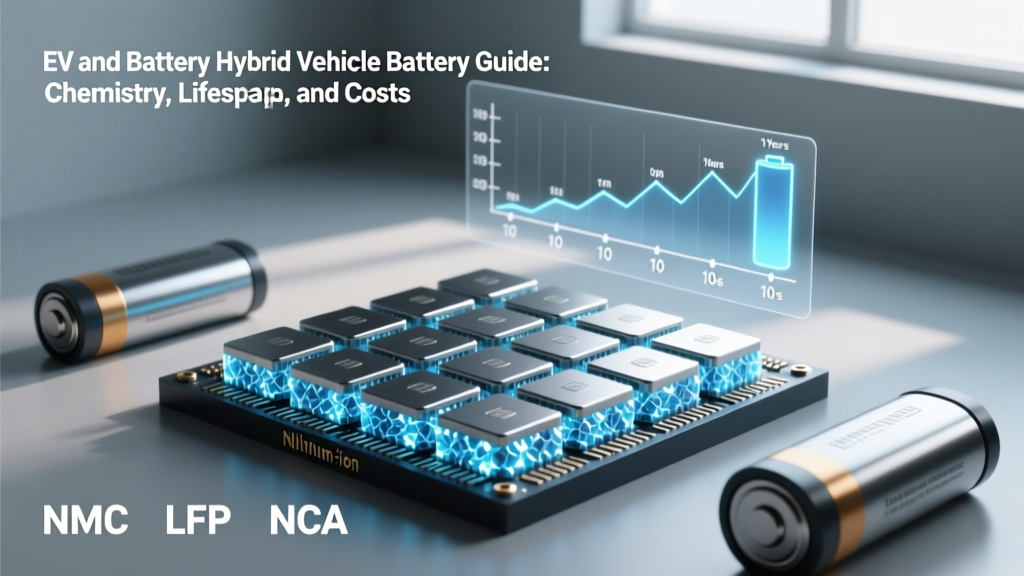
Not all lithium-ion batteries are the same. The cathode chemistry determines energy density, cycle life, thermal stability, cold-weather performance, and cost. In 2026, three chemistries dominate the EV and battery hybrid vehicle market:
- NMC (Nickel Manganese Cobalt): The most common chemistry in long-range BEVs and most PHEVs. Offers high energy density, making it ideal for vehicles that need to pack maximum range into a limited space.
- NCA (Nickel Cobalt Aluminum): Used primarily by Tesla and a few other manufacturers. Similar advantages to NMC with slightly higher energy density but comparable trade-offs.
- LFP (Lithium Iron Phosphate): Found in standard-range Teslas, many Chinese-market EVs now sold globally, and an increasing number of entry-level models. Lower energy density but significantly longer cycle life and better thermal stability.
| Attribute | LFP (Lithium Iron Phosphate) | NMC / NCA |
|---|---|---|
| Energy Density | Lower (~160–200 Wh/kg cell-level) | Higher (~220–300 Wh/kg cell-level) |
| Cycle Life | 3,000–5,000+ full cycles | 1,000–2,500 full cycles |
| Thermal Stability | Excellent — less prone to thermal runaway | Good — requires more active thermal management |
| Cold-Weather Performance | Moderate — greater range loss below 32°F | Better — retains more usable capacity in cold |
| Cost (per kWh) | Lower — no cobalt or nickel | Higher — commodity-sensitive materials |
| Recommended SoC for Daily Use | 100% (LFP tolerates full charge well) | 80% for daily; 100% for trips only |
| Typical Applications | Standard-range BEVs, some PHEVs | Long-range BEVs, most PHEVs, performance models |
Which is better? It depends on your use case. If you need maximum range in a battery hybrid vehicle with a small battery pack, NMC's higher energy density matters. If you plan to own the car for 15+ years and charge daily to full, LFP's superior cycle life and 100% SoC tolerance make it the more durable choice. Neither is universally superior — the right chemistry matches your driving pattern.
How Long Do EV and Hybrid Batteries Actually Last?
The short answer: far longer than most buyers assume. Data from fleet operators, manufacturer studies, and independent researchers consistently shows that modern lithium-ion traction batteries outlast the vehicles they power.
According to analysis by Geotab's fleet battery study, which tracked over 10,000 electric vehicles across multiple model years, the average EV battery loses approximately 2.3% of its capacity per year under typical use. That translates to roughly 88% State of Health (SoH) after five years and around 77% after ten years — well within usable territory for most drivers.
Typical Degradation Curve (NMC, average use):
| Year | Approximate Miles | Average Capacity Retained (SoH) |
|---|---|---|
| Year 1 | 12,000 | ~96–97% |
| Year 3 | 36,000 | ~92–94% |
| Year 5 | 60,000 | ~87–90% |
| Year 8 | 96,000 | ~80–85% |
| Year 10 | 120,000 | ~75–80% |
| Year 15 | 180,000 | ~68–75% |
Note: Degradation is non-linear. Most batteries experience a steeper initial drop (first 1–2 years), then stabilize into a slower, more predictable decline. Data reflects averages — individual results vary based on climate, charging habits, and battery management system (BMS) quality.
For battery hybrid vehicles specifically — PHEVs with smaller packs (typically 10–25 kWh) — the picture is slightly different. PHEV batteries cycle more frequently relative to their size because the electric-only range is shorter, meaning drivers deplete and recharge a larger percentage of the pack daily. However, manufacturers compensate by using larger buffer zones (the portion of the battery the car won't let you use) to protect longevity. Toyota's RAV4 Prime, for instance, uses a 18.1 kWh pack but only makes approximately 14.5 kWh usable — a ~20% buffer that significantly extends cycle life.
What Does the Battery Warranty Actually Cover?
Federal law in the United States mandates that all EV and PHEV manufacturers provide a minimum battery warranty of 8 years or 100,000 miles (whichever comes first) in most states. In California Air Resources Board (CARB) states, that requirement extends to 10 years or 150,000 miles.
However, the warranty doesn't cover all capacity loss. It covers failure below a defined capacity retention threshold — typically 70% of original capacity, though some manufacturers set it at 65% or 68%.
| Manufacturer | Warranty Term | Capacity Threshold | Notes |
|---|---|---|---|
| Tesla (Model 3/Y LFP) | 8 yr / 100,000 mi | 70% | Standard Range models |
| Tesla (Model 3/Y LR/Perf) | 8 yr / 120,000 mi | 70% | Long Range & Performance |
| Hyundai / Kia | 10 yr / 100,000 mi | 70% | Among the longest coverage |
| Toyota (PHEV/HEV) | 10 yr / 150,000 mi | Varies by model | CARB-aligned in all states for hybrids |
| Ford (BEV) | 8 yr / 100,000 mi | 70% | Mustang Mach-E, F-150 Lightning |
| GM (Ultium BEV) | 8 yr / 100,000 mi | 70% | Cadillac, Chevrolet, GMC EVs |
Key distinction: The warranty covers the high-voltage traction battery — the large lithium-ion pack that powers the electric motor. It does not cover the 12V auxiliary battery (the small lead-acid or lithium battery that runs accessories and electronics). The 12V battery is a wear item, just like in a conventional car, and typically needs replacement every 3–5 years at a cost of $150–$400.
If your battery drops below the threshold within the warranty period, the manufacturer will repair or replace it — but usually with a pack that meets the threshold, not necessarily a brand-new one. Read the fine print in your owner's manual or warranty booklet.
How Much Does a Battery Replacement Cost?
This is the question that generates the most anxiety, and the most misinformation. Let's ground it in actual numbers.
As of 2026, lithium-ion battery pack prices have fallen to roughly $110–$140 per kWh at the cell level, though fully installed replacement costs (including labor, BMS recalibration, coolant, and dealer markup) remain higher. Here's what real-world replacements look like:
| Vehicle Type | Battery Size | Estimated Replacement Cost (2026) | When Typically Needed |
|---|---|---|---|
| PHEV (e.g., Toyota RAV4 Prime) | ~18 kWh | $3,000–$5,500 | Rarely before 200,000+ mi |
| Standard-Range BEV (e.g., Tesla Model 3 RWD) | ~60 kWh | $8,000–$12,000 | Rarely before 200,000+ mi |
| Long-Range BEV (e.g., Tesla Model Y LR, Hyundai Ioniq 5) | ~75–84 kWh | $10,000–$16,000 | Rarely before 200,000+ mi |
| Large BEV / Truck (e.g., F-150 Lightning, Rivian R1T) | ~100–135 kWh | $15,000–$22,000 | Rarely before 150,000+ mi |
The critical context most articles omit: The vast majority of EV and battery hybrid vehicle owners will never need a battery replacement. Data from Consumer Reports and warranty claim statistics from major automakers indicate that fewer than 2–3% of batteries require replacement under warranty, and most of those failures occur early (manufacturing defects) rather than late (wear-out). A well-maintained battery in a 2026 vehicle is statistically likely to retain 70%+ capacity at 200,000 miles.
If you do face an out-of-warranty replacement, costs will continue declining. Battery recycling and second-life markets are maturing, and refurbished packs are becoming available at 40–60% of new-pack cost for older vehicles.
What Kills a Battery Early — and How to Prevent It
Lithium-ion batteries degrade through two mechanisms: calendar aging (time-dependent, happens even when parked) and cycle aging (use-dependent, caused by charge/discharge cycles). You can't stop calendar aging, but you can significantly slow cycle aging by understanding the stressors.
Factors That Accelerate Degradation
- Frequent DC fast charging: Occasional fast charging is fine. But daily use of 150+ kW DC chargers generates sustained heat and high C-rates that accelerate wear. Research from the Idaho National Laboratory found that vehicles charged exclusively on DC fast chargers showed measurably higher degradation than those using Level 2 — though the difference was smaller than many feared (roughly an additional 1–2% loss over several years).
- Extreme heat exposure: Sustained ambient temperatures above 95°F, especially when combined with high State of Charge, is the single worst condition for lithium-ion chemistry. If you live in Phoenix or Las Vegas, garage parking and preconditioning matter significantly.
- Sustained high SoC: For NMC/NCA batteries, sitting at 100% charge for days or weeks accelerates degradation. Set your daily charge limit to 80% and only charge to 100% when you're about to drive a long trip.
- Deep discharges: Regularly driving the battery to 0% (or very close) stresses the cells. Try to keep your minimum SoC above 10–15% for daily driving.
- Cold charging without preconditioning: Charging a cold battery (below ~40°F) at high power causes lithium plating on the anode — a permanent, irreversible form of degradation. Always use your vehicle's battery preconditioning feature before fast charging in cold weather.
Best Practices for Maximum Longevity
- Charge primarily on Level 2 at home (7–11 kW) — it's gentler on the battery and dramatically cheaper than public DC charging.
- Set charge limits appropriately: 80% for NMC/NCA daily use, 100% acceptable for LFP.
- Use preconditioning (available on virtually all 2026 BEVs and PHEVs) before fast charging and before departure in cold weather.
- Avoid leaving the car at 100% SoC for extended periods — if you charge to full, drive it soon after.
- In hot climates, park in shade or a garage when possible; the thermal management system works harder (and consumes energy) when the car bakes in the sun.
How to Monitor Your Battery's State of Health
State of Health (SoH) is a percentage representing your battery's current maximum capacity relative to its original capacity when new. A brand-new battery is at 100% SoH; a battery that can only hold 85 kWh of its original 100 kWh is at 85% SoH.
Here's how to check it in 2026:
- In-vehicle displays: Many modern EVs and PHEVs now include a battery health indicator in the infotainment system. Tesla added a battery health percentage in software updates starting in 2024. Hyundai, Kia, and BMW also provide SoH readouts in their EV menus.
- OBD-II diagnostic tools: Third-party OBD-II readers like the OBD Eleven or Carista adapter, paired with apps such as Car Scanner or Leaf Spy (for Nissan Leaf), can read the BMS-reported SoH directly. This is the most reliable DIY method.
- Charging data analysis: Apps like TeslaFi, Stats (for Tesla), or ABRP (A Better Route Planner) can estimate SoH by comparing the energy added during a full charge cycle to the battery's known original capacity. This method is less precise but requires no extra hardware.
- Dealer diagnostic: Any authorized service center can pull a full battery health report during routine service. Ask for it specifically — it's not always included in standard inspections.
For battery hybrid vehicle owners with PHEVs, SoH monitoring is equally important but slightly less consequential for daily driving. A PHEV battery degrading from 100% to 80% SoH means your electric-only range drops from, say, 42 miles to ~34 miles — still functional, just reduced. The gasoline engine seamlessly compensates.
Beyond Lithium-Ion: Solid-State and Silicon Anode Batteries
If you've read EV headlines in the past few years, you've seen promises of solid-state batteries — cells that replace the liquid electrolyte with a solid material, theoretically offering higher energy density, faster charging, improved safety, and longer life. Here's where the technology actually stands as of 2026:
- Toyota has announced a solid-state battery for a limited-production vehicle expected in 2027–2028, with claims of 750+ km (WLTP) range and 10-minute fast charging. This remains announced, not available, and initial deployment will be in low-volume, high-price models.
- Samsung SDI and QuantumScape (backed by Volkswagen) are in advanced prototype and early production-validation stages. Mass-market availability is not expected before 2029–2030.
- Silicon anode batteries — which replace graphite anodes with silicon to increase energy density — are closer to market. Several manufacturers have begun integrating partial silicon anodes into existing NMC cells, offering incremental improvements (5–15% energy density gains) rather than revolutionary leaps. These are appearing in select 2026 model-year vehicles.
The realistic outlook: If you're buying an EV or battery hybrid vehicle today or in the next 2–3 years, you will be buying a lithium-ion vehicle with LFP, NMC, or NCA chemistry. Solid-state technology is genuine and progressing, but it will not be widely available or affordable until the early 2030s at the earliest. Don't delay a purchase waiting for it — current lithium-ion technology is mature, well-understood, and proven to last the life of the vehicle.
Frequently Asked Questions
How long do EV batteries last in years and miles?
Based on fleet data from Geotab and manufacturer warranty statistics, most modern EV and PHEV batteries retain 70–80% of their original capacity at 150,000–200,000 miles (roughly 12–15 years of average driving). Complete failure requiring replacement is rare — under 3% of batteries fail, and most of those failures occur early due to manufacturing defects, not wear.
How much does it cost to replace an EV battery in 2026?
Replacement costs range from approximately $3,000–$5,500 for a small PHEV battery to $15,000–$22,000 for a large BEV truck battery, including parts and labor. However, the vast majority of owners never need a replacement — batteries typically outlast the vehicles they're installed in. Costs continue to decline as cell prices drop and refurbished packs become available.
What does the federal battery warranty cover?
U.S. federal law requires a minimum 8-year/100,000-mile warranty on all EV and PHEV traction batteries (10 years/150,000 miles in CARB states). The warranty covers capacity loss below a defined threshold — typically 70% of original capacity. It covers the high-voltage traction battery only, not the 12V auxiliary battery.
How do I check my battery's State of Health?
Check your vehicle's infotainment system for a built-in battery health display (available on most 2024+ models), use an OBD-II diagnostic tool with an app like Car Scanner, analyze charging data through apps like TeslaFi, or request a battery health report from your dealer during service.
LFP vs NMC — which battery chemistry should I choose?
Choose LFP if you want maximum cycle life, better thermal safety, and the convenience of charging to 100% daily — ideal for standard-range commuting. Choose NMC if you need maximum range per charge, better cold-weather performance, or are buying a long-range or performance model. Neither is universally better; the right choice depends on your driving pattern and climate.
Does frequent DC fast charging damage the battery?
Occasional DC fast charging has minimal impact. However, exclusive reliance on DC fast charging (150+ kW daily) does measurably increase degradation — roughly 1–2% additional capacity loss over several years compared to Level 2 charging. For daily use, Level 2 home charging is strongly recommended. Save DC fast charging for road trips.
Should I worry about battery degradation in a PHEV?
PHEV batteries are smaller and cycle more frequently, but manufacturers design them with larger buffer zones to protect longevity. A degraded PHEV battery simply means reduced electric-only range — the gasoline engine compensates seamlessly. Toyota's hybrid battery warranty (10 yr/150,000 mi) reflects the company's confidence in real-world durability based on decades of hybrid data.
For authoritative data on EV efficiency, range, and emissions, consult the U.S. Department of Energy's fueleconomy.gov database. For current federal tax credit eligibility rules that may affect your purchase decision, refer to the IRS Clean Vehicle Credits page.