Why a 2016 Nissan Maxima Battery Search Leads Straight to EV Battery Questions
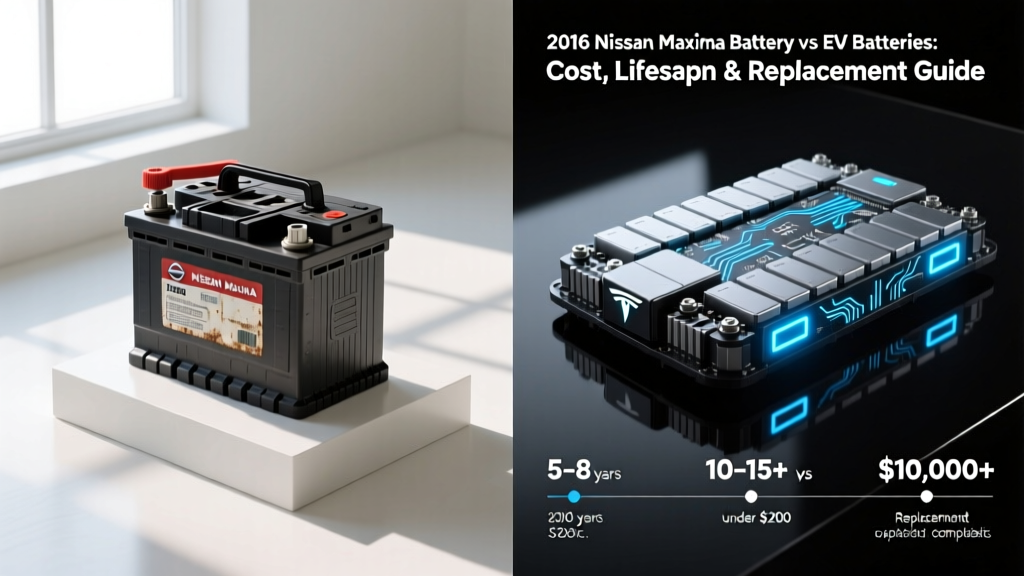
If you've landed here searching for a 2016 Nissan Maxima battery, you're likely facing a replacement decision on Nissan's flagship sedan — or comparing the cost of keeping a gas car alive versus switching to an electric vehicle. The 2016 Maxima uses a conventional 12-volt lead-acid battery (Group 35, ~$180-$240 at retail) to start its 3.5L V6. That's a straightforward swap every 3-5 years.
But if your search is really about electric vehicle batteries — the high-voltage traction packs that power EVs and plug-in hybrids — the conversation is entirely different. EV batteries are measured in kilowatt-hours (kWh), cost thousands rather than hundreds, and are engineered to outlast the cars they power. This guide breaks down exactly what EV battery ownership looks like in 2026: chemistry, degradation data, warranty coverage, replacement costs, and how to maximize longevity.
LFP vs NMC/NCA: The Chemistry Trade-Off Every EV Buyer Must Understand
Not all EV batteries are built the same. The two dominant lithium-ion chemistries in 2026 are NMC/NCA (nickel manganese cobalt / nickel cobalt aluminum) and LFP (lithium iron phosphate). Your EV's chemistry determines range, longevity, cold-weather behavior, and price.
| Attribute | LFP (Lithium Iron Phosphate) | NMC / NCA (Nickel-Based) |
|---|---|---|
| Energy Density | Lower (~160 Wh/kg cell-level) | Higher (~250-300 Wh/kg cell-level) |
| Typical EV Range | Shorter packs, common on Standard Range trims | Longer range per kWh of pack weight |
| Cycle Life | 3,000-5,000+ full cycles | 1,000-2,000 full cycles |
| Cold Performance | Weaker below 32°F; range loss more pronounced | Better low-temp output and charging speed |
| Charging to 100% | Recommended periodically for BMS calibration | Best kept at 80-90% daily; 100% for trips only |
| Cost | ~15-25% cheaper per kWh to produce | Higher due to nickel/cobalt commodity costs |
| Common 2026 Examples | Tesla Model 3 RWD, Ford Mustang Mach-E Select, base BYD models | Tesla Model Y Long Range, Hyundai Ioniq 5, Rivian R1S |
Which is better? It depends on your use case. LFP wins for daily commuting, long cycle life, and budget-conscious buyers who can charge at home every night. NMC wins for road-trippers who need maximum range, cold-climate drivers, and anyone towing. Neither chemistry is universally superior — they solve different problems.
How Long Do EV Batteries Actually Last? Real Degradation Data
The fear that an EV battery will "die" at 100,000 miles is outdated. Modern thermal management systems and improved cell chemistry have pushed typical degradation far below early-EV benchmarks.
Typical EV Battery Degradation Curve (NMC and LFP Combined Data):
- Year 1 / 15,000 mi: ~2-5% capacity loss (initial settling)
- Year 3 / 45,000 mi: ~5-8% total loss
- Year 5 / 75,000 mi: ~8-12% total loss
- Year 8 / 120,000 mi: ~10-17% total loss
- Year 10+ / 150,000+ mi: ~15-22% total loss (varies widely by climate and charging habits)
According to Geotab's large-scale battery health study tracking over 10,000 EVs, the average electric vehicle loses approximately 2.3% of its battery capacity per year. At that rate, an EV battery retains roughly 77% of its original capacity after a decade — well above the threshold most drivers find acceptable for daily use.
For context, a 2016 Nissan Maxima's 12V battery is typically replaced every 3-5 years at $180-$240 per swap. An EV traction battery, by contrast, is designed for the life of the vehicle. Most EVs sold since 2020 will see their batteries outlast their bodies.
What Does the EV Battery Warranty Actually Cover?
Federal law mandates that EV batteries carry a minimum warranty of 8 years / 100,000 miles (10 years / 150,000 miles in California and states adopting CARB standards). But the details matter — specifically, the capacity retention threshold that triggers a warranty claim.
| Manufacturer | Warranty Period | Mileage Cap | Capacity Threshold |
|---|---|---|---|
| Tesla (Model 3/Y LFP) | 8 years | 100,000 mi | 70% retention |
| Tesla (Model 3/Y Long Range) | 8 years | 120,000 mi | 70% retention |
| Hyundai / Kia | 10 years | 100,000 mi | 70% retention |
| Ford (Mach-E, F-150 Lightning) | 8 years | 100,000 mi | 70% retention |
| GM (Ultium-based) | 8 years | 100,000 mi | 70% retention |
| Rivian | 8 years | 120,000 mi | 70% retention |
| BMW / Mercedes (BEV) | 8 years | 100,000 mi | 70% retention |
What this means in practice: If your EV originally had 300 miles of EPA range and drops below 210 miles (70%) within the warranty window, the manufacturer must repair or replace the battery at no cost. In reality, very few modern EVs hit that threshold within 8 years. The warranty is a safety net, not a prediction.
How Much Does an EV Battery Cost to Replace?
Out-of-warranty battery replacement is the number one concern for used-EV buyers. Costs vary enormously by pack size, chemistry, and whether you're paying for a new, refurbished, or salvaged unit.
| Vehicle Category | Battery Size (kWh) | New OEM Pack | Refurbished / Remanufactured | Typical Replacement Trigger |
|---|---|---|---|---|
| Compact EV (e.g., Chevy Bolt, Nissan Leaf) | 40-65 kWh | $8,000 - $14,000 | $4,500 - $8,000 | 150,000+ mi or cell failure |
| Mid-size EV (e.g., Tesla Model 3, Ioniq 5) | 60-82 kWh | $12,000 - $18,000 | $7,000 - $12,000 | Rare before 200,000 mi |
| Large EV / SUV (e.g., F-150 Lightning, Rivian) | 98-135 kWh | $18,000 - $30,000 | $12,000 - $20,000 | Cell/module failure or extreme degradation |
| Luxury EV (e.g., Mercedes EQS, BMW iX) | 90-120 kWh | $20,000 - $35,000 | $14,000 - $22,000 | Uncommon; most under warranty |
The critical context: most EV batteries never need a full replacement. Module-level repairs (replacing individual cell groups rather than the entire pack) are increasingly available and cost $2,000-$5,000. According to data from Consumer Reports, the vast majority of EV owners will sell or retire their vehicles before the battery requires out-of-warranty service.
Compare that to the 2016 Nissan Maxima, where you'll spend $180-$240 on a 12V battery every 3-5 years, plus ongoing costs for alternator health, starter wear, and the V6's maintenance schedule. The EV battery conversation is higher-stakes per event but far lower-frequency.
Factors That Accelerate EV Battery Degradation
Battery chemistry sets the ceiling, but your habits determine where you land on the degradation curve. These are the proven accelerants of capacity loss:
Battery Care Best Practices
- Avoid chronic DC fast charging: Occasional road-trip fast charging is fine. Daily reliance on 150+ kW DCFC stresses cells thermally. Level 2 home charging (7-11 kW) is gentler.
- Don't sit at 100% SoC: For NMC/NCA batteries, set your daily charge limit to 80-90%. LFP batteries tolerate 100% better and actually benefit from periodic full charges for cell balancing.
- Minimize deep discharges: Try not to routinely drop below 10-15% State of Charge. The 20-80% window is the sweet spot for NMC longevity.
- Precondition in extreme temperatures: Use your EV's scheduled departure or preconditioning feature to warm or cool the battery before driving and charging. This is critical below 32°F and above 95°F.
- Avoid prolonged storage at extreme SoC: If leaving your EV for weeks, store it at ~50% SoC in a temperature-stable environment.
- Use regenerative braking wisely: In cold weather, reduce regen intensity until the battery warms up — high regen into a cold battery causes stress.
How to Check Your EV's Battery State of Health (SoH)
State of Health (SoH) is the percentage of original capacity your battery currently holds. A new EV starts at 100% SoH; a 5-year-old EV might sit at 90-93%. Here's how to monitor it:
- In-vehicle displays: Tesla, Hyundai, Kia, and BMW offer battery health readouts in their settings menus. Nissan Leaf owners can access SoH via the LeafSpy third-party app and an OBD-II dongle.
- Manufacturer apps: Most OEM companion apps (Tesla, FordPass, Hyundai Bluelink) provide SoH estimates or range-vs-original comparisons.
- OBD-II diagnostic tools: Devices like the OBDeleven or dedicated EV scan tools can pull BMS (Battery Management System) data for precise SoH figures.
- Dealer diagnostics: Any authorized service center can run a full battery health report, often required for warranty claims.
- Third-party services: Companies like Recurrent Auto provide battery health reports for used-EV purchases, comparing your pack against fleet averages.
If you're evaluating a used EV — or comparing a used 2016 Nissan Maxima against a used EV like a 2018-2020 Nissan Leaf — requesting a battery health report is as important as checking a Carfax.
What's Next: Solid-State, Silicon Anodes, and Realistic Timelines
Next-generation battery technology is real, but timelines matter. Here's where things stand as of 2026:
- Silicon anode batteries: Companies like Sila Nanotechnologies and Group14 are shipping silicon-dominant anode cells that boost energy density by 20-40% over graphite anodes. These are appearing in limited production vehicles (Mercedes G-Class EV, select premium models) but won't reach mainstream pricing until approximately 2028-2030.
- Solid-state batteries: Toyota, Samsung SDI, and QuantumScape have demonstrated functional solid-state cells with faster charging and higher energy density. Toyota has announced limited production for 2027-2028, but volume availability at consumer price points is realistically 2030 or later. These are not available to buy today.
- Sodium-ion batteries: CATL and BYD are producing sodium-ion packs for budget EVs in China, with lower cost but also lower energy density. US-market adoption is expected in entry-level models by 2028-2029.
The practical takeaway: today's NMC and LFP batteries are mature, well-warrantied, and sufficient for the vast majority of drivers. Waiting for solid-state is not a rational purchase strategy unless your timeline extends well past 2030.
Frequently Asked Questions
How long do EV batteries last in years and miles?
Most modern EV batteries retain 77-85% of original capacity after 10 years or 150,000 miles based on fleet data from Geotab and Recurrent Auto. They are engineered to outlast the vehicle itself. Full failure before 200,000 miles is rare.
How much does an EV battery cost to replace?
Out-of-warranty replacement ranges from $8,000-$14,000 for compact EVs to $18,000-$30,000 for large SUVs and trucks. Refurbished packs cost 40-60% less. However, most EV batteries never require replacement during typical ownership.
What does the EV battery warranty cover?
Federal law requires a minimum 8-year/100,000-mile warranty guaranteeing at least 70% capacity retention. California and CARB states extend this to 10 years/150,000 miles. If your battery drops below the threshold, the manufacturer repairs or replaces it at no cost.
How do I check my EV battery health?
Use your vehicle's built-in battery health display, the OEM companion app, an OBD-II scanner with EV capability, or request a dealer diagnostic report. For used EVs, third-party services like Recurrent Auto provide independent SoH assessments.
LFP vs NMC — which battery chemistry is better?
LFP offers longer cycle life (3,000-5,000 cycles), lower cost, and tolerance for 100% daily charging — ideal for commuters. NMC delivers higher energy density, better cold-weather performance, and longer range per pound — ideal for road-trippers and cold climates. Neither is universally superior; choose based on your driving pattern.
Is a 2016 Nissan Maxima battery the same as an EV battery?
No. The 2016 Maxima uses a standard 12V lead-acid battery (Group 35, ~$180-$240) that powers the starter and electronics. An EV traction battery is a high-voltage lithium-ion pack (40-135 kWh, $8,000-$30,000) that powers the drivetrain. They serve entirely different functions at entirely different scales.