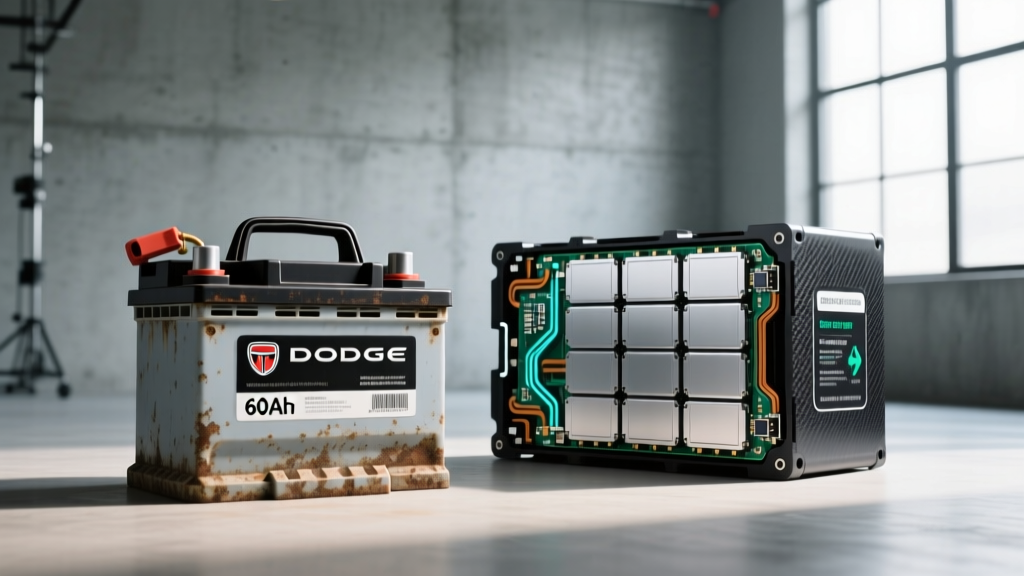
If you've landed here searching for a 2014 Dodge Avenger battery, you're likely dealing with a dead 12-volt starter battery in a gasoline midsize sedan — not an EV traction pack. That's a critical distinction, and one we'll address head-on. But if you're also researching EV batteries because you're considering an electric vehicle for your next purchase, this guide bridges both worlds: what a conventional 12V battery does, what a high-voltage EV traction battery does, and why modern battery technology has evolved far beyond what powered that Avenger.
The 2014 Dodge Avenger Battery: What You Actually Need
The 2014 Dodge Avenger shipped with a conventional lead-acid 12V auxiliary battery (typically Group Size 26 or 34, depending on engine). This battery's sole job is cranking the internal combustion engine and powering accessories when the alternator isn't running. It has nothing in common with the lithium-ion traction batteries that propel electric vehicles.
A replacement 12V battery for the 2014 Avenger runs $120–$220 at auto parts stores and typically lasts 3–5 years. That's a straightforward, well-understood maintenance item. But the moment you step into an EV, the "battery conversation" shifts entirely to the high-voltage traction pack — the component that stores energy for propulsion, costs thousands more, and lasts dramatically longer.
Let's break down everything EV buyers and owners need to know about modern traction batteries.
EV Battery Chemistry: LFP vs. NMC/NCA Trade-Offs
Two dominant chemistries power today's EVs: LFP (lithium iron phosphate) and NMC/NCA (nickel manganese cobalt / nickel cobalt aluminum). Your choice of chemistry affects range, longevity, cold-weather behavior, and price.
| Attribute | LFP (LiFePO₄) | NMC / NCA |
|---|---|---|
| Energy Density | Lower (~160 Wh/kg cell-level) | Higher (~250–300 Wh/kg cell-level) |
| Typical Cycle Life | 3,000–6,000+ cycles | 1,000–2,500 cycles |
| Cold-Weather Performance | Reduced (more range loss below 32°F) | Better low-temperature discharge |
| Thermal Stability | Excellent (higher runaway threshold) | Good (requires more active cooling) |
| Cost per kWh | Lower ($80–$110/kWh pack-level, 2026) | Higher ($110–$140/kWh pack-level, 2026) |
| Cobalt Content | None | Varies (reducing in newer formulations) |
| Common In | Tesla Model 3 RWD, base Model Y, BYD models, Ford Mustang Mach-E Select | Long-range AWD models, Hyundai Ioniq 5/6, Rivian, Lucid, high-performance trims |
Which is better? Neither is universally superior. LFP wins on cycle life, cost, and safety — ideal for standard-range daily drivers who charge to 100% regularly. NMC/NCA wins on energy density and cold-weather range — better for long-range buyers in northern climates. Tesla's own guidance reflects this split: LFP-equipped vehicles are cleared for routine 100% charging, while NMC vehicles are recommended to daily-charge at 80%.
How Long Do EV Batteries Last? Real Degradation Data
EV batteries don't "die" suddenly like a phone battery. They gradually lose capacity over time and charge cycles. Industry data from Geotab's fleet study of over 10,000 EVs shows average degradation of approximately 1.8% per year across all chemistries — meaning a typical EV retains roughly 85–90% of original capacity after 8 years.
Here's what that looks like with concrete data points:
- Tesla Model 3/Y (NMC, 2018–2022): ~5–8% capacity loss at 100,000 miles, per Tesla's 2023 Impact Report and third-party fleet data.
- Nissan Leaf (passively cooled, 2013–2017 NMC): 15–25% loss at 80,000–100,000 miles, worsened by hot climates — a cautionary tale for thermal management importance.
- Chevrolet Bolt EV/EUV (NMC, liquid-cooled): 5–7% loss at 100,000 miles, consistent with modern liquid-cooled packs.
- LFP-equipped Tesla Model 3 RWD: Early fleet data suggests <5% degradation at 100,000 miles, benefiting from LFP's superior cycle life.
Most EV batteries outlast the vehicle's economic life. Catastrophic failure (sudden, total loss) is rare; gradual capacity fade is the norm. A battery at 70% capacity still drives the car — it just has less range.
What Does the Battery Warranty Cover?
Federal law mandates that EV manufacturers warrant the traction battery for a minimum of 8 years / 100,000 miles (10 years / 150,000 miles in California Air Resources Board states). Most manufacturers set the replacement threshold at 70% retained capacity during the warranty period.
| Manufacturer | Warranty Period | Mileage Cap | Capacity Threshold |
|---|---|---|---|
| Tesla (Model 3/Y RWD – LFP) | 8 years | 100,000 mi | 70% |
| Tesla (Long Range / Performance) | 8 years | 120,000 mi | 70% |
| Hyundai / Kia (Ioniq 5, EV6) | 10 years | 100,000 mi | 70% |
| Ford (Mach-E, F-150 Lightning) | 8 years | 100,000 mi | 70% |
| GM (Bolt, Blazer EV, Equinox EV) | 8 years | 100,000 mi | 60–70% (varies) |
| Rivian (R1T / R1S) | 8 years | 175,000 mi | 70% |
Key caveat: the warranty covers capacity degradation below the threshold and manufacturing defects. It does not cover damage from accidents, flooding, or improper modifications. Always read the specific warranty booklet — GM's 60% threshold on some models, for instance, is notably more lenient than the industry-standard 70%.
How Much Does an EV Battery Replacement Cost?
Out-of-warranty traction battery replacement is the single biggest fear among prospective EV buyers. Here's the reality with 2026 pricing:
| Vehicle | Battery Size (kWh) | Estimated Replacement Cost | Notes |
|---|---|---|---|
| Tesla Model 3 RWD (LFP) | ~60 kWh | $8,000–$12,000 | Refurbished packs available for less |
| Tesla Model Y Long Range | ~75 kWh | $12,000–$16,000 | Module-level repair sometimes possible |
| Hyundai Ioniq 5 | 77.4 kWh | $14,000–$20,000 | 10-year warranty reduces out-of-pocket risk |
| Ford F-150 Lightning (Extended) | ~131 kWh | $20,000–$30,000 | Largest consumer packs cost the most |
| Chevrolet Bolt EV | 65 kWh | $10,000–$14,000 | Recall replacements were free through GM |
Context matters: pack prices have fallen from over $1,000/kWh in 2010 to roughly $100–$140/kWh at the pack level in 2026, per BloombergNEF lithium-ion battery price surveys. More importantly, most EV batteries never need replacement during the vehicle's usable life. The 8–10 year warranty covers the period when early failures would occur, and data shows the vast majority of packs retain well above 70% capacity at 150,000+ miles.
When replacement is needed (typically 12–15+ years or 200,000+ miles for significant degradation), refurbished packs and module-level repairs are increasingly available at 30–50% below new-pack pricing.
Factors That Affect EV Battery Life (and How to Maximize It)
Not all miles are created equal when it comes to battery wear. These factors have the greatest impact on long-term State of Health (SoH):
- Extreme State of Charge: Regularly sitting at 100% (NMC) or 0% accelerates degradation. LFP tolerates 100% far better. For NMC, daily charging to 80% and occasional 100% before road trips is the sweet spot.
- DC Fast Charging Frequency: Frequent 150+ kW sessions generate heat. Occasional fast charging is fine; daily reliance on DCFC without preconditioning can add 1–2% extra annual degradation. Modern thermal management mitigates this significantly.
- Temperature Extremes: Sustained exposure to 95°F+ ambient heat is the single worst factor for lithium-ion longevity. Cold weather reduces range temporarily but causes less permanent damage. Garage parking in hot climates measurably extends pack life.
- Depth of Discharge: Shallow cycles (20%–80%) cause less wear than deep cycles (5%–100%). You don't need to obsess over this, but avoiding routine full discharges helps.
- Preconditioning: Using your EV's battery preconditioning feature before fast charging warms the pack to optimal temperature, improving charge speed and reducing thermal stress.
Battery Care Checklist
- Set daily charge limit to 80% (NMC) or 100% (LFP — follow manufacturer guidance)
- Use Level 2 home charging as your primary method; reserve DCFC for road trips
- Enable battery preconditioning when navigating to a fast charger
- Avoid leaving the vehicle at 0% or 100% SoC for extended periods (weeks)
- Park in shade or a garage during sustained high-heat periods
- Install manufacturer app updates — they often include battery management improvements
How to Check Your EV's Battery Health (State of Health)
State of Health (SoH) is the percentage of original capacity your battery retains. Most EVs don't display SoH directly on the dashboard, but you have several options:
- Manufacturer App: Tesla, Hyundai, Ford, and others provide estimated range figures that, compared to original EPA ratings, give a rough SoH proxy. If your Model 3 Long Range originally showed 330 miles at 100% and now shows 305, that's roughly 92% SoH.
- OBD-II Diagnostic Tools: Devices like the OBDLink MX+ paired with apps such as EV Pro or Scan My Tesla can read detailed battery data including SoH percentage, cell voltage variance, and degradation curves.
- Dealership Diagnostic: Most manufacturers can run a battery health report during service visits. Request this before purchasing a used EV.
- Third-Party Services: Companies like Recurrent Auto offer battery health reports based on connected vehicle data, often free for members.
For used-EV buyers: always verify SoH before purchase. A 2019 Model 3 at 88% SoH is perfectly healthy; one at 76% may approach warranty-threshold territory and warrants negotiation.
Emerging Battery Tech: Solid-State and Silicon Anodes
Next-generation battery technologies are in active development but are not yet commercially available in production consumer EVs as of 2026. Here's a realistic timeline:
- Solid-State Batteries: Toyota, Samsung SDI, and QuantumScape have demonstrated prototypes with 400+ Wh/kg energy density and 10-minute fast-charge capability. Toyota has announced limited production for 2027–2028, but widespread availability in affordable models is realistically 2030+. Cost remains the primary barrier.
- Silicon Anode Batteries: Companies like Sila Nanotechnologies and Group14 are replacing graphite anodes with silicon to boost energy density by 20–40%. Early deployments appear in luxury/performance applications (Mercedes G-Class electric, 2025–2026), with broader adoption expected by 2028–2030.
- Sodium-Ion Batteries: CATL and BYD have begun deploying sodium-ion packs in Chinese-market micro-EVs. Lower energy density but zero lithium/cobalt dependency makes them attractive for budget segments. US availability: uncertain, likely 2028+.
These technologies are promising, but they don't change today's buying calculus. Current LFP and NMC batteries already deliver 200,000+ mile lifespans with acceptable degradation — the data supports that clearly.
Frequently Asked Questions
Is the 2014 Dodge Avenger battery the same as an EV battery?
No. The 2014 Avenger uses a 12V lead-acid starter battery (~$120–$220, 3–5 year life). EV traction batteries are high-voltage lithium-ion packs (400V–800V) that store 50–130+ kWh of energy and cost $8,000–$30,000 to replace but last 12–20+ years.
How long do EV batteries last in years and miles?
Real-world fleet data shows most EV batteries retain 85–90% capacity at 8 years / 100,000 miles. Many packs reach 200,000+ miles while still above the 70% warranty threshold. Catastrophic failure is rare with modern liquid-cooled designs.
How much does an EV battery cost to replace?
Out-of-warranty replacement ranges from $8,000 (smaller LFP packs) to $30,000 (large packs like the F-150 Lightning Extended Range). However, most batteries never need replacement during the vehicle's life, and 8–10 year warranties cover early failures.
What does the EV battery warranty actually cover?
Federally mandated minimum: 8 years / 100,000 miles. Coverage includes capacity loss below a specified threshold (typically 70% retention) and manufacturing defects. It does not cover accident damage, misuse, or environmental damage.
LFP vs. NMC — which battery chemistry should I choose?
Choose LFP if you want maximum cycle life, lower cost, and plan to charge to 100% daily for commuting. Choose NMC/NCA if you need maximum range per charge, live in a cold climate, or prioritize performance. Both are proven and reliable with proper care.
Does fast charging damage my EV battery?
Occasional DC fast charging causes minimal extra wear. Daily fast charging without preconditioning can accelerate degradation by 1–2% per year. Modern thermal management systems significantly reduce this risk. For daily use, Level 2 home charging is optimal.