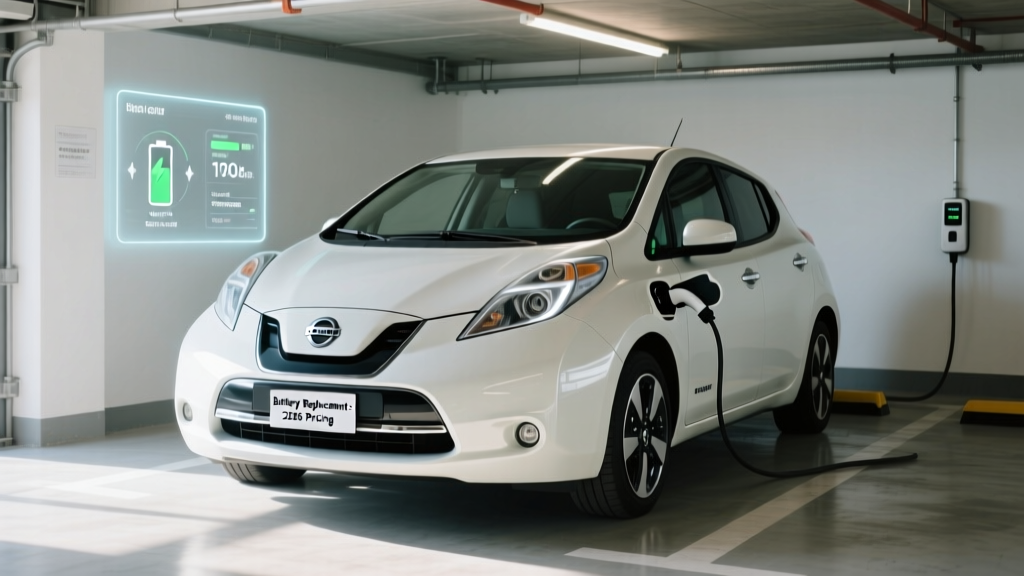
If you own a first-generation Nissan LEAF — especially a 2013 model with the original 24 kWh battery — you've likely noticed the range dropping. A car that once delivered 73–84 miles of EPA-rated range may now struggle to hit 50 miles on a full charge. That degradation raises the critical question: what does a 2013 Nissan LEAF battery replacement cost in 2026, and is it worth it?
This guide breaks down exact replacement pricing, battery chemistry trade-offs, degradation benchmarks across the EV industry, and practical steps to maximize whatever pack you're running — whether it's in a 2013 LEAF or a brand-new 2026 model.
2013 Nissan LEAF Battery Replacement Cost: What You'll Actually Pay
The 2013 LEAF shipped with a 24 kWh lithium-ion traction battery using manganese-based chemistry (LMO/NMC blend). Nissan also offered a dealer-installed 30 kWh upgrade in later years. Here's what replacement looks like in 2026:
| Battery Pack | Capacity | Part Cost (OEM/Refurb) | Labor (2–4 hrs) | Total Estimated Cost |
|---|---|---|---|---|
| 24 kWh OEM New | 24 kWh | $6,500–$8,500 | $400–$800 | $6,900–$9,300 |
| 24 kWh Refurbished | 24 kWh | $3,500–$5,500 | $400–$800 | $3,900–$6,300 |
| 30 kWh OEM New | 30 kWh | $7,500–$10,000 | $400–$800 | $7,900–$10,800 |
| 30 kWh Refurbished | 30 kWh | $4,000–$6,500 | $400–$800 | $4,400–$7,300 |
| 40 kWh Upgrade (2018+ pack retrofit) | 40 kWh | $8,000–$12,000 | $600–$1,200 | $8,600–$13,200 |
Key context: A 2013 LEAF's current resale value typically ranges from $3,000 to $6,500 depending on condition and mileage. A brand-new OEM battery can exceed the car's value — which is why most owners opt for refurbished packs or pursue the 40 kWh retrofit for a meaningful range bump (roughly 107–150 EPA miles with the newer pack).
Real-World Range Reality for the 2013 LEAF: The original EPA rating was 75 miles (24 kWh) and 107 miles (30 kWh). In 2026, a 13-year-old 24 kWh pack with 30–40% degradation may deliver only 40–55 miles in mild weather and 30–40 miles in cold conditions (below 35°F). Highway driving at 70+ mph further reduces range by 15–25% versus city use.
Why EV Batteries Degrade — and How Much to Expect
All lithium-ion batteries lose capacity over time. The 2013 LEAF's air-cooled battery is particularly susceptible to heat-related degradation because it lacks the liquid thermal management systems found in modern EVs like the Tesla Model 3 or Hyundai Ioniq 5. Here's what the data shows:
Typical EV Battery Degradation Benchmarks:
- Air-cooled packs (2011–2017 LEAF): 20–40% capacity loss by year 10, depending on climate. Hot-climate states (AZ, TX, CA inland) see the worst outcomes.
- Liquid-cooled packs (Tesla, GM, Hyundai, Ford): 8–15% capacity loss over 10 years / 150,000 miles, per data aggregated by Recurrent Auto.
- LFP chemistry packs (Tesla Model 3 RWD, BYD): 5–10% loss over equivalent mileage, with slower calendar aging.
- Industry average (all chemistries): ~1.5–2.5% loss per year for the first 5 years, then a slower linear decline.
The 2013 LEAF's LMO/NMC chemistry combined with passive air cooling makes it an outlier on the high-degradation end. Owners in Phoenix or Las Vegas have reported capacity bars dropping to 8/12 or even 7/12 (Nissan's dashboard health indicator) within 6–8 years.
EV Battery Warranty: What's Covered and for How Long
Federal law mandates that EV battery warranties cover a minimum of 8 years / 100,000 miles (10 years / 150,000 miles in CARB states like California). For a 2013 LEAF, that factory warranty expired years ago — but understanding current warranty structures helps if you're considering a newer EV.
| Vehicle | Warranty Term | Capacity Threshold | Chemistry |
|---|---|---|---|
| Nissan LEAF (2025–2026) | 8 yr / 100,000 mi | Below 70% (9 bars) | NMC |
| Tesla Model 3 Long Range | 8 yr / 120,000 mi | Below 70% | NMC/NCA |
| Tesla Model 3 RWD | 8 yr / 100,000 mi | Below 70% | LFP |
| Hyundai Ioniq 5 | 10 yr / 100,000 mi | Below 70% | NMC |
| Chevrolet Equinox EV | 8 yr / 100,000 mi | Below 60% | NMC (Ultium) |
| BYD Seal (if US-available) | 8 yr / 100,000 mi | Below 70% | LFP (Blade) |
What triggers a warranty claim? If your battery's State of Health (SoH) drops below the stated threshold — typically 70% of original capacity — within the warranty period, the manufacturer will repair or replace it at no cost. For the 2013 LEAF, the original warranty used a "capacity bar" system: dropping below 9 of 12 bars (roughly 75% SoH) within 5 years/60,000 miles triggered coverage. That warranty is long expired for 2013 models.
LFP vs. NMC vs. NCA: Which Battery Chemistry Is Best?
Battery chemistry is the single biggest factor in longevity, cost, and real-world performance. The 2013 LEAF used an older LMO/NMC blend, but today's EV buyers choose primarily between LFP and NMC/NCA.
| Attribute | LFP (Lithium Iron Phosphate) | NMC (Nickel Manganese Cobalt) | NCA (Nickel Cobalt Aluminum) |
|---|---|---|---|
| Energy Density | Lower (~160 Wh/kg cell) | Higher (~220–260 Wh/kg cell) | Highest (~260–300 Wh/kg cell) |
| Cycle Life | 3,000–5,000+ cycles | 1,000–2,000 cycles | 800–1,500 cycles |
| Calendar Aging | Slower degradation | Moderate degradation | Moderate degradation |
| Cold Performance | Weaker below 32°F (slower charging, ~15–20% range loss) | Better cold tolerance (~10–15% range loss) | Better cold tolerance (~10–15% range loss) |
| Cost | Lower (no cobalt/nickel) | Higher (cobalt, nickel) | Higher (cobalt, nickel) |
| Safety / Thermal Stability | Excellent (resists thermal runaway) | Good (requires active cooling) | Good (requires active cooling) |
| Charging to 100% Daily | Recommended (BMS calibration) | Not recommended (80% daily target) | Not recommended (80% daily target) |
| Used In | Tesla Model 3 RWD, BYD, Ford base models | Hyundai, Kia, VW, most Long Range EVs | Tesla Long Range/Performance, Rivian |
Which is better? For longevity and cost, LFP wins — it lasts significantly more charge cycles and uses cheaper materials. For range and cold-weather performance, NMC/NCA wins. If you live in a warm climate and charge at home daily, LFP is the smarter long-term bet. If you need maximum range or live in a cold region, NMC/NCA is preferable. The 2013 LEAF's older LMO chemistry is inferior to both on every metric.
Factors That Kill (or Extend) Your EV Battery
Whether you're trying to squeeze more life from a 2013 LEAF pack or protect a brand-new 2026 EV, these factors have the biggest impact on battery longevity:
Battery Care Best Practices (Data-Backed):
- Avoid frequent DC fast charging. Repeated 50+ kW sessions accelerate degradation, especially in air-cooled packs like the LEAF. Reserve DCFC for road trips; use Level 2 at home. Per IDTechEx research, vehicles that DCFC more than 3x/week show ~2–4% additional capacity loss over 5 years versus Level 2-only charging.
- Keep State of Charge (SoC) between 20–80% for NMC/NCA. Sitting at 100% for extended periods stresses the cathode. LFP owners can charge to 100% daily without penalty.
- Avoid extreme heat exposure. The 2013 LEAF's air-cooled pack is especially vulnerable. Park in shade or a garage whenever possible. Battery temperatures above 104°F (40°C) accelerate chemical degradation permanently.
- Don't store at 0% or 100% SoC. If leaving the car unused for weeks, target 50% SoC.
- Precondition the battery before fast charging. Modern EVs do this automatically; the 2013 LEAF does not — another reason its packs degrade faster during DCFC.
- Minimize high-speed driving in extreme heat. Sustained 80+ mph driving generates significant battery heat, especially in passively cooled packs.
How to Check Your EV Battery's State of Health (SoH)
State of Health (SoH) is the percentage of original capacity your battery retains. A 24 kWh pack at 75% SoH holds only 18 kWh of usable energy — directly reducing your range.
For the 2013 Nissan LEAF:
- Dashboard capacity bars: The LEAF displays 12 bars on the far right of the instrument cluster. 12/12 = ~100% SoH; 9/12 ≈ 75%; 8/12 ≈ 65–70%. This is a rough estimate — not precise.
- Leaf Spy Pro (OBD-II app): A $20 Bluetooth OBD-II dongle plus the Leaf Spy app ($10–20) gives you exact SoH percentage, cell voltage variance, battery temperature, and charge/discharge power. This is the gold standard for LEAF owners.
- Dealer diagnostic: Nissan dealers can run a battery health report, typically for $50–$100 if not covered under a service visit.
For modern EVs (2020+):
- Most vehicles display SoH in the settings menu or via the companion app (Tesla, Hyundai, BMW).
- OBD-II tools like OBD2 scanners with EV-specific software (e.g., OBDeleven for VW/Audi, Car Scanner for Tesla) pull SoH data from the BMS.
- Services like Recurrent offer free battery health reports by connecting to your vehicle's telematics data.
Is Replacing a 2013 LEAF Battery Worth It?
This is an economic calculation, not just a technical one. Consider these factors:
Replace the battery if:
- You depend on the LEAF as a daily driver and the degraded range no longer meets your commute needs.
- The rest of the car is in excellent condition (no rust, good tires, functioning A/C and electronics).
- You can source a refurbished 24 kWh pack for under $5,000 installed — bringing the total investment to around $8,000–$11,000 for a car with renewed 60–70 mile range.
- You opt for the 40 kWh retrofit (if available through a specialist) to gain ~120+ miles of range, effectively modernizing the car.
Don't replace — consider trading or retiring — if:
- The battery replacement cost exceeds the car's total value and you lack sentimental attachment.
- You want modern safety features (the 2013 LEAF lacks automatic emergency braking, lane-keep assist, and has a 3-star NHTSA overall rating).
- You want DC fast charging speeds above 50 kW (the 2013 LEAF peaks at ~47 kW and tapers aggressively).
- A used EV like a 2019–2021 LEAF (40 or 62 kWh, liquid-cooled in newer trims) or a used Bolt EV can be had for $10,000–$15,000 with far more range and a remaining battery warranty.
Emerging Battery Tech: What's on the Horizon
While solid-state batteries and silicon-anode cells dominate headlines, realistic timelines matter for today's buyers:
- Solid-state batteries: Toyota, Nissan, and Samsung SDI have announced pilot production for 2027–2029, with commercial availability in limited models expected around 2028–2030. These promise 30–50% more energy density, faster charging (10–80% in ~10 minutes), and improved safety. However, costs will initially be high, limiting adoption to premium models.
- Silicon-anode batteries: Companies like Sila Nanotechnologies and Group14 are supplying silicon-dominant anode materials to Mercedes-Benz and others for 2025–2027 models. These offer 10–20% energy density gains over graphite anodes and faster charge acceptance.
- Sodium-ion batteries: CATL and BYD have begun producing sodium-ion packs for budget EVs in China (2024–2026). These are cheaper than LFP but have lower energy density — suitable for city cars, not long-range vehicles. US availability remains uncertain.
- LFP improvements: CATL's second-generation LFP cells (2025–2026) push energy density to ~180 Wh/kg, narrowing the gap with NMC while maintaining the cycle-life advantage.
Bottom line: None of these technologies are available in a 2013 LEAF retrofit. If you're buying a new EV in 2026, you're choosing between mature LFP and NMC/NCA — both of which, with proper care, will outlast the typical ownership period.
Frequently Asked Questions
How long do EV batteries last in years and miles?
Most modern liquid-cooled EV batteries (2018+) retain 85–92% of original capacity at 150,000 miles / 10 years. Air-cooled packs like the 2013 LEAF degrade faster — often reaching 60–75% SoH by year 10 in warm climates. Complete battery failure (the car won't drive) is rare; gradual capacity loss is the norm. Many EV batteries outlast the vehicle's body, suspension, and electronics.
How much does an EV battery cost to replace?
Replacement costs vary dramatically by model and pack size. Small packs (24–40 kWh): $4,000–$10,000. Mid-size packs (60–80 kWh): $8,000–$16,000. Large packs (90–100+ kWh): $12,000–$22,000+. Refurbished packs typically cost 40–60% less than new OEM. Labor adds $400–$1,500 depending on complexity. The 2013 Nissan LEAF battery replacement cost falls in the $3,900–$9,300 range depending on pack choice and new vs. refurbished.
What does the EV battery warranty actually cover?
Battery warranties cover capacity loss below a specified threshold (usually 70% SoH) and manufacturing defects. They do not cover damage from accidents, flooding, or aftermarket modifications. Federal minimum is 8 years / 100,000 miles; some brands (Hyundai, Kia) extend to 10 years. For a 2013 LEAF, the original 5-year/60,000-mile capacity warranty and 8-year/100,000-mile defect warranty have both expired.
How do I check and maximize my EV battery's health?
Check SoH via the vehicle's built-in display, an OBD-II diagnostic tool (Leaf Spy for LEAF, OBDeleven for VW, Car Scanner for Tesla), or a dealer service visit. Maximize health by: charging to 80% daily (NMC/NCA) or 100% (LFP), avoiding DC fast charging when possible, parking in shade/garages, preconditioning before fast charging, and not storing the vehicle at 0% or 100% SoC for extended periods.
LFP vs. NMC — which battery chemistry is better and why?
LFP wins on longevity (3,000–5,000 cycles vs. 1,000–2,000), cost (no cobalt), and safety (superior thermal stability). NMC wins on energy density (more range per kWh of battery weight) and cold-weather performance. Choose LFP if you prioritize long-term durability and home-charge daily in a moderate climate. Choose NMC/NCA if you need maximum range, tow frequently, or live in a cold region. Both chemistries in 2026 EVs will comfortably last 150,000+ miles with proper care.
Can I upgrade my 2013 LEAF to a bigger battery?
Yes, but it's complex. Some independent EV shops offer 40 kWh or even 62 kWh pack retrofits from later LEAF models (2018+). Costs range from $8,600 to $15,000+ installed. This requires compatible BMS software and sometimes wiring harness modifications. The range improvement is significant (120–215 EPA miles depending on pack), but the investment may exceed the car's value. Check with LEAF specialist shops like Muxsan or EV shops in your area for current availability and pricing.