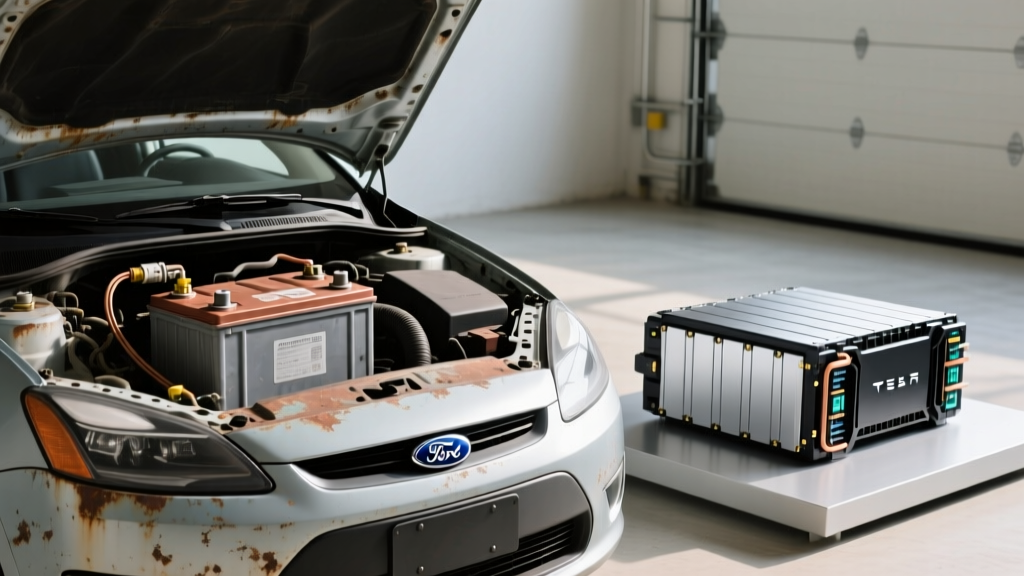
If you've ever searched for a 2006 Ford Focus battery, you were almost certainly looking for a 12-volt lead-acid starter battery — the kind that cranks a 2.0L inline-four engine and costs about $120 at an auto parts store. Fast-forward to 2026, and the word "battery" in an automotive context means something radically different: a 60-to-100+ kWh lithium-ion traction pack that powers an electric vehicle for hundreds of miles. Understanding the leap between the two — and more importantly, understanding how modern EV batteries actually work, age, and cost — is essential for anyone considering an electrified vehicle.
This guide bridges that gap. We'll start with what made the 2006 Focus battery simple, then move deep into the chemistry, degradation science, warranty structures, replacement economics, and emerging technology that define EV ownership in 2026.
The 2006 Ford Focus Battery: A Baseline for Comparison
The 2006 Ford Focus used a Group 59 or Group 96R 12V lead-acid battery rated at roughly 550–650 cold-cranking amps (CCA) and about 0.5 kWh of total energy storage. Its job was singular: spin the starter motor and run accessories when the alternator wasn't active. Replacement was a five-minute DIY job, and a new battery cost between $90 and $160.
That simplicity is the defining contrast. A modern EV traction battery stores 100 to 200 times more energy, operates at 400–800 volts, weighs 800–1,200 pounds, and requires sophisticated thermal management, cell-balancing electronics, and high-voltage safety interlocks. Yet the fundamental question buyers ask remains the same: how long will it last, and what happens when it wears out?
EV Battery Chemistry in 2026: LFP vs NMC vs NCA
Not all lithium-ion batteries are the same. The cathode chemistry determines energy density, cycle life, cold-weather behavior, and cost. In 2026, two chemistries dominate the EV market, with a third present in premium and performance applications:
- LFP (Lithium Iron Phosphate): Used in standard-range Tesla Model 3/Y, BYD vehicles, and several entry-level EVs from Ford and others. No cobalt or nickel.
- NMC (Nickel Manganese Cobalt): Found in most long-range EVs from Hyundai, Kia, BMW, VW, and GM.
- NCA (Nickel Cobalt Aluminum): Primarily Tesla's long-range and performance models.
| Attribute | LFP | NMC (811/622) | NCA |
|---|---|---|---|
| Energy density (cell-level) | 160–180 Wh/kg | 220–260 Wh/kg | 250–280 Wh/kg |
| Cycle life (to 80% SoH) | 3,000–5,000+ | 1,500–2,500 | 1,200–2,000 |
| Cold-weather performance | Moderate loss (~15–20% at 20°F) | Better (~10–15% at 20°F) | Better (~10–15% at 20°F) |
| Cost per kWh (pack-level) | ~$95–$110 | ~$120–$145 | ~$130–$155 |
| Thermal runaway risk | Very low | Low | Low (requires more management) |
| Recommended daily SoC | 100% OK | 80% recommended | 80% recommended |
| Typical use case | Standard range, fleet, daily commuter | Long range, AWD, premium | Performance, max range |
Which is better? It depends on your driving pattern. If you commute 30–50 miles daily and charge at home, an LFP pack offers superior longevity and the convenience of daily 100% charging. If you regularly drive 200+ miles between charges or need maximum range in cold climates, NMC or NCA delivers the energy density you need. Neither is universally "better" — the trade-off is range-per-charge versus total lifetime cycles.
How Long Do EV Batteries Actually Last?
The short answer: almost certainly longer than you'll own the car. But the data tells a more nuanced story.
According to fueleconomy.gov, modern lithium-ion EV batteries are engineered to retain at least 70–80% of their original capacity after 100,000–150,000 miles. Real-world fleet data supports this:
Observed Degradation Data Points (2020–2025 Model Years):
- Tesla Model 3/Y (NCA/NMC, 2020–2023): ~5–7% loss at 100,000 miles per Tesla's 2024 Impact Report. Fleet data from Recurrent Auto shows median 94% SoH at 60,000 miles.
- Chevrolet Bolt EV/EUV (NMC, 2017–2023): ~8–12% loss at 100,000 miles. Earlier 2017–2019 models saw slightly higher degradation before GM's battery recall and replacement program.
- Hyundai Ioniq 5 (NMC, 2022–2025): Limited long-term data; early fleet averages show ~3–5% loss at 40,000 miles.
- Tesla Model 3 Standard Range (LFP, 2021–2025): Projected 3–5% loss at 100,000 miles based on LFP cycle-life advantages, though real-world 150k+ mile data is still accumulating.
- Ford Mustang Mach-E (NMC, 2021–2025): ~5–8% loss at 60,000 miles based on owner-reported data via FordPass.
The critical insight: degradation is non-linear. Most EV batteries lose 2–5% capacity in the first year (the "break-in" drop), then settle into a slow, linear decline of roughly 1–2% per year or per 15,000–20,000 miles. A battery reaching 80% State of Health (SoH) at 150,000 miles still provides substantial range — a 75 kWh pack at 80% SoH delivers 60 usable kWh, which in a vehicle rated at 3.5 miles/kWh still yields ~210 miles per charge.
What Does the Battery Warranty Actually Cover?
Federal law mandates a minimum 8-year/100,000-mile warranty on EV battery packs for vehicles sold in the United States, and most manufacturers meet or exceed this standard. Some states with California Air Resources Board (CARB) alignment extend this to 10 years/150,000 miles.
| Vehicle | Warranty Term | Capacity Threshold | Notes |
|---|---|---|---|
| Tesla Model 3/Y (Standard Range, LFP) | 8 yr / 100,000 mi | 70% retention | Limited to manufacturing defects + capacity below threshold |
| Tesla Model 3/Y (Long Range, NCA) | 8 yr / 120,000 mi | 70% retention | Higher mileage cap reflects NCA pack |
| Hyundai Ioniq 5 / Ioniq 6 | 10 yr / 100,000 mi | 70% retention | Among the longest terms in the industry |
| Ford Mustang Mach-E | 8 yr / 100,000 mi | 70% retention | Covers battery components + capacity |
| Chevrolet Equinox EV / Blazer EV | 8 yr / 100,000 mi | 60% retention (varies) | Verify specific model-year terms with dealer |
| BMW i4 / iX | 8 yr / 100,000 mi | 70% retention | Transferable to second owner |
| Kia EV6 / EV9 | 10 yr / 100,000 mi | 70% retention | Matches Hyundai's industry-leading term |
What's covered: Manufacturing defects, cell failures, module imbalances, and capacity loss below the stated threshold. If your 75 kWh pack drops below 52.5 kWh (70%) within the warranty window, the manufacturer must repair or replace it at no cost.
What's not covered: Damage from accidents, flooding, unauthorized modifications, or failure to follow recommended maintenance (e.g., ignoring coolant service intervals for liquid-cooled packs). Normal degradation above the threshold is also excluded — a pack at 72% SoH at year 9 is technically "within spec."
EV Battery Replacement Cost: The Honest Numbers
This is where fear-mongering runs rampant, so let's anchor the discussion in data. Yes, an out-of-warranty EV battery replacement is expensive. But context matters enormously:
| Vehicle / Battery Size | Chemistry | Estimated Part Cost | Labor | Total Range |
|---|---|---|---|---|
| Tesla Model 3 Standard Range (~57 kWh) | LFP | $5,500–$7,500 | $1,000–$1,800 | $6,500–$9,300 |
| Tesla Model Y Long Range (~81 kWh) | NCA | $9,000–$13,000 | $1,200–$2,000 | $10,200–$15,000 |
| Hyundai Ioniq 5 (~77.4 kWh) | NMC | $8,500–$12,000 | $1,500–$2,500 | $10,000–$14,500 |
| Ford Mustang Mach-E ER (~91 kWh) | NMC | $10,000–$14,000 | $1,500–$2,500 | $11,500–$16,500 |
| Chevrolet Silverado EV (~200 kWh) | NMC (Ultium) | $20,000–$30,000 | $2,500–$4,000 | $22,500–$34,000 |
| BMW iX xDrive50 (~111 kWh) | NMC | $14,000–$20,000 | $2,000–$3,500 | $16,000–$23,500 |
When is replacement actually needed? Almost never during the first owner's tenure. The vast majority of EV batteries outlast 200,000 miles before dropping below 70% SoH. When replacements do occur under warranty, they're typically due to individual cell or module failures, not wholesale capacity loss. Some manufacturers (notably BMW and Hyundai) can replace individual modules rather than the entire pack, reducing costs significantly.
Consider the comparison: a 2006 Ford Focus timing belt replacement ran $600–$900, and an engine or transmission rebuild could exceed $3,000–$5,000. EV owners trade that mechanical risk for battery risk — but the data shows battery risk is statistically lower over a 10-year ownership period.
Factors That Accelerate (or Preserve) Battery Life
Battery longevity isn't purely a function of time and mileage. How you charge and drive has measurable impact:
What Hurts Your Battery:
- Frequent DC fast charging above 150 kW: Occasional road-trip fast charging is fine. Daily use of 150–350 kW chargers generates sustained heat that accelerates electrolyte decomposition. Studies from the Idaho National Laboratory showed packs exclusively fast-charged degraded ~5–8% more over 50,000 miles than packs charged primarily on Level 2.
- Sustaining 100% SoC for long periods (NMC/NCA): Sitting at full charge stresses the cathode. If you don't need 100%, set your charge limit to 80% for daily use. LFP is the exception — manufacturers recommend periodic 100% charges for cell balancing.
- Deep discharges below 10% SoC: Consistently running the pack to near-zero stresses the anode. The buffer helps (most EVs reserve 2–5 kWh below the displayed 0%), but habitually arriving at 0% is suboptimal.
- Extreme heat exposure: Parking in 110°F+ desert heat for extended periods without thermal management active can cause calendar degradation. Most modern EVs run cooling even when parked, but this draws from the pack.
- Ignoring coolant service: Liquid-cooled battery systems require periodic coolant replacement (typically every 4–5 years). Neglecting this can impair thermal management and accelerate degradation.
What Preserves Your Battery:
- Level 2 home charging (7–11 kW): Gentle, low-heat charging is the gold standard for daily use.
- Keeping SoC between 20–80% (NMC/NCA): This "middle zone" minimizes cathode and anode stress.
- Preconditioning before fast charging: Warming or cooling the pack to optimal temperature (typically 25–35°C) before DC charging reduces thermal stress and improves charge speed. Most EVs do this automatically when you navigate to a charger.
- Moderate ambient storage: Garage parking in extreme climates significantly reduces calendar degradation.
Monitoring Battery Health: How to Check SoH
State of Health (SoH) is the percentage of your battery's original capacity that remains usable. A new 75 kWh pack at 95% SoH has ~71.25 kWh available. Here's how to check it:
- OEM apps: Tesla's app shows estimated range at 100% (from which you can calculate approximate SoH). Hyundai's Blue Link and FordPass provide battery health indicators. BMW's iDrive system displays a battery health percentage under vehicle settings.
- OBD-II diagnostic tools: Third-party tools like OBDeleven (for VW Group), LeafSpy (originally for Nissan Leaf, adapted for other platforms), and Tesla-specific scan tools can read cell-level voltage data and pack SoH directly from the BMS (Battery Management System).
- Manual calculation: Charge to 100%, note the displayed range, and compare it to the original EPA-rated range. If your 310-mile rated EV shows 285 miles at 100%, your approximate SoH is 285/310 = ~92%. This method has margin of error (displayed range adjusts for recent driving efficiency) but provides a reasonable estimate.
- Dealer diagnostics: Most service centers can run a full battery health report. Request this during routine service, especially if you're approaching warranty mileage thresholds.
What's Next: Solid-State, Silicon Anodes, and Realistic Timelines
Emerging battery technologies promise step-changes in energy density and charge speed, but timeline honesty is critical:
- Solid-state batteries: Replace the liquid electrolyte with a solid ceramic, polymer, or sulfide layer, potentially doubling energy density and enabling 10-minute fast charges. Toyota has announced a 2027–2028 production target for limited solid-state EVs. Samsung SDI and QuantumScape are targeting 2028–2030 for broader production. This technology is not available in any production vehicle as of 2026.
- Silicon anode batteries: Replacing graphite anodes with silicon can boost energy density by 20–40%. Sila Nanotechnologies and Group14 Technologies are supplying early silicon-dominant anode materials, with limited deployment in 2026–2027 model-year premium EVs. Expect incremental adoption, not a sudden revolution.
- Sodium-ion batteries: CATL and BYD are producing sodium-ion packs for lower-cost, shorter-range EVs in China. These offer ~120–160 Wh/kg (below LFP) but eliminate lithium entirely, reducing cost and supply-chain risk. US-market availability remains uncertain beyond 2028.
- LMFP (Lithium Manganese Iron Phosphate): An evolution of LFP adding manganese for ~15–20% higher energy density while retaining LFP's cost and safety advantages. Tesla and Ford have signaled interest; expect deployment in 2027–2028 model-year vehicles.
The practical takeaway: today's lithium-ion batteries are mature, reliable, and backed by extensive warranties. Waiting for solid-state is a valid choice if your purchase timeline extends to 2029+, but current EVs will not be obsolete when newer chemistries arrive — just as a 2020 Model 3 remains a compelling used EV today.
From the 2006 Focus to 2026 EVs: The Ownership Calculus
The 2006 Ford Focus battery was a consumable — a $120 item you swapped every 3–5 years without a second thought. The 2026 EV traction battery is a precision-engineered, actively managed system designed to outlast the vehicle around it. The economics have inverted: where the Focus required regular mechanical maintenance (timing belts, spark plugs, transmission fluid, oxygen sensors), the EV eliminates nearly all of that in exchange for a single high-value component that rarely fails within normal ownership.
If you're cross-shopping a used gas car against a new or used EV, the battery question shouldn't paralyze your decision. Check the SoH, verify the warranty status, understand the chemistry, and drive with confidence. The data is clear: the battery is almost never the reason an EV becomes uneconomical to own.
Frequently Asked Questions
How long do EV batteries last in years and miles?
Based on fleet data from Tesla, Recurrent Auto, and manufacturer reports, most modern EV batteries retain 70–85% of their original capacity at 150,000 miles or 10–12 years. Many will exceed 200,000 miles before dropping below the 70% warranty threshold. LFP chemistry packs are projected to last 300,000+ miles based on their 3,000–5,000+ cycle life ratings.
How much does an EV battery cost to replace out of warranty?
Replacement costs range from approximately $6,500 for a smaller LFP pack (e.g., Tesla Model 3 Standard Range) to $34,000 for a massive pack like the Chevrolet Silverado EV's ~200 kWh Ultium battery. Most mainstream EVs (60–90 kWh packs) fall in the $10,000–$16,000 range including labor. However, wholesale pack replacement is rare — module-level repairs often cost significantly less.
What does the EV battery warranty cover?
Federal law requires a minimum 8-year/100,000-mile warranty covering manufacturing defects and capacity loss below a specified threshold (typically 70% of original capacity). Some manufacturers, including Hyundai and Kia, extend this to 10 years/100,000 miles. The warranty does not cover accident damage, unauthorized modifications, or normal degradation above the threshold. Check IRS.gov for current federal EV incentive details that may offset purchase costs.
How do I check my EV's battery health?
Use your vehicle's companion app (Tesla, FordPass, Blue Link, etc.) to check estimated range at 100% charge and compare it to the original EPA rating. For more precise data, an OBD-II diagnostic tool can read SoH directly from the Battery Management System. Dealers can also run comprehensive battery health reports during service visits.
LFP vs NMC — which battery chemistry should I choose?
Choose LFP if: you charge at home daily, commute under 100 miles, want maximum cycle life, and prefer the convenience of regular 100% charging. Choose NMC if: you need maximum range per charge (300+ miles), regularly drive in cold weather, or take frequent road trips requiring DC fast charging. LFP is the longevity champion; NMC is the range champion. Neither is defective or risky — they serve different use cases.
Is the 12V battery in an EV the same as a 2006 Ford Focus battery?
Functionally similar but not identical. EVs still use a 12V auxiliary battery (sometimes lead-acid, increasingly lithium-iron-phosphate) to power computers, lights, and accessories. However, the 12V battery in an EV is charged by a DC-DC converter from the main traction pack, not by an alternator. The 2006 Focus battery and the EV's 12V battery serve the same low-voltage role, but the EV's high-voltage traction battery (400–800V, 50–200 kWh) is an entirely different system that the Focus never had.
Does fast charging damage my EV battery?
Occasional DC fast charging (road trips, a few times per month) has minimal impact on battery health. Daily exclusive use of 150+ kW fast chargers does accelerate degradation — Idaho National Laboratory testing showed roughly 5–8% additional capacity loss over 50,000 miles compared to Level 2 charging. Modern thermal management systems mitigate much of this, but Level 2 home charging remains the gentler, recommended daily approach.