If you own or are considering a used 2013 Hyundai Sonata Hybrid, the high-voltage battery is likely your biggest concern — and your biggest unknown. Unlike a conventional 12V auxiliary battery that powers lights and accessories, the traction battery is the core energy storage system that enables electric propulsion, regenerative braking, and the fuel economy this sedan is known for. In 2026, these vehicles are over a decade old, and understanding battery health, replacement economics, and how this early hybrid system compares to modern electrified vehicles is essential for making a smart purchase or ownership decision.
This guide breaks down the 2013 Hyundai Sonata Hybrid battery in detail — from its nickel-metal hydride (NiMH) chemistry to real-world degradation patterns, replacement costs, and what today's buyers should know about maximizing remaining battery life. We'll also compare it against modern lithium-ion systems to give you full context.
2013 Hyundai Sonata Hybrid Battery: Core Specifications
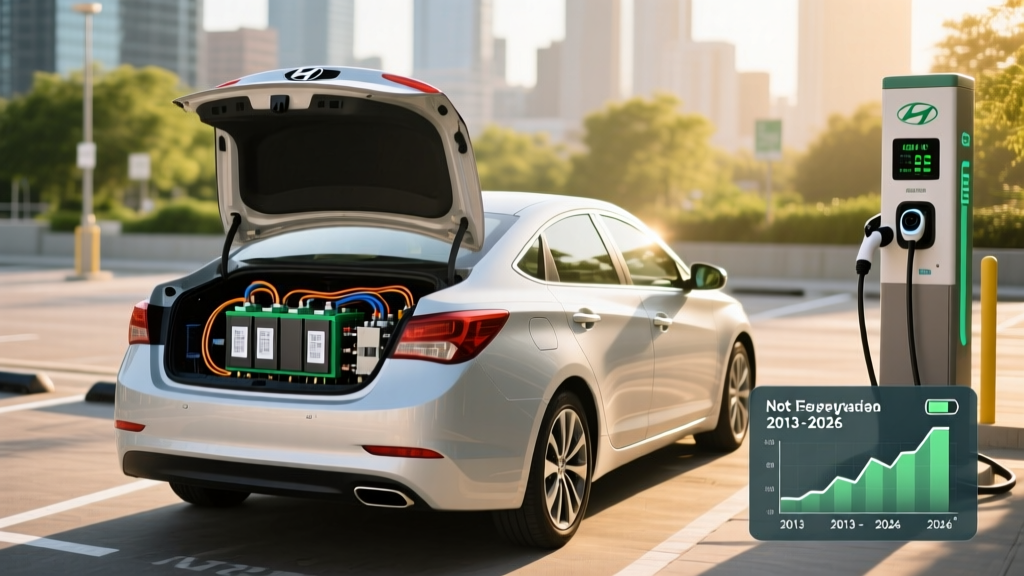
The 2013 Sonata Hybrid uses a 1.4 kWh nickel-metal hydride (NiMH) high-voltage battery pack manufactured by LG Chem. This is a relatively small pack by modern standards — it's designed for hybrid assist, not extended electric-only driving. Here's the full spec breakdown:
| Specification | Value |
|---|---|
| Battery Chemistry | Nickel-Metal Hydride (NiMH) |
| Gross Capacity | 1.4 kWh |
| Usable Capacity | ~0.9 kWh (hybrid buffer) |
| System Voltage | 270V nominal |
| Electric Motor Output | 40 kW (53 hp) |
| Combined System Output | 206 hp (2.4L I4 + electric motor) |
| EPA Fuel Economy (Combined) | 37 MPG |
| EV-Only Mode | Limited, low-speed only (~1 mile) |
| Battery Location | Behind rear seats, trunk area |
| Battery Cooling | Air-cooled (cabin air) |
The NiMH chemistry was the industry standard for hybrids in the early 2010s — the Toyota Prius used similar technology for years. While NiMH is heavier and less energy-dense than modern lithium-ion cells, it has proven remarkably durable in hybrid applications, with many packs lasting well beyond 150,000 miles.
How Long Does the 2013 Sonata Hybrid Battery Last?
Based on owner reports, service data, and hybrid battery longevity research, the 2013 Hyundai Sonata Hybrid NiMH battery typically lasts 150,000 to 200,000 miles or 12 to 15 years before requiring replacement or significant refurbishment. In 2026, many original batteries in these vehicles are approaching or have exceeded this window.
Real-world degradation data for NiMH hybrid batteries shows:
- Years 1-5 (0-75,000 mi): Minimal noticeable degradation; ~5-8% capacity loss. Fuel economy remains within 1-2 MPG of original.
- Years 6-10 (75,000-150,000 mi): Moderate degradation; ~10-18% capacity loss. Owners may notice slightly reduced electric assist and 1-3 MPG drop in combined driving.
- Years 11-15 (150,000-200,000+ mi): Accelerated degradation risk; 18-30% capacity loss. Check engine light or hybrid system warnings may appear. Fuel economy can drop 3-6 MPG below original rating.
According to data compiled by fueleconomy.gov, the 2013 Sonata Hybrid's original EPA rating was 37 MPG combined. Vehicles with degraded batteries in real-world testing often report 31-34 MPG combined — a meaningful but not catastrophic drop, since the gasoline engine remains the primary power source.
The key difference between this NiMH hybrid battery and a modern BEV lithium-ion pack: because the Sonata Hybrid battery is so small and is never deeply discharged (the hybrid control system maintains a state-of-charge buffer between roughly 40% and 80%), individual cell stress is lower. However, NiMH cells are more susceptible to "memory effect" and voltage depression from repeated shallow cycling over many years.
Battery Chemistry Explained: NiMH vs. Modern Lithium-Ion (LFP and NMC)
The 2013 Sonata Hybrid's NiMH battery represents an older generation of electrified vehicle technology. To understand where battery tech stands in 2026, here's how the major chemistries compare:
| Characteristic | NiMH (2013 Sonata Hybrid) | NMC/NCA (Modern EVs) | LFP (Modern EVs) |
|---|---|---|---|
| Energy Density | 60-120 Wh/kg | 200-300 Wh/kg | 140-180 Wh/kg |
| Cycle Life | 500-1,000 full cycles | 1,000-2,000 cycles | 3,000-5,000+ cycles |
| Cold Performance | Moderate loss below 32°F | 10-20% range loss at 20°F | 15-25% range loss at 20°F |
| Cost per kWh | N/A (legacy) | $110-$140/kWh (2026) | $80-$100/kWh (2026) |
| Thermal Stability | Good | Moderate (requires active cooling) | Excellent |
| Typical Application | HEV/PHEV (small packs) | BEV (long range) | BEV (standard range, fleet) |
| Degradation Rate | ~2-3%/year (hybrid use) | ~1.5-2.5%/year | ~1-1.5%/year |
NMC (Nickel Manganese Cobalt) and NCA (Nickel Cobalt Aluminum) chemistries dominate long-range EVs like the Tesla Model 3 Long Range, Hyundai Ioniq 6, and Ford Mustang Mach-E. They offer the highest energy density, enabling 300+ mile ranges, but are more expensive and require sophisticated thermal management.
LFP (Lithium Iron Phosphate) has surged in popularity since 2023, now used in the Tesla Model 3 RWD, standard-range Ford Mustang Mach-E, and BYD models. LFP trades some energy density for dramatically longer cycle life, better thermal stability, lower cost, and no cobalt. LFP packs can be charged to 100% daily without the degradation concerns of NMC — a significant ownership advantage.
For the 2013 Sonata Hybrid owner, the practical takeaway: NiMH was robust for its application but is now obsolete. If you're replacing a failed pack, you're sourcing legacy parts. If you're comparing this car to a modern hybrid or EV, the lithium-ion advantage in efficiency, power, and longevity is substantial.
2013 Hyundai Sonata Hybrid Battery Replacement Cost
Replacement costs for the 2013 Sonata Hybrid high-voltage battery vary significantly based on whether you choose a new OEM pack, a refurbished unit, or individual cell replacement:
| Option | Cost Range (2026) | Warranty | Notes |
|---|---|---|---|
| New OEM Battery (Hyundai) | $3,500 - $4,500 | 1 year / 12,000 mi (parts) | Limited availability; may require dealer order |
| Refurbished / Remanufactured Pack | $2,000 - $3,000 | 1-3 years / 12,000-36,000 mi | Most common choice for older vehicles; quality varies by supplier |
| Individual Cell Replacement | $800 - $1,500 | Varies by shop | Only viable if 1-2 cells are bad; requires specialized hybrid shop |
| Used Salvage Pack | $500 - $1,200 | None / 30 days | Highest risk; unknown remaining life |
| Labor (any option) | $300 - $700 | N/A | 2-4 hours at hybrid-certified shop |
Total replacement cost for the most common path — a refurbished pack with professional installation — typically lands between $2,500 and $3,500 in 2026. Given that a well-maintained 2013 Sonata Hybrid has a current market value of approximately $4,000-$7,000 depending on mileage and condition, a battery replacement represents a significant percentage of the vehicle's worth.
This is the economic reality that owners of aging hybrids face: the battery replacement decision is essentially a "total the car or invest in a repair" calculation. If the rest of the vehicle is in excellent condition, replacement makes sense. If the car has other aging components (suspension, transmission, AC compressor), it may be time to consider upgrading to a modern hybrid or EV.
What Does the Hyundai Hybrid Battery Warranty Cover?
Hyundai originally provided one of the best hybrid battery warranties in the industry for the 2013 Sonata Hybrid:
| Warranty Component | Coverage |
|---|---|
| Hybrid Battery | 8 years / 100,000 miles (10 yr / 150,000 mi in CARB states) |
| Hybrid System Components | 8 years / 100,000 miles |
| Capacity Retention Threshold | Not explicitly defined for NiMH (unlike modern BEV warranties at 70%) |
| Transferability | Fully transferable to second owners |
In 2026, virtually all 2013 Sonata Hybrids are out of factory warranty — even in CARB states (California, New York, Massachusetts, and others with extended emissions warranties), the 10-year/150,000-mile window has closed for most vehicles. This means any battery failure is an out-of-pocket expense.
For comparison, modern Hyundai electrified vehicles carry stronger warranty terms. The 2026 Hyundai Ioniq 5 (BEV) includes a 10-year/100,000-mile battery warranty with a 70% capacity retention guarantee — if the battery degrades below 70% of original capacity within the warranty period, Hyundai replaces it at no cost. This kind of explicit capacity threshold was not standard practice in 2013.
Factors That Accelerate Hybrid Battery Degradation
Not all 2013 Sonata Hybrid batteries age equally. Several factors determine whether your pack reaches 200,000 miles or fails at 120,000:
- Avoid prolonged storage at extreme SoC: Don't leave the car sitting for weeks with the battery fully depleted or fully charged. Drive it at least once every two weeks.
- Minimize extreme heat exposure: The Sonata Hybrid battery is air-cooled using cabin air. Park in shade or a garage when possible — sustained battery temperatures above 110°F accelerate cell degradation.
- Keep the cabin air intake clear: The battery cooling system draws from the rear cabin area. Don't block rear-seat vents with cargo or seat covers.
- Use the car regularly: NiMH cells perform best with consistent cycling. A daily-driven Sonata Hybrid will typically outlast one that sits unused for long periods.
- Address check engine / hybrid warnings immediately: A single failing cell module can stress the entire pack. Early diagnosis by a hybrid-qualified technician can save thousands.
- Maintain the 12V auxiliary battery: A weak 12V battery forces the hybrid system to work harder during startup cycles, adding stress to the high-voltage pack.
Cold weather is less damaging to NiMH than extreme heat, but winter performance does decline. Expect reduced electric-assist contribution and slightly lower MPG in sustained sub-freezing temperatures — typically a 2-4 MPG drop in combined driving when temperatures stay below 25°F.
How to Check Your Sonata Hybrid Battery Health
Unlike modern EVs that provide detailed State of Health (SoH) readouts through the infotainment system or app, the 2013 Sonata Hybrid does not have a built-in battery health display accessible to the owner. Here are your options:
- OBD-II Scan Tool with Hybrid Data: Devices like the ScanGauge II or Torque Pro (with hybrid-compatible adapters) can read battery voltage, individual cell module voltages, battery temperature, and state of charge in real time. Significant voltage imbalance between modules (>0.3V difference) indicates cell degradation.
- Dealer Diagnostic: A Hyundai dealer can run a hybrid battery health check using the GDS (Global Diagnostic System). This provides the most accurate assessment but typically costs $100-$150 as a standalone service.
- Independent Hybrid Shop: Specialists in hybrid repair often offer battery health assessments for $50-$100, and can identify individual weak cell modules.
- DIY Monitoring: Track your fuel economy over time. A sustained drop of 3+ MPG below your historical average (accounting for seasonal variation) is a strong indicator of battery degradation.
For modern EVs, checking SoH is far simpler — vehicles like the Tesla Model 3, Hyundai Ioniq 5, and Ford Mustang Mach-E display battery health metrics directly in the vehicle settings or companion app. Third-party tools like Recurrent also provide battery health reports for many connected EVs.
Emerging Battery Technology: What's Coming Next
While the 2013 Sonata Hybrid's NiMH battery is legacy technology, the broader battery landscape in 2026 is evolving rapidly. Here's what's on the horizon — with realistic timelines:
- Improved LFP Chemistry: CATL's second-generation LFP cells (now in production) offer energy density approaching 200 Wh/kg, closing the gap with NMC. Expect wider adoption in mid-range EVs and potentially future PHEVs.
- Silicon Anode Batteries: Companies like Sila Nanotechnologies and Group14 are commercializing silicon-dominant anodes that boost energy density by 20-40%. These are appearing in limited production vehicles in 2025-2026, with broader availability expected by 2028-2029.
- Solid-State Batteries: Toyota, Samsung SDI, and QuantumScape continue to develop solid-state cells promising 500+ mile range, 10-minute charging, and enhanced safety. However, mass production remains 2028-2030 at the earliest for mainstream vehicles. Early deployments are limited to low-volume, premium applications.
- Sodium-Ion Batteries: CATL and BYD have begun limited production of sodium-ion cells for budget EVs in China. These offer lower energy density but dramatically lower cost and no lithium dependency. US-market availability is expected in 2027-2028 for entry-level models.
None of these technologies are available for retrofitting into a 2013 Sonata Hybrid. They're relevant context if you're weighing whether to invest in a battery replacement for your current vehicle or upgrade to a newer electrified vehicle that benefits from these advances.
Should You Replace the Battery or Upgrade?
This is the core decision for 2013 Sonata Hybrid owners facing battery issues in 2026. Here's a practical framework:
- The vehicle has under 140,000 miles and is in excellent mechanical condition
- You can source a quality refurbished pack for under $2,500 installed
- You plan to keep the car for 3+ more years
- Your daily commute is under 40 miles and you don't need modern tech features
- The vehicle has over 160,000 miles or needs other major repairs
- Battery replacement quotes exceed $3,500 in your area
- You want modern safety features (AEB, blind-spot monitoring, lane-keeping) not available in 2013
- You're interested in a PHEV or BEV with dramatically lower operating costs and current §30D tax credit eligibility
For context, a 2026 Hyundai Sonata Hybrid starts at approximately $31,000 and achieves an EPA-rated 47 MPG combined — a 10 MPG improvement over the 2013 model — with a modern lithium-ion polymer battery and an updated warranty. The IRS §30D tax credit may apply to certain new PHEV and EV purchases, though eligibility depends on MSRP caps, buyer income limits, and battery sourcing requirements — consult a tax professional for your specific situation.
Frequently Asked Questions
How long does a 2013 Hyundai Sonata Hybrid battery last?
Typically 150,000 to 200,000 miles or 12 to 15 years. In 2026, most original batteries are at or beyond this window. Actual lifespan depends heavily on climate, driving habits, and whether the battery cooling system was maintained.
How much does it cost to replace a 2013 Sonata Hybrid battery?
Between $2,500 and $4,500 depending on whether you choose a refurbished pack (most common at $2,000-$3,000) or new OEM ($3,500-$4,500), plus $300-$700 in labor. Individual cell repair can cost $800-$1,500 if only one or two modules have failed.
Can I drive a 2013 Sonata Hybrid with a degraded battery?
Yes — the gasoline engine remains fully functional even with significant battery degradation. However, fuel economy will drop (potentially to 31-34 MPG from the original 37 MPG), acceleration may feel sluggish, and the hybrid system warning light may illuminate. Continued driving with a severely degraded pack can stress other hybrid components.
Is the 2013 Sonata Hybrid battery covered by any warranty in 2026?
No. Hyundai's original 8-year/100,000-mile hybrid battery warranty (10 years/150,000 miles in CARB states) has expired for all 2013 models. Any replacement is an out-of-pocket expense, though some refurbished battery suppliers offer their own 1-3 year warranties.
What's the difference between the high-voltage hybrid battery and the 12V battery?
The 2013 Sonata Hybrid has two batteries: a 1.4 kWh high-voltage NiMH traction battery (270V) that powers the electric motor and stores energy from regenerative braking, and a standard 12V lead-acid auxiliary battery that powers electronics, lights, and starts the control systems. The 12V battery is inexpensive ($100-$200) and straightforward to replace. The high-voltage pack is the expensive, complex component discussed in this guide. Never confuse the two — and never attempt to service the high-voltage system without proper training, as 270V can be lethal.
How does the Sonata Hybrid NiMH battery compare to a modern EV battery?
Modern EV batteries (NMC or LFP lithium-ion) offer dramatically higher energy density (200-300 Wh/kg vs. 60-120 Wh/kg for NiMH), longer cycle life (1,000-5,000+ cycles vs. 500-1,000), faster charging capability, and explicit capacity-retention warranties (70% over 8-10 years). A 2026 EV like the Hyundai Ioniq 5 carries a 77.4 kWh NMC pack — roughly 55 times the energy capacity of the Sonata Hybrid's 1.4 kWh NiMH pack — enabling 300+ miles of all-electric range.