From a 2012 Nissan Rogue Battery to Modern EV Packs: What Every Owner Should Know
If you've searched for "2012 Nissan Rogue battery" information, you're likely dealing with a 12-volt lead-acid starter battery replacement — a $150–$250 maintenance item that has nothing to do with electric vehicle propulsion. But that search often leads to a bigger question: how do modern EV high-voltage traction batteries compare in longevity, cost, and reliability to the conventional car batteries we've replaced for decades?
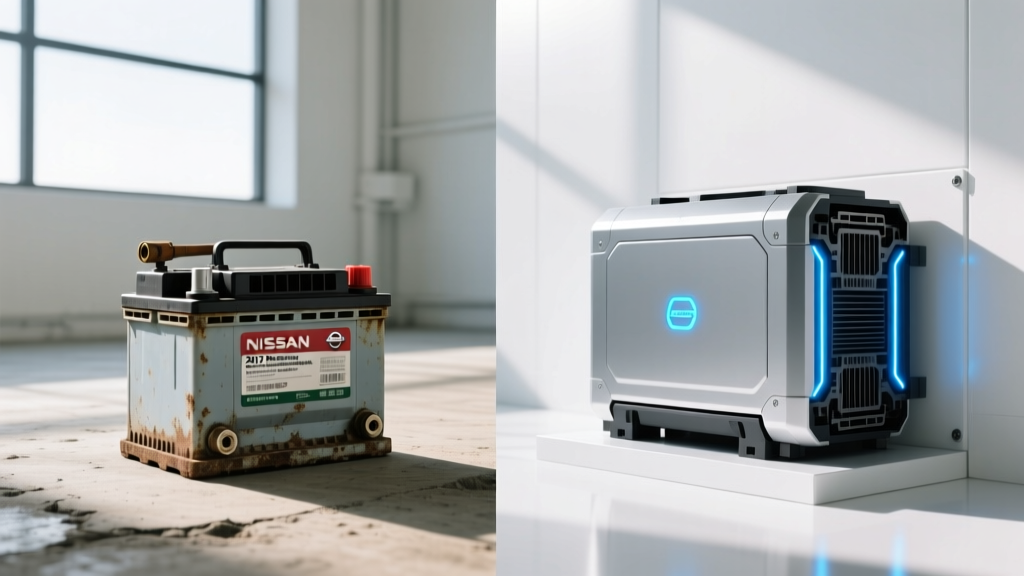
The answer is transformative. A 2012 Nissan Rogue uses a Group 35 lead-acid 12V battery rated for roughly 3–5 years. A 2026 EV traction battery — whether in a Nissan Ariya, Tesla Model Y, or Hyundai Ioniq 5 — is engineered to outlast the vehicle itself, with warranties covering 8 years or 100,000 miles and real-world data showing 10–15% capacity loss over 150,000+ miles.
This guide breaks down everything you need to know about modern EV battery technology, from chemistry trade-offs to replacement economics, so you can make an informed decision whether you're transitioning from a conventional vehicle or optimizing your current EV ownership.
Understanding EV Battery Chemistry: LFP vs NMC vs NCA
Modern EV batteries aren't one-size-fits-all. The two dominant lithium-ion chemistries in 2026 are Lithium Iron Phosphate (LFP) and Nickel Manganese Cobalt (NMC), with Nickel Cobalt Aluminum (NCA) appearing in select Tesla applications. Each has distinct trade-offs that affect range, longevity, and cost.
| Attribute | LFP (Lithium Iron Phosphate) | NMC/NCA (Nickel-based) |
|---|---|---|
| Energy Density | 160–180 Wh/kg (lower) | 220–260 Wh/kg (higher) |
| Cycle Life | 3,000–5,000+ cycles | 1,000–2,000 cycles |
| Cold-Weather Performance | Greater range loss below 32°F | Better low-temp efficiency |
| Cost per kWh | $80–$100 (lower) | $110–$140 (higher) |
| Thermal Stability | Excellent (less prone to thermal runaway) | Good (requires more active cooling) |
| State of Charge Tolerance | Can charge to 100% daily | Best kept 20–80% for longevity |
| Common Applications | Tesla Model 3 RWD, Model Y RWD, Ford Mustang Mach-E Select | Tesla Long Range, Hyundai Ioniq 5, most premium EVs |
Which is better? It depends on your use case. LFP excels for daily commuters who can charge to 100% without degradation worry and prioritize long cycle life. NMC/NCA delivers more range per pound, making it preferable for long-range models and cold-climate drivers. Tesla's shift to LFP in standard-range vehicles and Ford's LFP adoption for the Mach-E Select reflect the industry's confidence in LFP for mainstream applications.
How Long Do EV Batteries Actually Last? Real Degradation Data
The fear that EV batteries need replacement every few years — like the 12V battery in your 2012 Nissan Rogue — is a persistent myth. Real-world data from millions of EVs on the road tells a different story.
Typical EV Battery Degradation Curve:
- Year 1 (0–15,000 miles): 2–5% capacity loss (initial "break-in" degradation)
- Years 2–5 (15,000–75,000 miles): 1–2% per year (linear, gradual decline)
- Years 6–10 (75,000–150,000 miles): 0.5–1.5% per year (slowing degradation rate)
- Average at 100,000 miles: 85–90% State of Health (SoH)
- Average at 150,000 miles: 80–87% SoH
According to Geotab's analysis of over 10,000 EVs, the average electric vehicle loses approximately 2.3% of battery capacity per year. At that rate, a 2026 EV with a 300-mile EPA range would still deliver roughly 255 miles after 10 years — well within usable territory for most drivers.
The Nissan Leaf provides a cautionary tale about early EV battery design. The 2011–2017 Leaf used passive air cooling rather than active liquid thermal management, leading to accelerated degradation in hot climates. Some Arizona Leafs lost 20–30% capacity within 5 years. Modern EVs from 2020 onward universally employ liquid-cooled battery packs, largely eliminating this issue.
EV Battery Warranty Terms: What's Actually Covered
Federal law mandates that EV batteries carry a minimum warranty of 8 years or 100,000 miles (whichever comes first), with California Air Resources Board (CARB) states requiring 10 years or 150,000 miles. But the details matter — specifically, the capacity retention threshold that triggers a warranty claim.
| Manufacturer | Warranty Period | Capacity Threshold | Coverage |
|---|---|---|---|
| Tesla (Model 3/Y LFP) | 8 yr / 100,000 mi | 70% retention | Repair or replacement |
| Tesla (Long Range) | 8 yr / 120,000 mi | 70% retention | Repair or replacement |
| Hyundai/Kia | 10 yr / 100,000 mi | 70% retention | Repair or replacement |
| Ford | 8 yr / 100,000 mi | 70% retention | Repair or replacement |
| GM (Ultium platform) | 8 yr / 100,000 mi | 70% retention | Repair or replacement |
| Nissan Ariya | 8 yr / 100,000 mi | 70% retention (9 bars of 12) | Repair or replacement |
| Volkswagen ID.4 | 8 yr / 100,000 mi | 70% retention | Repair or replacement |
The 70% threshold is industry standard. If your battery drops below 70% of original capacity within the warranty period, the manufacturer must repair or replace it at no cost. In practice, very few modern liquid-cooled EV batteries fall below this threshold within warranty terms. Tesla's 2025 Impact Report noted that Model S/X batteries retain an average of 88% capacity at 150,000 miles, while Model 3/Y packs retain approximately 89%.
EV Battery Replacement Costs: When and How Much
Unlike the $180 battery you'd drop into a 2012 Nissan Rogue, EV traction battery replacement is a major service event — but one that's increasingly rare and increasingly affordable on a per-kWh basis.
| Vehicle | Battery Size | Replacement Cost (Parts + Labor) | Cost per kWh |
|---|---|---|---|
| Tesla Model 3 (LFP, 60 kWh) | 60 kWh | $8,000–$11,000 | $133–$183 |
| Tesla Model Y LR (82 kWh) | 82 kWh | $12,000–$16,000 | $146–$195 |
| Hyundai Ioniq 5 (77.4 kWh) | 77.4 kWh | $11,000–$15,000 | $142–$194 |
| Ford Mustang Mach-E ER (91 kWh) | 91 kWh | $14,000–$18,000 | $154–$198 |
| Chevrolet Equinox EV (85 kWh) | 85 kWh | $12,000–$16,000 | $141–$188 |
| Nissan Ariya (91 kWh) | 91 kWh | $13,000–$17,000 | $143–$187 |
Context matters enormously here. According to fueleconomy.gov, the average American drives 14,000 miles per year. At that rate, reaching 150,000 miles takes nearly 11 years — and most EV batteries still hold 80%+ capacity at that point. The vast majority of EVs are scrapped or sold with their original battery intact.
When replacement is needed, it's typically due to:
- Catastrophic failure (manufacturing defect — covered under warranty)
- Physical damage (collision, flooding — covered by insurance)
- Extreme age/mileage (200,000+ miles with gradual capacity loss below usable levels)
Battery pack costs have fallen from over $1,000/kWh in 2010 to approximately $130–$140/kWh at the cell level in 2026, according to BloombergNEF. Full pack replacement costs include labor, diagnostics, and dealer markup, pushing the total to $150–$200/kWh installed.
Factors That Accelerate (or Preserve) Battery Life
While modern EV batteries are remarkably durable, your habits influence how quickly they degrade. Understanding these factors helps you maximize longevity.
Factors That Accelerate Degradation
- Frequent DC fast charging above 150 kW — Repeated high-power charging generates heat stress; occasional use is fine, but daily 350 kW sessions add up
- Sustained 100% State of Charge — Leaving an NMC battery at 100% for days (especially in heat) accelerates calendar aging (LFP is more tolerant)
- Deep discharges to 0% — Regularly draining to empty stresses cells; keep above 10% when possible
- Extreme heat exposure — Parking in 100°F+ sun without thermal management active degrades cells faster
- Aggressive driving in extreme cold — High-power discharge from a frozen battery without preconditioning causes lithium plating risk
Habits That Maximize Battery Longevity
- Charge to 80% daily (NMC) or 100% daily (LFP) — Set your charge limit accordingly
- Use Level 2 home charging as your primary method (7–11 kW is gentle on cells)
- Precondition your battery before fast charging and before cold-weather driving
- Keep SoC between 20–80% for NMC; LFP owners can charge to 100% but benefit from occasional 20% discharge cycles for BMS calibration
- Park in shade or a garage when possible in hot climates
- Use scheduled charging to finish charging just before departure rather than sitting at high SoC overnight
The single most impactful habit? Avoiding sustained high State of Charge in hot weather. A 2024 study by Recurrent Auto found that EVs in moderate climates (Pacific Northwest, Northeast) showed 2–3% less degradation over 100,000 miles compared to identical models in Arizona and Texas, largely due to reduced thermal stress.
How to Check and Monitor Your EV Battery Health
Unlike the 2012 Nissan Rogue, where battery health meant checking voltage with a multimeter, modern EVs provide sophisticated State of Health (SoH) monitoring — though access varies by manufacturer.
Manufacturer Tools and In-Car Displays
Most EVs display battery health indirectly:
- Tesla: The mobile app shows estimated range at 100% charge; comparing this to original EPA range gives a rough SoH estimate. Third-party tools like Tessie or TeslaFi provide more granular data.
- Hyundai/Kia: The infotainment system includes an EV battery diagnostics page showing SoH percentage (Engineering Mode access required on some models).
- Nissan Ariya: Battery capacity indicator shows 12 bars; each bar represents roughly 8.3% of original capacity.
- GM (Ultium): The myChevrolet/myCadillac app provides battery health metrics.
- Ford: FordPass app shows estimated range and battery health status.
Third-Party Battery Health Reports
Services like Recurrent and AvtoTrend generate detailed battery health reports using OBD-II data, showing exact kWh capacity remaining, degradation curves, and projected lifespan. These reports are particularly valuable when buying a used EV, as they provide independent verification beyond the seller's claims.
The OBD-II Method
For technically inclined owners, an OBD-II dongle paired with apps like LeafSpy (Nissan), ABRP (general), or Scan My Tesla can read actual battery capacity in kWh, cell voltage variance, and temperature data — the most accurate way to assess SoH without dealer equipment.
Emerging Battery Technology: What's Coming (and When)
While today's lithium-ion batteries are mature and reliable, next-generation technologies promise step-change improvements. Here's a realistic timeline — noting that none of these are available in production vehicles as of 2026.
Solid-State Batteries
Solid-state batteries replace the liquid electrolyte with a solid conductor, promising 30–50% higher energy density, faster charging (potentially 10–80% in under 10 minutes), and improved safety. Toyota has announced solid-state EVs for 2027–2028, while Samsung SDI targets 2027 production. However, manufacturing scalability remains a significant challenge, and initial deployment will likely be limited to premium, low-volume models.
Silicon Anode Technology
Companies like Sila Nanotechnologies and Group14 are developing silicon-dominant anodes that can store 20–40% more energy than graphite anodes. The Mercedes G-Class 580e (PHEV) uses a silicon anode battery from Sila starting in 2025, and broader EV adoption is expected by 2027–2028 as production scales.
Sodium-Ion Batteries
CATL and BYD have begun deploying sodium-ion batteries in Chinese-market EVs, offering lower cost (no lithium, cobalt, or nickel) at the expense of lower energy density. These are best suited for affordable, short-range urban EVs and may reach Western markets by 2028–2029 in budget segments.
The practical takeaway? Today's lithium-ion batteries are proven, reliable, and sufficient for the vast majority of drivers. Waiting for solid-state is unnecessary unless you have very specific range or charging-speed requirements that current technology cannot meet.
Frequently Asked Questions
How long do EV batteries last in years and miles?
Modern liquid-cooled EV batteries typically last 15–20 years or 150,000–200,000+ miles before degrading below 70–80% of original capacity. Real-world data from Geotab and Recurrent Auto shows average degradation of 2.3% per year, meaning a 300-mile EV would still offer ~230 miles of range after 15 years. Most EV batteries outlast the vehicle they're installed in.
How much does it cost to replace an EV battery?
Out-of-warranty EV battery replacement costs range from $8,000 to $18,000 depending on battery size and vehicle model, translating to roughly $140–$200 per kWh installed. However, the vast majority of EV batteries never need replacement — they're designed to last the vehicle's lifetime, and most are still functional at 200,000+ miles. Warranty coverage (8 years/100,000 miles minimum, 70% capacity threshold) protects against premature failure.
What does an EV battery warranty actually cover?
EV battery warranties cover capacity loss below a defined threshold — typically 70% of original capacity — within the warranty period (usually 8 years/100,000 miles, or 10 years/150,000 miles in CARB states). If your battery drops below this threshold, the manufacturer repairs or replaces it at no cost. Warranties do not cover damage from accidents, modifications, or improper use, but they do cover manufacturing defects and normal degradation that exceeds the threshold.
How do I check my EV battery health?
Methods vary by manufacturer: Tesla owners can compare current 100% range to original EPA range via the app; Hyundai/Kia owners can access SoH percentage through Engineering Mode; Nissan Ariya owners can check the 12-bar capacity display. For the most accurate reading, use an OBD-II dongle with a compatible app (LeafSpy, Scan My Tesla, ABRP) to read actual kWh capacity. Third-party services like Recurrent also offer battery health reports using connected-car data.
Is LFP or NMC better for my EV?
LFP (Lithium Iron Phosphate) is better for daily commuters who want maximum cycle life, can charge to 100% without degradation concern, and prioritize lower cost. NMC/NCA (Nickel-based) is better for drivers who need maximum range, live in cold climates (better low-temperature performance), or frequently take long road trips. Neither is universally "better" — Tesla uses LFP in standard-range vehicles and NCA in Long Range models, reflecting this use-case split.
Does fast charging damage my EV battery?
Occasional DC fast charging (1–2 times per week) has minimal impact on modern battery health. However, daily use of high-power chargers (150–350 kW) does accelerate degradation slightly due to heat stress. A 2024 Recurrent Auto study found that EVs that fast-charged more than 90% of the time showed approximately 3–4% more degradation over 100,000 miles compared to those primarily using Level 2 home charging. The practical recommendation: use Level 2 at home as your primary method, and fast-charge on road trips or when needed — your battery will still last the vehicle's lifetime.
Will my EV battery need replacement before I sell the car?
Statistically, no. The average American keeps a vehicle for 8.4 years and drives 14,000 miles per year, totaling roughly 118,000 miles at trade-in. At that mileage, modern EV batteries typically retain 85–90% of original capacity — well above warranty thresholds and entirely usable. Battery replacement before selling is extremely rare and usually only occurs in high-mileage fleet vehicles or taxis exceeding 250,000 miles.
The Bottom Line: EV Batteries Are Built to Last
The gap between a 2012 Nissan Rogue's $180 lead-acid starter battery and a modern EV's $12,000+ lithium-ion traction pack is enormous — but so is the difference in longevity and capability. Where that Rogue battery might last 4 years, today's EV batteries are engineered for 15–20 years and 200,000+ miles, backed by warranties that protect against premature degradation.
The data is clear: EV battery replacement is a rare event, not an inevitable ownership cost. With proper care — moderate State of Charge habits, Level 2 home charging as your baseline, and preconditioning before fast charges — your EV battery will likely outlast your ownership of the vehicle. The fear of a catastrophic $15,000 bill is largely a relic of early, passively-cooled EVs like the first-generation Nissan Leaf, not a reflection of 2026's liquid-cooled, chemically optimized, warranty-backed reality.