If you've searched for a 2009 Ford F-150 battery, you likely already know the answer: it's a 12V lead-acid unit (Group 65, ~650–850 CCA) that costs roughly $120–$200 and needs replacement every 3–5 years. It exists solely to crank a 4.6L or 5.4L V8 and run accessories when the alternator isn't spinning. But that search also surfaces a much bigger question for truck buyers crossing over to electric: how do modern EV traction batteries compare in longevity, cost, and maintenance?
This guide answers that question with hard data — chemistry trade-offs, real-world degradation curves, warranty terms, replacement costs, and the emerging solid-state horizon. Whether you're keeping a legacy F-150 on the road or evaluating a 2026 Ford F-150 Lightning, understanding what's inside the battery pack is the single most important factor in long-term EV ownership.
The 2009 Ford F-150 Battery: A Quick Baseline
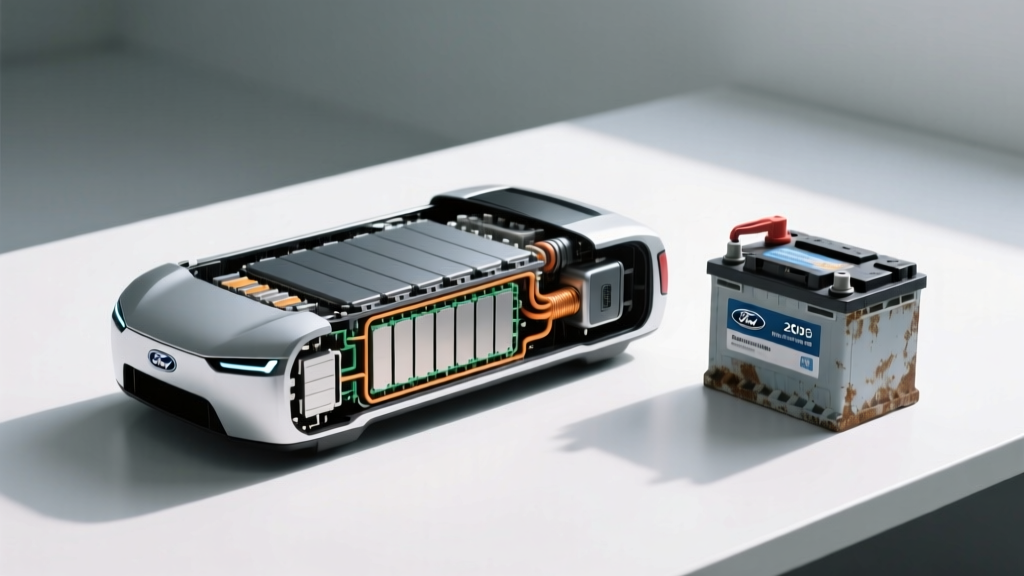
Before diving into EV traction packs, let's establish what a 2009 Ford F-150 battery actually is. It's a conventional flooded lead-acid or AGM 12V battery rated at around 12.8V nominal, 70–80 Ah, and 650–850 cold-cranking amps. It powers the starter motor, ECU, lights, and infotainment. Typical lifespan: 3–5 years, depending on heat exposure and parasitic drain. Replacement cost at an auto parts store: $120–$220.
By contrast, a modern EV like the 2026 F-150 Lightning carries two batteries: a small 12V lithium-ion auxiliary unit (similar role to the 2009's lead-acid) and a massive high-voltage traction battery ranging from 98 kWh (Standard Range) to 131 kWh (Extended Range) using NMC (nickel manganese cobalt) chemistry. That traction battery is what propels the truck, and it's engineered to last the life of the vehicle. Confusing the two is the single most common mistake new EV owners make.
EV Battery Chemistry: LFP vs NMC vs NCA Explained
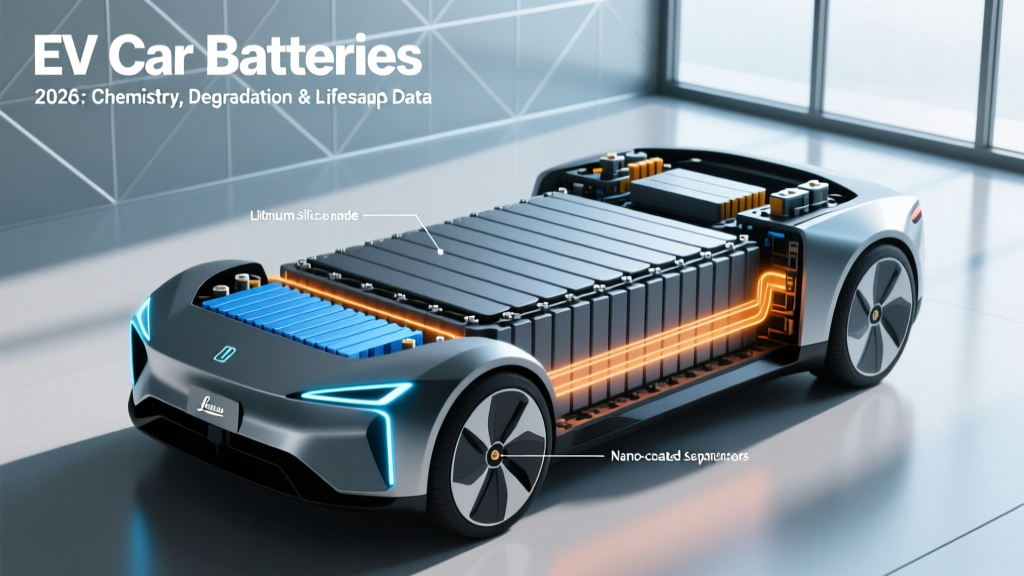
Not all EV batteries are the same. The two dominant lithium-ion chemistries in 2026 passenger vehicles are LFP (lithium iron phosphate) and NMC/NCA (nickel manganese cobalt / nickel cobalt aluminum). Each has distinct strengths.
| Attribute | LFP (LiFePO₄) | NMC / NCA |
|---|---|---|
| Energy Density | ~160–180 Wh/kg (lower) | ~220–260 Wh/kg (higher) |
| Typical Range Impact | Slightly shorter range for same pack weight | Longer range per kg |
| Cycle Life | 3,000–5,000+ cycles to 80% SoH | 1,500–2,500 cycles to 80% SoH |
| Cold-Weather Performance | More range loss below 20°F; slower cold charging | Better low-temp conductivity |
| Thermal Stability | Excellent — less prone to thermal runaway | Good but requires more active cooling |
| Cost per kWh (2026) | ~$80–$100 | ~$110–$140 |
| Recommended Charge Habit | Can charge to 100% daily | Best kept 20–80% for daily; 100% for trips |
| Notable 2026 Vehicles | Tesla Model 3 RWD, BYD models, base Ford F-150 Lightning (Standard Range) | Tesla Model Y LR, Hyundai Ioniq 5 LR, F-150 Lightning Extended Range |
Which is better? It depends on your use case. LFP wins on longevity and cost — if you plan to keep a vehicle 10+ years and 150,000+ miles, LFP's superior cycle life is a meaningful advantage. NMC wins on range and cold-weather usability — if you need maximum EPA miles or live in Minnesota, NMC's higher energy density and better cold performance matter. Neither is universally superior; the right choice maps to your driving pattern.
How Long Do EV Batteries Actually Last?
The short answer, backed by fleet data: most modern EV traction batteries outlast the vehicles they're installed in. According to analysis from Geotab's 6,300-vehicle fleet study, the average EV battery loses approximately 1.8% of its capacity per year under typical use. That translates to roughly 82–90% State of Health (SoH) at the 10-year mark.
- Tesla Model 3/Y (NMC): ~5–7% loss at 100,000 miles; ~10–12% at 200,000 miles (Tesla Impact Report 2024)
- Nissan Leaf (NMC, passively cooled): Faster degradation — 15–25% loss by 80,000 miles in hot climates due to lack of active thermal management
- Chevrolet Bolt EV (NMC): ~6–9% loss at 80,000 miles with active liquid cooling
- LFP-equipped vehicles (Tesla Model 3 RWD, BYD): Early data suggests <5% loss at 100,000 miles, though long-term LFP fleet data is still maturing
The critical takeaway: battery degradation is non-linear. Most capacity loss occurs in the first 20,000–30,000 miles (a steep initial drop of 2–4%), after which the curve flattens significantly. A battery that has lost 5% in its first 40,000 miles is not on track to lose 25% by 200,000 miles — it will likely plateau well above 80% SoH.
What Does the Battery Warranty Actually Cover?
Federal law (EPA emissions warranty requirements) effectively mandates that EV manufacturers warrant the traction battery for a minimum of 8 years / 100,000 miles (10 years / 150,000 miles in CARB states like California, New York, and others). Here's how major manufacturers structure their coverage in 2026:
| Manufacturer | Warranty Term | Capacity Threshold | CARB-State Extension |
|---|---|---|---|
| Tesla (Model 3/Y) | 8 yr / 120,000 mi (LR/AWD); 8 yr / 100,000 mi (RWD) | 70% retention | 10 yr / 150,000 mi |
| Ford (F-150 Lightning) | 8 yr / 100,000 mi | 70% retention | 10 yr / 150,000 mi |
| Hyundai / Kia (Ioniq 5 / EV6) | 10 yr / 100,000 mi | 70% retention | Varies by state |
| GM (Chevrolet Equinox EV, Blazer EV) | 8 yr / 100,000 mi | 70% retention | 10 yr / 150,000 mi |
| Rivian (R1T, R1S) | 8 yr / 175,000 mi | 70% retention | Per CARB rules |
What triggers a warranty claim? If diagnostic testing confirms your battery has fallen below the stated capacity threshold (typically 70% of original) within the warranty period, the manufacturer will repair or replace modules — or the full pack — at no cost. This covers defects and abnormal degradation, not damage from accidents, flooding, or unauthorized modifications. Normal gradual loss from 100% to, say, 85% over 8 years is not a warranty claim — that's expected behavior.
EV Battery Replacement Cost: What to Expect
Here's where the comparison to a 2009 Ford F-150 battery becomes stark. Replacing a high-voltage EV traction battery is a major service event — but it's also one that most owners will never need. Out-of-warranty replacements are rare because most batteries retain functional capacity well beyond 200,000 miles.
| Vehicle | Battery Size | Chemistry | Estimated Pack Cost | Labor (est.) | Total Range |
|---|---|---|---|---|---|
| Tesla Model 3 RWD | ~60 kWh | LFP | $5,000–$8,000 | $1,500–$2,500 | $6,500–$10,500 |
| Tesla Model Y Long Range | ~75 kWh | NMC | $8,000–$12,000 | $1,500–$2,500 | $9,500–$14,500 |
| Ford F-150 Lightning Ext. Range | 131 kWh | NMC | $18,000–$25,000 | $2,000–$4,000 | $20,000–$29,000 |
| Hyundai Ioniq 5 Long Range | 77.4 kWh | NMC | $9,000–$13,000 | $1,500–$2,500 | $10,500–$15,500 |
| Chevrolet Equinox EV | ~85 kWh | NMC | $10,000–$14,000 | $1,500–$3,000 | $11,500–$17,000 |
Two important contextual points. First, pack-level prices have dropped roughly 90% since 2010 (from ~$1,200/kWh to ~$100–$140/kWh in 2026, per BloombergNEF), and they continue to decline. Second, many replacements involve only individual module swaps rather than full-pack replacement, which can cut costs by 60–75%. A single failed module in a 12-module pack might cost $1,500–$3,000 to replace, not $15,000.
Factors That Accelerate (or Protect) Battery Health
Battery longevity isn't random — it's largely within the owner's control. Here's what the data shows about the biggest factors affecting State of Health over time:
- Daily charge limit: Set to 80% for NMC; 100% is fine for LFP. Avoid leaving NMC at 100% for extended periods.
- DC fast charging: Occasional use is fine; daily 350 kW sessions accelerate degradation modestly (~1–2% additional loss over 100k miles). Precondition the battery before fast charging.
- Temperature extremes: Park in shade or a garage when possible. Batteries degrade fastest above 95°F sustained. Active thermal management (liquid cooling) mitigates this significantly.
- Avoid deep discharge: Don't routinely run the pack below 10%. Lithium-ion cells experience stress at both extremes of SoC.
- Storage: If the vehicle will sit for weeks, leave it plugged in with a charge limit of ~50–60%. This is the ideal storage SoC for NMC chemistry.
- Regen braking settings: Standard regen is fine. Extreme one-pedal driving doesn't measurably affect battery health — the BMS manages charge acceptance rates.
The single biggest predictor of premature degradation is sustained high-temperature exposure combined with high state of charge. A Model S left at 100% in a Phoenix driveway for weeks will degrade faster than one kept at 70% in a Seattle garage. Modern battery management systems (BMS) actively protect against the worst scenarios, but owner habits still matter over a 10-year horizon.
How to Check Your EV Battery's State of Health
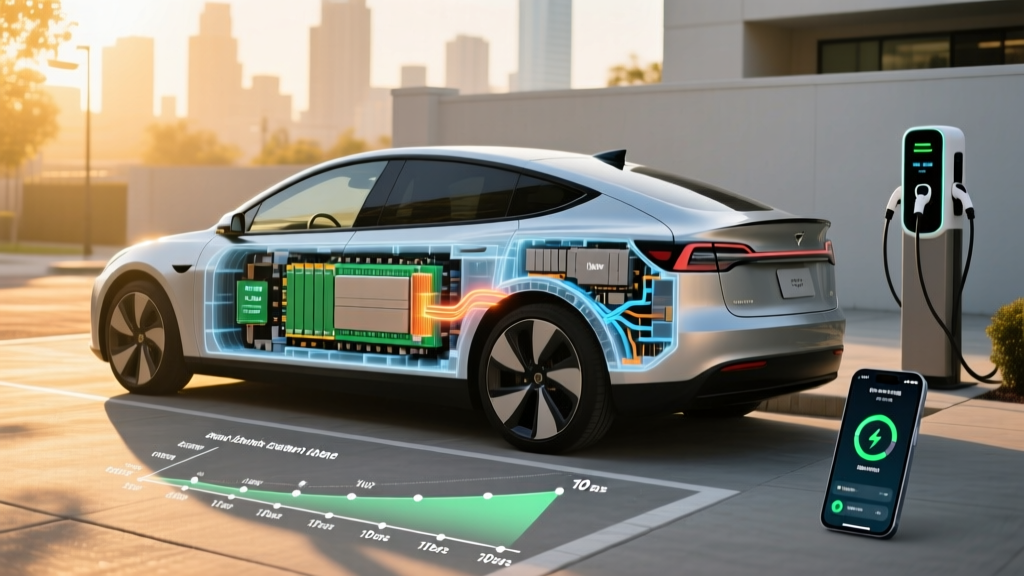
State of Health (SoH) is expressed as a percentage: 100% means the battery holds its original rated capacity; 85% means it now holds 85% of that. Here's how to monitor it:
- In-vehicle displays: Tesla offers a battery health estimate in the Service menu. Hyundai/Kia provides SoH via the dealer diagnostic tool. Ford's SYNC system shows estimated range, which indirectly reflects degradation.
- OBD-II apps: Tools like LeafSpy (Nissan Leaf), Scan My Tesla, or Car Scanner ELM OBD2 can read BMS-reported SoH, cell voltage variance, and pack temperature directly.
- Dealer diagnostics: Any authorized service center can run a full battery health report. Request one before buying a used EV — it's the single most important pre-purchase check.
- Range tracking: The simplest method. If your vehicle showed 310 EPA miles at 100% SoC when new and now shows 275 at 100% under similar temperatures, you've experienced roughly 11% degradation. Compare this against the EPA's published range figures for your model year.
Cell voltage variance is the more advanced metric. Healthy packs show <20 mV difference between the highest and lowest cell. Variance above 50 mV suggests an imbalanced or failing module — a warranty-worthy condition if it falls below the capacity threshold.
What's Next: Solid-State, Silicon Anodes, and Realistic Timelines
Forward-looking battery technology is advancing, but timelines matter. Here's where the industry stands in 2026:
- Solid-state batteries: Toyota and Samsung SDI have announced pilot production for 2027–2028, targeting ~750 km (466 mi) range and 10-minute fast charging. However, these are limited-run vehicles at premium prices. Mass-market solid-state is realistically 2030+. No currently sold passenger EV uses a solid-state pack.
- Silicon anode technology: Companies like Sila Nanotechnologies and Group14 are supplying silicon-dominant anode materials to manufacturers including Mercedes-Benz and Panasonic. These boost energy density by 20–40% vs. graphite anodes and are appearing in limited 2026 production vehicles. Expect broader adoption by 2028.
- Sodium-ion batteries: CATL and BYD are producing sodium-ion cells for low-cost, short-range EVs in China. Energy density is ~30% lower than LFP, but raw material costs are dramatically cheaper. US-market vehicles using sodium-ion are not yet available but could appear in entry-level models by 2028–2029.
- LFP improvements: CATL's second-generation LFP cells (2025–2026) have closed much of the energy-density gap with NMC, reaching ~190 Wh/kg at the cell level. This makes LFP viable for longer-range vehicles without the cobalt/nickel supply chain concerns.
The practical takeaway for buyers: today's lithium-ion batteries — both LFP and NMC — are mature, well-understood technology with proven 150,000–200,000+ mile lifespans. Waiting for solid-state means waiting years and paying a significant premium when it arrives. For 2026 buyers, the chemistry choice (LFP vs NMC) matters far more than chasing next-generation tech.
Frequently Asked Questions
How long do EV batteries last in years and miles?
Based on fleet data, most modern liquid-cooled EV batteries retain 80–90% of original capacity at 150,000–200,000 miles, which typically corresponds to 10–15 years of average driving (12,000–15,000 miles/year). Many will functionally outlast the vehicle's body and interior. The battery doesn't "die" at a specific mileage — it gradually loses capacity, similar to a smartphone.
How much does an EV battery cost to replace?
Full pack replacement ranges from roughly $6,500 for a compact EV (e.g., Tesla Model 3 RWD with LFP) to $25,000–$29,000 for a large truck (e.g., F-150 Lightning Extended Range with 131 kWh NMC). However, module-level repairs cost 60–75% less, and most batteries never need replacement under normal ownership. Warranty coverage protects against abnormal degradation for 8–10 years.
What does the EV battery warranty cover?
The standard warranty covers defects and capacity loss below a stated threshold (typically 70% of original capacity) for 8 years / 100,000 miles (extended in CARB states). It does not cover accident damage, improper modifications, or normal gradual capacity loss above the threshold. Check your specific manufacturer's terms — Hyundai/Kia offers 10 years, and Rivian covers up to 175,000 miles.
How do I check and maximize my EV battery health?
Monitor SoH through your vehicle's service menu, OBD-II diagnostic apps, or dealer reports. To maximize longevity: charge NMC to 80% daily (100% for LFP), avoid leaving the pack at 100% or below 10% for extended periods, minimize daily DC fast charging, precondition before fast charging, and park in temperature-moderate environments when possible.
LFP vs NMC — which chemistry should I choose?
Choose LFP if you want maximum cycle life, lower cost, and plan to keep the vehicle 10+ years. Accept slightly lower range and reduced cold-weather performance. Choose NMC if you need maximum EPA range, live in a cold climate, or prioritize fast-charging speed in winter. Both chemistries are proven to last 150,000+ miles with proper care.
Is the 2009 Ford F-150 battery the same as an EV battery?
No. The 2009 F-150 uses a standard 12V lead-acid starting battery (~$120–$220, replaced every 3–5 years). An EV like the 2026 F-150 Lightning uses a high-voltage lithium-ion traction battery (98–131 kWh, $10,000–$29,000 replacement, designed for 150,000+ miles). EVs also carry a separate small 12V battery for auxiliary systems, but it's the traction pack that defines the vehicle's range, performance, and long-term value.