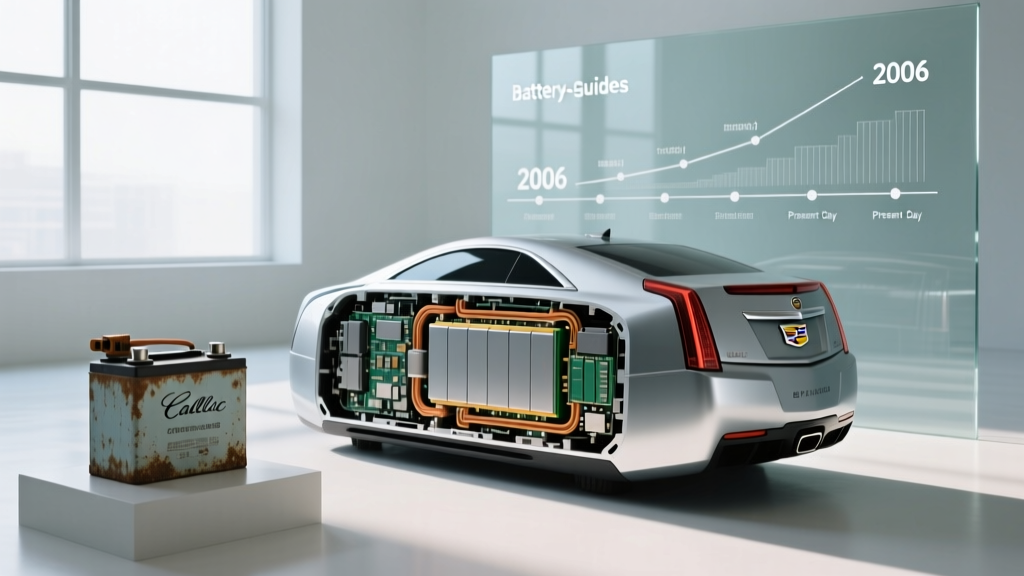
If you've ever replaced the 12V lead-acid battery in a 2006 Cadillac CTS, you probably spent $150–$250 at an auto parts store and had it done in ten minutes. That simple, maintenance-free experience is exactly what many EV shoppers hope to replicate when they ask: "How long will an EV battery last, and what happens when it dies?"
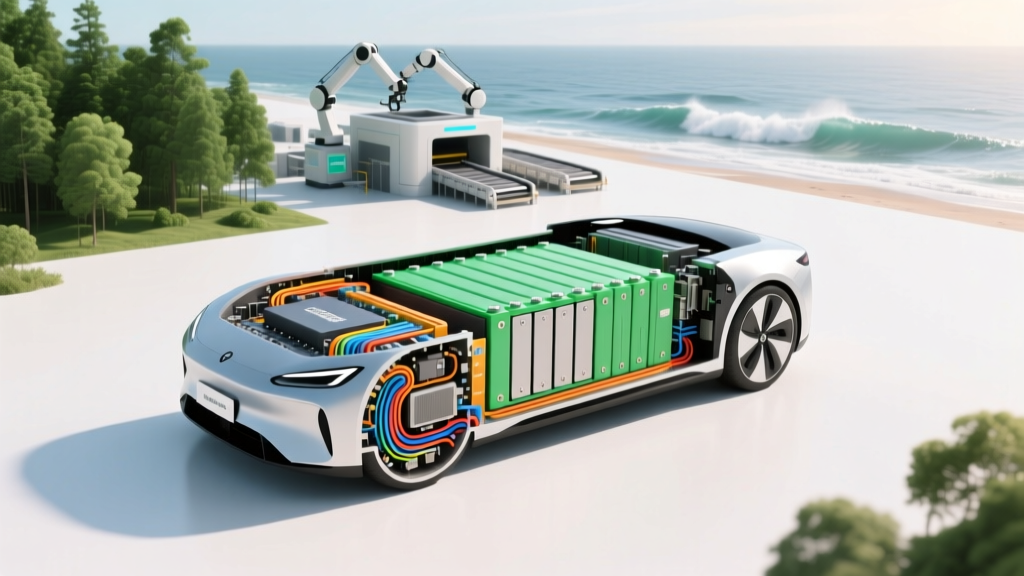
The answer is reassuring—but fundamentally different. A modern EV's high-voltage traction battery is a liquid-cooled, chemically engineered system designed to outlast the vehicle itself. In this guide, we'll walk through the real data on EV battery longevity, chemistry trade-offs, replacement economics, and what's coming next—using the familiar benchmark of a conventional car battery (like the one in a 2006 Cadillac CTS) as our starting point.
12V Auxiliary vs. High-Voltage Traction: A Critical Distinction
Before we get into degradation curves and chemistry tables, let's clear up the most common point of confusion. A 2006 Cadillac CTS uses a single 12V lead-acid battery to crank the starter and run accessories. Modern EVs also carry a small 12V battery (sometimes lithium, sometimes lead-acid) to power lights, infotainment, and safety systems—but the real work is done by the high-voltage traction battery, typically operating at 400V or 800V and storing 50–130 kWh of energy.
When we say "EV battery" in this article, we mean the traction pack. This is the component that costs thousands to replace, carries an 8–10 year federal warranty, and determines your vehicle's range. The 12V auxiliary battery in an EV is a $100–$300 consumable, just like in your old CTS.
How Long Do EV Batteries Actually Last?
The short answer: far longer than most buyers expect. Data from fleet operators, manufacturer reports, and independent testing consistently shows that modern lithium-ion traction batteries retain 85–95% of their original capacity after 100,000 miles, depending on chemistry and usage patterns.
- Tesla Model 3/Y (NMC/NCA): ~12% average capacity loss at 200,000 miles, per Tesla's 2023 Impact Report and independent fleet data from Recurrent Auto.
- Chevrolet Bolt EV (NMC, 65 kWh): Reported 5–8% loss at 100,000 miles in owner surveys; GM's warranty guarantees ≥60% at 8 years/100,000 miles (the federal minimum, though GM sets a higher internal bar).
- Tesla Model 3 Standard Range (LFP): LFP packs show minimal degradation in the first 50,000 miles—often under 3%—according to Recurrent's 2024 fleet analysis.
- Nissan LEAF (passive-cooled NMC, older generations): Higher degradation rates of 15–25% over 8 years due to lack of active thermal management. The 2026 LEAF uses active liquid cooling.
Most EV batteries will deliver 150,000–300,000+ miles before capacity drops below 70% of new. For context, the average American drives ~13,500 miles per year (FHWA data), meaning a typical EV battery will serve 15–22 years before reaching that threshold. Most vehicles are scrapped for other reasons long before the pack fails.
LFP vs. NMC vs. NCA: Chemistry Trade-Offs Explained
Not all EV batteries are the same. The two dominant chemistries in 2026 are LFP (lithium iron phosphate) and NMC/NCA (nickel manganese cobalt / nickel cobalt aluminum). Each has distinct strengths.
| Attribute | LFP (LiFePO₄) | NMC / NCA |
|---|---|---|
| Energy Density | Lower (~160 Wh/kg cell-level) | Higher (~250–300 Wh/kg cell-level) |
| Typical Use | Standard-range models (Tesla Model 3 RWD, Ford Mustang Mach-E Select) | Long-range & performance models (Model 3 LR, Hyundai Ioniq 5 LR, Rivian) |
| Cycle Life | 3,000–5,000+ cycles to 80% SoH | 1,000–2,000 cycles to 80% SoH |
| Cold-Weather Performance | Moderate; slower charge acceptance below freezing | Better low-temp performance with preconditioning |
| Recommended SoC for Daily Use | 100% (LFP tolerates full charge well) | 80% daily; 100% for trips only |
| Cost | Lower ($100–120/kWh pack-level in 2026) | Higher ($130–160/kWh pack-level in 2026) |
| Cobalt Content | Zero cobalt—less supply-chain risk | Contains cobalt (sourcing/ethical considerations) |
| Safety / Thermal Stability | Excellent; higher thermal runaway threshold | Good with active thermal management |
Which is better? Neither is universally superior. LFP wins on longevity, cost, and ethical sourcing—ideal for daily commuters who charge at home and don't need 350+ miles of range. NMC/NCA wins on energy density and cold-weather capability—better for road-trippers and buyers in northern climates who need maximum range in a smaller package.
What Does the EV Battery Warranty Actually Cover?
Federal law (EPA/CARB requirements) mandates a minimum of 8 years / 100,000 miles for EV battery emissions-related components. Most manufacturers exceed this baseline. The warranty guarantees that the battery will retain a minimum percentage of its original capacity—typically 70%—over the warranty period.
| Manufacturer | Warranty Period | Min. Capacity Retention | Notes |
|---|---|---|---|
| Tesla | 8 yr / 120,000 mi (Model 3/Y LR) | 70% | 100,000 mi for RWD (LFP) |
| Hyundai / Kia | 10 yr / 100,000 mi | 70% | Among the longest coverage |
| Ford | 8 yr / 100,000 mi | 70% | Covers battery & hybrid components |
| GM (Chevy/Cadillac) | 8 yr / 100,000 mi | 70% | Ultium platform; modular pack design allows partial replacement |
| Rivian | 8 yr / 175,000 mi | 70% | Highest mileage threshold among mainstream OEMs |
Key nuance: The warranty covers defects and excessive degradation, not damage from accidents, flooding, or aftermarket modifications. If your battery drops below the guaranteed threshold within the warranty window, the manufacturer will repair or replace it at no cost—often swapping in a refurbished pack with capacity above the threshold, not necessarily a brand-new unit.
How Much Does an EV Battery Replacement Cost?
This is the question that keeps potential buyers up at night. Let's put it in perspective: the 12V battery in a 2006 Cadillac CTS costs $150–$250 to replace. An EV traction battery replacement is a fundamentally different proposition—but also far less common than internet fear suggests.
| Vehicle Class / Example | Battery Size | Estimated Full-Pack Cost | Typical Replacement Timeline |
|---|---|---|---|
| Compact EV (Chevy Bolt, Nissan LEAF) | 60–65 kWh | $6,000–$9,000 | Rarely needed; 200k+ mi expected life |
| Mid-size sedan/SUV (Tesla Model 3, Ioniq 5) | 75–84 kWh | $10,000–$16,000 | Rarely needed; 250k+ mi expected life |
| Large SUV/Truck (F-150 Lightning, Rivian R1S) | 100–149 kWh | $15,000–$25,000 | Very rare; modular packs allow partial repair |
The realistic picture: According to data from Recurrent Auto, fewer than 1.5% of EVs on the road have required a full battery replacement outside of warranty-covered defects. The vast majority of EVs will be retired, traded, or totaled in an accident before the battery reaches end-of-life. Pack-level costs continue to decline—BloombergNEF projects average pack prices below $100/kWh by 2027, which would bring a 75 kWh replacement to roughly $7,500.
Additionally, manufacturers like GM (Ultium) and Tesla are designing modular packs where individual cell modules can be replaced instead of the entire battery—potentially cutting out-of-warranty repair costs by 50–70%.
Factors That Affect EV Battery Longevity
Just as a 2006 Cadillac CTS engine lasted longer with regular oil changes, an EV battery's lifespan is heavily influenced by how it's used. Here are the factors that matter most, ranked by impact:
- Avoid sustained 100% SoC (NMC/NCA only): Daily charging to 80% can double cycle life compared to daily 100% charges. LFP owners can charge to 100% daily without penalty—this is a key advantage of the chemistry.
- Minimize DC fast charging as a daily routine: Occasional fast charging (road trips) is fine. Daily 150+ kW DC sessions accelerate degradation by an estimated 2–5% over 100,000 miles compared to Level 2 home charging. The heat generated at high charge rates is the primary stressor.
- Use preconditioning: Most EVs let you precondition (warm) the battery before fast charging or departure. A cold battery charged at high power suffers lithium plating—a permanent degradation mechanism. Preconditioning mitigates this significantly.
- Avoid extreme SoC storage: If storing the vehicle for weeks, leave it at ~50% SoC. Storing at 100% or near 0% for extended periods accelerates calendar degradation.
- Park in shade or a garage in extreme heat: Sustained battery temperatures above 95°F (35°C) accelerate calendar aging. Active thermal management helps, but it can't fully offset weeks of 110°F ambient heat without drawing parasitic power.
- Don't obsess over regenerative braking settings: Regen has negligible impact on battery degradation. Drive comfortably.
Monitoring Battery Health: How to Check State of Health (SoH)
State of Health (SoH) is the percentage of original capacity your battery currently retains. A new battery is 100% SoH; a battery that held 80 kWh when new but now holds 72 kWh is at 90% SoH.
How to check SoH in 2026:
- In-vehicle displays: Tesla, Hyundai/Kia, BMW, and Rivian provide SoH or estimated degradation figures directly in the vehicle's settings menu or mobile app.
- OBD-II dongles + apps: Tools like OBDeleven, LeafSpy (for Nissan), and Scan My Tesla read the BMS (Battery Management System) directly for precise SoH data.
- Recurrent Auto / Geotab fleet tools: These platforms track degradation over time by comparing actual energy consumed to EPA-rated efficiency, providing a trend line rather than a single snapshot.
- Dealer diagnostic: Any authorized service center can run a full battery health report. This is recommended before purchasing a used EV out of warranty.
What to watch for: Degradation is not linear. Most packs lose 3–5% in the first year (initial formation losses), then settle into a slow, linear decline of ~0.5–1% per year. A sudden drop in range (e.g., 10% in a month) is abnormal and warrants a diagnostic check—it may indicate a faulty cell module, not normal aging.
What's Next: Solid-State, Silicon Anodes, and Realistic Timelines
The battery landscape is evolving rapidly, but it's critical to separate laboratory announcements from production reality.
Solid-state batteries replace the liquid electrolyte with a solid material, promising higher energy density (~400–500 Wh/kg), faster charging, and improved safety. Toyota, Samsung SDI, and QuantumScape have all announced prototype milestones. However, as of 2026, no solid-state EV battery is in mass production. Toyota's first limited-production solid-state EV is expected in 2027–2028, with broad availability not projected until 2030+.
Silicon-dominant anodes (replacing graphite) offer 20–40% more energy density. Companies like Sila Nanotechnologies and Group14 are supplying silicon-composite anode materials to manufacturers including Mercedes-Benz (for the G-Class EV) and Panasonic. This technology is in early production now and will become mainstream by 2028–2029.
Sodium-ion batteries (no lithium, no cobalt) are entering the market in budget EVs in China (BYD Seagull, JAC Yiwei). They offer lower energy density but dramatically lower cost and better cold-weather performance. US-market availability is expected in 2027–2028 for entry-level models.
The practical takeaway: If you're buying an EV in 2026, today's LFP and NMC packs are mature, well-understood, and backed by warranties that make battery replacement a non-issue for the overwhelming majority of owners. Waiting for solid-state means waiting at least 3–5 years for meaningful market availability.
Frequently Asked Questions
How long do EV batteries last in years and miles?
Based on fleet data, most modern EV batteries (2020+) retain 85–95% capacity at 100,000 miles and 80–90% at 200,000 miles. In years, that translates to 15–22+ years of typical use before reaching 70% capacity. LFP chemistry packs tend to outlast NMC on cycle count, though real-world results depend heavily on charging habits and climate.
How much does an EV battery cost to replace?
Out-of-warranty replacement costs range from approximately $6,000 for a compact EV (60 kWh) to $25,000 for a large truck/SUV (130+ kWh). However, fewer than 1.5% of EVs have required full pack replacement, and costs are declining ~10% annually. Modular pack designs from GM, Tesla, and others allow partial module replacement at a fraction of full-pack cost.
What does the EV battery warranty cover?
Federal law requires a minimum of 8 years/100,000 miles. Most manufacturers guarantee the battery will retain at least 70% of original capacity over this period. The warranty covers defects and abnormal degradation—not accident damage, flood damage, or modifications. Hyundai/Kia and Rivian offer extended terms (10 yr/100,000 mi and 8 yr/175,000 mi, respectively).
How do I check and maximize my EV's battery health?
Check SoH through your vehicle's app, an OBD-II diagnostic tool, or a dealer service visit. To maximize longevity: charge NMC/NCA to 80% daily (100% for LFP), minimize daily DC fast charging, precondition before fast charges in cold weather, avoid storing at 0% or 100% SoC for extended periods, and park in moderate temperatures when possible.
LFP vs. NMC — which chemistry is better for me?
Choose LFP if you charge at home daily, commute under 200 miles, want the longest cycle life, and value lower cost and cobalt-free sourcing. Choose NMC/NCA if you need maximum range (300+ miles), frequently road-trip in cold climates, or tow heavy loads. Both chemistries are proven and will outlast the vehicle with proper care.
Is an EV battery anything like the 12V battery in my old 2006 Cadillac CTS?
Fundamentally, no. The 12V battery in a 2006 CTS is a simple lead-acid unit that cranks a starter motor and typically lasts 3–5 years before a $200 swap. An EV traction battery is a liquid-cooled, actively managed lithium-ion system costing $6,000–$25,000 to replace—but designed to last 15–22+ years. The two share the word "battery" and little else.