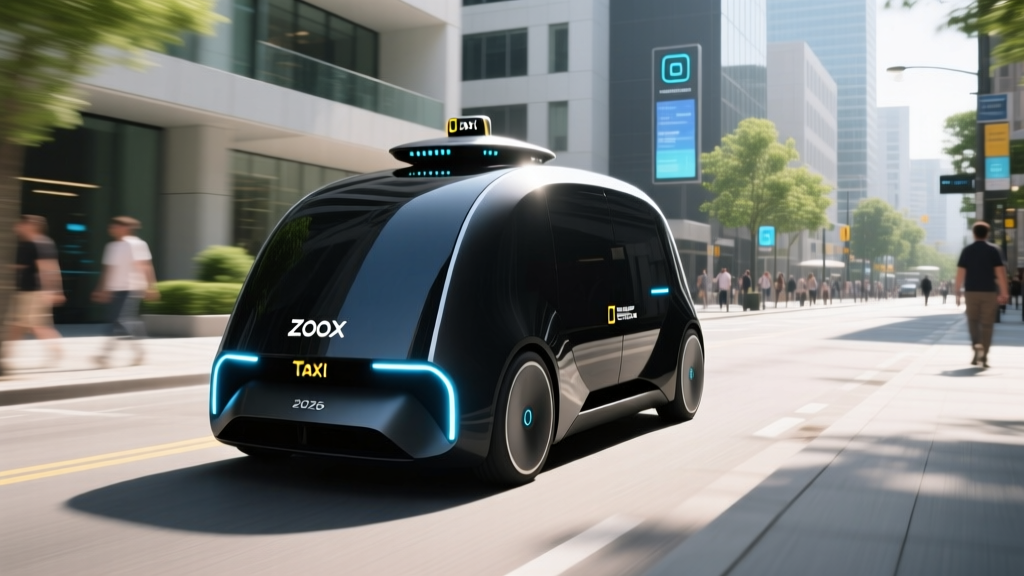
Amazon's Zoox has spent years quietly building one of the most distinctive robotaxi platforms in the autonomous vehicle space — a purpose-built, bidirectional carriage with no steering wheel or pedals. Unlike Tesla's Full Self-Driving, which remains a Level 2 driver-assist system requiring constant human supervision, Zoox operates at SAE Level 4: fully driverless within defined geographic zones. If you've been searching for the Zoox waitlist and wondering whether you can actually hail a ride, this guide breaks down exactly where the service is live, what it costs, and what the real-world limitations are as of early 2026.
What Is Zoox and How Does Its Autonomy Level Compare?
Zoox was founded in 2014 and acquired by Amazon in 2020 for approximately $1.3 billion. The company developed both a custom autonomous vehicle — a compact, symmetrical pod that can drive equally well in either direction — and the full software stack to operate it without any human driver onboard.
This is a critical distinction in the autonomous vehicle landscape. Here's how Zoox fits into the SAE automation framework:
| Level | Name | Driver Required? | Examples |
|---|---|---|---|
| Level 0 | No Automation | Yes, full-time | Traditional vehicles |
| Level 1 | Driver Assistance | Yes, full-time | Adaptive cruise control, lane-keep assist |
| Level 2 | Partial Automation | Yes, must supervise | Tesla Autopilot/FSD Supervised, GM Super Cruise, Ford BlueCruise |
| Level 3 | Conditional Automation | Yes, on standby | Mercedes Drive Pilot (limited conditions) |
| Level 4 | High Automation | No (within geofence) | Zoox, Waymo One, Cruise (suspended) |
| Level 5 | Full Automation | No, anywhere | Does not yet exist commercially |
Zoox operates at Level 4, meaning the vehicle handles all driving tasks — including edge cases and emergency maneuvers — without any expectation that a passenger will intervene. There is no steering wheel, no brake pedal, and no driver's seat. However, this autonomy is geofenced: the vehicle only operates within mapped, approved zones under certain conditions.
Where Can I Use the Zoox Robotaxi Right Now?
As of early 2026, Zoox has moved beyond its initial employee-only testing phase and opened limited public access in select cities. Here's the current service footprint:
| City | Status | Access Type | Notes |
|---|---|---|---|
| Las Vegas, NV | Live | Public waitlist / invite | Initial public deployment zone near the Strip and downtown |
| San Francisco, CA | Live (limited) | Employee + invite-only | Testing on public roads since 2023; gradual public expansion |
| Foster City, CA | Testing | Employee-only | Near Zoox HQ; not open to public riders |
| Austin, TX | Testing / Mapping | Not yet available | Announced expansion target; no public rides yet |
| Atlanta, GA | Announced | Not yet available | Preliminary mapping; no timeline confirmed |
Las Vegas is the first city where Zoox has opened rides to non-employees through its waitlist program. The deployment zone covers a defined area including parts of the Las Vegas Strip corridor and downtown. If you're outside these zones, you cannot currently hail a Zoox — the geofence is strictly enforced and the vehicle will not operate beyond its mapped boundaries.
How to Join the Zoox Waitlist and What to Expect
Signing up for the Zoox waitlist is straightforward but availability is tightly controlled:
- Visit the Zoox website (zoox.com) and navigate to the rider experience or "Get a Ride" section.
- Submit your information — typically your name, email, phone number, and the city where you'd like to ride.
- Wait for an invitation. Zoox onboards riders in waves, prioritizing users in active deployment zones (primarily Las Vegas as of 2026).
- Download the Zoox rider app once invited. The app handles ride requests, pickup/dropoff within the geofence, and trip status.
- Request a ride. Pickup and dropoff points must be within the approved geofence zone. The vehicle arrives autonomously — no driver, no steering wheel.
Wait times vary significantly. Early Las Vegas adopters reported receiving invitations within weeks of signing up, while users in non-deployment cities may remain on the list indefinitely until Zoox expands to their area. There is no public mechanism to expedite waitlist priority.
Zoox Pricing vs. Uber and Lyft: What Does a Ride Cost?
During its initial public deployment phase in Las Vegas, Zoox has offered rides at no cost to invited riders — effectively a free promotional period to build ridership data and public familiarity. This is consistent with how Waymo initially launched in Phoenix and San Francisco before introducing per-ride pricing.
When Zoox transitions to paid service, the expected pricing model is comparable to standard rideshare tiers:
| Service | Estimated Cost (3-mile trip) | Surge Pricing? | Notes |
|---|---|---|---|
| Zoox (current promo) | $0.00 | No | Free during invite-only public phase |
| Zoox (projected paid) | $8–$14 | Likely dynamic | Based on comparable Waymo pricing |
| UberX | $10–$18 | Yes | Varies by time/demand |
| Lyft Standard | $10–$17 | Yes | Varies by time/demand |
| Waymo One (SF/LA) | $9–$16 | Limited | Comparable robotaxi benchmark |
One economic advantage robotaxis have over traditional rideshare: no driver payout. In a standard Uber ride, the driver typically receives 55–70% of the fare. Robotaxi operators redirect that margin toward vehicle costs, operations, and profit. Over time, this structural difference could push robotaxi pricing below human-driven rideshare, though Zoox has not confirmed long-term pricing.
How Safe Are Zoox Robotaxis? The Real Data
Safety is the single most scrutinized aspect of any driverless service. Zoox, like all autonomous vehicle operators in California, is required to report disengagement data and collision reports to the state's Department of Motor Vehicles (DMV). In Nevada, reporting requirements differ but Zoox has publicly shared some operational metrics.
Zoox Safety Record — What We Know (Through Early 2026)
- Public road testing miles: Zoox has accumulated over 1 million autonomous miles on public roads across its testing fleet, including its Toyota Highlander-based test vehicles and the purpose-built Zoox carriage.
- Collision reports: As of early 2026, Zoox has filed a small number of collision reports with the NHTSA Standing General Order, most involving low-speed contact with other vehicles or objects during testing phases. No serious passenger injuries have been publicly reported.
- Vehicle design safety: The purpose-built Zoox carriage features a symmetric crash structure, airbags positioned for all seating orientations, and a battery pack mounted low for stability. Zoox has stated it targets IIHS Top Safety Pick standards for its carriage.
- Redundant systems: The vehicle uses redundant compute, steering, braking, and power systems — if one system fails, a backup takes over without requiring human intervention.
For context, Waymo — the most mature robotaxi operator — has published data showing its vehicles are involved in fewer police-reported crashes per million miles than human drivers in the same cities. Zoox has not yet published equivalent comparative data at scale, largely because its public ridership numbers are still small compared to Waymo's tens of thousands of weekly paid rides.
The honest assessment: Zoox's safety record is promising but limited by sample size. The vehicle's redundant architecture and purpose-built design are engineering strengths, but real-world validation at millions of passenger-miles is still ahead.
Under the Hood: Zoox's Sensor and Technology Stack
Zoox takes a sensor-rich approach to perception, in direct contrast to Tesla's camera-only strategy. The Zoox carriage is equipped with a comprehensive sensor suite:
Key Technology Components
- LiDAR: Multiple roof-mounted and bumper-integrated LiDAR units provide 360-degree 3D point-cloud mapping of the environment. LiDAR excels at precise distance measurement regardless of lighting conditions — critical for nighttime and high-glare scenarios.
- Cameras: A suite of high-resolution cameras covers all directions, providing color and texture data for object classification (traffic lights, signs, pedestrian gestures).
- Radar: Forward and side-facing radar units track velocity of other moving objects and perform reliably in rain and fog where LiDAR and cameras can degrade.
- HD Maps: Zoox pre-maps every street in its geofence at centimeter-level precision. The vehicle localizes itself against this map in real time, providing an additional layer of positional certainty beyond GPS.
- Compute: Custom onboard computing hardware processes sensor fusion, prediction, and planning — all decisions are made locally without reliance on a remote teleoperator for routine driving.
- Remote guidance: For unusual edge cases (construction zones, unusual road closures), a remote human guidance operator can provide high-level direction — but does not "drive" the vehicle in real time.
This multi-sensor approach (LiDAR + camera + radar + HD maps) is the industry-standard architecture for Level 4 operations, shared by Waymo and most other robotaxi developers. The redundancy across sensor modalities means the vehicle can maintain perception even when one sensor type is degraded — for example, radar continuing to track vehicles when heavy rain scatters LiDAR returns.
Regulatory Landscape: Who Approves Zoox Operations?
Autonomous vehicle regulation in the United States remains a patchwork of state-level frameworks with limited federal oversight:
- California (CPUC + DMV): The California Department of Motor Vehicles issues testing and deployment permits. The California Public Utilities Commission (CPUC) regulates commercial passenger service. Zoox holds permits for driverless testing and has been working through CPUC approval for commercial fare-charging service in San Francisco.
- Nevada: Nevada's regulatory environment has been more permissive for robotaxi deployment. The Nevada DMV and state legislature created frameworks allowing driverless commercial operations, which enabled Zoox's Las Vegas public launch.
- Federal (NHTSA): The National Highway Traffic Safety Administration sets vehicle safety standards (FMVSS) but has historically required features like steering wheels and mirrors. Zoox received a specific exemption from certain FMVSS requirements to operate its carriage without a steering wheel — a significant regulatory milestone. NHTSA's Standing General Order also requires all AV operators to report crashes.
- Texas and Georgia: Both states have AV-friendly legislation, but Zoox has not yet received deployment approvals for commercial service in Austin or Atlanta.
The regulatory process is slow and city-specific. Every new deployment zone requires mapping, testing, local government coordination, and permit approval — which is why geographic expansion remains gradual despite the technology's maturity.
Current Limitations: What Zoox Cannot Do Yet
Level 4 autonomy is powerful but bounded. Here are the real constraints you'll encounter as a Zoox rider:
Operational Limitations
- Geofence boundaries: The vehicle will not drive outside its mapped zone. If your destination is even one block beyond the geofence, you cannot set it as a dropoff point. Pickup and dropoff are restricted to approved locations within the zone.
- Weather restrictions: Heavy rain, dense fog, and snow degrade LiDAR and camera performance. Zoox may suspend operations or restrict service during severe weather events. The Las Vegas deployment benefits from the city's dry climate — this limitation will be more pronounced as Zoox expands to cities with harsher weather.
- Speed limits: Zoox vehicles currently operate on roads with speed limits up to approximately 35–45 mph. Highway driving at 65+ mph is not part of the current operational design domain.
- Construction zones: Unmapped road changes, temporary lane shifts, and complex construction zones may cause the vehicle to stop and request remote guidance, adding delay to your trip.
- No inter-city trips: You cannot take a Zoox from Las Vegas to Henderson or from San Francisco to Oakland. These are strictly intra-city, geofenced services.
- Limited passenger capacity: The Zoox carriage seats up to four passengers. There is no option for larger groups, wheelchair accessibility details vary, and cargo space is limited compared to a standard rideshare SUV.
- Wait times: With a limited fleet size in early deployment, wait times for a Zoox vehicle can be longer than Uber or Lyft, particularly during peak demand periods.
Frequently Asked Questions
Is the Zoox robotaxi truly self-driving, or is there a driver?
Zoox is a true SAE Level 4 driverless vehicle. There is no human driver in the car, no steering wheel, and no pedals. The vehicle handles all driving tasks autonomously within its geofenced service area. This is fundamentally different from Tesla's FSD Supervised or GM's Super Cruise, which are Level 2 systems requiring an attentive human driver at all times.
How long is the Zoox waitlist?
There is no fixed wait time. In Las Vegas, some users have received invitations within a few weeks of signing up. In cities where Zoox is not yet publicly available, you may remain on the waitlist indefinitely. Signing up early positions you for priority when Zoox expands to your city.
Can I use Zoox if I'm visiting Las Vegas?
Yes — if you're on the waitlist and receive an invitation, you can request rides within the Las Vegas geofence zone regardless of your home address. The Zoox app works like a standard rideshare app for requesting pickups and dropoffs within the service area.
What happens if the Zoox vehicle encounters a problem during my ride?
The vehicle is equipped with redundant systems (dual compute, dual braking, dual steering). If a primary system fails, the backup takes over. For situations the vehicle cannot resolve autonomously, a remote guidance operator can provide high-level direction. The vehicle can also pull over safely and contact support if needed. In-vehicle screens and a help button allow passengers to communicate with Zoox support at any time.
How does Zoox compare to Waymo?
Both are Level 4 robotaxi services, but Waymo has a significant head start in scale. Waymo One operates commercially in Phoenix, San Francisco, Los Angeles, and is expanding to Austin, with tens of thousands of paid rides per week. Zoox is earlier in its public deployment curve, with a smaller fleet and fewer cities. However, Zoox's purpose-built carriage (designed from the ground up for autonomy rather than retrofitting an existing vehicle) offers design advantages in packaging, sensor placement, and passenger experience that retrofitted vehicles like Waymo's Jaguar I-PACE fleet do not have.
Will Zoox come to my city?
Zoox has announced Austin and Atlanta as future expansion targets, but has not confirmed timelines for commercial service in either city. Expansion requires regulatory approval, HD mapping, local fleet deployment, and safety validation — a process that typically takes 12–24 months per new city after announcement.