The Zoox Vegas Map: What the Coverage Area Actually Looks Like
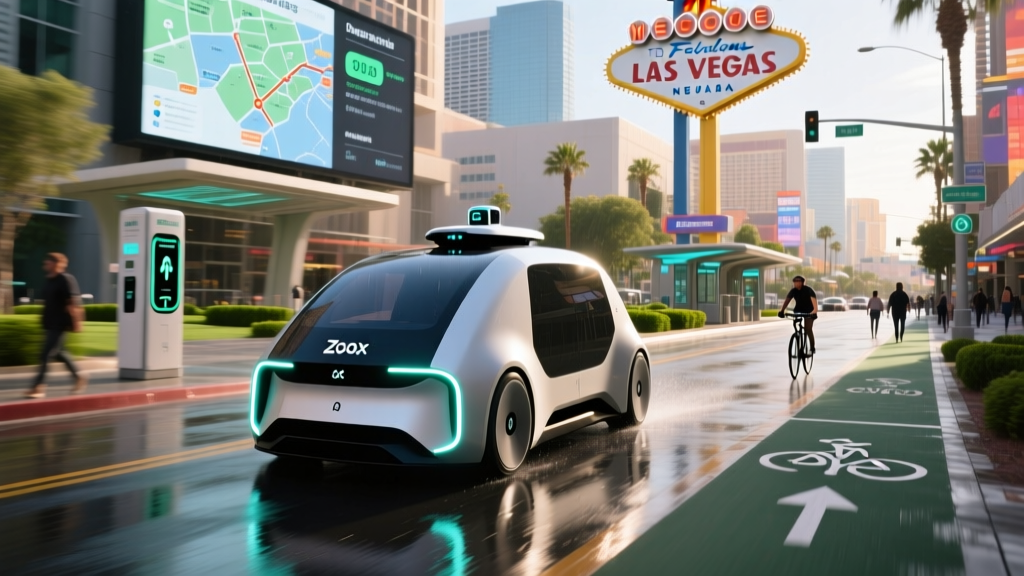
If you have been searching for a reliable zoox vegas map to figure out where Amazon's purpose-built robotaxi operates in Las Vegas, you are not alone. Zoox has steadily expanded its driverless footprint across the Las Vegas Valley since launching its commercial service, but the operational geofence is specific — and knowing its boundaries matters before you book a ride.
As of early 2026, Zoox's Las Vegas service area spans a roughly 15-square-mile corridor that includes the Las Vegas Strip (from Mandalay Bay north to the Strat), downtown Las Vegas (Fremont Street area), and portions of the surrounding arterials connecting these zones. The company has also extended coverage into segments of Paradise Road and parts of the convention center district, catering to the heavy tourist and business-traveler demand that defines the market.
Unlike Waymo, which operates a broader geofence across multiple Sun Belt cities, Zoox has pursued a denser, more controlled urban deployment strategy. The Vegas map is designed around high-demand, well-mapped corridors rather than sprawling suburban coverage. That means you can reliably hail a Zoox from your Strip hotel to a downtown restaurant — but you cannot currently take one to Henderson, Summerlin, or Harry Reid International Airport's terminal curbside (airport access remains under regulatory negotiation with the FAA and Clark County authorities).
| Zone | Status | Key Landmarks Covered |
|---|---|---|
| Las Vegas Strip Corridor | Live | Mandalay Bay to The Strat, major resorts |
| Downtown / Fremont Street | Live | Fremont Street Experience, Arts District |
| Convention Center District | Live | Las Vegas Convention Center, nearby hotels |
| Paradise Road Corridor | Live (partial) | Select hotels, east of Strip |
| Harry Reid Airport (LAS) | Not available | Under regulatory review |
| Henderson / Summerlin | Not available | No announced timeline |
Zoox also maintains active testing operations in the San Francisco Bay Area (Foster City headquarters and parts of San Francisco proper), with limited commercial availability there. But Las Vegas remains the company's primary commercial showcase — the dense tourist traffic, predictable grid layout, and favorable Nevada regulatory environment make it the logical proving ground for scaling a driverless fleet.
SAE Level 4 Autonomy: What Zoox Actually Is (and Is Not)
Understanding Zoox requires a clear grasp of SAE automation levels — a classification system that separates consumer driver-assist features from true driverless operation.
| Level | Name | Driver Required? | Examples |
|---|---|---|---|
| Level 0 | No Automation | Yes — full control | Conventional vehicles |
| Level 1 | Driver Assistance | Yes — hands on wheel | Adaptive cruise control |
| Level 2 | Partial Automation | Yes — must supervise | Tesla Autopilot, GM Super Cruise, Ford BlueCruise |
| Level 3 | Conditional Automation | Sometimes — must be ready to take over | Mercedes DRIVE PILOT (limited conditions) |
| Level 4 | High Automation | No — within geofenced ODD | Zoox, Waymo One, Cruise (pre-suspension) |
| Level 5 | Full Automation | No — anywhere, any condition | Does not exist commercially |
Zoox operates at SAE Level 4. This means the vehicle drives itself entirely — no steering wheel, no pedals, no human driver onboard — but only within its defined Operational Design Domain (ODD). That ODD includes the geofenced map area, specific weather conditions (clear to light rain), and mapped road types. If the vehicle encounters a scenario outside its ODD (heavy flooding, unmapped construction detour, sensor degradation), it will execute a safe stop or pull over rather than hand control to a passenger who may not be prepared to drive.
This is a fundamentally different proposition from Tesla's FSD (Supervised), which remains a Level 2 system requiring continuous driver attention regardless of marketing language. When you ride in a Zoox, there is no one in the driver's seat. The system is responsible for the entire dynamic driving task.
Zoox's Technology Stack: Lidar, Cameras, and the Bidirectional Platform
Zoox's purpose-built vehicle — the second-generation robotaxi that entered commercial service — was designed from the ground up as a driverless platform. It does not have a front or back in the traditional sense; the vehicle is bidirectional, capable of traveling in either direction without turning around. This design choice has practical implications for dense urban navigation, where three-point turns and U-turns add complexity and risk.
Sensor Suite
- Lidar: Multiple solid-state and spinning lidar units provide 360-degree 3D point-cloud mapping of the environment, accurate to centimeter-level resolution at ranges exceeding 150 meters.
- Cameras: A multi-camera array covers all directions, enabling object classification (pedestrian, cyclist, vehicle), traffic-light state detection, and lane-marking recognition.
- Radar: Millimeter-wave radar supplements lidar in adverse conditions (rain, fog, dust) where optical sensors degrade, providing velocity and distance data on moving objects.
- Ultrasonic sensors: Close-range proximity detection for low-speed maneuvers, curb detection, and parking.
Compute and Software
Zoox runs its perception, prediction, and planning stack on custom onboard compute hardware. The AI pipeline processes sensor fusion in real time, predicting the trajectories of surrounding agents (other vehicles, pedestrians, cyclists) and planning safe paths through complex urban intersections. The system leverages high-definition maps of its geofenced area — not just road geometry, but lane-level topology, signal phasing, curb heights, and known construction patterns.
Vehicle Platform Specs
- Powertrain: Fully electric, dual-motor AWD
- Battery: Estimated ~75-90 kWh usable (exact specs not publicly disclosed by Zoox)
- Top speed: Governed to approximately 75 mph
- Seating: 4 passengers, face-to-face configuration, no driver controls
- Accessibility: Designed for wheelchair-accessible variants in future fleet expansion
The multi-sensor approach (lidar + cameras + radar) stands in contrast to Tesla's camera-only strategy for its consumer FSD system. Zoox, like Waymo, has concluded that lidar redundancy is essential for Level 4 safety margins — particularly in the complex, high-stakes urban environments where robotaxis operate. The cost of lidar has dropped substantially since 2020, making this approach economically viable for fleet-scale deployment.
Safety Record: What the Data Shows
Safety is the single most scrutinized aspect of robotaxi operations, and Zoox has accumulated meaningful — though still limited relative to human-driver baselines — operational data.
| Metric | Zoox Data | Context |
|---|---|---|
| Driverless miles accumulated | Millions of miles (testing + commercial) | Exact figure not continuously published; Zoox reports periodic milestones |
| At-fault collisions (commercial service) | Very low reported incidence | Most reported incidents involve other parties striking the Zoox vehicle |
| Disengagement rate (testing) | Declining trend year-over-year | Disengagements = times a remote operator or safety driver intervenes |
| Fatalities | Zero reported | As of early 2026, no Zoox vehicle has been involved in a fatal collision |
| NHTSA Standing General Order reporting | Active compliance | Zoox reports incidents per NHTSA requirements for ADS-equipped vehicles |
Context matters here. Zoox's commercial fleet in Las Vegas is smaller than Waymo's multi-city operation, so total miles driven are lower — meaning statistical comparison to human-driver crash rates (approximately 1.35 fatalities per 100 million vehicle miles nationally, per NHTSA) requires careful framing. The available data suggests that robotaxis, including Zoox, are involved in fewer at-fault collisions per mile than human drivers in comparable urban environments, but the sample sizes remain insufficient to make definitive population-level claims.
What the data does show clearly: Zoox vehicles are exceptionally cautious. They obey speed limits strictly, yield conservatively at unprotected turns, and execute full stops at stop signs (a behavior many human drivers skip). This caution occasionally leads to the most common passenger complaint — rides that feel slower than a human-driven Uber — but it correlates with a strong collision-avoidance record.
For comparison, Waymo reported in 2024 that its fleet had driven over 25 million autonomous miles with a significantly lower at-fault crash rate than human benchmarks in the same cities. Zoox's numbers are directionally similar, though published at smaller scale. The IIHS and academic researchers continue to study robotaxi safety outcomes as fleet sizes grow.
Pricing: Zoox vs. Uber and Lyft in Las Vegas
One of the most practical questions for potential riders: what does a Zoox ride actually cost compared to conventional rideshare?
| Service | Estimated Fare | Surge Pricing? | Wait Time (typical) |
|---|---|---|---|
| Zoox | $0 (promotional) to ~$12-18 | No traditional surge | 3-8 minutes in coverage zone |
| UberX | $14-22 | Yes — frequent on Strip | 2-5 minutes |
| Lyft Standard | $13-20 | Yes — peak hours | 2-6 minutes |
| Uber Black | $28-45 | Yes | 3-7 minutes |
Zoox has historically offered free or heavily subsidized rides during its initial commercial rollout phases to build rider familiarity and gather feedback. As of 2026, the company has begun transitioning toward standard per-ride pricing in Las Vegas, though promotional pricing and loyalty incentives remain common. When standard pricing is in effect, Zoox fares are generally competitive with UberX and Lyft Standard — typically in the $12-18 range for a Strip-to-downtown trip, depending on distance and time of day.
A key differentiator: Zoox does not use traditional surge pricing. Instead, the app may show longer wait times or limited availability during peak demand, but the per-mile rate does not spike the way Uber and Lyft fares can during major events (CES, March Madness, New Year's Eve on the Strip). For riders accustomed to seeing a $40 UberX fare balloon to $80+ during peak hours, this predictability is a tangible advantage.
Tipping is not expected or solicited — there is no driver to tip. Zoox's revenue model relies on eventually achieving unit economics that undercut human-driven rideshare by eliminating driver compensation (which typically accounts for 60-75% of a rideshare fare). That inflection point depends on fleet utilization rates, vehicle cost amortization, and remote-assistance staffing ratios — all still scaling.
Current Limitations: Where Zoox Cannot (Yet) Take You
Despite the impressive technology, Level 4 robotaxis operate within strict boundaries. Understanding these limitations prevents frustration and sets accurate expectations.
- Geofence boundaries: The vehicle will not travel outside its mapped operational area. If your destination falls outside the Zoox Vegas map, the app will not let you book the ride. The Strip-to-suburbs commute is not yet possible.
- Weather restrictions: While Zoox vehicles can handle light rain, heavy monsoon downpours (common in Las Vegas from July to September) can trigger service suspensions or reduced operational zones. Flooding on roadways is a hard no-go — the vehicles will not traverse standing water of uncertain depth.
- Construction and road closures: Major unmapped construction detours can cause the vehicle to stop and wait for remote guidance. Las Vegas's constant roadwork on and around the Strip occasionally creates edge cases that require human-assisted routing.
- Airport access: Harry Reid International Airport does not currently permit robotaxi pickup or dropoff at terminal curbsides. Regulatory agreements between Zoox, the airport authority, and Clark County are ongoing.
- Passenger capacity: The vehicle seats exactly 4 passengers. No car seats, no oversized luggage beyond what fits in the designated cargo area, no pets (service animals excepted per ADA requirements).
- No multi-stop rides: Unlike Uber, you cannot add intermediate stops. The ride is point A to point B within the geofence.
- Accessibility: While Zoox has announced plans for wheelchair-accessible vehicle variants, the current fleet may not accommodate all mobility devices. Riders with specific accessibility needs should check the app for vehicle-type availability.
- Speed and route conservatism: Zoox vehicles drive at or below posted speed limits and may take routes that feel indirect to experienced local drivers. Expect a 15-minute human-driven trip to take 18-22 minutes in a Zoox.
Regulatory Landscape: Who Approves Robotaxi Operations
Robotaxi deployment in the United States requires navigating a layered regulatory framework that involves federal, state, and local authorities.
At the federal level, the National Highway Traffic Safety Administration (NHTSA) sets vehicle safety standards. Zoox received a significant regulatory accommodation when NHTSA granted exemptions from certain Federal Motor Vehicle Safety Standards (FMVSS) that presuppose a human driver — such as requirements for a steering wheel, mirrors, and a traditional windshield. These exemptions were essential for Zoox's bidirectional, driverless vehicle design to be street-legal.
At the state level, Nevada has been one of the most permissive jurisdictions for autonomous vehicle testing and deployment. The Nevada Department of Motor Vehicles (DMV) issues autonomous vehicle testing and deployment permits, and the state legislature passed enabling legislation early (AB 511 in 2011, updated subsequently). Nevada requires autonomous vehicle operators to maintain insurance, report collisions, and meet specific technology and safety benchmarks.
At the local level, Clark County and the City of Las Vegas coordinate on road access, traffic management, and emergency-response protocols for robotaxi operations. Local first responders receive training on how to interact with driverless vehicles (e.g., how to open doors manually, disable the vehicle in an emergency).
This multi-layered approval process means that expansion to new cities is not simply a matter of turning on a geofence. Each new market requires separate state and local permissions — a key reason why robotaxi growth, while accelerating, remains measured compared to the rapid expansion of traditional rideshare in the 2010s.
How to Ride: Booking, Experience, and Practical Tips
Using Zoox in Las Vegas is straightforward once you are inside the coverage zone:
- Download the Zoox app (available on iOS and Android) and create an account with a payment method.
- Set your pickup and dropoff within the operational geofence. The app will confirm availability and show estimated wait time.
- Meet the vehicle at the designated pickup point. The Zoox vehicle is distinctive — a compact, symmetrical pod with no visible driver's seat. Confirm the license plate and vehicle ID in the app.
- Unlock and board. The app unlocks the doors when you arrive. The interior features two bench seats facing each other, a central screen displaying your route, and climate controls.
- Ride and monitor. The vehicle handles all driving. The in-ride screen shows the vehicle's perception of its surroundings (detected vehicles, pedestrians, traffic signals) — a transparency feature that builds rider confidence.
- Exit at your destination. The doors unlock automatically when the vehicle stops. No tipping, no rating of a human driver — though you can rate the ride experience in the app.
Practical tips from experienced riders: book slightly ahead during peak Strip hours (Friday and Saturday nights, major convention weeks). If the vehicle makes an unexpected stop mid-route, it is typically responding to a detected obstacle or awaiting remote routing guidance — these pauses usually resolve within 30-90 seconds. For real-time service status and any operational alerts, check the Zoox app or the company's social media channels.
Frequently Asked Questions
Where can I use Zoox in Las Vegas right now?
Zoox operates in a geofenced zone covering the Las Vegas Strip corridor (roughly Mandalay Bay to The Strat), downtown Las Vegas / Fremont Street, the Convention Center district, and portions of Paradise Road. Service does not extend to Henderson, Summerlin, or Harry Reid International Airport.
How much does a Zoox ride cost compared to Uber or Lyft?
When standard pricing is active, Zoox fares are competitive with UberX and Lyft Standard — typically $12-18 for a Strip-to-downtown trip. Zoox does not use traditional surge pricing, though promotional and subsidized fares may still be available during the ongoing commercial rollout phase.
Is Zoox truly self-driving, or is there a human driver?
Zoox is a true SAE Level 4 autonomous vehicle. There is no steering wheel, no pedals, and no human driver onboard. The vehicle operates entirely autonomously within its geofenced service area. This is fundamentally different from Level 2 driver-assist systems like Tesla Autopilot or GM Super Cruise, which require an attentive human driver at all times.
How safe are Zoox robotaxis?
As of early 2026, Zoox has reported zero fatalities involving its vehicles. The fleet has accumulated millions of driverless miles across testing and commercial operations, with a low at-fault collision rate. The vehicles are programmed for conservative, rules-compliant driving. However, total fleet miles remain small relative to human-driver baselines, and the robotaxi industry continues to build its long-term safety dataset. Zoox complies with NHTSA's Standing General Order for crash reporting.
What happens if the Zoox vehicle encounters a problem during my ride?
Zoox vehicles are monitored by a remote assistance team. If the vehicle encounters an ambiguous scenario (unmapped construction, an unusual obstacle), it will stop safely and either resolve the situation autonomously or receive guidance from a remote operator. In the event of a mechanical or software fault, the vehicle is designed to pull over safely and unlock the doors. Emergency services can be contacted via the in-vehicle screen or by calling 911.
Can I take a Zoox to the Las Vegas airport?
Not currently. Harry Reid International Airport does not permit robotaxi operations at terminal curbsides. Regulatory discussions between Zoox, the airport authority, and local government are ongoing, but no public timeline for airport access has been announced as of early 2026.
Does Zoox operate in other cities besides Las Vegas?
Zoox also conducts testing and limited commercial operations in the San Francisco Bay Area (primarily Foster City and parts of San Francisco). Las Vegas remains the company's primary commercial market. Expansion to additional cities has been announced in principle but is subject to regulatory approvals in each new jurisdiction.