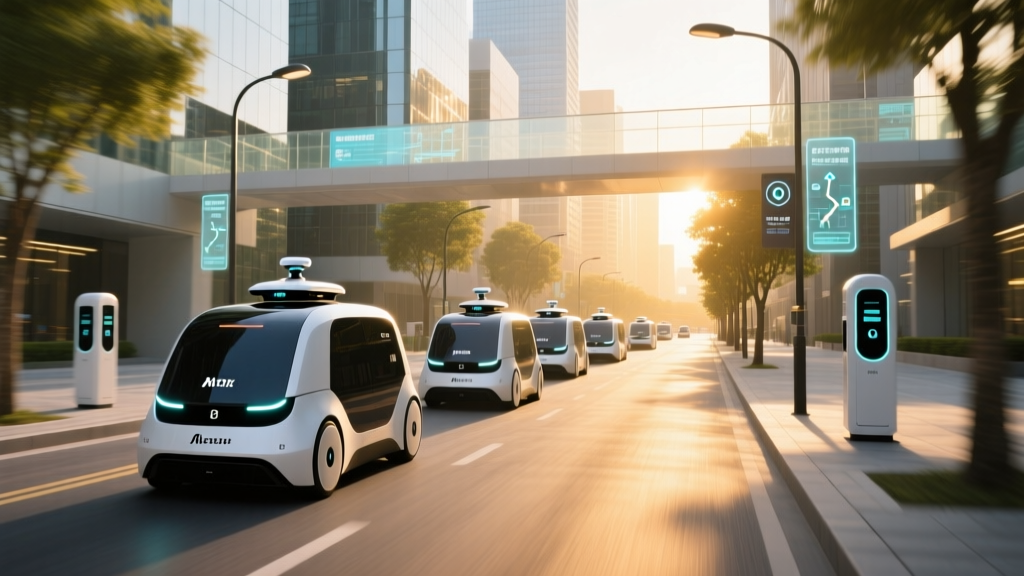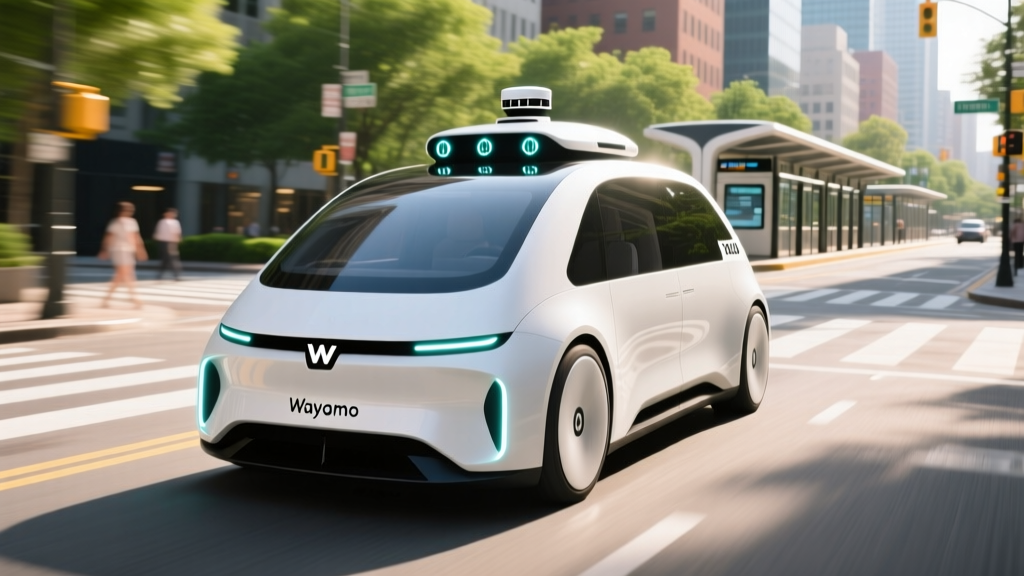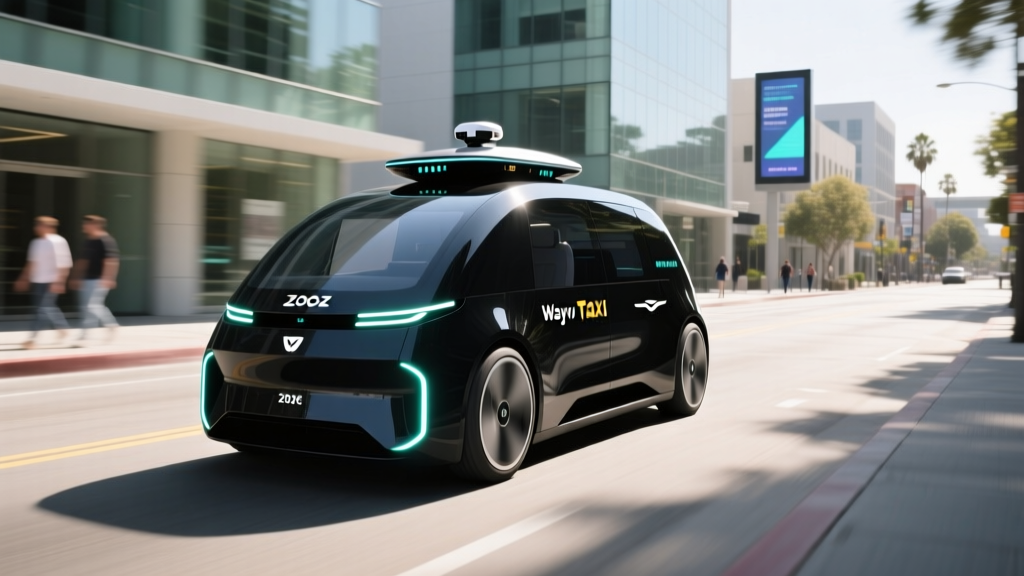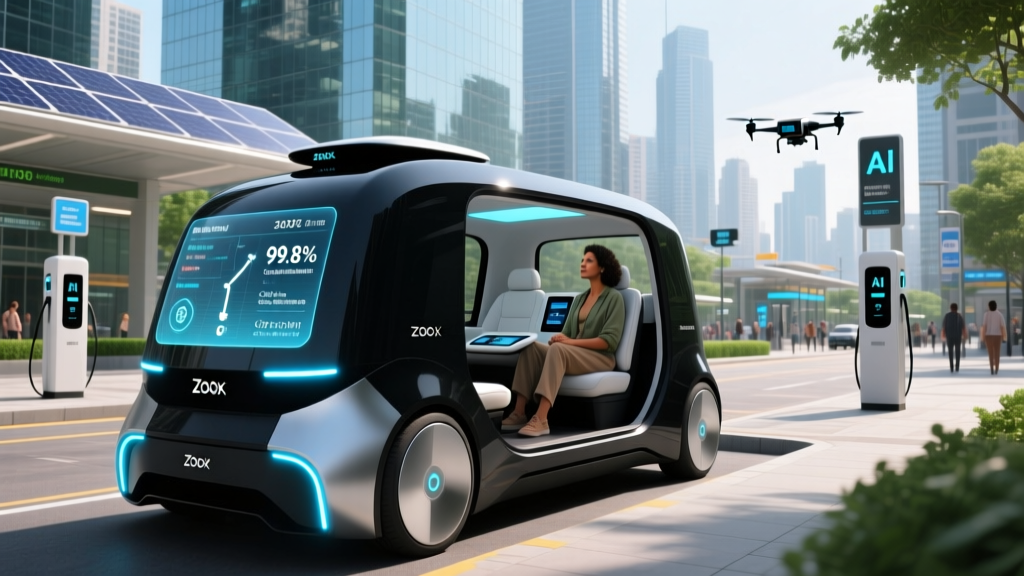
If you've seen a small, symmetrical vehicle with no steering wheel gliding through Las Vegas or San Francisco streets, you've likely spotted a Zoox robotaxi. Backed by Amazon since its 2020 acquisition, Zoox has taken a fundamentally different approach to autonomous mobility than competitors like Waymo: rather than retrofitting an existing car, Zoox engineered a purpose-built, bidirectional electric carriage from the ground up. As of early 2026, the company is operating commercial ride-hail services in select cities while continuing to expand its testing footprint. Here's a precise, data-grounded look at what the Zoox taxi is, where you can ride one, how safe the platform is, and what the experience actually costs.
What Is the Zoox Taxi, and What SAE Autonomy Level Is It?
The Zoox vehicle is a compact, battery-electric robotaxi designed exclusively for passenger mobility — it has no driver's seat, no steering wheel, and no pedals. The vehicle is bidirectional, meaning it can travel forward or backward with equal capability, and features four-wheel steering for tight urban maneuvering. Passengers sit face-to-face in a four-seat carriage layout.
The Zoox taxi operates at SAE Level 4 within its approved Operational Design Domain (ODD). This means the vehicle performs all driving tasks — steering, acceleration, braking, route navigation, and hazard response — without any human driver present or required. Level 4 differs fundamentally from Level 2 systems like Tesla Autopilot or GM Super Cruise, which require continuous driver supervision. Zoox's Level 4 designation applies within its geofenced service areas under defined conditions (speed limits, weather parameters, mapped routes). The vehicle does not operate at Level 5 (full automation everywhere in all conditions).
This distinction matters enormously for consumers. When you ride in a Zoox, there is no human behind the wheel ready to take over. The system handles the entire driving task within its approved domain, and if it encounters a situation it cannot resolve, it is designed to execute a minimal-risk maneuver — typically pulling over safely and contacting remote guidance operators.
Zoox Taxi Service Availability: Where Can You Ride Right Now?
Zoox has pursued a measured, city-by-city rollout rather than a rapid national expansion. As of early 2026, commercial (fare-charging) robotaxi service is available in limited areas, while testing with safety drivers or invited riders continues in additional markets.
| City | Status | Service Type | Notes |
|---|---|---|---|
| Las Vegas, NV | Commercial service live | Fare-charging robotaxi | Las Vegas Strip corridor and surrounding areas; primary commercial market |
| San Francisco, CA | Commercial service live (limited) | Fare-charging robotaxi | Selected neighborhoods; phased expansion under CPUC permits |
| Foster City, CA | Testing | Invited riders / employee shuttles | Near Zoox headquarters; limited public access |
| Austin, TX | Testing / expansion announced | Pre-commercial | Mapping and validation underway; commercial launch pending regulatory approval |
| Atlanta, GA | Testing announced | Pre-commercial | Early-stage testing; no public ride availability |
Where can I use this robotaxi service right now? As of early 2026, you can hail a fare-charging Zoox taxi in parts of Las Vegas and San Francisco. Other cities are in testing phases. Service areas within live cities are geofenced — you cannot request a ride outside the approved zone, and the vehicle will not travel beyond its mapped operational boundary.
For the most current service-area maps and availability, check the official Zoox ride page, as geofence boundaries and operating hours expand periodically.
Zoox Taxi Pricing: How Does It Compare to Uber and Lyft?
Zoox has positioned its robotaxi fares to be competitive with — and in many cases cheaper than — traditional rideshare services. The company's pricing strategy prioritizes ridership volume and market penetration over per-ride profitability, which is typical for early-stage robotaxi operators subsidized by deep-pocketed backers (in Zoox's case, Amazon).
| Service | Estimated Fare | Surge Pricing? | Notes |
|---|---|---|---|
| Zoox | $8 – $14 | No traditional surge | Flat or distance-based; introductory promotional pricing in some markets |
| UberX | $12 – $20 | Yes | Varies by demand, time of day, city |
| Lyft Standard | $11 – $19 | Yes | Similar variability to Uber |
| Waymo One | $10 – $17 | Limited dynamic pricing | Comparable to Zoox; varies by market |
How much does it cost vs Uber/Lyft? Zoox fares are typically 15–30% lower than comparable UberX or Lyft rides for the same distance, particularly during peak demand when traditional rideshare surge pricing kicks in. Zoox does not employ traditional surge pricing because its fleet size is fixed and managed through wait-time adjustments rather than fare multiplication. Exact pricing varies by city and trip distance.
To request a ride, users download the Zoox app (available on iOS and Android), set pickup and dropoff locations within the geofenced service area, and confirm the ride. Wait times in Las Vegas have typically ranged from 3 to 8 minutes during operating hours, though this fluctuates with fleet availability and demand.
Zoox Robotaxi Safety Record: What the Data Shows
Safety is the single most scrutinized aspect of any robotaxi operation. Zoox publishes safety data through regulatory filings and periodic transparency reports. Here's what is known from public records and regulatory disclosures as of early 2026.
- Autonomous miles driven: Estimated 1.5+ million driverless miles across testing and commercial operations (cumulative). Zoox does not publish a live odometer counter; figures are derived from regulatory filings and company disclosures.
- At-fault collisions: Zoox has reported a small number of minor contact incidents during testing and commercial operations. Per NHTSA Standing General Order crash reports, Zoox incidents have involved low-speed contacts, primarily with stationary objects or in complex urban scenarios. No fatalities or serious injuries have been publicly attributed to Zoox robotaxi operations.
- Disengagement / intervention rate: Zoox does not use traditional "disengagement" metrics in the same way as California DMV-reported testing data (since its commercial vehicles have no driver to disengage). Instead, the company tracks "minimal-risk maneuver" events — situations where the vehicle could not proceed and pulled over autonomously. Specific rates per 1,000 miles have not been published in a standardized public format as of early 2026.
- Remote guidance: Zoox vehicles can request assistance from remote operators for ambiguous scenarios (e.g., an unmapped construction zone). The vehicle does not surrender driving control to the remote operator; rather, the operator provides high-level guidance (e.g., "proceed around the obstacle on the left") and the vehicle executes the maneuver autonomously.
How safe are robotaxis? The honest answer is that robotaxi safety data is still accumulating. Zoox's record, based on available public data, shows no fatalities or serious injuries, with a small number of low-speed incidents typical of dense urban driving. For context, NHTSA data shows that human drivers in the U.S. experience approximately 1.3 fatalities per 100 million vehicle miles traveled. Robotaxi fleets have not yet accumulated enough driverless miles to make statistically definitive comparisons at that scale — Zoox's ~1.5 million miles is meaningful but not sufficient for population-level safety conclusions.
What is clear: Zoox vehicles operate with a comprehensive sensor suite (detailed below), obey speed limits within their ODD, and are designed to default to conservative behavior when uncertain. Whether that makes them "safer than humans" at scale remains an open empirical question that will require tens of billions of autonomous miles to resolve definitively.
Zoox Technology Stack: Sensors, Computing, and the Purpose-Built Vehicle
Unlike Waymo (which uses modified Jaguar I-PACE SUVs) or Cruise (which used modified Chevrolet Bolts), Zoox built its vehicle from scratch around the autonomy system. This eliminates the compromises of retrofitting and allows sensor placement optimized for 360-degree perception.
| LiDAR | Multiple solid-state and spinning LiDAR units providing redundant 360° point-cloud mapping; range up to ~150–200 meters depending on unit |
| Cameras | Multi-spectrum camera array covering all directions; used for object classification, traffic-light state detection, lane-line reading, and sign recognition |
| Radar | Multiple radar units for velocity detection of moving objects, performance in rain/fog where LiDAR and cameras degrade |
| Sensor redundancy | Every direction is covered by at least two independent sensor modalities (e.g., LiDAR + camera + radar overlap on all sides) — no single point of perception failure |
| Compute platform | Custom onboard computing stack with redundant processing paths; details proprietary but designed for real-time sensor fusion and planning at highway-adjacent speeds |
| HD mapping | Pre-built high-definition maps of every operational area; the vehicle localizes within these maps using LiDAR and other sensors. Zoox does not operate in unmapped areas. |
| Vehicle platform | Purpose-built EV: ~74 kWh battery pack (estimated), bidirectional drive, four-wheel steering, top speed ~75 mph, designed for urban and suburban corridors |
Zoox's approach is sensor-heavy and LiDAR-dependent — a sharp contrast to Tesla's camera-only FSD approach. The redundancy philosophy means that if one sensor modality degrades (e.g., cameras blinded by direct sun glare), LiDAR and radar maintain perception coverage. This multi-modal approach is standard among Level 4 robotaxi operators (Waymo uses a similar philosophy) and is considered essential for driverless operation by the broader autonomous vehicle industry outside of Tesla.
Regulatory Landscape: Who Approves Zoox Operations?
Robotaxi operations in the United States are governed by a patchwork of state and local regulations. There is no single federal "robotaxi license." Instead, Zoox must obtain approvals from multiple authorities before carrying paying passengers in each jurisdiction.
- California (CPUC & DMV): In California, the California Public Utilities Commission (CPUC) issues permits for commercial robotaxi service. The California DMV separately issues testing permits and requires annual disengagement reports for vehicles with safety drivers. Zoox holds CPUC permits for limited commercial operations in San Francisco.
- Nevada: Nevada's regulatory framework is more permissive for autonomous vehicle operations. The Nevada DMV issues autonomous vehicle testing and operation licenses, and Las Vegas has been broadly supportive of robotaxi deployments as a tourism and innovation draw.
- NHTSA (Federal): The National Highway Traffic Safety Administration does not "approve" robotaxis but sets Federal Motor Vehicle Safety Standards (FMVSS). Zoox received an NHTSA exemption in 2022 allowing its purpose-built vehicle — which lacks a steering wheel, mirrors, and other traditional controls — to operate on public roads without meeting certain FMVSS requirements designed for human-driven vehicles. This exemption was critical for Zoox's vehicle design.
- Local municipalities: City-level approvals, fire-department coordination, and law-enforcement protocols are negotiated individually. Zoox works with local first responders to ensure they can interact with the vehicle in emergencies (e.g., how to open doors, disable the vehicle, or communicate with passengers).
This regulatory patchwork is one reason robotaxi expansion is slow: each new city requires separate approvals, mapping, testing, and stakeholder negotiations. There is no "flip a switch and launch nationally" pathway.
Current Limitations: Where Zoox Cannot (Yet) Operate
Level 4 autonomy is powerful but bounded. The Zoox taxi operates within a defined Operational Design Domain, and stepping outside that domain is not permitted. Here are the real-world constraints riders and prospective riders should understand.
- Geofencing: The vehicle will only operate within pre-mapped, approved zones. You cannot request a ride from the Las Vegas Strip to a suburb 20 miles outside the geofence. Trips that start or end outside the zone are not available.
- Weather constraints: Heavy rain, fog, snow, and ice can degrade LiDAR and camera performance. Zoox restricts or suspends operations in severe weather. In San Francisco, dense fog can trigger service reductions. In Las Vegas, extreme heat is managed but can affect battery range and sensor cooling.
- Speed limits: Zoox vehicles are designed for urban and suburban corridors. They do not currently operate on high-speed freeways (65+ mph interstate highways) in most markets, limiting their utility for airport transfers or intercity trips that require freeway segments.
- Construction zones and edge cases: While the system handles many construction scenarios, highly dynamic or poorly marked construction zones may trigger a minimal-risk maneuver (pull-over) or require remote guidance. Novel scenarios — a parade route, an overturned truck, an unmarked detour — remain challenging.
- Accessibility: The Zoox vehicle is designed to accommodate wheelchairs, but real-world accessibility performance (ramp deployment, interior space for various wheelchair sizes) is still being validated at scale. Riders with specific accessibility needs should confirm availability through the app.
- No intercity or long-distance trips: This is an urban mobility service, not a long-haul solution. Typical trip distances are under 10 miles.
- Operating hours: Service is not necessarily 24/7 in all markets. Operating windows depend on local approvals and fleet-management schedules.
What are the current limitations? In short: geofenced service areas, weather sensitivity, no high-speed freeway driving, and an inability to handle every possible edge case without remote guidance or a pull-over maneuver. These are not unique to Zoox — every Level 4 robotaxi operator faces the same constraints — but they define the realistic use case: short-to-medium urban trips within mapped zones during acceptable weather.
Zoox vs. Waymo: How the Two Leading Robotaxis Compare
Zoox and Waymo are the two most prominent Level 4 robotaxi services operating commercially in the U.S. as of 2026. Their approaches differ in meaningful ways.
| Attribute | Zoox | Waymo One |
|---|---|---|
| Vehicle | Purpose-built Zoox carriage (no steering wheel) | Modified Jaguar I-PACE (retrofitted) |
| Seating | 4 passengers, face-to-face | Up to 3 passengers, forward-facing |
| Primary commercial cities | Las Vegas, San Francisco | Phoenix, San Francisco, Los Angeles, Austin |
| Sensor approach | LiDAR + camera + radar (redundant 360°) | LiDAR + camera + radar (redundant 360°) |
| Parent company | Amazon | Alphabet (Google) |
| Cumulative driverless miles | ~1.5M+ (estimated) | 30M+ (reported) |
| Freeway capability | Limited / not standard | Approved in select markets (e.g., Phoenix, SF) |
Waymo has a significant lead in cumulative driverless miles and geographic coverage. Zoox's advantage lies in its purpose-built vehicle — optimized entirely for passenger experience and autonomy, without the packaging compromises of a retrofit. As both services scale through 2026 and beyond, the competitive landscape will be shaped by fleet size, regulatory approvals, and per-mile economics.
Is This Truly Self-Driving or Driver-Assist?
This question deserves an unambiguous answer: Zoox is truly self-driving within its operational domain. There is no human driver in the vehicle. There is no steering wheel for a human to grab. The system handles all aspects of the driving task — lane changes, turns, traffic-light compliance, pedestrian detection, merging, and parking — without human intervention.
This is categorically different from Tesla's Full Self-Driving (Supervised), GM's Super Cruise, or Ford's BlueCruise, all of which are SAE Level 2 driver-assistance systems that require a human driver to remain attentive and ready to take over at any moment. Those systems can be impressive, but they are not autonomous. Zoox, Waymo, and similar Level 4 robotaxis are autonomous within their defined operational boundaries.
The key qualifier is "within its defined operational boundaries." Zoox is not Level 5 — it cannot drive anywhere, in any condition, on any road. It operates on mapped, approved routes in approved cities under approved conditions. Within those boundaries, however, it is genuinely driverless.
Frequently Asked Questions
Can I hail a Zoox taxi on the street, or do I need the app?
You need the Zoox app. Street hailing is not supported. All rides are requested, dispatched, and tracked through the app, similar to Uber or Lyft.
Is there a human monitor watching the ride remotely?
Zoox employs remote guidance operators who can assist the vehicle in ambiguous situations. However, these operators do not "drive" the vehicle in real time. They provide high-level route guidance (e.g., "take the next left"), and the vehicle's autonomous system executes all steering, braking, and acceleration.
How fast does the Zoox vehicle go?
The Zoox vehicle has a top speed of approximately 75 mph, but in practice it operates at or below posted speed limits within its urban service areas, typically 25–45 mph corridors.
What happens if the Zoox vehicle gets into an accident?
The vehicle is designed to detect collisions and automatically contact emergency services and Zoox support. Doors can be opened manually by passengers, and first responders are trained on the vehicle's systems in markets where Zoox operates.
Does Zoox operate in rain?
Light rain generally does not disrupt service. However, heavy rain, standing water, or conditions that significantly reduce sensor performance may trigger service reductions or temporary suspensions. This is a constraint shared by all LiDAR-dependent Level 4 systems.
Is Zoox cheaper than Uber?
Typically, yes — Zoox fares run 15–30% lower than comparable UberX rides for the same distance, particularly during peak demand periods when Uber applies surge pricing. Exact fares vary by city and trip length.
When will Zoox expand to my city?
Zoox has announced testing or planned expansion in Austin and Atlanta, with additional cities likely under evaluation. However, each new market requires regulatory approval, HD mapping, fleet deployment, and local stakeholder coordination — a process that typically takes 12–24 months from announcement to commercial launch. Check zoox.com for the latest city announcements.