If you've searched for Zoox stops Las Vegas recently, you've likely encountered reports of Amazon's autonomous vehicle division pausing, rerouting, or temporarily pulling its purpose-built robotaxis off Sin City streets. These operational stops are not a sign of failure — they are a hallmark of how Level 4 autonomous services manage safety in real time. This guide breaks down exactly what Zoox is doing in Las Vegas, why service interruptions happen, and what the data says about robotaxi safety in 2026.
What Zoox Actually Is: A Level 4 Robotaxi, Not Driver-Assist
SAE Automation Level: Level 4 (High Automation)
Zoox operates at SAE Level 4 within its geofenced service areas. This means the vehicle handles all driving tasks — steering, acceleration, braking, navigation, and edge-case response — without any human driver present or required to intervene. This is fundamentally different from Level 2 systems like Tesla Autopilot, Ford BlueCruise, or GM Super Cruise, which require continuous driver supervision. Zoox vehicles have no steering wheel, no pedals, and no driver's seat.
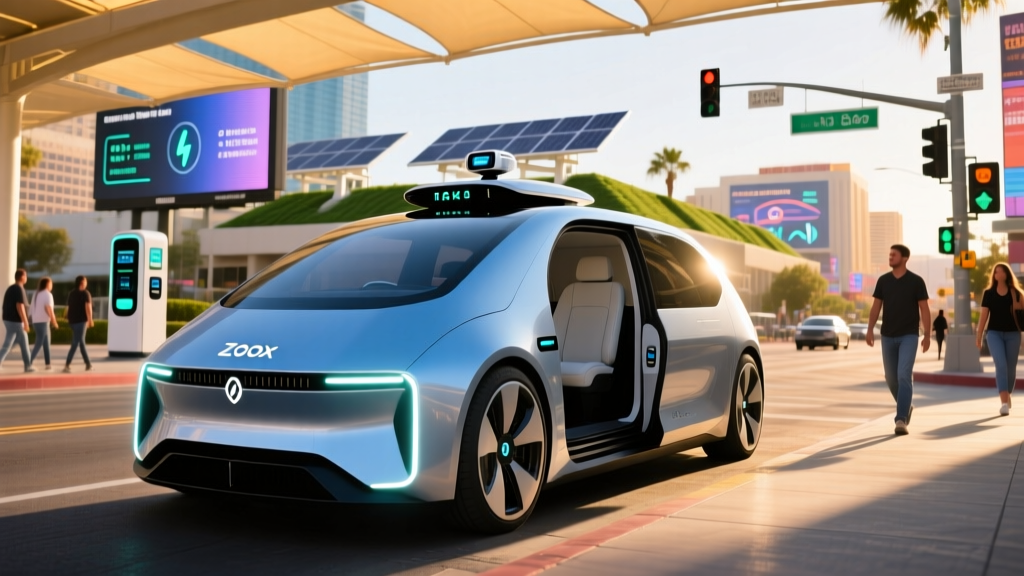
The Zoox vehicle is a purpose-built, bidirectional carriage-style pod manufactured at Amazon's facility in Hayward, California. It seats four passengers face-to-face, has a top speed of 75 mph, and uses a battery pack that enables roughly 16 hours of continuous operation before requiring a charge. The vehicle is not sold to consumers — it exists solely as a mobility-as-a-service platform.
| Specification | Detail |
|---|---|
| SAE Automation Level | Level 4 (geofenced) |
| Vehicle Type | Purpose-built robotaxi (no steering wheel/pedals) |
| Seating | 4 passengers, face-to-face |
| Top Speed | 75 mph |
| Operational Runtime | ~16 hours per charge |
| Sensor Suite | Lidar + cameras + radar (360° coverage) |
| Propulsion | Dual-motor AWD, fully electric |
| Consumer Purchase | Not available — ride-hail only |
Where Can You Use Zoox Right Now?
As of early 2026, Zoox operates commercial robotaxi service in a limited but growing footprint. Unlike Waymo, which has scaled aggressively across multiple metro areas, Zoox has taken a more deliberate rollout approach — prioritizing safety validation over geographic breadth.
| City | Status | Service Area Notes |
|---|---|---|
| Las Vegas, NV | Active (periodic pauses) | Downtown / Strip corridor geofence; stops occur for weather, construction, or software validation |
| Foster City, CA | Active | Initial testing and limited public rides; Bay Area hub |
| San Francisco, CA | Limited / Validation | Targeted corridors; not yet full commercial launch |
| Phoenix, AZ | Testing (no public rides) | Pre-commercial validation phase |
| Austin, TX | Announced / Testing | Mapping and validation; public timeline TBD |
Las Vegas remains Zoox's highest-profile market because the city's dense tourist corridor, predictable grid layout, and favorable regulatory environment make it an ideal proving ground. However, "Zoox stops Las Vegas" searches spike when the company temporarily suspends service — which can happen for several reasons detailed below.
Why Zoox Stops Operations in Las Vegas
Operational pauses are a deliberate safety feature, not a bug. When Zoox stops Las Vegas rides, it typically falls into one of these categories:
- Weather events: Las Vegas occasionally experiences monsoon-season flash flooding, haboobs (dust storms), or heavy rain. Lidar and camera performance degrades in low-visibility conditions, and Zoox will pull vehicles off the road rather than operate at reduced perception confidence.
- Software updates and validation: Zoox pushes over-the-air updates to its autonomous driving stack. After a major update, vehicles may be temporarily grounded while the fleet validates new behavior in simulation and controlled road tests before resuming passenger service.
- Construction and geofence changes: Las Vegas's Strip corridor is under near-constant construction. When lane configurations change unexpectedly or new detours appear outside the mapped geofence, Zoox pauses affected routes until the map data is updated and verified.
- Incident investigation: If any vehicle in the fleet experiences a disengagement, near-miss, or collision, Zoox may pause the entire local fleet pending root-cause analysis. This is standard practice across the robotaxi industry.
- Regulatory compliance: Nevada's Department of Motor Vehicles and the National Highway Traffic Safety Administration (NHTSA) periodically require reporting or operational reviews. Zoox may voluntarily pause during these windows.
The key takeaway: a robotaxi service that pauses when conditions exceed its operational design domain (ODD) is demonstrating responsible autonomy, not unreliability. The alternative — operating through conditions the system cannot handle — is what causes incidents.
How to Ride Zoox and What It Costs vs. Uber/Lyft
Riding Zoox in Las Vegas requires downloading the Zoox app (available on iOS and Android), creating an account, and requesting a ride within the geofenced service area. The experience is closer to an elevator ride than a traditional car trip: you enter a destination, the doors close, and the vehicle navigates autonomously.
| Service | Base Fare | Per-Mile Rate | Avg. 3-Mile Trip | Surge Pricing |
|---|---|---|---|---|
| Zoox | Competitive / subsidized | ~$1.00–$1.50/mi | ~$5–$8 | No surge pricing (fixed rates) |
| Waymo (where available) | ~$2.50 | ~$1.25–$1.75/mi | ~$7–$10 | Limited surge |
| UberX | ~$2.50–$3.50 | ~$1.50–$2.50/mi | ~$9–$15 | Yes (frequent in Vegas) |
| Lyft | ~$2.50–$3.00 | ~$1.40–$2.25/mi | ~$8–$13 | Yes (frequent in Vegas) |
Zoox has historically offered rides at or below rideshare rates — and occasionally free during promotional periods — as it builds ridership data and public trust. Amazon's deep pockets allow Zoox to subsidize fares during the growth phase. Expect pricing to normalize as the service scales, but Zoox's lack of a human driver means long-term unit economics should undercut traditional rideshare on per-mile cost.
Practical tips: Zoox rides cannot be hailed on the street. You must request through the app, and pickup/dropoff points are constrained to the geofenced zone. Rides on the Strip corridor typically cover the area between the Convention Center and Mandalay Bay, with specific stops rather than door-to-door flexibility.
Zoox Safety Record: What the Data Shows
Safety Data Context (as of early 2026):
- Zoox has accumulated millions of autonomous miles across its test and commercial fleets in California and Nevada.
- The company reports disengagement rates (instances where a remote operator must intervene) that have decreased year-over-year as the driving stack matures.
- Zoox is subject to NHTSA Standing General Order (SGO) reporting requirements, which mandate disclosure of any crash involving an ADS-equipped vehicle. These reports are publicly searchable on NHTSA's website.
- As with all robotaxi operators, the vast majority of reported incidents involve other human-driven vehicles colliding with the robotaxi — not the robotaxi initiating contact.
Sources: NHTSA SGO crash database, Zoox safety reports, California DMV disengagement filings.
It's important to contextualize robotaxi safety data. Zoox, like Waymo and Cruise before it, operates under intense public and regulatory scrutiny. Every minor contact is reported, whereas human driver incidents at similar rates would not make news. According to IIHS research, the most common robotaxi collision type is a low-speed rear-end or sideswipe caused by a human driver failing to yield — the same pattern seen in conventional traffic, but magnified by reporting requirements.
Zoox's purpose-built vehicle also includes design features that mitigate crash severity: the symmetric, carriage-style layout means there is no "front" or "rear" crumple zone bias, and the low top speed in urban geofenced areas (typically 35–45 mph) limits kinetic energy in any collision.
Technology Stack: How Zoox Sees the Road
Zoox uses a multi-modal sensor approach — fundamentally different from Tesla's camera-only FSD architecture. Here's the breakdown:
- Lidar (Light Detection and Ranging): Multiple lidar units provide a real-time 3D point cloud of the vehicle's surroundings, accurate to centimeter-level resolution. Lidar works independently of ambient light, giving Zoox reliable nighttime and low-light perception. This is critical for Las Vegas's neon-lit but shadow-heavy Strip environment.
- Cameras: A surround-camera array provides color, texture, and semantic information — reading traffic signs, detecting signal lights, identifying pedestrian gestures, and classifying objects. Cameras complement lidar by adding the "what" to lidar's "where."
- Radar: Forward and surround radar units detect velocity and distance of moving objects, particularly useful for tracking other vehicles at intersections and in rain or fog where lidar and camera performance may degrade.
- HD Maps and Geofencing: Zoox pre-maps every inch of its service area at sub-centimeter precision. The vehicle localizes itself within this map in real time, comparing sensor data against known landmarks. The geofence defines the exact boundary where the system is validated to operate — the vehicle will not drive outside it.
This sensor fusion approach — lidar + camera + radar + HD maps — is the industry consensus for Level 4 operations. It provides redundancy that camera-only systems cannot match, particularly in edge cases like direct sun glare, heavy rain, or construction-zone cone detection.
Regulatory Landscape: Who Approves Zoox Operations?
Robotaxi operations in the United States require approval at multiple jurisdictional levels:
- Federal (NHTSA): The National Highway Traffic Safety Administration sets vehicle safety standards (FMVSS). Zoox received a notable exemption from NHTSA to deploy its steering-wheel-free, pedal-free vehicle — a waiver from standards written for human-driven cars. NHTSA also enforces the Standing General Order requiring crash reporting for all ADS-equipped vehicles.
- State (Nevada DMV / California DMV): Nevada was one of the first states to pass autonomous vehicle legislation, and its DMV issues testing and deployment permits. California's DMV similarly requires testing permits, annual disengagement reports, and deployment permits for commercial service. Zoox holds permits in both states.
- Local (City/County): Local jurisdictions control road access, permitting for commercial operations, and coordination with first responders. In Las Vegas, Zoox coordinates with the city's traffic management center and local law enforcement.
This layered regulatory environment means that a robotaxi operator like Zoox must maintain compliance across federal, state, and local authorities simultaneously — a significant operational overhead that also acts as a safety backstop.
Current Limitations of Zoox Robotaxis
Level 4 autonomy is powerful but bounded. Here are the scenarios where Zoox cannot operate or will pause service:
- Weather: Heavy rain, dust storms, flooding, and fog can exceed the sensor suite's operational design domain. Zoox will ground vehicles rather than operate with degraded perception.
- Geofence boundaries: The vehicle will not travel outside its pre-mapped, validated service area. If your destination is outside the geofence, the app will not allow the request.
- Unmapped construction: Sudden lane closures or detours not yet reflected in HD map data will cause the vehicle to stop and request remote assistance or reroute.
- Complex unpaved or off-road terrain: Zoox is designed for paved urban and suburban roads. Dirt roads, parking garages with tight spirals, or private property are outside its ODD.
- Emergency vehicle interactions: While Zoox vehicles are programmed to yield to emergency vehicles, complex multi-emergency-vehicle scenarios (e.g., a fire truck and ambulance approaching from different directions) can cause the vehicle to stop and await remote guidance.
- Passenger behavior: Interior cameras monitor the cabin. If a passenger is standing, interfering with vehicle systems, or creating a safety hazard, the vehicle may pull over and end the ride.
These limitations are not unique to Zoox — they apply to every Level 4 robotaxi operating today, including Waymo. The difference between a responsible operator and an irresponsible one is whether the system recognizes these limitations and stops, rather than attempting to operate beyond its capabilities.
Frequently Asked Questions
Is Zoox truly self-driving or is there a remote driver?
Zoox vehicles are driverless — there is no human behind the wheel, no steering wheel, and no pedals. However, Zoox employs remote fleet assistance operators who can provide high-level guidance (e.g., confirming a route around construction) if the vehicle encounters an ambiguous scenario. The remote operator does not "joystick" the car in real time; the vehicle's AI still executes all driving maneuvers. This is consistent with SAE Level 4, where the system handles all driving within its ODD without human intervention.
How much does a Zoox ride cost compared to Uber or Lyft in Las Vegas?
Zoox has priced rides competitively with — and often below — UberX and Lyft in Las Vegas, with estimated 3-mile trips in the $5–$8 range versus $9–$15 for traditional rideshare (which frequently surges on the Strip). Zoox does not currently implement surge pricing. Exact fares vary and may change as Zoox moves from a subsidized growth phase to commercial pricing.
Why does Zoox keep stopping service in Las Vegas?
Zoox pauses Las Vegas operations for weather events (monsoon rain, dust storms), software updates requiring fleet-wide validation, unexpected construction altering mapped routes, or post-incident investigations. These pauses are a safety feature of Level 4 systems — the vehicle and fleet are designed to stop operating when conditions exceed the validated operational design domain, rather than attempt to drive through scenarios the system may not handle safely.
How safe are Zoox robotaxis compared to human drivers?
Direct statistical comparison is difficult because robotaxi fleets operate millions of miles (not billions like the human driving population) and are subject to mandatory crash reporting that human drivers are not. NHTSA SGO data shows that the majority of robotaxi incidents involve other human-driven vehicles striking the autonomous vehicle, not the robotaxi causing the collision. Zoox's sensor fusion stack (lidar + camera + radar) provides 360° awareness that does not fatigue, get distracted, or drive impaired — the leading causes of human crashes.
Can I ride Zoox outside of Las Vegas?
As of 2026, Zoox also operates limited service in Foster City, California, and is in testing or validation phases in San Francisco, Phoenix, and Austin. Commercial availability outside Las Vegas remains limited. Check the Zoox app for current service-area maps, as geofenced zones expand incrementally.
What happens if the Zoox vehicle breaks down or gets stuck during my ride?
Zoox vehicles have redundant systems for critical functions (braking, steering, computing). If a primary system fails, a backup engages and the vehicle pulls to a safe stop. Remote fleet assistance monitors all active rides and can dispatch roadside support. The passenger can also contact support via an in-cabin screen or button at any time.