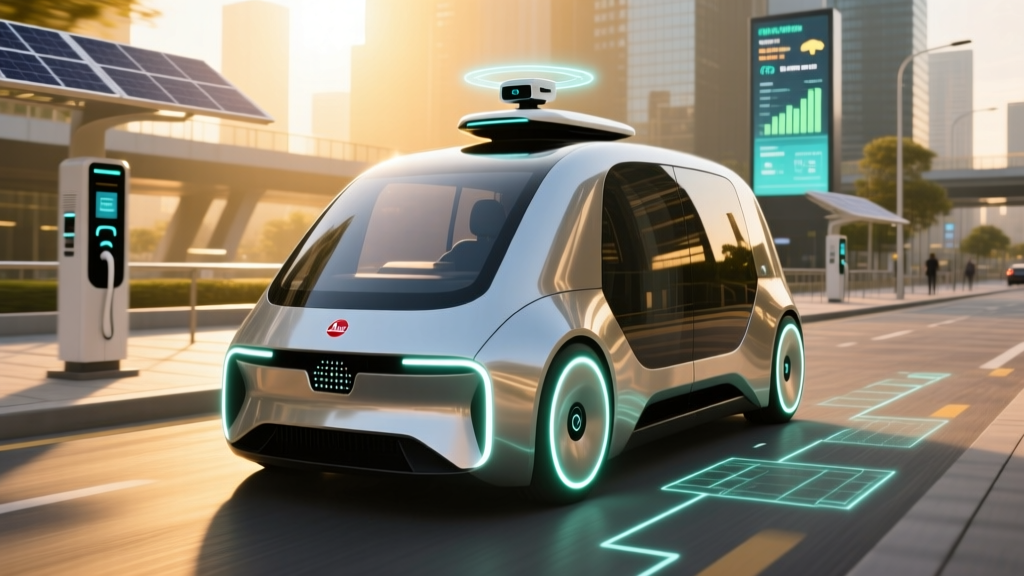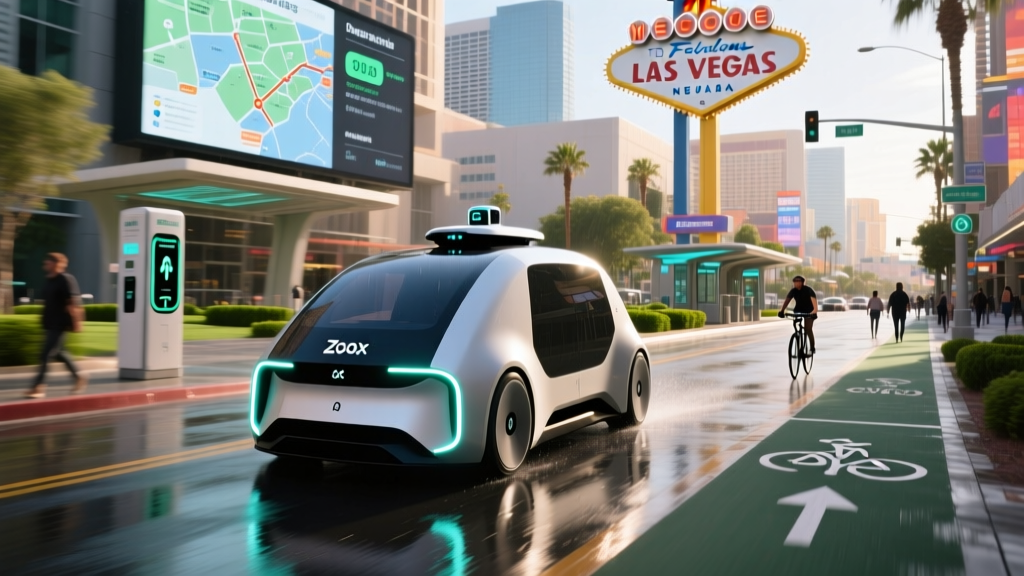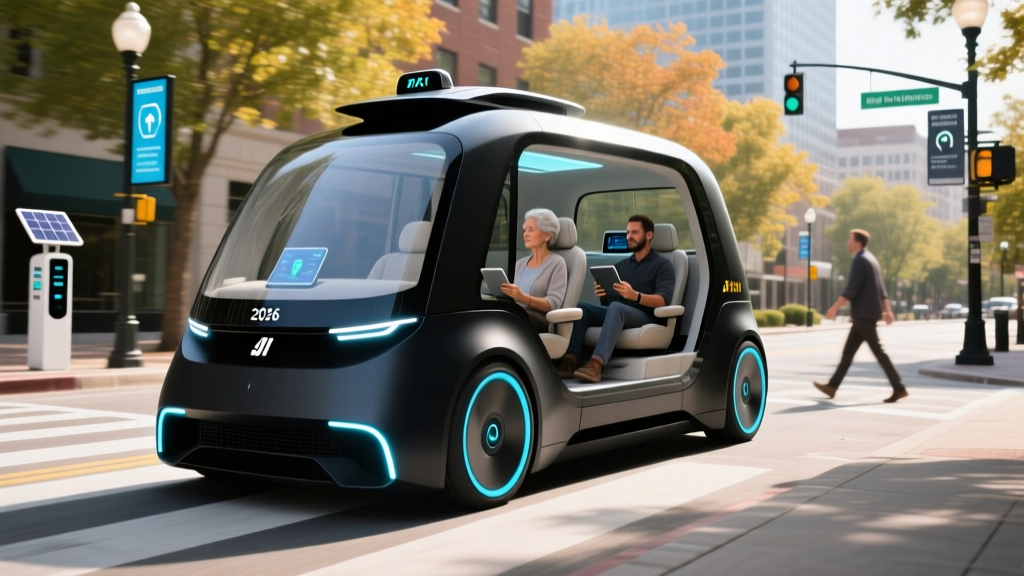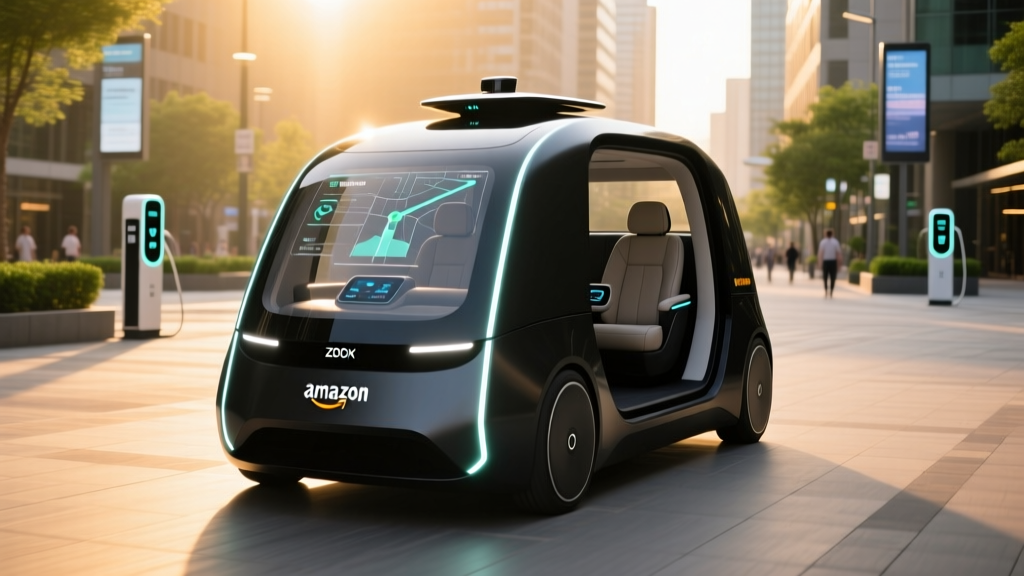
The Zoox shuttle isn't a concept car anymore. Amazon's autonomous vehicle subsidiary has moved its purpose-built, carriage-style robotaxi from testing into limited commercial service, putting it in a small but growing club of Level 4 driverless platforms actually carrying paying passengers on public roads. Unlike Tesla's FSD Supervised or GM's Super Cruise — which remain Level 2 driver-assist systems requiring an engaged human behind the wheel — the Zoox shuttle operates with no driver, no steering wheel, and no pedals.
This guide breaks down exactly where the Zoox shuttle runs today, what it costs relative to Uber and Lyft, how its sensor and compute stack works, what the safety record shows, and where the hard limitations still are. If you're tracking the robotaxi space as a potential rider, investor, or EV owner curious about where autonomy actually stands in 2026, this is the grounded, numbers-first picture.
What the Zoox Shuttle Actually Is (and What SAE Level It Runs At)
The Zoox vehicle is a ground-up, battery-electric robotaxi — not a retrofitted production car. It's a symmetrical, bidirectional carriage with facing bench seats, no steering wheel, no pedals, and no designated driver's seat. Zoox manufactures the vehicle at a facility in the Bay Area, and it is designed exclusively for ride-hailing service, not consumer sale.
The Zoox shuttle operates at SAE Level 4 within its approved Operational Design Domain (ODD). This means the system performs all driving tasks — steering, braking, navigation, hazard response — without any human intervention, but only within defined geographic, weather, and speed constraints. If conditions fall outside the ODD, the vehicle is designed to pull over safely rather than hand control to a passenger. This is fundamentally different from Level 2 systems like Tesla Autopilot, Ford BlueCruise, or GM Super Cruise, where a licensed driver must remain attentive and ready to take over at all times.
| Level | Name | Who Drives | Examples |
|---|---|---|---|
| Level 0 | No Automation | Human | Basic cruise control |
| Level 1 | Driver Assistance | Human (one feature assisted) | Adaptive cruise OR lane-keep |
| Level 2 | Partial Automation | Human (must supervise) | Tesla Autopilot/FSD Supervised, BlueCruise, Super Cruise |
| Level 3 | Conditional Automation | System (human on standby) | Mercedes Drive Pilot (limited markets, ≤40 mph) |
| Level 4 | High Automation | System (no human needed in ODD) | Zoox shuttle, Waymo One |
| Level 5 | Full Automation | System (everywhere, all conditions) | None currently deployed |
The critical distinction for consumers: when you step into a Zoox shuttle, there is no one in the front seat. The vehicle is the driver. Remote assistance operators can monitor and provide high-level guidance, but they do not "joystick" the vehicle in real time. This is the same operational model Waymo uses, and it's categorically different from any consumer car you can buy today.
Where Can You Ride the Zoox Shuttle Right Now?
Zoox has been methodical about its rollout — slower than Waymo's multi-city expansion, but deliberate. As of early 2026, the Zoox shuttle operates in limited commercial service in the following areas:
| City / Region | Status | Service Type | Notes |
|---|---|---|---|
| Las Vegas, NV (Strip corridor & surrounding areas) | Live — commercial rides | Employee + invited-rider program expanding to public | Primary commercial launch market |
| Foster City / Bay Area, CA | Live — testing + limited rides | Employee and early-access rider program | Headquarters region; longest-running test area |
| Phoenix, AZ (selected zones) | Testing | Pre-commercial operations | Announced expansion area |
| Atlanta, GA | Testing / mapping | Pre-commercial | Announced; not yet carrying riders |
Where can I use this robotaxi service right now? Realistically, Las Vegas is your best bet as a non-employee rider. Zoox has been progressively opening its Vegas service beyond Amazon and Zoox employees to invited external riders, with a broader public launch expected to scale through 2026. The Bay Area remains primarily an employee and test-rider program. Phoenix and Atlanta are in earlier stages — mapping, validation, and regulatory groundwork — and are not yet carrying passengers.
Zoox's approach is geofence-first: the company maps every lane, intersection, and curb in a service zone before activating rides. Expansion within a city happens block by block, not all at once.
How to Request a Ride and What It Costs vs. Uber or Lyft
Riders request a Zoox shuttle through the Zoox mobile app, similar to hailing an Uber or Lyft. You enter a pickup and drop-off point within the active geofence, and the nearest available vehicle routes to you. Wait times vary by zone density and fleet size — in Las Vegas, early riders have reported waits of 5–15 minutes during active service hours, though this will compress as fleet density increases.
| Service | Base Fare | Per-Mile Rate | Typical 3-Mile Ride | Surge Pricing |
|---|---|---|---|---|
| Zoox (promotional / early-access) | $0–$2 | Competitive with rideshare | $5–$12 | Not currently implemented |
| UberX (national avg.) | $2.50 | $1.25–$1.75 | $10–$16 | Yes — can 1.5–3x |
| Lyft Standard (national avg.) | $2.00 | $1.10–$1.60 | $9–$15 | Yes — Prime Time pricing |
| Waymo One (Phoenix/SF/LA) | $2.00–$3.00 | $1.20–$1.80 | $9–$17 | Rare; wait-time based |
How much does it cost vs Uber/Lyft? During its early-access phase, Zoox has priced rides competitively or offered them at steep discounts (and occasionally free) to build rider familiarity and collect feedback. As the service scales toward full commercial operation, Zoox has signaled pricing will be competitive with UberX and Lyft Standard — the economic thesis being that removing the driver (who typically takes 25–35% of a rideshare fare) allows the platform to undercut human-driven services while still targeting profitability at scale.
One practical difference: Zoox vehicles seat up to four passengers on facing bench seats, and there is no option for a "shared ride" with strangers at this stage. Every ride is private to your party.
The Technology Stack: Lidar, Cameras, and Compute
Zoox takes a sensor-fusion approach to perception — meaning it combines multiple sensor types rather than relying on cameras alone (as Tesla's FSD does). This is the same multi-sensor philosophy Waymo, Cruise, and most other Level 4 operators use.
- Lidar: Multiple solid-state and spinning lidar units providing 360° 3D point-cloud mapping out to ~150+ meters. Lidar gives precise depth and shape data regardless of lighting.
- Cameras: A surround array of high-resolution cameras covering all directions, used for object classification (pedestrian vs. cyclist vs. cone), traffic-light state detection, and sign reading.
- Radar: Forward and corner radar units for velocity detection of moving objects and performance in rain/fog where lidar and cameras degrade.
- Microphones: External microphones to detect emergency vehicle sirens and trigger appropriate pull-over behavior.
- Compute: Custom onboard compute platform running Zoox's full self-driving stack — perception, prediction, planning, and control — in real time with redundancy across critical systems.
- HD Maps: Centimeter-accurate pre-built maps of every service zone, updated continuously. The vehicle localizes against these maps in real time.
- Connectivity: Cellular connection to Zoox's fleet operations center for remote assistance, software updates, and dispatch.
The bidirectional design of the vehicle is not just aesthetic — it allows the shuttle to reverse direction without a multi-point turn, which simplifies routing in tight urban environments and dead-end streets. Both ends of the vehicle are identical, with identical sensor arrays.
The battery-electric powertrain is sized for all-day urban operation. Zoox has not published a consumer-facing EPA range figure (the vehicle isn't sold to consumers), but the pack is designed to support a full shift of stop-and-go city driving with opportunity charging between rides. The vehicle's top speed is approximately 75 mph, though it operates well below that in its current geofenced urban zones.
Safety Record: What the Data Shows
How safe are robotaxis? This is the right question, and it demands actual numbers rather than marketing claims. Zoox, like all autonomous vehicle operators in California, is required to submit disengagement and collision reports to the California DMV. At the federal level, all Level 4 operators must report crashes to the National Highway Traffic Safety Administration (NHTSA) under a Standing General Order.
- Test and service miles driven: Zoox has accumulated millions of autonomous miles across its Bay Area and Las Vegas fleets, though exact cumulative figures are not broken out publicly from Amazon's broader AV reporting.
- Disengagement rate: In California DMV filings, Zoox has reported disengagement rates (instances where a safety driver or remote operator had to intervene) that have decreased year over year, consistent with the industry trend as software matures. Exact 2025 figures should be verified against the CA DMV AV program page.
- Reported collisions: Zoox vehicles have been involved in minor incidents during testing, as documented in NHTSA filings. Most reported AV collisions industry-wide are low-speed, rear-end contacts initiated by human-driven vehicles — not the robotaxi. Zoox's carriage-style design includes a large physical footprint and 360° sensor coverage that reduces blind-spot incidents.
- No passenger fatalities: As of early 2026, no Zoox shuttle has been involved in a fatal crash during testing or commercial operation.
For the most current data, check the NHTSA crash reporting portal and California DMV disengagement reports directly.
Context matters: Waymo, the most mature Level 4 operator, has published peer-reviewed data showing its vehicles are involved in fewer police-reported crashes per million miles than human drivers in comparable urban environments. Zoox has not yet published equivalent peer-reviewed safety studies at the same scale, largely because its commercial fleet and mileage are smaller. As Zoox scales, expect more granular safety data to become publicly available.
Regulatory Landscape: Who Approves Robotaxi Operations?
Robotaxi operations in the United States are governed by a patchwork of state and local authorities. There is no single federal "robotaxi license." Here's how the approval chain works for Zoox:
- State level: Each state sets its own rules for autonomous vehicle testing and commercial deployment. In California, the DMV issues testing permits and, separately, deployment permits for driverless commercial service. In Nevada, the Department of Transportation and state legislature have created frameworks for AV operation, and Zoox received approval to operate its purpose-built vehicle on public roads in Las Vegas.
- Federal level: NHTSA regulates vehicle safety standards. Zoox's purpose-built vehicle — which lacks a steering wheel, mirrors, and other features required under traditional Federal Motor Vehicle Safety Standards (FMVSS) — required an NHTSS exemption or regulatory reinterpretation. Zoox has worked through this process, and the vehicle has been cleared for operation in its approved service areas.
- Local/municipal: City governments and local transportation authorities often have input on where AVs can operate, pick-up/drop-off zones, and coordination with emergency services.
The regulatory environment is evolving. Some states (Arizona, Nevada) have been permissive; others have paused or restricted robotaxi operations following incidents (notably California's suspension of Cruise's permit in late 2023). Zoox has benefited from a more cautious, slower rollout that has avoided the regulatory backlash Cruise experienced.
Current Limitations: Where the Zoox Shuttle Cannot Go
Level 4 autonomy is powerful but bounded. The Zoox shuttle has hard operational limits — areas and conditions where it simply will not run. Understanding these is essential for setting expectations.
- Geofence boundaries: The shuttle operates only within pre-mapped zones. If your destination falls outside the active geofence, the ride cannot be requested. Zones expand gradually but are not citywide.
- Weather restrictions: Heavy rain, snow, ice, and dense fog degrade lidar and camera performance. Zoox restricts or suspends service during severe weather — the vehicle will pull over safely if conditions deteriorate mid-ride.
- Highway driving: Current Zoox operations are urban and suburban, not highway. While the vehicle can reach ~75 mph, its approved ODD focuses on lower-speed city streets.
- Construction zones: Major, unmapped construction that alters lane configurations can force the vehicle to stop and request remote assistance or reroute.
- Unprotected left turns: Like all robotaxis, complex unprotected left turns across oncoming traffic remain one of the hardest edge cases. Zoox handles these but may take conservative, sometimes slow approaches.
- No intercity or airport service: You cannot currently take a Zoox shuttle from one city to another or to most airports, due to geofence and highway constraints.
- Limited hours: Service availability depends on fleet operations schedules. Late-night or very early-morning availability may be restricted in early deployment phases.
- Accessibility: While the carriage design includes a wide door opening and low floor, full ADA-compliant wheelchair accessibility in all scenarios is still being validated across the fleet.
What are the current limitations? In short: the Zoox shuttle works well within its geofenced, fair-weather, urban-speed envelope. It does not replace Uber for a 40-mile airport run in a rainstorm. Think of it as a capable city hopper, not a universal replacement for all ride-hailing trips.
Zoox vs. Waymo: How the Two Level 4 Services Compare
| Attribute | Zoox Shuttle | Waymo One (6th-gen) |
|---|---|---|
| Vehicle type | Purpose-built carriage (no steering wheel) | Modified Jaguar I-PACE (retrofitted) |
| SAE Level | Level 4 | Level 4 |
| Service cities (2026) | Las Vegas (primary), Bay Area (limited) | Phoenix, San Francisco, Los Angeles, Austin (expanding) |
| Public availability | Early-access / expanding to public | Fully open to public via Waymo app |
| Parent company | Amazon | Alphabet (Google) |
| Sensor approach | Lidar + camera + radar (fusion) | Lidar + camera + radar (fusion) |
| Seating | 4 passengers, facing benches | Up to 3 passengers, forward-facing |
| Top speed | ~75 mph | ~65–75 mph |
| Highway operation | Not currently | Limited highway segments (Phoenix) |
Waymo is significantly further ahead in commercial scale — it completes hundreds of thousands of paid rides per week across multiple cities. Zoox is earlier in its commercial arc but has the advantage of a purpose-built vehicle optimized from the ground up for rider experience and autonomous operation, rather than a retrofitted consumer car. Amazon's logistics and capital resources give Zoox a long runway to scale, but the gap in live service coverage is substantial as of 2026.
Frequently Asked Questions
Is the Zoox shuttle truly self-driving, or is it driver-assist like Tesla FSD?
The Zoox shuttle is genuinely self-driving — SAE Level 4 — within its operational zone. There is no steering wheel, no pedals, and no human driver. This is categorically different from Tesla's FSD (Supervised), Ford BlueCruise, or GM Super Cruise, which are all Level 2 driver-assist systems that require a licensed, attentive human driver behind the wheel at all times. Zoox and Waymo are the only Level 4 services carrying passengers in the U.S.
Can I buy a Zoox shuttle for personal use?
No. The Zoox vehicle is not available for consumer purchase. It is a fleet-only robotaxi designed, manufactured, and operated exclusively by Zoox (an Amazon subsidiary) for ride-hailing service. There are no announced plans for a consumer version.
How does Zoox handle emergencies or unexpected situations?
Zoox vehicles are monitored by a remote fleet-assistance team. If the vehicle encounters a scenario it cannot resolve autonomously (e.g., an unmapped construction zone or an unusual road obstruction), it will come to a safe stop and can receive high-level guidance from a remote operator. The remote operator does not steer or brake the vehicle in real time — they provide strategic direction (e.g., "proceed around the obstacle on the left"). The vehicle also has redundant braking, steering, and compute systems to handle hardware failures.
Is the Zoox shuttle electric?
Yes. The Zoox shuttle is a battery-electric vehicle. It charges at Zoox's depot facilities between shifts. Exact battery capacity (kWh) and range figures have not been published in consumer-facing specifications, as the vehicle is not sold retail and operates within a defined urban zone with predictable daily mileage.
How does the Zoox shuttle compare to taking an Uber?
The ride experience is different: you get a private, forward-and-rear-facing carriage with no driver, no small talk, and no rating anxiety. Pricing is competitive with UberX/Lyft during commercial operation, and there is no surge pricing in the current early-access phase. The trade-off is limited availability — you can only use Zoox within specific geofenced zones in a handful of cities, whereas Uber is available virtually everywhere.
What happens if it rains or snows during my Zoox ride?
Zoox monitors weather conditions in real time. If conditions degrade beyond the vehicle's operational limits (heavy rain, snow, ice), the service may be suspended and the vehicle will pull over safely. Light rain is generally within the operational envelope, but the vehicle may drive more conservatively, increasing travel time.