The Zoox Service Area: Where Can You Actually Ride Driverless Today?
If you have searched for the Zoox service area hoping to hail a fully driverless ride, the answer in 2026 is both encouraging and geographically narrow. Zoox, the autonomous-vehicle subsidiary Amazon acquired in 2020 for $1.3 billion, operates a limited commercial robotaxi service in select zones of Las Vegas and the San Francisco Bay Area. Unlike Tesla's Full Self-Driving (Supervised) or GM's Super Cruise — which are Level 2 driver-assist systems requiring constant human oversight — Zoox runs a true SAE Level 4 driverless operation within tightly defined geofences.
This guide breaks down exactly where Zoox operates, how to access the service, what it costs relative to Uber and Lyft, the safety data behind its driverless miles, and the real-world limitations you should understand before booking a ride.
Zoox vehicles operate without a human driver behind the wheel, but only within pre-mapped, geofenced service zones under specific conditions. No steering wheel, no pedals, no driver seat. If the vehicle exits its operational design domain (ODD), it pulls over safely rather than handing control to a passenger. This is fundamentally different from Level 2 systems like Tesla Autopilot or Ford BlueCruise, where the driver remains legally responsible at all times.
Where Can I Use Zoox Right Now? City-by-City Breakdown
Zoox has been methodical — some would say slow — in expanding its commercial footprint. As of early 2026, the service operates in two metro areas, each with defined geographic boundaries:
| City / Region | Service Zone | Status | Notes |
|---|---|---|---|
| Las Vegas, NV | Las Vegas Strip corridor, downtown, Convention Center area | Live — Paid Rides | Primary commercial market; tourist-heavy routes |
| San Francisco Bay Area, CA | Select zones in Foster City, portions of SF (SoMa, Financial District) | Live — Paid Rides | HQ city; phased expansion from employee-only to public access |
| Austin, TX | TBD | Testing (No Public Rides) | Mapped and testing; no announced public launch date |
| Atlanta, GA | TBD | Testing (No Public Rides) | Limited testing operations; no commercial timeline |
Key constraint: Even within "live" cities, Zoox only operates inside its geofence. You cannot hail a Zoox from a suburb outside the mapped zone. Pickup and drop-off are restricted to approved locations within the operational design domain. This is not Uber — you go where Zoox is mapped to go.
Zoox received its critical NHTSA exemption to operate its purpose-built vehicle (which lacks traditional controls like a steering wheel) under a Federal Motor Vehicle Safety Standards (FMVSS) waiver. At the state level, the Nevada Public Utilities Commission and the California Public Utilities Commission (CPUC) have each granted permits for commercial driverless operations. For real-time regulatory updates, the CPUC Autonomous Vehicle Programs page is the authoritative source for California permits.
How to Book a Zoox Ride and What It Costs vs. Uber and Lyft
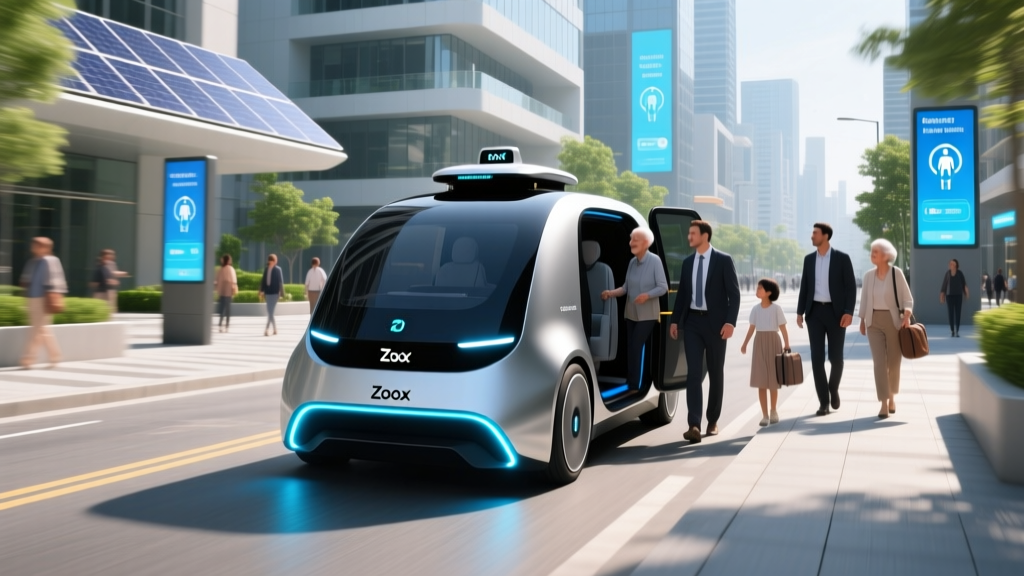
Accessing Zoox is straightforward but limited. Riders download the Zoox app (iOS/Android), create an account, and request a ride within the active service zone. The purpose-built Zoox vehicle — a compact, carriage-style EV with four inward-facing seats and no driver cockpit — arrives autonomously. There is no one behind the wheel. Remote fleet operators monitor vehicles and can intervene if the AI encounters an edge case it cannot resolve.
Zoox launched its paid public service in Las Vegas in mid-2025, initially with promotional pricing designed to build ridership and collect real-world data. Here is how pricing compares as of early 2026:
| Service | Estimated Fare | Surge Pricing | Tipping | Notes |
|---|---|---|---|---|
| Zoox | $6–$12 | Not yet active | No driver to tip | Introductory/promotional rates; expected to rise |
| UberX | $10–$18 | Yes (1.2x–3x+) | Expected (15–20%) | Widely available; variable ETA |
| Lyft | $9–$17 | Yes (Prime Time) | Expected (15–20%) | Comparable to UberX in most markets |
| Waymo One | $11–$20 | Yes (limited) | No driver to tip | Available in Phoenix, SF, LA; more mature network |
The economics reality: Zoox's current pricing is subsidized. Amazon is investing heavily in data collection and market penetration, much as Uber did in its early growth years. Expect fares to normalize upward as the service matures. The long-term thesis is that eliminating the driver — who typically takes 60–75% of a rideshare fare — makes robotaxis structurally cheaper at scale. That inflection point is still years away for Zoox specifically.
How Safe Are Zoox Robotaxis? The Real Data
Safety is the single most scrutinized question in autonomous vehicles, and Zoox has published limited but concrete data through regulatory filings and its voluntary safety reports.
- Total autonomous miles driven: ~1.5+ million miles across testing and commercial operations
- At-fault collisions: Zero reported at-fatalities; minor contact incidents documented in CPUC and NHTSA filings
- Disengagement rate: Zoox does not publicly report per-mile disengagement figures the way Waymo does, but internal data shared with regulators indicates sub-1 disengagement per 1,000 miles in mature geofenced zones
- Remote assistance: Fleet operators intervene remotely on edge cases (construction zones, unusual obstacles) — the vehicle stops and waits rather than making an unsafe decision
Sources: NHTSA AV reporting, California CPUC incident reports, Zoox voluntary safety self-assessments.
For context, Waymo — the most mature robotaxi operator — has logged over 40 million driverless miles and published peer-reviewed data showing a roughly 85% reduction in injury-causing crashes compared to human benchmarks in its operating areas. Zoox's dataset is far smaller, which means statistical confidence is lower. The company's safety case rests heavily on its purpose-built vehicle design: the Zoox carriage has no steering column, no dashboard hard surfaces, and airbag systems designed around a face-to-face seating layout, which the company argues reduces injury severity in the event of a collision.
The vehicle is also bidirectional — it can drive equally well in either direction, which eliminates the need for three-point turns or backing up in most scenarios. Each corner of the vehicle houses an identical sensor pod containing lidar, cameras, and radar, providing overlapping 360-degree perception.
Under the Hood: Zoox's Technology Stack Explained
Zoox takes a sensor-fusion approach that contrasts sharply with Tesla's camera-only vision strategy. Here is what powers the Zoox robotaxi:
- Primary sensors: Lidar (roof-mounted and corner pods), multiple high-resolution cameras, radar arrays — providing redundant 360° perception
- Compute: Custom onboard AI inference hardware (details proprietary); cloud-connected for fleet-level learning
- Mapping: HD pre-mapped routes within the geofence; centimeter-level localization
- Vehicle platform: Purpose-built symmetric EV — 4-wheel steering, bidirectional driving, ~75 kWh battery pack, estimated 150+ mile range (adequate for urban duty cycles with opportunity charging)
- Remote operations: Human fleet operators monitor multiple vehicles simultaneously and can provide high-level guidance (not real-time joystick driving) when the AI encounters novel scenarios
- Geofencing: The vehicle will not operate outside its pre-mapped ODD. If GPS or mapping confidence drops, the vehicle safely stops.
The decision to build a ground-up vehicle rather than retrofitting an existing car (as Waymo does with the Jaguar I-PACE and Zeekr) gives Zoox engineering freedom. There is no steering column to protect in a crash, no driver sightline requirements, and the battery pack is integrated into a skateboard chassis optimized for low-speed urban maneuvering rather than highway performance. The trade-off: Zoox cannot simply buy vehicles from an OEM at scale — it must manufacture its own, which constrains how fast it can grow.
Regulatory Landscape: Who Approves Zoox Operations?
Robotaxi regulation in the United States operates on a patchwork of federal and state authority:
- Federal (NHTSA): Sets vehicle safety standards (FMVSS). Zoox received a limited exemption to operate a vehicle without a steering wheel, mirrors, or traditional controls. NHTSA also mandates crash reporting for all ADS-equipped vehicles.
- State — California (CPUC + DMV): The DMV issues testing permits; the CPUC issues commercial passenger service permits. Zoox holds both. The CPUC can suspend permits — as it temporarily did for Cruise in late 2023 following a pedestrian-dragging incident in San Francisco.
- State — Nevada (Public Utilities Commission): Nevada has been more permissive for AV deployment, particularly in the Las Vegas corridor where tourism creates a controlled, high-demand use case.
- Local (city/county): Cities can impose additional operating restrictions, speed limits, and zone exclusions. San Francisco has been notably more contentious than Las Vegas in public acceptance.
The regulatory environment remains fluid. Following the Cruise incident in 2023 and subsequent fleet grounding, regulators across multiple states have increased scrutiny of robotaxi operators. Zoox has so far avoided major regulatory action, but the bar for public trust — and regulatory patience — remains high.
Current Limitations: Where Zoox Falls Short
If you are considering a Zoox ride, understand these real-world constraints:
- Geofence boundaries: The vehicle will not pick up or drop off outside its mapped zone. Suburban trips, airport runs (in most cases), and cross-city routes outside the ODD are unavailable.
- Severe weather: Heavy rain, fog, or unusual weather conditions can trigger operational pauses. Lidar performance degrades in heavy precipitation.
- Highway driving: The Zoox vehicle is designed for urban speeds (typically under 45 mph). It does not operate on freeways.
- Construction and road closures: While the AI handles routine cones and lane shifts, major unplanned construction can cause the vehicle to stop and wait for remote assistance, adding delay.
- Accessibility: The current Zoox vehicle is not wheelchair-accessible. ADA compliance remains an open challenge for the robotaxi industry broadly.
- Luggage and cargo: With four seats and a compact form factor, luggage space is limited. This is a people mover, not an airport shuttle.
- Wait times: Fleet size is limited. During peak demand in Las Vegas, wait times can exceed 15–20 minutes — longer than Uber/Lyft in most scenarios.
These are not unique to Zoox — Waymo faces similar geofence and weather constraints — but they are important context if you expect a seamless replacement for traditional rideshare.
Zoox vs. Waymo: How the Two Level 4 Robotaxis Compare
Zoox is not the only Level 4 robotaxi you can hail. Waymo, the Alphabet subsidiary, is the clear market leader in 2026 by ridership volume, city coverage, and miles driven. Here is a head-to-head comparison:
| Category | Zoox | Waymo One |
|---|---|---|
| SAE Level | Level 4 | Level 4 |
| Live Cities (Paid Rides) | Las Vegas, San Francisco | Phoenix, San Francisco, Los Angeles, Austin |
| Vehicle | Purpose-built Zoox carriage | Jaguar I-PACE, Zeekr RT (retrofit) |
| Driverless Miles Logged | ~1.5M+ | 40M+ |
| Sensor Approach | Lidar + Camera + Radar | Lidar + Camera + Radar |
| Highway Capable | No | Limited (some freeway segments) |
| Parent Company | Amazon | Alphabet (Google) |
| Avg. Wait Time (Peak) | 10–20 min | 3–8 min (mature markets) |
Waymo is the clear choice if you need coverage across more cities and shorter wait times. Zoox's differentiator is the purpose-built vehicle experience — riding in a vehicle with no driver controls is a qualitatively different experience than sitting in a retrofit Jaguar with a spinning lidar on the roof. For novelty and ride quality in Las Vegas, Zoox is compelling. For daily utility, Waymo leads.
Is This Truly Self-Driving or Just Driver-Assist?
This is the most important distinction in the entire autonomous vehicle space, and Zoox sits firmly on the "truly self-driving" side of the line — with a critical caveat.
Zoox is SAE Level 4. There is no steering wheel, no pedals, and no expectation that a passenger will take over. The vehicle handles the entire driving task within its operational design domain. If it encounters a situation it cannot handle, it stops safely and requests remote assistance — it never hands the wheel to you, because there is no wheel.
This is categorically different from:
- Tesla FSD (Supervised): SAE Level 2. The driver must remain alert, hands near the wheel, and legally responsible. The car assists; the human drives.
- GM Super Cruise / Ford BlueCruise: SAE Level 2. Hands-off on pre-mapped highways, but eyes-on and driver-responsible.
- Mercedes Drive Pilot: SAE Level 3 (limited). The car drives in specific traffic-jam conditions, and the manufacturer assumes liability — but only below 40 mph on approved highways.
Zoox and Waymo are the only two services in the U.S. where you can sit in the back seat, pay zero attention to the road, and arrive at your destination without any human driving input whatsoever. That is Level 4, and it is a fundamentally different technological and legal proposition than anything available in a consumer vehicle you can purchase.
Frequently Asked Questions
Where can I use Zoox right now?
Zoox offers paid driverless rides in Las Vegas (Strip corridor and downtown) and select zones of the San Francisco Bay Area (Foster City, parts of SoMa/Financial District). Service is restricted to pre-mapped geofence boundaries. Austin and Atlanta are in testing but not open to the public.
How much does a Zoox ride cost compared to Uber or Lyft?
As of early 2026, Zoox fares in Las Vegas range from approximately $6–$12 for a typical 3-mile trip, which is below UberX ($10–$18) and Lyft ($9–$17) for comparable routes. These are likely introductory/subsidized rates. No tipping is required since there is no driver.
How safe are Zoox robotaxis?
Zoox has logged over 1.5 million autonomous miles with no reported at-fault fatalities. Minor contact incidents have been documented in regulatory filings. The fleet is small, so statistical confidence is lower than Waymo's 40+ million-mile dataset. The vehicle's purpose-built design (no steering column, face-to-face seating with dedicated airbags) is engineered to reduce injury severity in collisions.
Can Zoox drive on the highway?
No. The Zoox vehicle is designed for urban environments at speeds typically under 45 mph. It does not operate on freeways or high-speed roads.
What happens if the Zoox vehicle encounters a situation it cannot handle?
The vehicle comes to a safe stop and connects with a remote fleet operations specialist who can provide high-level guidance (route selection, confirming it is safe to proceed). The remote operator does not "joystick" the car in real time — they provide decision support to the AI.
Is Zoox available in my city?
Unless you are in Las Vegas or specific zones of San Francisco, the answer is currently no. Zoox has announced testing in Austin and Atlanta, but no public launch dates for those markets. Expansion is expected to be gradual, prioritizing regulatory approval and fleet scaling.
Does Zoox operate in rain or bad weather?
Light rain is generally manageable. Heavy rain, dense fog, or unusual weather conditions can trigger operational pauses or reduced service availability. Lidar-based perception systems are affected by heavy precipitation, and Zoox takes a conservative approach to weather-related edge cases.