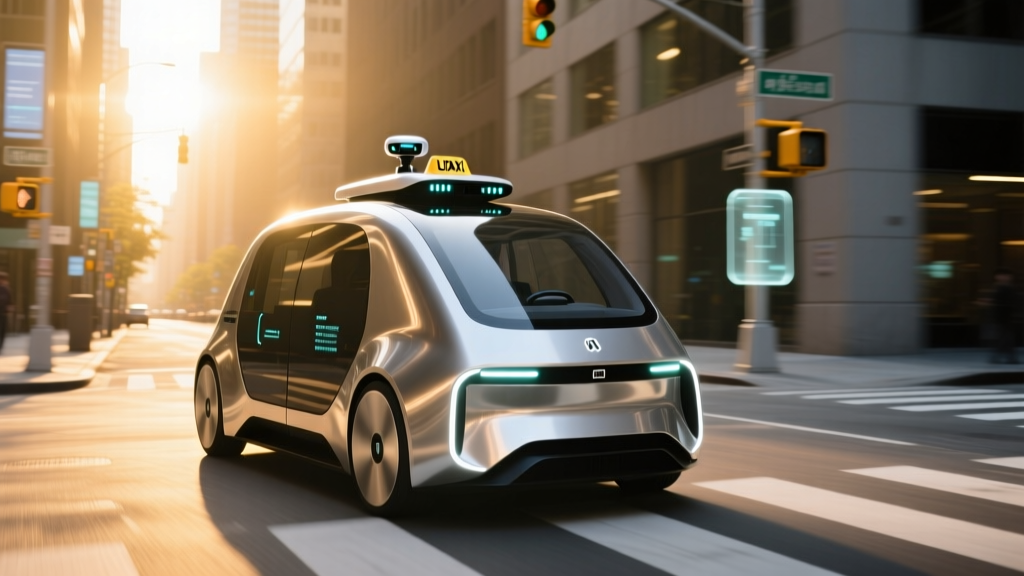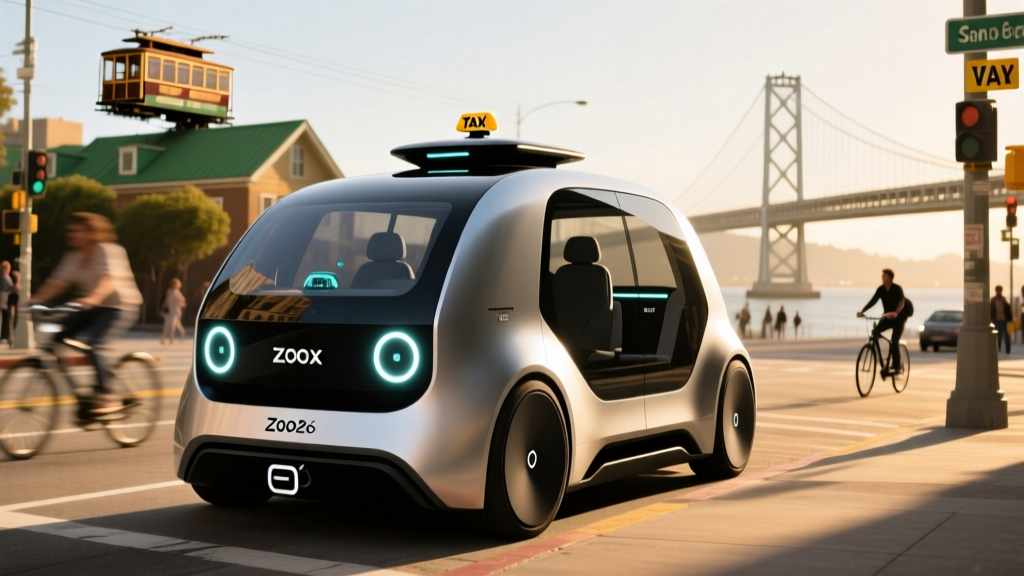
Amazon's Zoox has been one of the most closely watched entries in the autonomous vehicle space, primarily because it took the unusual step of designing a ground-up, purpose-built robotaxi rather than retrofitting an existing production car. If you've been searching for details on Zoox in San Francisco — where it operates, what a ride actually feels like, how it stacks up on safety, and whether it's genuinely driverless — this guide covers the current state of the service heading into 2026.
Unlike Tesla's Full Self-Driving (Supervised), which remains an SAE Level 2 driver-assist system requiring constant human oversight, Zoox operates as a true Level 4 robotaxi in geofenced urban areas. There is no steering wheel, no pedals, and no driver. That distinction matters enormously when evaluating safety, regulatory approval, and what you can actually expect from a ride.
What Zoox Actually Is: SAE Level 4 Explained
The Society of Automotive Engineers (SAE) defines six levels of driving automation, from Level 0 (no automation) to Level 5 (full automation everywhere, in all conditions). Understanding where Zoox sits on this scale is essential before evaluating its real-world performance.
| Level | Name | Who Drives | Example |
|---|---|---|---|
| 0 | No Automation | Human | Conventional car |
| 1 | Driver Assistance | Human + system assists | Adaptive cruise control |
| 2 | Partial Automation | Human supervises | Tesla Autopilot/FSD, GM Super Cruise, Ford BlueCruise |
| 3 | Conditional Automation | System drives in limited conditions; human on standby | Mercedes DRIVE PILOT (limited markets) |
| 4 | High Automation | System drives fully in geofenced area; no human needed | Zoox, Waymo |
| 5 | Full Automation | System drives everywhere, all conditions | Does not yet exist commercially |
Zoox is classified as SAE Level 4. This means the vehicle handles all driving tasks — steering, braking, navigation, obstacle avoidance — without any human intervention, but only within a predefined operational design domain (ODD). That ODD includes specific geofenced streets in approved cities under certain weather and lighting conditions. Outside that domain, the vehicle will not operate.
This is fundamentally different from Level 2 systems like Tesla FSD (Supervised) or GM Super Cruise, where a licensed driver must remain attentive and ready to take over at any moment. When you ride in a Zoox, there is nobody in a driver's seat. The vehicle is entirely autonomous within its service area.
Where You Can Ride Zoox Right Now
Zoox's rollout has been methodical and city-specific, governed by permits from state regulators. As of early 2026, the service operates in the following areas:
| City | Status | Service Area | Hours |
|---|---|---|---|
| San Francisco, CA | Live — public rides | Geofenced zones covering SoMa, Mission, Financial District, parts of the Embarcadero | Limited hours (not 24/7) |
| Foster City, CA | Live — public rides | Suburban test and service zone | Limited hours |
| Las Vegas, NV | Live — public rides | Las Vegas Strip corridor and surrounding areas | Limited hours |
| Seattle, WA | Testing / early access | Selected corridors — not fully open to public | N/A |
| Austin, TX | Testing | Pre-commercial testing phase | N/A |
For Zoox in San Francisco specifically, the geofence covers a growing but still bounded footprint. You cannot hail a Zoox to SFO airport or across the Golden Gate Bridge. The vehicle will only accept trips with both pickup and drop-off inside its approved zone. If your destination falls outside the boundary, the app simply won't let you book the ride.
Zoox expanded its San Francisco footprint incrementally through 2025, adding new neighborhoods after accumulating sufficient safety data and securing updated permits from the California Public Utilities Commission (CPUC), which regulates commercial passenger service in the state.
The Zoox Vehicle: Purpose-Built, Not Retrofitted
One of the most distinctive aspects of Zoox is that its robotaxi is not a modified consumer vehicle. Unlike Waymo, which uses the Jaguar I-PACE, Zoox engineered a bidirectional, carriage-style vehicle from scratch. Key design features include:
- Bidirectional driving: The vehicle has no defined "front" or "back" — it can drive equally well in either direction, which simplifies maneuvers like U-turns and three-point turns in tight urban streets.
- Four-wheel steering: All four wheels can turn, giving the vehicle an extremely tight turning radius (approximately 24 feet) — critical for navigating San Francisco's narrow, congested streets.
- Face-to-face seating: The interior accommodates up to four passengers seated facing each other, with no steering wheel, pedals, or dashboard.
- Top speed: Approximately 75 mph, though it rarely approaches this in urban service.
- Electric powertrain: Battery-electric with an estimated range sufficient for a full day of urban operations before returning to a depot for charging.
The carriage-style design is immediately recognizable on San Francisco streets and signals to pedestrians and other drivers that this is not a conventional vehicle with a distracted driver — it's a machine making its own decisions.
Technology Stack: Sensors, Lidar, and Compute
Zoox employs a redundant, multi-sensor perception system — a deliberate contrast to Tesla's camera-only approach. The stack includes:
Zoox Sensor Suite
| Sensor Type | Function | Redundancy Notes |
|---|---|---|
| Lidar (multiple units) | 3D point-cloud mapping of surroundings; precise distance measurement to objects, pedestrians, cyclists | Overlapping fields of view for 360° coverage |
| Cameras (multiple) | Object classification, traffic signal recognition, lane detection, reading signs | Overlapping coverage across visible spectrum |
| Radar | Velocity detection of moving objects; performs in rain/fog where lidar and cameras degrade | Covers long-range and short-range |
| Ultrasonic sensors | Near-field object detection during low-speed maneuvers and docking | Close-range redundancy |
| IMU + GPS + HD maps | Precise localization within the geofenced area; dead-reckoning if GPS is degraded | Multi-source positioning |
This sensor redundancy is a hallmark of Level 4 systems. If one sensor modality degrades — for example, cameras in heavy rain — lidar and radar continue to provide reliable perception data. The onboard compute platform fuses all sensor inputs in real time to build a comprehensive model of the vehicle's surroundings.
Zoox also relies on high-definition maps of its service areas. These maps encode lane geometry, traffic signal locations, speed limits, crosswalk positions, and known construction zones. The vehicle uses these maps for localization (knowing exactly where it is, to centimeter-level precision) and route planning, while real-time sensor data handles dynamic obstacles like pedestrians, other vehicles, and unexpected road closures.
How to Ride Zoox in San Francisco — and What It Costs
Booking a Zoox ride is straightforward, though the experience differs from a typical Uber or Lyft hail:
- Download the Zoox app (available on iOS and Android).
- Enter your pickup and drop-off — both must be within the active geofence.
- Wait for vehicle assignment — the app shows the vehicle's approach and exact pickup point.
- Board the vehicle — doors unlock automatically. No driver interaction needed.
- Ride — an interior screen shows the route and provides trip status. Emergency stop buttons are accessible but intended for genuine emergencies.
- Arrive and exit — the vehicle waits briefly to ensure you've exited safely.
As for pricing, Zoox has positioned its service competitively against traditional rideshare during its commercialization phase:
| Metric | Zoox | UberX (SF avg.) | Lyft (SF avg.) |
|---|---|---|---|
| Base fare | $0 (promotional period) / ~$2.50 standard | ~$2.50 | ~$2.00 |
| Per-mile rate | ~$1.25–$1.50 | ~$1.50–$1.80 | ~$1.40–$1.70 |
| Per-minute rate | ~$0.30–$0.40 | ~$0.35–$0.50 | ~$0.30–$0.45 |
| Typical 3-mile trip | ~$7–$12 | ~$10–$16 | ~$9–$15 |
| Surge pricing | Not currently implemented | 1.5x–3x during peak | Prime Time pricing |
| Tips | Not applicable (no driver) | Expected ($2–$5) | Expected ($2–$5) |
During its initial commercial rollout, Zoox offered free or heavily discounted rides to build ridership and gather feedback. As the service matures into 2026, pricing has moved toward standard rates that remain slightly below UberX and Lyft for comparable trips — partly because there's no driver to pay and partly because Zoox is still prioritizing market adoption over immediate profitability.
The tip dynamic is worth noting: without a driver, the total cost of a Zoox ride often ends up 20–30% lower than a comparable rideshare trip where tipping is customary.
Safety Data: What the Numbers Show
Safety is the most scrutinized aspect of any robotaxi operation. Zoox, like Waymo and Cruise before it, is required to report disengagement data and collision reports to California's Department of Motor Vehicles (DMV) and the National Highway Traffic Safety Administration (NHTSA).
Zoox Safety Metrics — Key Data Points
- Autonomous miles driven (California): Zoox has accumulated hundreds of thousands of autonomous miles across its California operations (San Francisco and Foster City), with the fleet growing through 2025–2026.
- Disengagement rate: California DMV disengagement reports track how often a safety driver (during testing phases) had to take manual control. Zoox's disengagement rate has improved significantly as the system has matured, though exact figures vary by reporting period. For context, leading operators report disengagement rates of roughly 1 per 5,000–15,000 autonomous miles during testing.
- Collision reports: Like all autonomous vehicle operators in California, Zoox must file OL 316 collision reports for any incident involving the vehicle. Most reported robotaxi collisions industry-wide are minor, low-speed incidents where another human-driven vehicle rear-ended or sideswiped the robotaxi — not the reverse.
- No passenger injuries reported in Zoox's public commercial operations as of early 2026, according to publicly available CPUC and DMV filings.
It's important to contextualize these numbers. Robotaxis operate in dense urban environments with pedestrians, cyclists, delivery trucks, and unpredictable human drivers. The comparison baseline matters: the Insurance Institute for Highway Safety (IIHS) and NHTSA data consistently show that roughly 94% of traffic fatalities involve human error — distraction, impairment, speeding, or fatigue. Level 4 robotaxis eliminate those specific failure modes within their operational domain.
That said, robotaxis face edge cases that human drivers handle intuitively: a police officer directing traffic with hand signals, a double-parked delivery truck blocking a lane, or an unprotected left turn across oncoming traffic in a busy intersection. How the system handles these scenarios is where the engineering challenge lies, and it's why geofencing and incremental expansion remain the industry standard.
Regulatory Landscape: Who Approves Zoox Operations
Deploying a driverless vehicle for public rides requires navigating overlapping regulatory frameworks:
- California DMV: Issues autonomous vehicle testing permits and requires annual disengagement reports. Zoox holds a valid testing permit and, subsequently, a deployment permit for commercial operations.
- CPUC (California Public Utilities Commission): Regulates commercial passenger service — the equivalent of a taxi or rideshare license. Zoox received its CPUC permits to offer paid rides to the public in designated areas.
- NHTSA (federal): Sets vehicle safety standards. Zoox's purpose-built vehicle required specific regulatory engagement because it lacks traditional controls (steering wheel, mirrors). In 2024, Zoox received NHTSA approval to operate its vehicle without certain legacy requirements that assumed a human driver, a significant regulatory milestone.
- San Francisco Municipal Transportation Agency (SFMTA): Manages local street access, parking, and curb-use policies that affect where robotaxis can pick up and drop off passengers.
The regulatory path has not been frictionless. After Cruise's high-profile incident in late 2023 — where a pedestrian was dragged under a Cruise robotaxi — California regulators temporarily suspended Cruise's permits and increased scrutiny on all operators. Zoox, which was still in earlier-stage deployment at the time, was not directly affected but benefited from the industry-wide safety review that followed, as it reinforced the importance of conservative expansion.
Current Limitations: What Zoox Cannot Do
Despite impressive technology, Zoox — like every Level 4 robotaxi — operates within strict boundaries. Understanding these limitations is essential before you book a ride:
Known Limitations of Zoox Service (2026)
- Geofencing: The vehicle only operates within its approved service zone. Trips starting or ending outside the boundary are not available.
- Weather constraints: Heavy rain, dense fog, or unusual road conditions (flooding, ice) may cause the system to reduce speed, pull over safely, or decline to dispatch. San Francisco's fog is generally manageable, but severe weather events pause service.
- No highway driving: Zoox is designed for urban streets, not freeways. You cannot take it from SoMa to SFO via I-280.
- Limited hours: Service is not available 24/7. Operating windows are defined by permit conditions and current system capability.
- Accessibility: While the Zoox vehicle is designed with accessibility in mind, not all pickup/drop-off points may be fully ADA-compliant due to curb and infrastructure constraints in older parts of San Francisco.
- No stops mid-trip: You cannot ask the vehicle to stop at a convenience store or make a detour. The route is calculated and executed autonomously.
- Construction zones: While the system can handle many construction scenarios, major unexpected road closures or complex temporary traffic patterns may cause the vehicle to reroute or, in rare cases, safely stop and request remote assistance.
- Capacity: Maximum four passengers. No cargo beyond what fits on your lap or in the seating area — no airport-runs-with-luggage scenarios.
These limitations are not unique to Zoox. Waymo's service in San Francisco, Phoenix, and Los Angeles operates under similar constraints. The technology is genuinely impressive within its domain, but that domain is deliberately narrow by design — safety and regulatory compliance require it.
Zoox vs. Waymo: How San Francisco's Two Robotaxis Compare
San Francisco is one of the few cities where riders can experience two distinct Level 4 robotaxi services. Here's how they stack up:
| Feature | Zoox | Waymo |
|---|---|---|
| Vehicle | Purpose-built carriage (no steering wheel) | Jaguar I-PACE (modified production EV) |
| Seating | 4 passengers, face-to-face | Up to 3 passengers, forward-facing |
| SAE Level | Level 4 | Level 4 |
| SF Coverage | Growing geofence (SoMa, Mission, FiDi, Embarcadero) | Broader coverage across most of SF |
| Hours | Limited hours | Extended hours (approaching 24/7 in some areas) |
| Pricing | Competitive / promotional | Comparable to UberX/Lyft |
| Airport service | No | Limited (SFO service expanding) |
| Parent company | Amazon | Alphabet (Google) |
Waymo has a significant head start in San Francisco, with broader geographic coverage and longer operating hours. Zoox's advantage lies in its purpose-built vehicle design — the bidirectional capability, tighter turning radius, and passenger-facing interior represent a fundamentally different approach to what an urban mobility vehicle can be. As Zoox's geofence expands and operating hours extend through 2026, the two services will increasingly overlap.
Frequently Asked Questions
Is Zoox in San Francisco truly self-driving, or is there a remote driver?
Zoox is truly driverless — there is no human in the vehicle, and no remote operator controlling it in real time. The vehicle makes all driving decisions autonomously using its onboard sensor suite and compute platform. Remote assistance may be used in rare edge cases (e.g., an ambiguous construction zone), but the remote operator does not "drive" the vehicle; they provide high-level guidance that the vehicle's system then executes.
How much does a Zoox ride cost compared to Uber or Lyft?
Zoox pricing is generally comparable to or slightly below UberX and Lyft for equivalent trips within San Francisco. A typical 3-mile ride costs roughly $7–$12. Without a driver to tip, the total out-of-pocket cost is often 20–30% lower than a comparable rideshare trip. Pricing may adjust as Zoox moves past its initial promotional phase.
How safe are Zoox robotaxis based on real data?
As of early 2026, Zoox has reported no passenger injuries during its public commercial operations in California. Like all AV operators, Zoox files collision reports with the California DMV; most reported incidents industry-wide involve other human-driven vehicles colliding with the robotaxi at low speed, not the reverse. The system's safety record should be evaluated against the baseline of human-driven vehicles, which are involved in approximately 40,000+ fatalities annually in the U.S. according to NHTSA data.
Can I take a Zoox to SFO Airport or across the Bay Bridge?
No. Zoox currently operates only within its approved geofence in San Francisco, which covers central neighborhoods like SoMa, the Mission, the Financial District, and parts of the Embarcadero. Highway driving, airport trips, and cross-bay routes are not available. The vehicle is designed for urban streets, not freeways.
What happens if the Zoox vehicle encounters an emergency?
The vehicle is equipped with interior emergency stop buttons and a communication system that connects passengers to Zoox's operations center. The vehicle's system is designed to pull over safely and stop if it detects a system fault, an obstruction, or an emergency situation. First responders can interact with the vehicle using external interfaces if needed.
Is Zoox available 24/7?
No. Zoox operates during limited hours defined by its CPUC permit and current system capabilities. Operating windows have expanded as the service has matured, but 24/7 service is not yet available in San Francisco.
How does Zoox's approach differ from Tesla's Full Self-Driving?
This is a critical distinction. Tesla FSD (Supervised) is an SAE Level 2 driver-assist system — the human driver must remain fully attentive and is legally responsible for the vehicle at all times. Zoox is an SAE Level 4 system with no driver present. They are different categories of technology with different regulatory frameworks, different safety models, and different liability structures. Zoox does not sell its vehicles to consumers; it operates them as a service.
Zoox in San Francisco represents one of the most tangible examples of Level 4 autonomous mobility available to the public today. The service is limited in scope — geofenced, weather-sensitive, and restricted to urban streets — but within those boundaries, it delivers a genuinely driverless experience that was theoretical just a few years ago. As the geofence grows and operating hours expand through 2026, Zoox will increasingly become a practical transportation option for residents and visitors in central San Francisco, not just a technology demonstration.