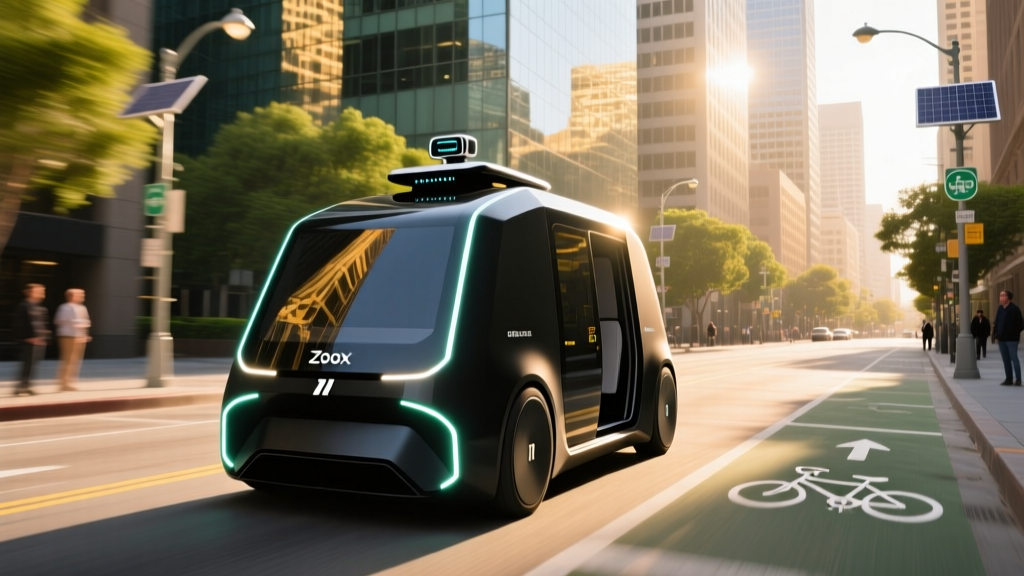
If you have been searching for when is Zoox coming to San Francisco, the answer is nuanced: Zoox's purpose-built robotaxi has been testing on San Francisco streets since late 2023, but a fully commercial, fare-charging, open-to-the-public service in the city remains in a phased rollout through 2026. Here is exactly where things stand, what the vehicle can and cannot do, and how a Zoox ride will compare to the Uber or Lyft you are already hailing.
Where Zoox Operates Right Now (And Where It Is Headed)
Zoox, the autonomous-vehicle subsidiary Amazon acquired in 2020 for roughly $1.3 billion, has pursued a slower, more methodical city-by-city expansion than its closest competitor, Waymo. As of early 2026, here is the operational footprint:
| City | Status | Service Type | Hours | Public Access |
|---|---|---|---|---|
| Foster City, CA | Active | Employee + invited-rider pilot | Limited daytime | Invite-only |
| San Francisco, CA | Active testing | Mapping, validation, supervised runs | Varies | Not yet open to public |
| Las Vegas, NV | Active | Employee + invited-rider pilot | Limited hours | Invite-only |
| Phoenix, AZ | Testing | Validation and mapping | Varies | No |
| Atlanta, GA | Announced | Future expansion target | TBD | No |
For the specific question of when Zoox is coming to San Francisco as a bookable ride: Zoox has been operating its purpose-built bidirectional vehicle on SF streets in a testing capacity since receiving its California DMV autonomous-vehicle testing permit. However, the California Public Utilities Commission (CPUC) must grant a commercial deployment permit before Zoox can charge fares and open rides to the general public in the city. Based on Zoox's public statements and regulatory filings, a limited commercial launch in San Francisco is targeted for the second half of 2026, with a broader rollout expected to follow into 2027.
This timeline is notably later than Waymo, which has operated a commercial robotaxi service in San Francisco since 2022 and expanded across the Bay Area. Zoox's slower pace reflects its decision to develop an entirely new vehicle from scratch rather than retrofitting an existing production car.
What Level of Autonomy Is Zoox? (It Is Not Driver-Assist)
Understanding Zoox's autonomy level is critical, because consumers frequently conflate consumer driver-assist features with true self-driving. They are fundamentally different categories.
SAE Automation Levels — Where Zoox Sits
| SAE Level | Name | Driver Required? | Examples |
|---|---|---|---|
| Level 0 | No Automation | Full-time driver | Basic cruise control |
| Level 1 | Driver Assistance | Full-time driver | Adaptive cruise, lane-keep |
| Level 2 | Partial Automation | Full-time driver, hands on or eyes on | Tesla Autopilot, GM Super Cruise, Ford BlueCruise |
| Level 3 | Conditional Automation | Driver available for takeover | Mercedes DRIVE PILOT (limited conditions) |
| Level 4 | High Automation | No driver in geofenced area | Zoox, Waymo, Cruise (pre-suspension) |
| Level 5 | Full Automation | No driver anywhere | Does not exist commercially |
Zoox is a Level 4 system. There is no steering wheel, no pedals, and no human driver onboard. The vehicle operates autonomously within its geofenced service area. This is categorically different from Tesla's FSD (Supervised), which is a Level 2 system requiring constant driver attention and readiness to take over. If you are comparing "self-driving" experiences, a Zoox ride and a Tesla on FSD are not the same product.
The Zoox Vehicle: Purpose-Built From the Ground Up
Unlike Waymo, which outfits the Jaguar I-PACE with its sensor suite, Zoox designed and built its own vehicle — a compact, carriage-shaped, bidirectional pod. Here is what makes it distinct:
Technology Stack Overview
- Form factor: Symmetrical, bidirectional (drives equally well in either direction), seats four passengers face-to-face
- Dimensions: Approximately 60% the volume of a Toyota RAV4 — designed for dense urban environments
- Powertrain: Fully electric battery-electric vehicle (BEV) with bidirectional drive capability
- Top speed: 75 mph (though urban operations typically stay well below this)
- Sensor suite:
- LiDAR: Multiple solid-state and spinning LiDAR units providing 360° 3D point-cloud mapping
- Cameras: High-resolution camera array covering all directions for object classification, traffic-light recognition, and lane detection
- Radar: Multi-mode radar for velocity detection and performance in low-visibility conditions
- Ultrasonic sensors: Close-range object detection for low-speed maneuvering
- Compute: Custom onboard computing platform running Zoox's proprietary AI driving software
- Geofencing: High-definition maps of approved operational areas; vehicle will not operate outside its geofence
The multi-sensor approach (LiDAR + cameras + radar) contrasts with Tesla's camera-only vision system. Zoox, like Waymo, relies on LiDAR as a core sensing modality for depth perception and redundancy. This sensor diversity is a deliberate safety choice: if one modality is degraded (e.g., camera glare from sun angle), the others compensate.
How to Ride Zoox and What It Will Cost
Once Zoox opens commercial service in San Francisco, the experience will work similarly to Waymo One or the former Cruise app:
- Download the Zoox app (expected to launch alongside commercial service)
- Request a ride within the geofenced service area
- The vehicle arrives — no driver, no steering wheel. Doors unlock automatically.
- Ride to your destination — the vehicle handles all driving tasks
- Exit and rate — payment is processed automatically through the app
For pricing, Zoox has not published official fare structures for San Francisco. However, based on comparable robotaxi pricing and industry expectations:
| Service | Estimated Fare | Surge Pricing? | Tips Required? |
|---|---|---|---|
| UberX (SF avg.) | $12–$18 | Yes (can 2–3x) | Expected (15–20%) |
| Lyft Standard (SF avg.) | $11–$17 | Yes | Expected |
| Waymo One (current) | $10–$16 | Limited/none | No driver to tip |
| Zoox (projected) | $10–$16 | Unlikely initially | No driver to tip |
Robotaxis generally price at or slightly below rideshare because there is no driver to pay. However, early commercial phases may include promotional pricing or free rides to build ridership, as Waymo and Cruise did. Expect Zoox to launch with introductory incentives in San Francisco.
How Safe Are Robotaxis? The Real Data
Safety is the single most scrutinized aspect of autonomous vehicles, and rightly so. After Cruise's October 2023 incident in San Francisco — where a pedestrian was dragged after being struck by a human-driven vehicle and then run over by a Cruise robotaxi — regulators and the public demanded greater transparency. Here is what the data actually shows:
Robotaxi Safety Data Points
- Waymo: Over 5 million fully autonomous (driverless) miles driven as of late 2023. A study published by the Insurance Institute for Highway Safety (IIHS) and independent researchers found Waymo's autonomous vehicles had a lower crash rate per million miles than human-driven benchmarks in comparable urban environments.
- Cruise (pre-suspension): Accumulated millions of driverless miles in San Francisco before its permit was suspended in October 2023. The California DMV cited concerns about the company's response to the pedestrian-dragging incident, not the frequency of collisions overall.
- Zoox: As of early 2026, Zoox has not published a comprehensive public safety report with disengagement rates or collision-per-million-mile figures, because its commercial driverless mileage is still relatively limited compared to Waymo. Zoox has held a California DMV autonomous-vehicle testing permit and is required to report disengagements and collisions to the state.
- NHTSA Standing General Order: All companies testing or deploying Level 4 vehicles must report crashes to the National Highway Traffic Safety Administration within 24 hours for serious incidents. This data is publicly searchable.
The honest assessment: robotaxis from established operators (Waymo in particular) have demonstrated safety performance that is competitive with or better than human drivers in controlled urban environments at moderate speeds. However, the sample sizes for Zoox specifically remain smaller, and the edge cases — construction zones, erratic human behavior, severe weather — remain the frontier challenges for all Level 4 systems.
Current Limitations: What Zoox Cannot Do (Yet)
Level 4 autonomy is impressive within its operational design domain (ODD), but it is not universal capability. Here are the real limitations:
Known Limitations of Zoox and Similar Level 4 Robotaxis
- Geofencing: The vehicle will only operate within its pre-mapped, approved service area. Request a ride to an unzoned neighborhood, and the app will simply not offer it.
- Weather: Heavy rain, dense fog, and snow degrade LiDAR and camera performance. Most Level 4 services suspend or limit operations in severe weather. San Francisco's fog may trigger reduced service areas during certain conditions.
- Construction zones: Rapidly changing lane configurations and temporary signage challenge even advanced perception systems. Vehicles may reroute or pull over when encountering unmapped construction.
- Highway driving: Zoox's vehicle is designed for urban speeds (up to 75 mph capability, but primarily operating at 25–45 mph in city environments). It will not take you from San Francisco to Los Angeles.
- Pickup/dropoff precision: The vehicle must pull to a safe, legal stopping point. It cannot stop in a bus lane, double-park, or pull into a private garage. Expect to walk a short distance from your exact door to the vehicle's stopping point.
- No human override: There is no steering wheel. If you need to change the route mid-trip, you can only do so through the in-vehicle screen or app — you cannot "take over" driving.
- Accessibility: Zoox has stated its vehicle is designed with wheelchair accessibility in mind, but real-world validation with passengers using mobility devices is still ongoing during pilot phases.
The Regulatory Landscape: Who Approves Zoox in California?
Operating a commercial robotaxi in California requires navigating a three-layer regulatory stack:
- California DMV — Testing Permit: Required to test autonomous vehicles on public roads. Zoox holds this permit and must report disengagements (instances where a safety operator or remote assist takes over) and collisions annually. The DMV can suspend permits, as it did with Cruise in October 2023.
- California Public Utilities Commission (CPUC) — Commercial Deployment Permit: This is the permit that allows a company to charge fares and operate a commercial passenger service. Waymo holds a statewide CPUC permit. Zoox will need its own CPUC approval before it can offer paid rides in San Francisco.
- NHTSA — Federal Vehicle Safety Standards: At the federal level, Zoox's purpose-built vehicle received a notable exemption: in 2022, NHTSA granted Zoox permission to operate its vehicle without traditional safety equipment like a steering wheel and rearview mirrors, which are normally required under Federal Motor Vehicle Safety Standards (FMVSS). This was a landmark regulatory decision enabling purpose-built robotaxi designs.
The CPUC process is the key gate for the "when is Zoox coming to San Francisco" question. Until that commercial permit is granted, Zoox can test but cannot charge riders.
Zoox vs. Waymo: How They Compare in San Francisco
| Attribute | Zoox | Waymo |
|---|---|---|
| Vehicle | Purpose-built Zoox pod (bidirectional, no steering wheel) | Jaguar I-PACE (retrofitted with Waymo Driver suite) |
| SAE Level | Level 4 | Level 4 |
| Sensor Approach | LiDAR + cameras + radar + ultrasonic | LiDAR + cameras + radar |
| SF Commercial Service | Not yet (targeting H2 2026) | Active since 2022 |
| Seating Capacity | 4 passengers (face-to-face) | Up to 3 passengers (traditional seating) |
| Parent Company | Amazon | Alphabet (Google) |
| Operating Hours | Limited (pilot phase) | 24/7 in SF |
| App Availability | Not yet public | Waymo One (publicly available) |
If you want to ride a robotaxi in San Francisco today, Waymo is your only option. Zoox is building toward a differentiated experience — the face-to-face seating, bidirectional movement, and purpose-built design offer something Waymo's retrofitted Jaguars cannot — but it will arrive later.
Frequently Asked Questions
Where can I use a Zoox robotaxi right now?
As of early 2026, Zoox is operating invite-only pilot programs in Foster City, California, and Las Vegas, Nevada. San Francisco is in active testing but not yet open for commercial rides. You cannot currently hail a Zoox through any public app.
How much will a Zoox ride cost compared to Uber or Lyft?
Zoox has not published official pricing. Based on Waymo's current fares and the economics of driverless operations, expect pricing in the $10–$16 range for a typical 3-mile urban trip — competitive with or slightly below UberX and Lyft, with no surge pricing and no tip required.
How safe are robotaxis like Zoox? Is there real data?
Waymo has published data from over 5 million driverless miles showing crash rates at or below human benchmarks. Zoox's public safety data is more limited because its commercial driverless mileage is lower. All Level 4 operators must report incidents to NHTSA under a Standing General Order. The Cruise suspension in 2023 demonstrated that regulators will act when safety concerns arise.
What are the current limitations of Zoox?
Zoox operates only within geofenced areas, is affected by severe weather, may struggle with unmapped construction zones, is designed for urban speeds rather than highway travel, and cannot stop in illegal or inaccessible locations. There is no steering wheel or human override capability.
Is Zoox truly self-driving, or is it like Tesla Autopilot?
Zoox is a true Level 4 self-driving system with no steering wheel, no pedals, and no human driver onboard. This is fundamentally different from Tesla Autopilot or FSD (Supervised), which are Level 2 driver-assist systems requiring a fully engaged human driver at all times. The two should never be compared as equivalent technologies.
When exactly will Zoox launch commercially in San Francisco?
Zoox has targeted the second half of 2026 for limited commercial service in San Francisco, pending CPUC approval. A broader rollout with wider service-area coverage is expected to follow into 2027. These timelines are estimates and subject to regulatory and technical readiness.
Can I ride Zoox to the airport?
Airport service depends on geofence boundaries and airport authority agreements. Waymo has expanded to include SFO service for some users. Whether Zoox's initial San Francisco geofence will include SFO or other airport zones has not been confirmed.
The bottom line for anyone asking when Zoox is coming to San Francisco: the vehicle is already on the streets, but the commercial, app-based, pay-for-a-ride experience is a 2026 event at the earliest. If you need a robotaxi today, Waymo One is live and bookable. If you are willing to wait for a purpose-built, bidirectional pod with face-to-face seating and Amazon's backing, Zoox is building something genuinely different — just not quite yet for the public.