Zoox in San Francisco: What's Actually Operating in 2026
Zoox, the Amazon-backed autonomous vehicle company, has been building toward commercial robotaxi service with its purpose-built, carriage-style vehicle — a bidirectional, no-steering-wheel pod designed from the ground up for driverless operation. In San Francisco, Zoox has progressed from testing with safety drivers to limited driverless operations, but the service landscape remains distinct from competitors like Waymo. Here's what you need to know about riding a Zoox robotaxi in San Francisco right now, including where it operates, what it costs, and how safe the technology actually is.
Zoox's robotaxi is a Level 4 autonomous vehicle — meaning it operates without any human driver in the vehicle, but only within a defined Operational Design Domain (ODD). This is fundamentally different from Level 2 driver-assist systems like Tesla Autopilot or GM Super Cruise, which require continuous driver attention. In a Zoox robotaxi, there is no steering wheel, no pedals, and no expectation that a passenger will intervene. The vehicle handles all driving tasks within its approved geofence, and if it encounters a situation it cannot resolve, it pulls over safely and contacts a remote assistance operator.
Where Can I Ride a Zoox Robotaxi in San Francisco?
Zoox's San Francisco operations have expanded incrementally through regulatory approvals from the California Public Utilities Commission (CPUC) and the California Department of Motor Vehicles (DMV). As of 2026, Zoox operates its purpose-built robotaxi in select zones of San Francisco, primarily covering:
| City | Status (2026) | Service Type | Hours |
|---|---|---|---|
| San Francisco (SoMa, Mission Bay, parts of downtown) | Active — limited driverless service | Purpose-built Zoox vehicle (no steering wheel) | Select hours, expanding |
| Foster City, CA | Active — testing/early service | Purpose-built + modified SUV fleet | Daytime operations |
| Las Vegas, NV | Active — testing/early service | Purpose-built Zoox vehicle | Expanding |
| Austin, TX | Testing with safety drivers | Modified SUV fleet | N/A |
| Atlanta, GA | Testing with safety drivers | Modified SUV fleet | N/A |
Access to Zoox's driverless service in San Francisco is currently through an invitation-based waitlist via the Zoox app. Unlike Waymo, which has opened broader public access in its San Francisco and Phoenix service areas, Zoox has scaled its rider base more gradually. If you're in San Francisco and want to ride, download the Zoox app, join the waitlist, and you may be invited to take rides within the approved geofence.
Zoox Pricing: How Does It Compare to Uber and Lyft?
During its early commercial phase, Zoox has offered rides at subsidized rates — and in some promotional periods, free rides to invited users. As the service scales toward broader commercial availability, Zoox has indicated its pricing will be competitive with traditional rideshare services like Uber and Lyft.
| Service | Base Fare (est.) | Per-Mile Rate | 3-Mile Trip Estimate | Surge Pricing? |
|---|---|---|---|---|
| Zoox (current promo phase) | $0–$3 | $0.50–$1.00 | $2–$6 | No (currently) |
| Waymo One (SF) | $3–$5 | $1.00–$1.50 | $7–$12 | Limited |
| UberX (SF average) | $3–$5 | $1.50–$2.50 | $10–$18 | Yes (frequent) |
| Lyft Standard (SF average) | $3–$5 | $1.40–$2.30 | $9–$16 | Yes (frequent) |
The long-term economic thesis for robotaxis is compelling: remove the driver (who typically earns 60–75% of a rideshare fare), and the per-mile cost drops substantially. However, Zoox's current pricing reflects a subsidized growth phase. Expect fares to rise as the service matures, though likely remaining below UberX/Lyft on a per-mile basis once at scale. Zoox has not published a formal per-mile rate schedule for its full commercial launch, so these figures represent early-phase estimates based on available rider reports and comparable Waymo One pricing.
The Zoox Vehicle: Tech Stack and Sensor Suite
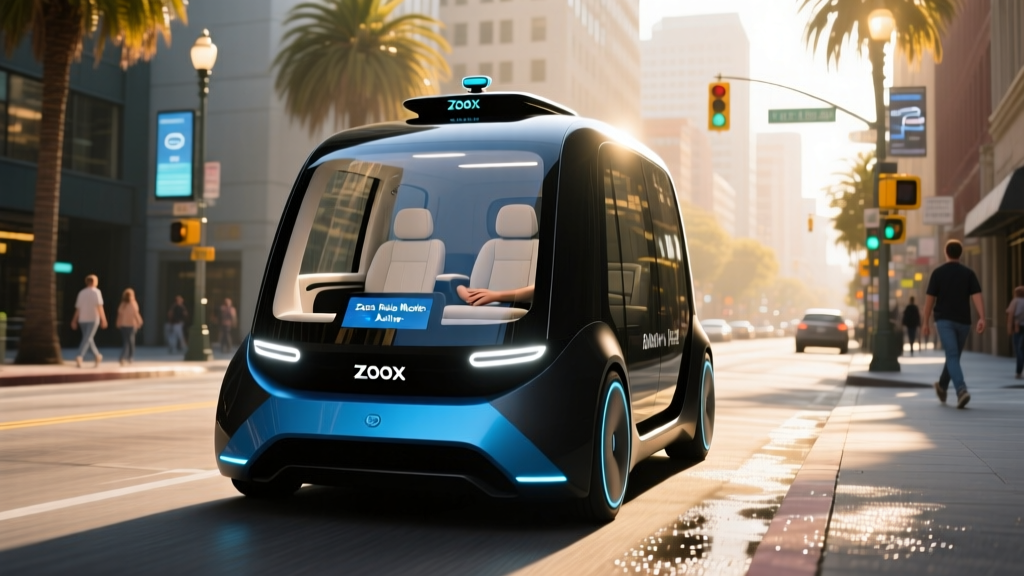
Zoox's purpose-built robotaxi is a radical departure from the modified SUV approach used by most competitors. The vehicle is a compact, symmetrical carriage-style pod with no steering wheel, no pedals, and no designated "front" — it drives equally well in either direction. Here's what powers it:
Zoox Sensor & Compute Architecture
- LiDAR: Multiple solid-state and spinning LiDAR units providing 360° point-cloud mapping — Zoox does not rely on camera-only perception (unlike Tesla's FSD approach).
- Cameras: A suite of overlapping cameras for object classification, traffic-light recognition, and redundancy.
- Radar: Forward and rear-facing radar for velocity detection and adverse-weather penetration.
- Compute: Custom onboard AI processing stack handling sensor fusion, path planning, and prediction in real time.
- Redundancy: Dual-redundant braking, steering, and compute systems — if one system fails, the backup takes over immediately.
- Geofencing: HD-mapped operational zones; the vehicle will not operate outside its pre-mapped and approved ODD.
Key distinction from camera-only approaches: Zoox uses LiDAR as a primary sensor, providing precise depth data regardless of lighting conditions. This is the same sensor philosophy used by Waymo and Cruise, and contrasts sharply with Tesla's vision-only FSD stack. The trade-off is higher hardware cost per vehicle, but greater redundancy and reliability in edge cases like direct sun glare, tunnel transitions, and low-contrast obstacles.
The Zoox vehicle seats up to four passengers facing each other in a lounge configuration. Top speed is limited to approximately 75 mph, though it operates well within urban speed limits in practice. The battery-electric powertrain provides a full day of operation on a single charge, though Zoox has not published exact kWh capacity figures for its production vehicle.
How Safe Are Zoox Robotaxis? Real Data and Incident Context
Autonomous vehicle safety data in California is partially available through DMV disengagement reports and the NHTSA Standing General Order crash reporting mandate. However, comprehensive per-mile incident rates for Zoox specifically are less publicly detailed than Waymo's published safety studies. Here's what we know from available regulatory filings and incident reports.
California requires all AV testing companies to file annual disengagement reports with the DMV. A "disengagement" occurs when the autonomous system either self-identifies a situation requiring human intervention or when a safety driver manually takes over. Zoox's disengagement data reflects its testing fleet (modified Toyota Highlanders with safety drivers), not its purpose-built driverless vehicle, which has no human driver to disengage.
| Year | Total Autonomous Miles | Total Disengagements | Miles per Disengagement |
|---|---|---|---|
| 2022 | ~75,000 | ~50 | ~1,500 |
| 2023 | ~150,000+ | Improving ratio | Increasing (exact figure in DMV filings) |
| 2024–2025 | Expanded multi-city testing | Continued improvement | See DMV annual reports |
Important context on disengagement data: Miles per disengagement is an imperfect safety metric. Companies test in different conditions, define disengagement triggers differently, and may deliberately test in challenging scenarios that increase disengagement frequency. A higher disengagement rate doesn't necessarily mean a less safe system — it may mean a more cautious one. The NHTSA crash reporting data provides a more standardized view, though it captures only reportable collisions, not near-misses.
Zoox's purpose-built vehicle has not been involved in any publicly reported serious-injury collisions during its driverless operations in San Francisco as of early 2026. The vehicle's low top speed, redundant systems, and conservative driving behavior (it yields aggressively and avoids complex unprotected left turns when possible) contribute to a cautious operational profile. However, Zoox has driven significantly fewer driverless miles than Waymo, which has accumulated tens of millions of fully driverless miles across Phoenix, San Francisco, and Los Angeles.
Regulatory Landscape: Who Approves Zoox Operations?
Operating a driverless robotaxi in San Francisco requires navigating a layered regulatory framework:
- California DMV: Issues testing permits and tracks disengagement data. Zoox holds a DMV testing permit and has received approval for driverless testing.
- CPUC (California Public Utilities Commission): Regulates commercial passenger service. Zoox received a TCP (Transportation Charter Party) permit allowing it to operate a commercial robotaxi service. The CPUC's AV programs govern whether companies can charge fares, operate 24/7, and expand service areas.
- NHTSA (Federal): The National Highway Traffic Safety Administration has granted Zoox exemptions from certain Federal Motor Vehicle Safety Standards (FMVSS) that assume a human driver — such as requirements for a steering wheel, mirrors, and manual controls. This exemption is critical: without it, Zoox's purpose-built vehicle could not legally operate on public roads.
- San Francisco Municipal Authority: The SFMTA and city supervisors have weighed in on robotaxi operations, particularly regarding traffic congestion, parking behavior, and emergency-vehicle interaction. Local approval has been a friction point for all AV operators in the city.
This regulatory stack means that Zoox's expansion is gated not just by technology readiness but by permit approvals at each level. Any change in CPUC policy, NHTSA exemption renewal, or local political sentiment can accelerate or constrain growth.
Current Limitations: What Zoox Cannot Do
Zoox Robotaxi Limitations — 2026
- Geofenced zones only: The vehicle operates exclusively within HD-mapped areas approved by regulators. Request a ride outside the geofence, and the app won't let you. Expansion is incremental, not citywide.
- Weather constraints: Heavy rain, dense fog, and low-visibility conditions can cause the system to restrict operations or pull over. LiDAR and cameras degrade in extreme precipitation.
- No highway driving: Zoox's current ODD is urban surface streets. The vehicle will not merge onto freeways or operate at highway speeds above ~75 mph.
- Conservative routing: The vehicle avoids certain complex maneuvers (unprotected left turns across heavy traffic, narrow construction zones) and may take longer routes than a human driver.
- Limited passenger capacity: Maximum four passengers. No car seats, no wheelchair accessibility in the current vehicle design.
- No stops en route: You can't ask the vehicle to stop at a convenience store or add a mid-trip waypoint. Point A to Point B only.
- Wait times: With a smaller fleet than Waymo, wait times in San Francisco can be longer, particularly at the edges of the service area.
- Remote assistance delays: If the vehicle encounters an unmapped construction zone or an unusual obstacle, it may stop and wait for a remote operator to authorize a path. This can add minutes to a trip.
These limitations aren't unique to Zoox — they apply broadly to all Level 4 robotaxi services operating today. The key difference from Waymo is scale: Waymo has mapped and validated significantly more of San Francisco's street network and operates a larger fleet, resulting in broader coverage and shorter wait times.
How to Ride: Getting Started with Zoox in San Francisco
- Download the Zoox app (iOS/Android) and create an account.
- Join the waitlist. Access is currently invitation-based. Zoox has been gradually expanding its rider pool.
- Receive an invitation. When approved, you'll be able to request rides within the service area.
- Request a ride. Enter your pickup and dropoff — both must fall within the geofence.
- Verify and board. The vehicle identifies you via the app (and sometimes a code displayed on the exterior screen). Doors unlock automatically.
- Ride. There is no driver. The vehicle navigates autonomously. Screens inside display the route and allow you to control climate and music.
- Exit. The vehicle stops, doors unlock, and you exit. Payment is processed through the app.
The experience is notably different from a Waymo ride in a modified Jaguar I-PACE or Hyundai Ioniq 5. The Zoox vehicle's lounge-style seating (passengers face each other), large windows, and absence of any driver controls create an unmistakably "robot" atmosphere. Some riders find it liberating; others find the lack of any human or manual override slightly unnerving on their first trip.
Frequently Asked Questions
Is the Zoox robotaxi truly self-driving, or is there a driver?
The Zoox purpose-built vehicle is a Level 4 autonomous vehicle with no steering wheel, no pedals, and no driver — human or otherwise. It operates entirely autonomously within its geofenced service area. This is categorically different from Level 2 systems like Tesla FSD (Supervised) or GM Super Cruise, which require a licensed driver behind the wheel at all times. In a Zoox robotaxi, you are a passenger, not a driver.
How much does a Zoox ride cost compared to Uber or Lyft?
During its early service phase, Zoox has offered heavily subsidized or free rides to invited users. As commercial operations scale, Zoox plans to price competitively with rideshare — likely in the range of $1.00–$1.50 per mile, below typical UberX/Lyft rates in San Francisco ($1.50–$2.50/mi). Robotaxi economics improve dramatically without a driver to pay, but fleet operations, vehicle depreciation, and remote-assistance staffing still carry significant costs.
What happens if the Zoox vehicle encounters an emergency or accident?
The vehicle has dual-redundant braking and steering systems. If a primary system fails, the backup engages immediately. In a collision or medical emergency, the vehicle can contact emergency services automatically, and passengers have access to an in-vehicle support button to reach a live Zoox operator at any time. The vehicle is also designed to pull over safely and stop if it detects a system fault it cannot resolve while driving.
Can I ride a Zoox robotaxi anywhere in San Francisco?
No. Zoox operates within a defined geofence covering parts of SoMa, Mission Bay, and adjacent neighborhoods. The exact boundaries expand over time as Zoox maps and validates additional streets and receives regulatory approval. If your desired route falls outside the geofence, the app will not allow you to request the ride.
How does Zoox compare to Waymo in San Francisco?
Waymo has a larger fleet, broader service area, longer operating hours, and more accumulated driverless miles in San Francisco. Zoox's advantage is its purpose-built vehicle design (no retrofitted steering wheel, lounge seating, bidirectional driving) and Amazon's financial backing. For riders, Waymo currently offers more reliable availability and coverage. Zoox offers a more novel vehicle experience but with more limited access.
Does Zoox operate in bad weather?
Zoox's Level 4 system has weather limitations. In heavy rain, dense fog, or other low-visibility conditions, the vehicle may restrict its operational area, reduce speed, or suspend service entirely. This is a shared limitation across all LiDAR-and-camera-based robotaxi systems operating today.