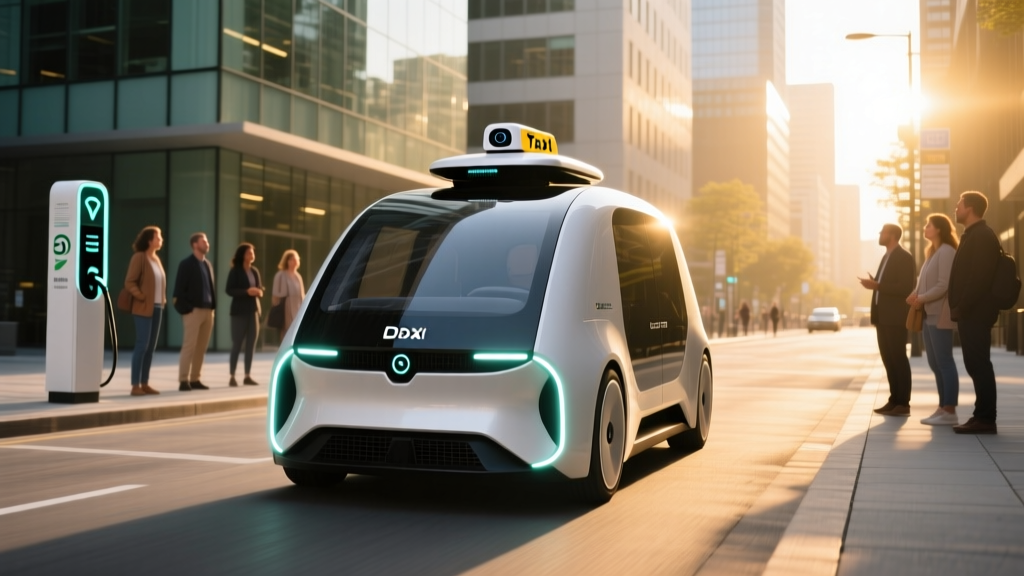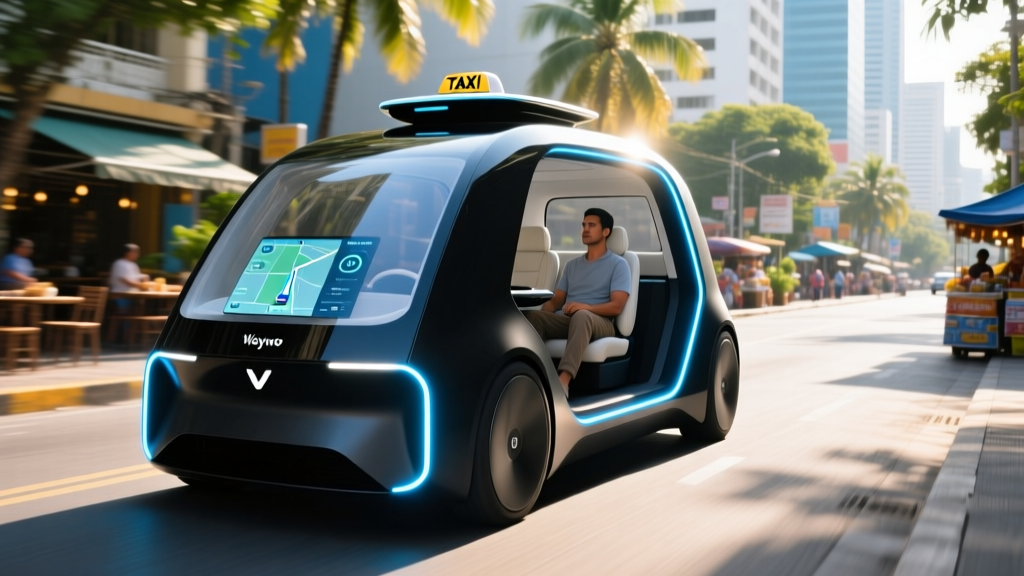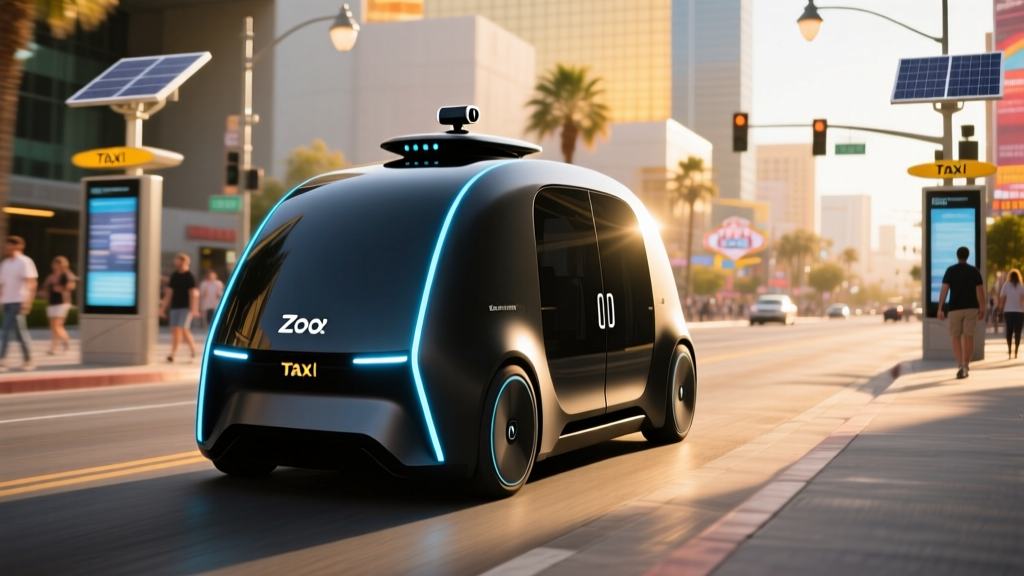
The Zoox robotaxi Las Vegas service represents one of the most visible deployments of true driverless transportation in the United States. Unlike Tesla's FSD (Supervised) or GM's Super Cruise — which remain SAE Level 2 driver-assist systems requiring active human supervision — Zoox operates a Level 4 autonomous service with no driver behind the wheel. If you're visiting or living in Las Vegas and wondering whether you can actually hail one, what it costs, and how safe the platform really is, this guide breaks down the verified facts as of 2026.
What the Zoox Robotaxi Actually Is (And What It Isn't)
Zoox, acquired by Amazon in 2020 for roughly $1.3 billion, designed its vehicle from the ground up as a robotaxi — not a retrofitted consumer car. The Zoox vehicle is a bidirectional, carriage-style pod with no steering wheel, no pedals, and no driver's seat. It seats four passengers face-to-face and is engineered exclusively for dense urban environments at speeds up to 75 mph.
The Zoox robotaxi operates at SAE Level 4 within its approved Operational Design Domain (ODD). This means the system performs all driving tasks without human intervention within defined geographic and environmental conditions. There is no human fallback driver in the vehicle. This is fundamentally different from Level 2 systems like Tesla Autopilot, Ford BlueCruise, or GM Super Cruise, which require continuous driver attention and hands-on or eyes-on supervision. Level 4 robotaxis are driverless by design; Level 2 consumer vehicles are driver-assist by regulation.
This distinction matters because marketing language around "self-driving" often blurs these categories. When you ride in a Zoox in Las Vegas, you are in a vehicle that no human is operating. When you engage FSD on a Tesla Model Y, you are still the driver — legally and functionally.
Where Can You Use the Zoox Robotaxi Right Now?
Zoox has been testing on public roads in Las Vegas since 2019 and began offering limited employee and invited-guest rides in its purpose-built vehicle in late 2023. As of 2026, the service operates within a defined geofenced zone on and around the Las Vegas Strip corridor.
| City | Status | Service Area | Public Access |
|---|---|---|---|
| Las Vegas, NV | Operational | Strip corridor & surrounding geofenced zone (~3–5 sq mi) | Invite-only / waitlist; expanding toward public beta |
| Foster City, CA | Operational (testing) | San Francisco Peninsula suburban zone | Employees and approved riders only |
| San Francisco, CA | Testing | Select neighborhoods | Not publicly available |
| Austin, TX | Announced / early mapping | TBD | Not available |
Las Vegas remains Zoox's primary public-facing market. The geofenced zone covers high-density tourist corridors where the vehicle's speed profile and sensor suite are optimized. If your destination falls outside the ODD boundary, the app will not allow you to book the ride — the vehicle simply will not travel outside its approved area.
How to Ride and What It Costs vs. Uber/Lyft
Accessing the Zoox robotaxi in Las Vegas currently requires joining a waitlist or receiving an invitation. Zoox has not yet launched full open-market, on-demand hailing comparable to Uber or Lyft. Approved riders download the Zoox app, set a pickup and dropoff within the geofenced zone, and a vehicle arrives autonomously.
During its early-access phase, Zoox has offered rides at no charge to invited riders — a deliberate strategy to accumulate miles, rider feedback, and safety data before commercial pricing is set. This will change as the service scales toward a paid public model.
| Service | Est. Fare (3 mi) | Driver Present? | Wait Time (avg) |
|---|---|---|---|
| Zoox Robotaxi | Free (early access); est. $6–$10 at launch | No — driverless | 5–12 min (limited fleet) |
| UberX | $9–$16 | Yes — human driver | 3–7 min |
| Lyft Standard | $8–$15 | Yes — human driver | 3–8 min |
| Waymo One (where available) | $8–$14 | No — driverless | 3–6 min |
Industry analysts project that robotaxi services will target price parity with or slight discounts below conventional rideshare once fleet density reaches scale — the economic thesis being that removing the driver (who typically earns 60–75% of the fare) dramatically reduces per-mile cost. Zoox's Amazon backing provides capital to subsidize early pricing aggressively.
Safety Data: What the Numbers Actually Show
Safety is the single most scrutinized aspect of robotaxi operations. Unlike human drivers, autonomous vehicle operators in California and Nevada are required to report disengagement data and collision reports to regulators.
- Testing since: 2018 (public roads), with millions of autonomous miles logged across simulation and real-world driving
- Disengagement reports: Zoox files periodic disengagement data with the California DMV; intervention rates have trended downward year-over-year as software matures
- NHTSA Standing General Order: Zoox is subject to NHTSA's mandatory crash-reporting order for Level 4 systems — any reportable incident is filed within 24 hours and made publicly accessible via NHTSA's AV reporting portal
- Vehicle design: Purpose-built crash structure with symmetric crumple zones, airbags for all four seats, and a low center of gravity from the skateboard battery architecture
- No fatal incidents reported in Zoox's driverless operations as of early 2026
For context, the U.S. traffic fatality rate sits at approximately 1.35 deaths per 100 million vehicle miles traveled (NHTSA FARS data). Robotaxi operators have collectively logged tens of millions of driverless miles. While the sample size is still small compared to the ~3 trillion miles driven annually by human drivers, the absence of fatalities in Zoox operations to date is a meaningful data point — though not a guarantee of future performance.
Zoox's safety case rests on eliminating the primary causes of human crashes: distraction, impairment, fatigue, and speeding. The vehicle cannot text, drink, fall asleep, or exceed its programmed speed limits. Its sensor array provides 360-degree perception without blind spots.
Technology Stack: Lidar, Cameras, and the Geofence
Zoox uses a multi-modal sensor suite — a deliberate contrast to Tesla's camera-only approach. The vehicle's perception system fuses data from:
- Lidar: Multiple solid-state and spinning lidar units providing high-resolution 3D point clouds out to 150+ meters, unaffected by lighting conditions
- Cameras: A surround array of high-dynamic-range cameras for object classification, traffic-light state detection, and signage reading
- Radar: Long-range and short-range radar for velocity detection and performance in rain/fog where lidar and cameras degrade
- IMU/GPS/HD Maps: Inertial measurement units, centimeter-accurate GPS, and pre-built high-definition maps for localization within the geofence
- Compute: Redundant onboard computing with fail-operational architecture — if one compute node fails, a backup maintains full driving capability to execute a safe stop
The geofence is not merely a GPS boundary — it is a mapped operational design domain that includes lane-level detail, speed profiles, known construction zones, and approved routing corridors. When the vehicle approaches the geofence edge, it will not proceed. If conditions within the ODD change unexpectedly (a sudden road closure, for example), the vehicle can execute a minimal risk condition — typically a controlled pullover — without human input.
This lidar-plus-camera-plus-radar approach costs significantly more per vehicle than a camera-only system but provides redundant perception that regulators and safety engineers generally consider more robust for driverless operations.
Regulatory Landscape: Who Approves Robotaxi Operations?
Robotaxi deployment in the United States is governed by a patchwork of state and federal regulations — there is no single national framework.
- Nevada: The Nevada Department of Motor Vehicles (DMV) and the Nevada Legislature (NRS 482A) established one of the earliest legal frameworks for autonomous vehicle testing and deployment. Operators must obtain a testing permit, carry specific insurance, and submit safety documentation before carrying passengers. The Nevada DMV oversees compliance.
- California: The California DMV issues testing and deployment permits, while the California Public Utilities Commission (CPUC) regulates commercial passenger service. Zoox holds permits in both states.
- Federal (NHTSA): The National Highway Traffic Safety Administration sets vehicle safety standards (FMVSS). Zoox received a notable exemption from certain FMVSS requirements — specifically those mandating a steering wheel and mirrors — because its vehicle was designed without them. NHTSA also mandates crash reporting through its Standing General Order for all Level 2–5 systems.
This regulatory fragmentation means that a robotaxi approved in Las Vegas cannot simply begin operating in Miami or Chicago without separate state-level authorization. Expansion is inherently slow and jurisdiction-by-jurisdiction.
Current Limitations: What Zoox Cannot Do
Level 4 autonomy within a geofence is a significant engineering achievement, but it comes with hard constraints that riders should understand before booking:
- Geofence boundary: The vehicle will not travel outside its approved ODD. Trips from the Strip to Henderson or the airport may fall outside the zone.
- Severe weather: Heavy rain, dust storms (haboobs), or flooding can degrade lidar and camera performance. Zoox may suspend operations or reduce speed during these events.
- Construction zones: Unmapped lane shifts, temporary barriers, and flaggers present edge cases. The vehicle may pull over and request remote assistance if it cannot resolve the scenario confidently.
- Speed profile: The Zoox vehicle is designed for urban speeds up to 75 mph. It is not intended for highway interstate travel at 80+ mph.
- Fleet size: As of 2026, the Las Vegas fleet remains limited. Wait times can exceed 10–15 minutes during peak tourist hours, and availability is not guaranteed.
- Accessibility: While Zoox has stated design intent for ADA accessibility, early-access operations may not accommodate all wheelchair configurations. Confirm with the app before booking.
- No manual override: There is no steering wheel for a passenger to grab in an emergency. The system is designed to handle all scenarios autonomously or execute a safe stop — which may feel unsettling to first-time riders.
These limitations are not unique to Zoox — Waymo's Phoenix and San Francisco services operate under similar constraints. The key takeaway: robotaxis work well within their designed envelope but are not yet a universal replacement for human-driven rideshare.
Zoox vs. Waymo: How the Two Level 4 Services Compare
Waymo (Alphabet) is the other major Level 4 robotaxi operator in the U.S. and offers a useful comparison point for anyone evaluating the autonomous ride-hailing landscape:
| Attribute | Zoox | Waymo One |
|---|---|---|
| Vehicle | Purpose-built Zoox pod (no steering wheel) | Jaguar I-PACE (modified, with steering wheel) |
| Primary Markets | Las Vegas, Foster City, SF (testing) | Phoenix, SF, LA, Austin |
| Public Access | Invite/waitlist (Las Vegas) | Open to public (paid) in multiple cities |
| Miles Driven (driverless) | Millions (exact figure not fully public) | 40+ million driverless miles (as of 2025) |
| Pricing Model | Free (early access); TBD at scale | Per-mile + base fare (comparable to UberX) |
| Backing | Amazon | Alphabet (Google) |
Waymo is further along in commercial deployment and public accessibility. Zoox's advantage lies in its purpose-built vehicle architecture — designed from scratch for autonomous passenger service rather than adapted from a consumer EV — and Amazon's logistics and capital resources.
Is the Zoox Robotaxi Worth Trying in Las Vegas?
If you can get access, yes — with realistic expectations. The Zoox robotaxi Las Vegas experience offers a genuine look at what Level 4 autonomy feels like in practice: a quiet, smooth, slightly surreal ride through the Strip corridor with no human at the controls. The face-to-face seating, the absence of a dashboard, and the vehicle's ability to navigate traffic, pedestrians, and signalized intersections autonomously make it a compelling demonstration of where urban transportation is heading.
But it is not yet a practical daily transportation option for most visitors. Fleet size is limited, the geofence is constrained, and public access remains gated. For reliable, on-demand rides across the full Las Vegas valley, Uber and Lyft remain the default. Zoox is a glimpse of the future operating within a carefully bounded present.
Frequently Asked Questions
Is the Zoox robotaxi truly self-driving, or is there a remote driver?
There is no driver in the vehicle — no steering wheel, no pedals, no human fallback. The vehicle operates autonomously at SAE Level 4 within its geofenced zone. Zoox does employ remote fleet assistance operators who can provide guidance in edge cases (e.g., an unmapped construction zone), but these operators do not "drive" the vehicle in real time. The vehicle's own systems execute all steering, braking, and acceleration.
How much does a Zoox ride cost compared to Uber or Lyft?
During its early-access phase in Las Vegas, Zoox has offered rides for free to invited riders. Once the service transitions to paid public operation, industry estimates suggest pricing in the $6–$12 range for typical Strip-corridor trips (2–4 miles), which would be competitive with or slightly below UberX/Lyft Standard fares. Final pricing has not been publicly announced as of early 2026.
Can I hail a Zoox robotaxi anywhere in Las Vegas?
No. The service operates within a defined geofenced zone covering the Las Vegas Strip corridor and immediate surroundings. Pickup and dropoff must both fall within this zone. Destinations outside the boundary — such as the airport, downtown Fremont Street, or suburban Henderson — are not currently served. The app will confirm whether your requested route is within the operational area.
How safe are Zoox robotaxis compared to human drivers?
Zoox has reported no fatalities in its driverless operations as of early 2026. The vehicle's sensor suite (lidar, cameras, radar) provides 360-degree perception without the distraction, impairment, or fatigue that cause the majority of human-driven crashes. However, total driverless miles across the industry remain a small fraction of total U.S. vehicle miles, so statistical comparisons to human drivers (1.35 fatalities per 100 million miles, per NHTSA FARS) should be interpreted with the understanding that sample sizes are still maturing.
What happens if the Zoox vehicle encounters something it can't handle?
The vehicle is programmed to execute a "minimal risk condition" — typically a controlled deceleration and pullover to the side of the road — if it encounters a scenario it cannot resolve with high confidence. Remote fleet assistance may then provide routing guidance. The vehicle will not proceed into an uncertain situation at speed.
When will Zoox be available to the general public without a waitlist?
Zoox has not announced a specific date for fully open public access in Las Vegas. The company has been progressively expanding its rider pool through 2025 and 2026. Full commercial launch — with open hailing and paid fares — will depend on fleet scaling, regulatory approvals, and accumulated safety data. Waymo's multi-year ramp in Phoenix provides a precedent: expect a gradual expansion rather than a sudden open launch.