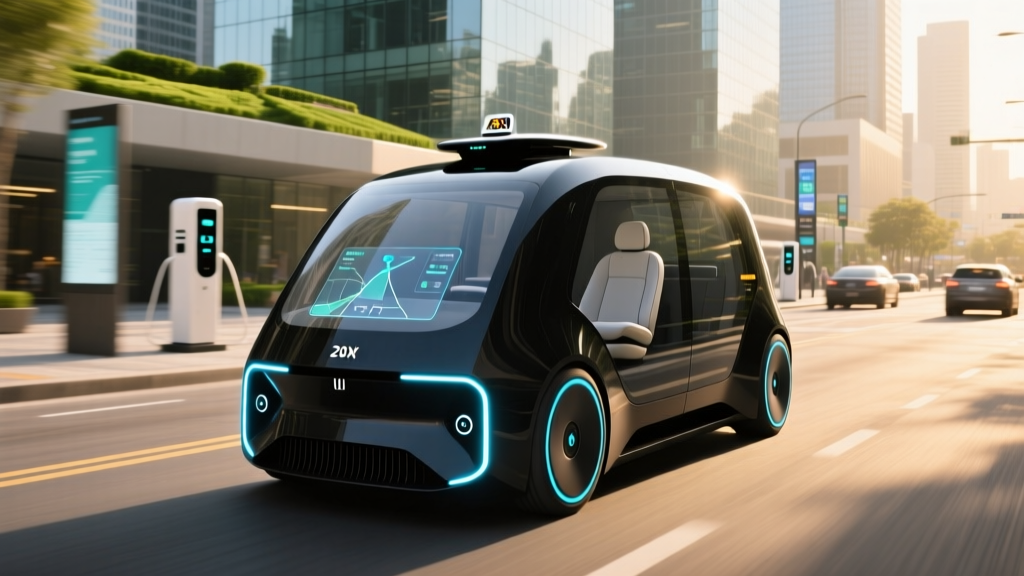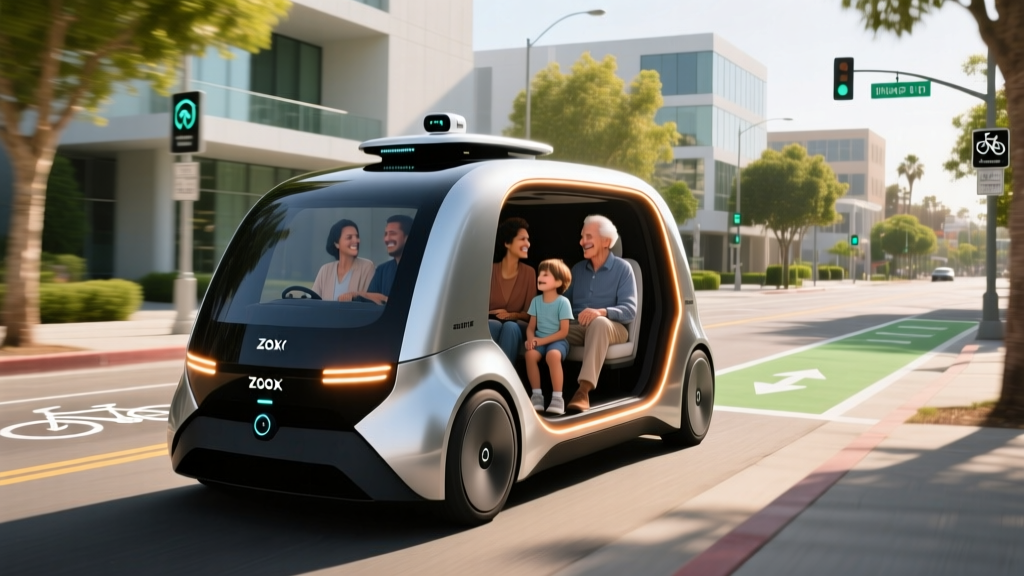
Zoox operates one of the most ambitious robotaxi programs in the United States — a purpose-built, bidirectional electric vehicle with no steering wheel, designed from the ground up for autonomous ride-hailing. Headquartered in Foster City, California, the Amazon-owned company has moved from testing to commercial service in select cities. If you've searched for "zoox foster city hq" wondering what the company actually delivers to riders today, this guide breaks down exactly where you can ride, what it costs, how safe the system is, and where the technology still falls short.
What Zoox Actually Is: SAE Level 4 Robotaxi, Not Driver-Assist
Before examining service details, it's critical to distinguish what Zoox is — and what it isn't. Consumer EVs with features like Tesla Autopilot, Ford BlueCruise, or GM Super Cruise operate at SAE Level 2: the driver must remain engaged and supervise the vehicle at all times. Zoox operates at SAE Level 4, meaning the vehicle handles all driving tasks within a defined operational design domain (ODD) with no human driver onboard and no expectation of human intervention.
| Level | Description | Examples |
|---|---|---|
| Level 2 | Driver-assist (hands on or eyes on) | Autopilot, BlueCruise, Super Cruise |
| Level 3 | Conditional automation (eyes off, must take over on request) | Mercedes DRIVE PILOT (limited markets) |
| Level 4 | High automation — no driver needed within geofence | Zoox, Waymo One |
| Level 5 | Full automation everywhere, all conditions | Does not exist commercially |
Zoox's Level 4 designation means no safety driver sits behind a wheel — because there is no steering wheel. The vehicle's bidirectional design (it drives equally well forward and backward) and four-wheel steering enable maneuvers conventional cars cannot perform, such as parallel parking by sliding laterally. This is a fundamentally different architecture than retrofitting a consumer EV with sensors.
Where Can You Ride a Zoox Robotaxi Right Now?
Zoox's service footprint has expanded steadily since its first commercial rides. The company's Foster City, California headquarters serves as its engineering hub and primary testing ground, but commercial rider operations extend beyond the Bay Area. As of early 2026, Zoox operates or has confirmed expansion into the following markets:
| City | Status | Service Area Notes |
|---|---|---|
| Las Vegas, NV | Commercial service (live) | Las Vegas Strip corridor, airport-adjacent zones; expanded geofence in 2025 |
| San Francisco, CA | Commercial service (live) | Select neighborhoods; phased expansion from initial SoMa/Financial District zones |
| Foster City, CA | Testing & employee rides | HQ campus area; public access limited to invited riders |
| Austin, TX | Testing / early access | Mapped corridors; commercial launch anticipated |
| Atlanta, GA | Testing | Public road testing underway; no commercial service yet |
Availability is geofenced: you can only request rides within Zoox's mapped operational zones, and the app will not allow pickups or drop-offs outside those boundaries. This is a hard constraint of Level 4 systems — they require high-definition mapping and validated routes.
Zoox's Purpose-Built EV: Tech Stack and Vehicle Specs
Zoox doesn't retrofit existing vehicles. Its custom robotaxi is a carriage-style EV with passengers sitting face-to-face in a symmetrical cabin. Here's what powers it:
Sensor and Compute Architecture
- LiDAR: Multi-unit solid-state and spinning LiDAR array providing 360° 3D point-cloud perception out to ~200+ meters. Unlike Tesla's camera-only approach, Zoox uses LiDAR as a primary depth-sensing modality.
- Cameras: Overlapping high-resolution camera array covering all directions with redundancy; used for object classification, traffic-light recognition, and lane detection.
- Radar: Forward and corner radar units for velocity detection and performance in rain/fog where LiDAR and cameras degrade.
- Compute: Custom onboard computing stack running Zoox's proprietary perception, prediction, and planning software — processing sensor fusion in real time at the vehicle level (no remote teleoperation for driving decisions).
- Redundancy: Dual-redundant braking, steering, and compute systems. If a primary system fails, the backup can bring the vehicle to a safe stop.
Vehicle Specifications
| Seating | 4 passengers (facing each other) |
| Steering | Four-wheel steer; bidirectional (no front/back distinction) |
| Top speed | 75 mph |
| Battery | ~75 kWh (estimated), NMC chemistry |
| Range | Up to ~16 hours of continuous operation per charge cycle (Zoox spec) |
| Charging | DC fast charging capable; fleet depot charging |
The LiDAR-first approach places Zoox firmly in the same sensor camp as Waymo, and in contrast to Tesla's vision-only FSD strategy. The practical implication: Zoox vehicles carry higher per-unit sensor cost but gain depth perception that doesn't rely on learned visual inference alone. For robotaxi operations within geofenced urban areas, this redundancy is a regulatory and safety advantage.
How to Use Zoox and What It Costs vs. Uber/Lyft
Riding in a Zoox is straightforward but differs from traditional rideshare in key ways:
- Download the Zoox app (available in supported cities).
- Request a ride — enter pickup and drop-off within the active geofence.
- No driver, no tipping — the vehicle arrives autonomously; you unlock via the app.
- In-ride controls — passengers have access to climate, music, and a "stop" button that safely pulls the vehicle over.
On pricing, Zoox has generally undercut traditional rideshare to build ridership and gather real-world data. Exact fares vary by city and time of day, but here's how the pricing structure typically compares:
| Factor | Zoox | UberX / Lyft |
|---|---|---|
| Base fare (typical 3-mile trip) | $5–$10 (promotional pricing common) | $10–$18 |
| Surge pricing | Less volatile (fleet-managed) | Frequent during peak hours |
| Tipping | Not applicable | Expected ($2–$5 typical) |
| Route flexibility | Geofenced — fixed zones only | Anywhere the driver will go |
| Wait time | Variable; limited fleet size | 2–8 min typical in urban areas |
| Availability | Limited hours in some markets | 24/7 in most cities |
The cost advantage is real but comes with trade-offs: you can't go outside the geofence, the fleet is smaller so wait times can be longer, and service hours may not cover late-night or early-morning trips. For airport runs within the Las Vegas geofence or commutes within San Francisco's active zone, Zoox can meaningfully undercut Uber — particularly because there's no driver to pay.
Safety Record: What the Data Shows
Safety is the most scrutinized dimension of any robotaxi operation. Zoox, like all autonomous vehicle operators in California, reports disengagement and collision data to state regulators. Here's what's documented:
Zoox Safety Data Points
- Testing miles: Zoox has accumulated over 1 million autonomous miles across its test fleet in multiple states, with the majority in California and Nevada (California DMV AV program).
- Disengagement rate: In California DMV reports, Zoox has reported disengagement rates improving year-over-year, with recent figures showing fewer than 1 disengagement per 1,000–2,000 autonomous miles in mature testing zones. (Disengagements include both system-initiated and safety-driver-initiated events.)
- Collision record: As of early 2026, Zoox has not reported any at-fault collisions involving pedestrians or other vehicles during driverless commercial operations. Minor low-speed contact incidents during testing phases have been reported to NHTSA's Standing General Order as required.
- No steering wheel = no driver error: The purpose-built vehicle eliminates the risk of a distracted or impaired human driver — the leading cause of conventional crashes per NHTSA data.
Context matters: Zoox's commercial fleet is far smaller than Waymo's, which operates thousands of vehicles across multiple cities and has logged tens of millions of paid rider miles. Smaller fleet size means fewer total exposure miles, which makes statistical safety comparisons less robust. However, Zoox's clean commercial-operations record to date is notable, and its redundant sensor stack and vehicle design are engineered specifically for urban speeds where most serious collisions occur.
Current Limitations: Where Zoox Cannot Operate
Level 4 autonomy is powerful within its domain but comes with hard boundaries. These are not future challenges — they define today's rider experience:
- Geofence boundaries: You cannot travel outside the mapped zone. If your destination falls beyond the geofence, the app will not let you book the ride.
- Weather constraints: Heavy rain, fog, or unusual road conditions can trigger operational pauses. Zoox vehicles may reduce speed or pull over if sensor confidence drops below safety thresholds.
- Construction zones: Unmapped lane closures or detours that fall outside the HD map can require remote assistance or route recalculation, adding delay.
- No highway operation (in most markets): Zoox is designed for urban and suburban corridors, not freeway merges at 70+ mph. While the vehicle is technically capable of 75 mph, operational deployment focuses on surface streets.
- Limited fleet size: Wait times can exceed 15–20 minutes during peak demand or in peripheral zones within the geofence.
- No intercity trips: Foster City to San Jose, or Las Vegas Strip to Henderson — these cross-jurisdiction trips fall outside current operational design.
These limitations are shared across the Level 4 robotaxi industry. Waymo faces similar geofence and weather constraints. The difference is scale: Waymo's larger fleet and longer operational history in cities like Phoenix and San Francisco mean broader coverage and more edge-case experience.
Regulatory Landscape: Who Approves Zoox Operations?
Robotaxi operations in the U.S. require a patchwork of state and local approvals. Zoox does not simply launch wherever it wants — each market requires regulatory clearance:
- California: The California DMV issues testing and deployment permits. The California Public Utilities Commission (CPUC) regulates commercial passenger service. Zoox holds both testing and driverless deployment permits.
- Nevada: The Nevada DMV and state legislature created an AV-friendly regulatory framework. Las Vegas operations are permitted under state law with local coordination.
- Federal (NHTSA): The National Highway Traffic Safety Administration does not currently "approve" AVs but requires crash reporting under its Standing General Order and can issue recalls or investigations. Zoox's purpose-built vehicle received NHTSA exemptions for lacking traditional controls (steering wheel, pedals, mirrors).
- Texas, Georgia: Testing operations comply with state AV laws that generally permit autonomous testing with varying levels of reporting requirements.
The regulatory environment remains in flux. Some cities have pushed back on robotaxi expansion after high-profile incidents involving competitors (notably Cruise's suspension in late 2023). Zoox has benefited from a more cautious rollout strategy — slower expansion, smaller fleet — that has so far avoided the regulatory backlash that curtailed other operators.
Inside the Foster City HQ: Why Location Matters
Zoox's Foster City headquarters is more than an office — it's an integrated engineering, testing, and fleet-operations campus located in the heart of the San Francisco Peninsula. The location offers several strategic advantages:
- Proximity to talent: Foster City sits between San Francisco and Silicon Valley, within commuting distance of Stanford, UC Berkeley, and the broader Bay Area robotics/AI workforce.
- Testing environment: The surrounding streets provide a mix of suburban, arterial, and highway-adjacent driving scenarios ideal for validation testing before urban deployment.
- Amazon integration: As an Amazon subsidiary (acquired in 2020 for ~$1.3 billion), Zoox benefits from proximity to Amazon's logistics and cloud infrastructure teams in the region.
- Regulatory access: Being headquartered in California means direct engagement with the DMV and CPUC — the two most influential state-level AV regulators in the country.
For prospective riders or industry watchers visiting the area, the Foster City campus is not a public showroom. However, Zoox has occasionally hosted community events and rider-feedback sessions at the HQ, and employees frequently use the vehicles for internal shuttle runs in the surrounding area.
Zoox vs. Waymo: How the Two Level 4 Robotaxis Compare
| Attribute | Zoox | Waymo One |
|---|---|---|
| Vehicle | Purpose-built carriage (no steering wheel) | Jaguar I-PACE EV (retrofitted) |
| SAE Level | Level 4 | Level 4 |
| Sensor stack | LiDAR + camera + radar | LiDAR + camera + radar |
| Commercial cities (2026) | Las Vegas, San Francisco | Phoenix, San Francisco, Los Angeles, Austin |
| Fleet size | Hundreds (estimated) | 1,000+ vehicles |
| Paid rides completed | Hundreds of thousands (est.) | 10+ million |
| Parent company | Amazon | Alphabet (Google) |
| Pricing vs. Uber | Generally cheaper (promotional) | Comparable to UberX |
Waymo has a significant lead in scale and rider volume. Zoox's advantage lies in its purpose-built vehicle — designed for passenger comfort and urban maneuverability rather than adapted from a consumer SUV. Over time, if Zoox scales its fleet, the custom vehicle design could prove more cost-efficient per ride.
Frequently Asked Questions
Is Zoox truly self-driving, or is there a remote human controlling it?
Zoox vehicles are genuinely driverless — there is no human behind the wheel, no steering wheel, and no pedals. The AI system makes all real-time driving decisions. Remote operators can assist with edge cases (e.g., confirming whether a construction cone is a temporary obstacle), but they do not "drive" the vehicle remotely. This is a key distinction from teleoperation systems.
Can I ride a Zoox from Foster City to San Francisco?
Not currently. Foster City is primarily a testing and HQ location, not a commercial service zone. To ride commercially, you'd need to be within the active San Francisco or Las Vegas geofences. Intercity trips between geofences are not supported.
How much does a Zoox ride cost compared to Uber?
Zoox rides typically cost $5–$10 for a standard urban trip, which is generally 30–50% less than a comparable UberX ride. Promotional pricing is common as Zoox builds ridership. There's no tipping, since there's no driver.
What happens if the Zoox vehicle encounters a situation it can't handle?
The vehicle is designed to execute a "minimal risk condition" — it will slow down, pull to the side of the road, and stop safely. Remote assistance can then help resolve the situation (e.g., confirming a safe path around an obstacle), or the ride may be rerouted or ended with a refund.
Does Zoox operate in bad weather?
Zoox vehicles operate in light rain and typical urban conditions. However, heavy rain, dense fog, or other conditions that significantly degrade sensor performance may trigger operational pauses or speed reductions. This is a limitation shared by all LiDAR-based Level 4 systems.
Is Zoox owned by Amazon?
Yes. Amazon acquired Zoox in June 2020 for approximately $1.3 billion. Zoox operates as an independent subsidiary, and Amazon has invested in fleet scaling and infrastructure. The acquisition gives Zoox access to Amazon's capital, logistics expertise, and AWS cloud computing resources.