Zoox is one of the most talked-about names in autonomous mobility — a purpose-built robotaxi backed by Amazon that ditches the steering wheel entirely. But for riders curious about hailing a ride, the first question is practical: how much does Zoox cost, and can you actually get one where you live?
This guide breaks down everything we know about Zoox's rider pricing, service footprint, safety record, and technology as of early 2026 — with concrete data, not marketing promises.
What Zoox Actually Is: SAE Level 4, Not Driver-Assist
Before discussing price, it's critical to understand what Zoox is — and what it isn't. The Zoox vehicle is a SAE Level 4 autonomous robotaxi. That means it operates without any human driver, no steering wheel, no pedals, and no expectation that a passenger will intervene. This is fundamentally different from consumer driver-assist systems like Tesla Autopilot, Ford BlueCruise, or GM Super Cruise, which are SAE Level 2 and require an engaged, licensed driver behind the wheel at all times.
SAE Automation Levels — Quick Reference
| Level | Name | Who Drives? | Example |
|---|---|---|---|
| Level 2 | Driver Assistance | Human (must supervise) | Tesla Autopilot/FSD Supervised, BlueCruise |
| Level 3 | Conditional Automation | System (human on standby) | Mercedes Drive Pilot (limited conditions) |
| Level 4 | High Automation | System (no human needed) | Zoox, Waymo One |
| Level 5 | Full Automation | System (any condition, anywhere) | Does not yet exist commercially |
Zoox operates at Level 4 within a defined geofenced service area under specific conditions. It cannot drive everywhere in every weather scenario.
Where Can You Ride Zoox Right Now?
Zoox's commercial rider service has been expanding gradually. Unlike Waymo One, which operates across multiple major metros, Zoox has taken a more measured rollout approach. Here's the current operational footprint as of early 2026:
| City | Status | Service Area Notes |
|---|---|---|
| Las Vegas, NV | Commercial service (invite/waitlist) | Las Vegas Strip corridor and surrounding areas; primary launch market |
| San Francisco, CA | Testing + limited rider program | Select neighborhoods; Zoox HQ city — extensive testing operations |
| Foster City, CA | Testing operations | Suburban Bay Area testing zone near Zoox offices |
| Austin, TX | Testing / pre-commercial | Announced testing expansion; commercial timeline TBD |
| Atlanta, GA | Testing / pre-commercial | Announced expansion target; not yet open to general public riders |
Key point: Zoox has been prioritizing Las Vegas as its primary commercial launch city. If you're outside these metros, you cannot hail a Zoox ride yet. The company has not published a firm timeline for broader national availability.
How Much Does Zoox Cost vs. Uber and Lyft?
Zoox has not published a fixed public rate card as of early 2026 — its commercial rider service in Las Vegas has largely operated through invite-only programs, promotional free-ride periods, and early-access waitlists. However, based on available rider reports and the competitive robotaxi pricing landscape, here's what the economics look like:
| Service | Base Fare | Per Mile | Per Minute | Est. 5-Mile Ride |
|---|---|---|---|---|
| Zoox (estimated/promotional) | $0–$2.50 | $0.90–$1.25 | $0.20–$0.35 | $7–$12 |
| Waymo One | $2.00–$3.50 | $1.10–$1.50 | $0.25–$0.40 | $9–$15 |
| UberX | $2.50–$4.00 | $1.20–$1.80 | $0.30–$0.50 | $10–$18 |
| Lyft Standard | $2.50–$4.00 | $1.15–$1.70 | $0.28–$0.48 | $10–$17 |
What this means in practice: Robotaxi services including Zoox are pricing to compete with — or undercut — traditional rideshare. The incentive is clear: remove the human driver (the largest cost component for Uber/Lyft) and the unit economics allow lower fares while still targeting eventual profitability. During early-access phases, Zoox has offered rides at steep discounts or free to build rider familiarity and gather feedback.
Expect Zoox's long-term pricing to land in the $7–$14 range for a typical 5-mile urban trip, competitive with or slightly below UberX. Surge pricing dynamics may differ — robotaxis don't get tired or go offline during peak hours, but fleet availability caps supply.
Zoox's Technology Stack: Purpose-Built, Sensor-Rich
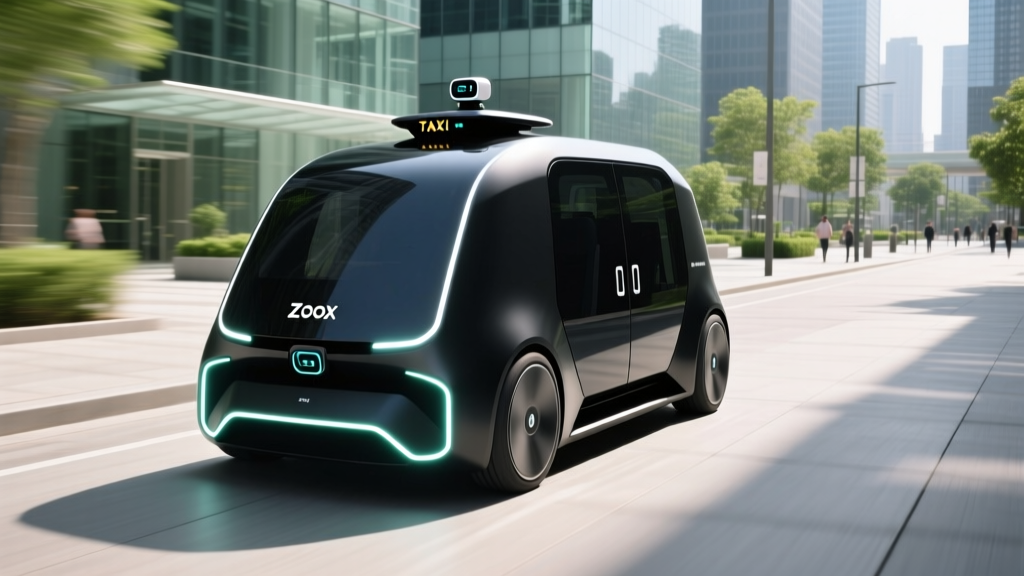
The Zoox vehicle isn't a retrofitted consumer car. It's a ground-up robotaxi — a bidirectional, carriage-style EV with no steering wheel, no dashboard, and seats facing each other. This design choice matters for both the rider experience and the sensor architecture.
Zoox Sensor & Compute Architecture
- LiDAR: Multiple solid-state and spinning LiDAR units providing 360° depth mapping — Zoox uses LiDAR as a primary sensor, unlike Tesla's camera-only FSD approach
- Cameras: Redundant camera arrays covering all directions for object classification, traffic signal reading, and lane detection
- Radar: Forward and surround radar for velocity detection and poor-weather penetration
- Compute: Custom onboard AI inference hardware processing sensor fusion in real-time
- HD Mapping: Pre-mapped geofenced service areas with centimeter-level precision; the vehicle localizes within its map continuously
- V2I Communication: Vehicle-to-infrastructure connectivity for traffic signal awareness in supported corridors
- Bidirectional Driving: Symmetrical vehicle design allows equal capability driving in either direction — useful for tight urban maneuvers without three-point turns
The reliance on LiDAR plus cameras plus radar represents a sensor-redundant approach — if one modality is degraded (e.g., camera glare at sunset), others compensate. This is the industry-standard approach for Level 4 operations, shared by Waymo and Cruise. The trade-off is higher per-vehicle hardware cost, estimated at well over $100,000 per vehicle including sensors and compute, though Zoox has not disclosed exact figures.
The vehicle runs on a battery-electric powertrain. Zoox has not published the exact battery capacity (kWh) publicly, but the vehicle is designed for all-day urban operation with opportunity charging between shifts — typical robotaxi duty cycles involve 16-20 hours of daily operation.
Safety Record: What the Data Shows
Safety is the single most scrutinized aspect of robotaxi operations. Zoox, like all autonomous vehicle operators in California, is required to report disengagement data and collision reports to the California DMV. In Nevada, the company operates under permits from the Nevada Department of Motor Vehicles Autonomous Vehicle program.
Zoox Safety Data Points (as of early 2026)
- Testing miles accumulated: Millions of autonomous miles across California and Nevada test fleets — exact cumulative figures reported annually to state regulators
- Disengagement rate: Zoox's California DMV disengagement reports have shown improving intervention-free miles year over year; specific rates vary by testing period and operational domain
- Collision reports: Zoox has filed required collision reports with NHTSA and state regulators for incidents during testing — the majority at low speeds in complex urban environments, consistent with industry-wide robotaxi collision patterns
- No reported passenger fatalities: As of publication, no Zoox robotaxi rider fatality has been reported
- NHTSA Standing General Order: Zoox is subject to NHTSA's Standing General Order requiring prompt crash reporting for vehicles with ADS (Automated Driving Systems)
Sources: California DMV AV program reports, NHTSA crash databases, Nevada DMV AV permits. Always check regulator sites for the most current data.
Context matters: Robotaxi collision data must be interpreted carefully. These vehicles operate in dense urban environments where low-speed contact incidents (e.g., being rear-ended at a stop, sideswiped by a delivery truck) are common even for human drivers. The meaningful metric is injury severity and fault attribution, not raw incident counts. Zoox's safety record has not drawn the level of regulatory scrutiny or service suspensions that affected Cruise's operations in late 2023.
Regulatory Landscape: Who Approves Robotaxi Operations?
Robotaxi deployment in the United States is governed by a patchwork of state and local regulations — there is no single federal "robotaxi license." Here's how the approval chain works for Zoox:
- California (CPUC + DMV): The California Public Utilities Commission (CPUC) issues permits for commercial passenger-carrying AV services. The California DMV separately issues testing and deployment permits. Zoox holds both testing and limited commercial permits.
- Nevada (DMV + PUCN): Nevada was one of the first states to create an AV regulatory framework. The Nevada DMV issues AV testing and operation permits, while the Public Utilities Commission of Nevada oversees commercial transportation services. Zoox's Las Vegas operations fall under this framework.
- NHTSA (Federal): The National Highway Traffic Safety Administration sets vehicle safety standards (FMVSS). Zoox received a notable exemption from certain FMVSS requirements — specifically the requirement for a steering wheel, mirrors, and manual controls — enabling its purpose-built vehicle design. NHTSA also mandates crash reporting under the Standing General Order.
- Local jurisdictions: City and county authorities often have input on operational zones, speed limits, and first-responder interaction protocols for robotaxis.
This fragmented regulatory environment means expansion is slow and state-by-state. A robotaxi legal in Las Vegas cannot simply begin operating in Phoenix or Miami without separate state approvals.
Current Limitations: What Zoox Cannot Do
Level 4 autonomy is impressive within its operational design domain (ODD) — but that domain has hard boundaries. Here are the current, real-world limitations of Zoox's robotaxi service:
Operational Limits
- Geofenced only: Cannot travel outside pre-mapped service zones — a trip from the Strip to a distant suburb may not be possible
- Weather constraints: Heavy rain, fog, or dust storms can trigger service suspension; the vehicle may pull over safely and wait
- No highway operation: Current service areas are urban/suburban corridors, not freeway routes between cities
- Speed limits: Operations typically capped at 35–45 mph in approved zones
- Construction zones: Major roadwork or detours outside mapped conditions may cause the vehicle to stop and request remote assistance
Rider Experience Limits
- No route customization: You can't ask the vehicle to make a stop or take a scenic route — it follows its planned path
- Wait times: Fleet size is limited; pickup wait times in early service phases can be 10–20+ minutes
- Accessibility: While the vehicle is designed for accessibility, wheelchair accommodation specifics depend on the vehicle generation and local ADA compliance verification
- No intercity trips: This is an urban last-mile solution, not a replacement for airport-to-suburb long hauls
- Limited hours: Depending on the market, service may not operate 24/7 during early deployment phases
These aren't minor footnotes — they define the practical utility of the service today. Zoox is best understood as a geofenced urban shuttle, not a go-anywhere replacement for your car.
How to Actually Get a Zoox Ride
If you're in a service area, here's the typical rider flow:
- Download the Zoox app (iOS/Android) — available in app stores for supported markets
- Join the waitlist — as of early 2026, Zoox's Las Vegas commercial service still uses a waitlist/invite model rather than open on-demand hailing
- Request a ride — once approved, you set pickup and dropoff within the geofenced zone
- Vehicle arrives — the Zoox vehicle pulls to your location; you verify your ride via the app and unlock the doors
- Ride — the interior features facing seats, a central screen showing the vehicle's perception of its surroundings, and climate/audio controls
- Arrival — the vehicle stops at your destination and you exit; payment is processed through the app
The experience is intentionally simple. There's no driver to rate, no tip to add, and no conversation to navigate. The in-vehicle screen showing the robotaxi's real-time perception (detecting pedestrians, other vehicles, traffic signals) serves a dual purpose: rider reassurance and transparency about what the system sees.
Zoox vs. Waymo: Quick Comparison
| Attribute | Zoox | Waymo One |
|---|---|---|
| SAE Level | Level 4 | Level 4 |
| Vehicle | Purpose-built (no steering wheel) | Jaguar I-PACE (modified, has steering wheel) |
| Primary Sensor | LiDAR + Camera + Radar | LiDAR + Camera + Radar |
| Commercial Cities (early 2026) | Las Vegas (primary) | Phoenix, San Francisco, Los Angeles, Austin |
| Availability Model | Waitlist/invite | Open to public in service areas |
| Parent Company | Amazon | Alphabet (Google) |
| Highway Capable | No (urban geofence) | Limited freeway segments in some markets |
Waymo is significantly ahead in commercial scale and geographic coverage. Zoox's advantage is its purpose-built vehicle — designed from the ground up as a passenger experience rather than a modified consumer SUV. Whether that translates into market share depends entirely on how quickly Zoox can scale fleet size and obtain regulatory approvals in new cities.
Frequently Asked Questions
Is Zoox truly self-driving or does it have a remote driver?
Zoox operates at SAE Level 4, meaning there is no human driver in the vehicle — no steering wheel, no pedals, no remote teleoperator "driving" the car in real-time. However, Zoox does employ remote assistance: if the vehicle encounters a scenario it cannot resolve autonomously (e.g., an unusual construction detour), a remote operator can provide high-level guidance (e.g., "proceed around the obstacle") rather than directly steering the vehicle. This is standard practice for Level 4 robotaxi operators.
How much does a Zoox ride cost compared to Uber?
Based on early-access pricing and competitive positioning, a typical 5-mile Zoox ride is estimated in the $7–$12 range, which is comparable to or slightly below UberX ($10–$18 for the same distance). During promotional periods, Zoox has offered free or heavily discounted rides. Final published pricing may vary by market and time of day.
Can I hail a Zoox in any city?
No. As of early 2026, Zoox's commercial rider service is primarily available in Las Vegas, with testing operations in San Francisco, Foster City (CA), Austin, and Atlanta. Even in Las Vegas, access is through a waitlist or invite system. You cannot hail a Zoox outside its geofenced service zone in supported cities.
How safe is Zoox compared to a human driver?
Zoox reports millions of autonomous testing miles with no reported passenger fatalities. The vehicle's sensor suite (LiDAR, cameras, radar) provides 360° awareness without distraction or fatigue — advantages over human drivers. However, robotaxis including Zoox have been involved in low-speed contact incidents in dense urban environments, consistent with the challenging driving conditions. Comprehensive comparative safety data (robotaxi vs. human per million miles) is still being accumulated across the industry. Check NHTSA and state DMV reports for the latest data.
What happens if the Zoox vehicle encounters a situation it can't handle?
The vehicle is designed to enter a "minimal risk condition" — typically pulling over safely or stopping in place. A remote assistance team can then evaluate the situation and provide high-level guidance. The vehicle will not proceed if it cannot confirm a safe path. In practice, this means occasional delays when the vehicle encounters unmapped construction, unusual road closures, or extreme weather.
Does Zoox operate on highways?
No. Zoox's current operational design domain is limited to urban and suburban streets within its geofenced service areas, typically at speeds up to 35–45 mph. It is not designed or approved for highway/freeway operation. This makes it a last-mile urban mobility solution, not an intercity travel option.
Who owns Zoox and what is its business model?
Zoox was acquired by Amazon in 2020 for approximately $1.3 billion. Its business model is direct-to-consumer robotaxi rides — essentially operating its own fleet-based ride-hail service without human drivers. Amazon's backing provides significant capital for fleet scaling, though Zoox operates as an independent subsidiary. Long-term, Amazon may also explore Zoox technology for delivery applications.
Autonomous vehicle regulations, service availability, and pricing change frequently. Verify current Zoox service status through the official Zoox app and your state's DMV autonomous vehicle program page. Safety data cited reflects publicly available regulatory filings as of early 2026.