What the Zoox Robo Taxi Actually Is — And Isn't
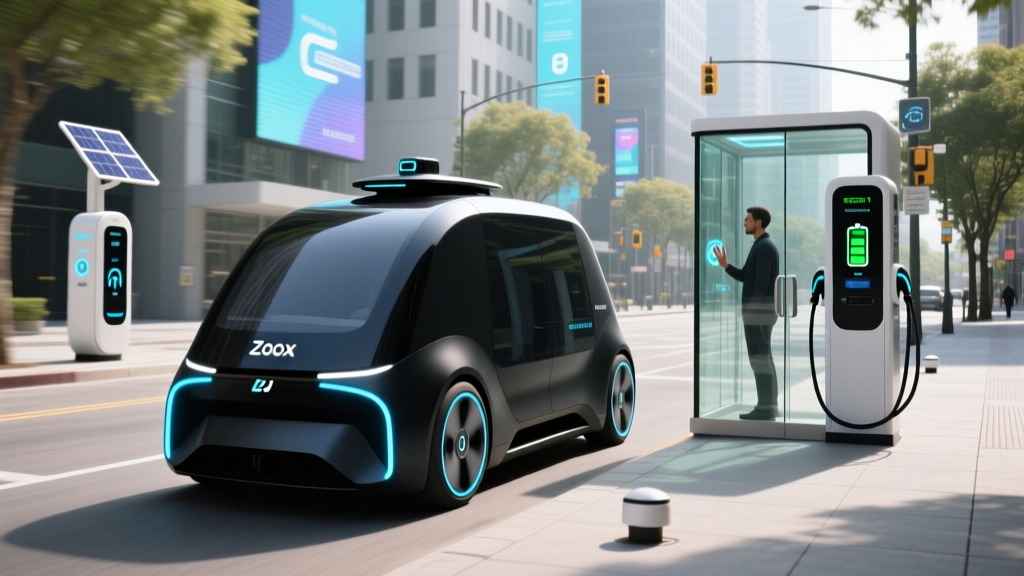
The Zoox robo taxi is a purpose-built, fully autonomous vehicle designed from the ground up for ride-hailing — not a retrofitted SUV with a sensor pack bolted on. Unlike Tesla's FSD Supervised or GM's Super Cruise, which are SAE Level 2 driver-assist systems that require a human behind the wheel, Zoox operates at SAE Level 4: no steering wheel, no pedals, no driver. The vehicle handles all driving tasks within its approved operational design domain (ODD), and if it encounters a situation it can't manage, it pulls over safely rather than handing control to a passenger.
Zoox operates without any human driver in the vehicle within its geofenced service areas. This is fundamentally different from Level 2 systems like Tesla Autopilot, Waymo's consumer FSD competitors, or Ford BlueCruise, where the driver must remain engaged and liable. At Level 4, Zoox assumes full liability for driving decisions within its ODD. The vehicle cannot operate outside approved zones or conditions.
Zoox was acquired by Amazon in 2020 for approximately $1.3 billion and has spent the years since developing both its custom vehicle platform and its autonomous driving stack. The company's dual-facing, carriage-style vehicle seats four passengers facing each other and is bidirectional — it can drive equally well in either orientation, eliminating the need for traditional turning maneuvers in tight urban spaces.
Where Can You Ride the Zoox Robo Taxi Right Now?
As of early 2026, Zoox has progressively expanded its commercial service footprint, though availability remains limited to specific geofenced zones in select cities. Here's the current operational landscape:
| City | Status | Service Zone Notes |
|---|---|---|
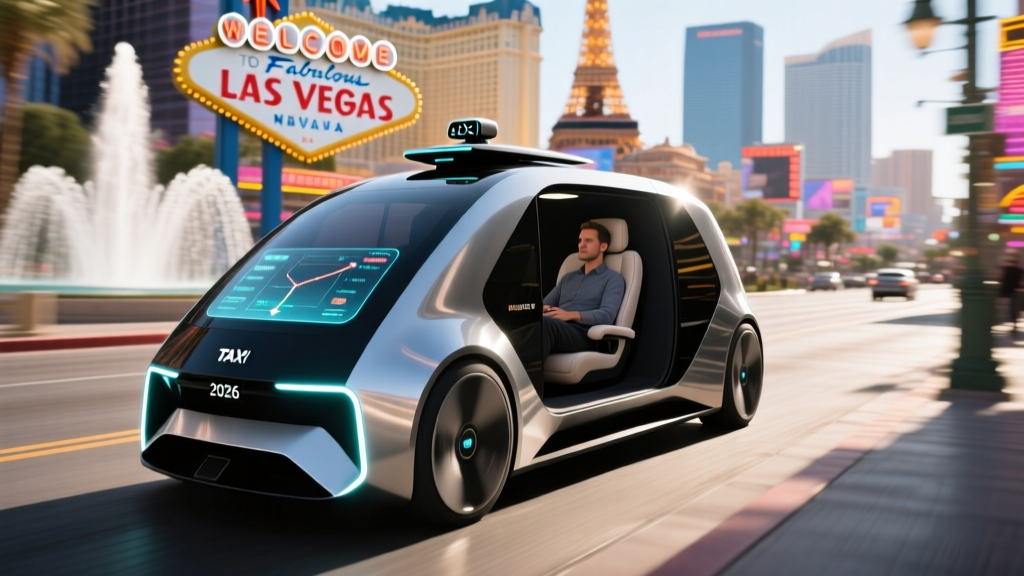
| Las Vegas, NV | Commercial service active | Las Vegas Strip corridor, downtown, and airport-adjacent zones; expanded coverage area through 2025 |
| San Francisco, CA | Commercial service active | Select neighborhoods including SoMa, Mission, and Financial District; gradual zone expansion ongoing |
| Foster City, CA | Testing / limited rides | Suburban testing zone near Zoox HQ; limited public access via waitlist |
| Austin, TX | Testing phase | Mapping and validation underway; no public rides yet |
| Atlanta, GA | Testing phase | Early-stage road testing and data collection |
The key distinction: Las Vegas and San Francisco are the only cities where you can currently request a ride as a member of the public. In other cities, Zoox vehicles are on the road for testing and validation, but they're not available for on-demand passenger service. Expansion timelines depend on regulatory approval in each jurisdiction, and announced plans should not be confused with live service.
How to Use Zoox and What It Costs vs Uber and Lyft
Riding in the Zoox robo taxi requires downloading the Zoox app (available on iOS and Android), creating an account, and requesting a ride within an active service zone. There is no waitlist gate for Las Vegas commercial service as of late 2025, though San Francisco access has rolled out in phases. The app functions similarly to Uber or Lyft: you set a pickup and dropoff point, the system confirms availability within the geofence, and the vehicle arrives autonomously.
Because the Zoox vehicle has no driver seat, the entire cabin is passenger space. Riders sit in one of four forward-facing or inward-facing seats, and the app provides a touchscreen interface for climate control, route visualization, and music selection. There's no driver to rate, no conversation obligation, and no tipping.
| Service | Base Fare (est.) | Per-Mile Rate | Per-Minute Rate | Typical 3-Mile Ride |
|---|---|---|---|---|
| Zoox | $0–$2.50 | ~$1.10–$1.50 | ~$0.25–$0.40 | $7–$12 |
| UberX | $2.50–$3.50 | $1.20–$1.80 | $0.30–$0.50 | $9–$16 |
| Lyft Standard | $2.00–$3.00 | $1.15–$1.70 | $0.28–$0.45 | $8–$15 |
| Waymo One | $2.00–$3.00 | $1.20–$1.60 | $0.30–$0.45 | $8–$14 |
Zoox has priced its service competitively with conventional rideshare, and in some promotional periods has offered rides at steep discounts or free to build ridership. The long-term economic model relies on eliminating driver compensation — which typically represents 60–75% of a rideshare fare — allowing Zoox to undercut human-driven services once fleet scale is achieved. Surge pricing dynamics differ too: Zoox availability is constrained by fleet size and geofence coverage, not driver supply.
Zoox Safety Record: What the Data Shows
Safety is the most scrutinized aspect of any robotaxi operation, and Zoox publishes disengagement and incident data as required by the California DMV and Nevada regulators. Here's what the numbers indicate based on publicly available filings and reports through 2025:
- Autonomous miles driven: Over 1 million driverless miles logged across testing and commercial operations (per California DMV disengagement reports)
- Disengagement rate: Approximately 1 human-safety-operator intervention per 5,000–8,000 autonomous miles during testing phases (improving annually); commercial driverless operations track incidents separately
- Reported collisions: Zoox has reported a small number of minor contact incidents to NHTSA under the Standing General Order for ADS-equipped vehicles — predominantly low-speed, other-party-at-fault events typical of dense urban driving
- Fatalities: Zero passenger or pedestrian fatalities attributed to Zoox autonomous operations as of early 2026
Sources: NHTSA Standing General Order crash data, California DMV, Zoox safety reports.
Context matters here. Robotaxi operations occur in dense urban environments at relatively low speeds (typically under 45 mph), where minor contact incidents — a side-mirror tap, a low-speed rear-end by a human driver — are statistically common. The relevant safety metric isn't "zero incidents" but whether the ADS performs at or above human-driver benchmarks for the same road types and conditions. Zoox's published data suggests its vehicles are involved in fewer at-fault incidents per mile than the human-driver urban average, though direct comparison is complicated by differing exposure profiles.
The National Highway Traffic Safety Administration (NHTSA) requires all ADS operators to report crashes within one day for incidents involving injury or significant damage. Zoox has complied with these reporting requirements, and its incident record is publicly searchable.
Under the Hood: Zoox's Technology Stack
Zoox's approach to autonomy differs meaningfully from Tesla's camera-centric vision-only strategy and from Waymo's lidar-forward stack mounted on a Jaguar I-PACE or Zeekr minivan. Zoox designed its vehicle and sensor suite as an integrated system.
Sensor Array
- LiDAR: Multiple solid-state and spinning lidar units providing 360° 3D point-cloud mapping out to ~150+ meters; critical for depth perception independent of lighting conditions
- Cameras: High-resolution camera arrays covering all directions for object classification, traffic-light recognition, lane detection, and semantic understanding
- Radar: Forward and corner radar units for velocity detection of moving objects, functioning reliably in rain and fog where lidar and cameras degrade
- Ultrasonic sensors: Short-range proximity detection for low-speed maneuvers, curb detection, and close-quarters navigation
Computing and Software
- Onboard compute: Custom high-performance computing platform running Zoox's full perception, prediction, and planning stack in real time — no reliance on remote teleoperation for driving decisions
- HD mapping: Centimeter-precision maps of every operational zone, continuously updated; the vehicle localizes itself within these maps using lidar and visual landmarks
- Prediction engine: Machine-learning models trained on millions of miles of urban driving data to predict pedestrian, cyclist, and vehicle behavior
- Redundancy: Dual-redundant braking, steering, and compute systems — if a primary system fails, the backup can execute a safe pullover maneuver without human intervention
Vehicle Design
- Bidirectional: Symmetrical design allows the vehicle to travel in either direction, simplifying three-point turns and enabling flexible routing in narrow streets
- Four-wheel steering: All four wheels steer, giving a tighter turning radius than conventional vehicles — critical for dense urban navigation
- Battery: Purpose-built battery pack (estimated ~75–85 kWh, lithium-ion NMC chemistry) designed for continuous stop-start duty cycles rather than highway cruising; targeted for ~16 hours of daily operation before requiring a charge
- No driver controls: No steering wheel, pedals, or mirrors — the NHTSA granted Zoox an exemption from FMVSS requirements that mandate these controls
The sensor-fusion approach — combining lidar, cameras, and radar — is the industry consensus for Level 4 operations. Tesla's camera-only strategy remains an outlier and has not achieved Level 4 deployment. Zoox's decision to build the vehicle around the sensor suite (rather than adapting sensors to an existing car) gives it tighter integration but also means every vehicle is custom-built at higher per-unit cost.
Regulatory Landscape: Who Approves Robotaxi Operations?
Robotaxi deployment in the United States is governed by a patchwork of state and local regulations — there is no single federal license that permits nationwide autonomous ride-hailing. Here's how the approval chain works for Zoox:
- California (CPUC + DMV): The California Public Utilities Commission issues permits for commercial passenger service, while the DMV handles testing permits and publishes disengagement data. Zoox holds both a DMV testing permit and a CPUC commercial deployment permit for San Francisco operations.
- Nevada (DMV + local authorities): Nevada was among the first states to pass autonomous vehicle legislation. Zoox received approval to operate commercially on public roads in Las Vegas through the state's AV regulatory framework, with additional coordination with Clark County and the City of Las Vegas.
- Federal (NHTSA): NHTSA does not "approve" autonomous vehicles for deployment but sets safety standards (FMVSS) and can grant exemptions. Zoox received a critical exemption allowing its vehicle to operate without traditional controls (steering wheel, pedals, mirrors). NHTSA also maintains crash-reporting requirements and can issue recalls or investigations.
- Other states: Texas, Arizona, Georgia, and others have AV-friendly legislation, but each requires separate applications, insurance proof, and sometimes local government coordination before commercial service can begin.
This state-by-state approval process is the primary bottleneck for robotaxi expansion. Unlike a rideshare company that can onboard drivers anywhere with minimal regulatory friction, a robotaxi operator must validate its technology and secure permits in each new jurisdiction — a process that typically takes 12–24 months per city.
Current Limitations of the Zoox Robo Taxi
Level 4 autonomy is a significant engineering achievement, but it comes with defined boundaries. Zoox's operational design domain (ODD) explicitly excludes scenarios the system cannot yet handle safely. Here's what riders and prospective users should understand:
What Zoox Cannot Do (Yet)
- Geofence boundaries: The vehicle will not drive outside its mapped and approved zone. If your destination is beyond the geofence, the ride simply cannot be requested. Service zones cover specific neighborhoods, not entire metro areas.
- Heavy weather: Torrential rain, heavy snow, dense fog, and ice degrade lidar and camera performance. Zoox suspends or limits operations during severe weather events — similar to how a cautious human driver might choose to stay off the road.
- Highway driving: Zoox vehicles are designed for urban surface streets at speeds typically under 45 mph. They do not merge onto freeways or operate at highway speeds, which limits trip types to intra-city point-to-point rides.
- Construction zones: Unmapped lane closures, temporary traffic patterns, and construction-zone flaggers present edge cases. The vehicle may reroute around construction or, in some cases, pull over and wait for remote guidance if the path is ambiguous.
- Unprotected left turns in heavy traffic: Complex unprotected turns with high oncoming traffic volumes remain challenging. The vehicle may take conservative approaches — waiting longer than a human driver would — which can increase trip time.
- Emergency vehicle interaction: While the system detects and responds to emergency vehicles, complex scenarios (multiple emergency vehicles, unclear right-of-way) can cause the vehicle to stop and wait rather than proceed cautiously.
- Pets and unusual cargo: Zoox has published policies on what can be brought into the vehicle. Large items, uncontained pets, or anything that might damage the interior are restricted — there's no driver to make a judgment call.
These limitations aren't unique to Zoox — Waymo and Cruise (before its 2024 operational pause) face similar ODD constraints. The difference is that Zoox's purpose-built vehicle, with no driver fallback, must be more conservative about entering situations it can't resolve independently. When a Zoox vehicle encounters an unresolvable scenario, it executes a Minimal Risk Condition (MRC) maneuver — typically pulling to the curb and stopping — rather than asking a passenger to take over.
Zoox vs Waymo: How the Two Robotaxi Leaders Compare
Zoox and Waymo are the two most prominent Level 4 robotaxi operators in the US, but their approaches diverge significantly:
| Attribute | Zoox | Waymo One |
|---|---|---|
| Vehicle | Purpose-built Zoox carriage (custom, bidirectional) | Jaguar I-PACE / Zeekr RT (retrofitted production vehicles) |
| SAE Level | Level 4 | Level 4 |
| Active commercial cities | Las Vegas, San Francisco | Phoenix, San Francisco, Los Angeles, Austin (expanding) |
| Driver in vehicle | None (no controls) | None (in commercial service) |
| Parent company | Amazon | Alphabet (Google) |
| Sensor approach | LiDAR + cameras + radar (integrated custom suite) | LiDAR + cameras + radar (custom 5th-gen suite) |
| Highway capable | No (urban surface streets only) | Limited (some freeway segments in Phoenix) |
Waymo has a larger commercial footprint and more accumulated driverless miles. Zoox's advantage is its ground-up vehicle design, which offers a more passenger-centric cabin experience and tighter urban maneuverability. Neither company has achieved profitability on robotaxi operations — both are investing heavily in fleet scale and geographic expansion.
Is the Zoox Robo Taxi Truly Self-Driving?
Yes — within its defined operational domain. This is not a semantic distinction; it's a regulatory and engineering one. When you ride in a Zoox vehicle, there is no human driver, no remote joystick operator controlling the vehicle in real time, and no steering wheel for a passenger to grab. The vehicle makes all driving decisions autonomously using its onboard sensor suite, HD maps, and AI planning stack.
This stands in stark contrast to consumer driver-assist systems. Tesla's Full Self-Driving (Supervised), despite its name, is an SAE Level 2 system that requires the driver to remain attentive and hands-on. Ford BlueCruise and GM Super Cruise are hands-off but eyes-on Level 2 systems on mapped highways — the driver is still responsible. Zoox, Waymo, and similar robotaxi services are Level 4: the system is the driver, and the company bears liability.
The "Level 4 within a geofence" model means autonomy is real but bounded. You're genuinely being driven by a computer, but only on streets the company has mapped, validated, and received regulatory approval to operate on. Outside those boundaries, the service simply doesn't exist.
Frequently Asked Questions
Is the Zoox robo taxi free to ride?
Zoox has offered free or heavily discounted promotional rides during launch phases in new cities, but its commercial service in Las Vegas and San Francisco charges fares comparable to or slightly below Uber/Lyft rates. Expect to pay roughly $7–$12 for a typical 3-mile urban trip. Promotional pricing may be available periodically through the Zoox app.
Can I request a Zoox ride to the airport?
It depends on whether the airport falls within the active geofence. In Las Vegas, Zoox has expanded coverage to include areas near Harry Reid International Airport (LAS), but riders should check the app for exact pickup/dropoff availability. San Francisco airport (SFO) service depends on the current geofence boundary and regulatory approvals for airport-adjacent zones.
What happens if the Zoox vehicle gets confused or breaks down?
If the vehicle encounters a scenario it cannot resolve, it executes a Minimal Risk Condition maneuver — typically pulling to the nearest safe curb position and stopping. Zoox maintains a remote fleet-assistance team that can assess the situation and, if needed, provide high-level guidance (e.g., confirming a route around an obstacle) or dispatch a physical support vehicle. The remote team does not "joystick" the car in real time.
How many passengers can the Zoox vehicle hold?
The Zoox vehicle seats four passengers. There is no driver seat. All four seats face inward in a carriage-style configuration. Riders under 18 must be accompanied by an adult, and the vehicle is not equipped with child car-seat anchors in all configurations — check Zoox's rider policies for specifics.
Is Zoox safer than a human Uber driver?
Zoox's published data indicates a lower at-fault incident rate per mile than the human-driver urban average, though direct statistical comparison is complex due to differing operational conditions. The vehicle never drives distracted, impaired, or fatigued, and its 360° sensor suite provides awareness no human can match. However, it can be overly conservative in complex scenarios, which occasionally causes delays or unnecessary stops. For the latest safety data, refer to NHTSA's crash reporting portal and Zoox's published safety reports.
Will Zoox come to my city?
Zoox has announced testing operations in Austin and Atlanta, with additional cities under evaluation. However, commercial launch requires regulatory approval, fleet deployment, and HD mapping — a process that typically takes 12–24 months after testing begins. Check the Zoox website or app for the most current city list rather than relying on announcement timelines.