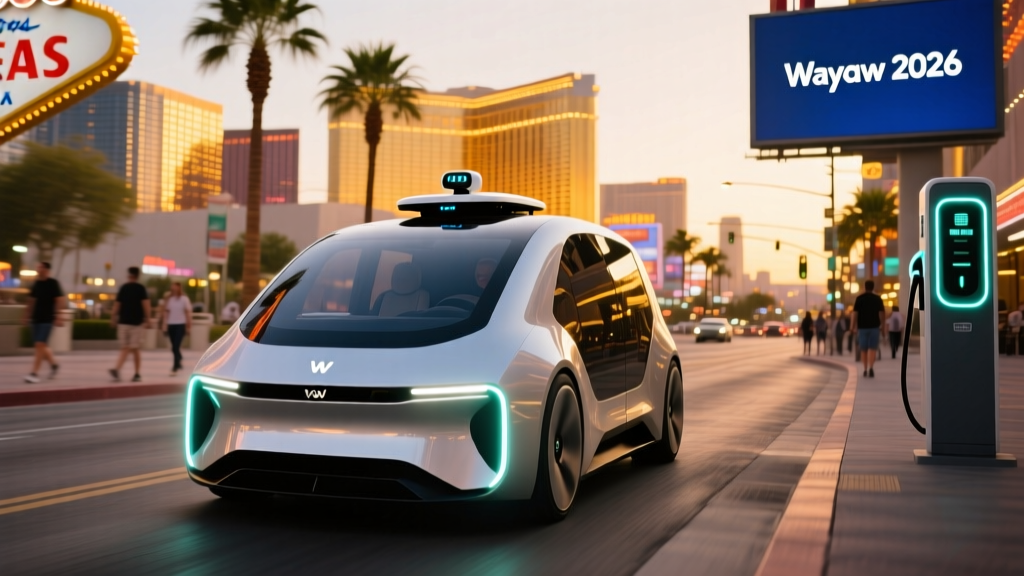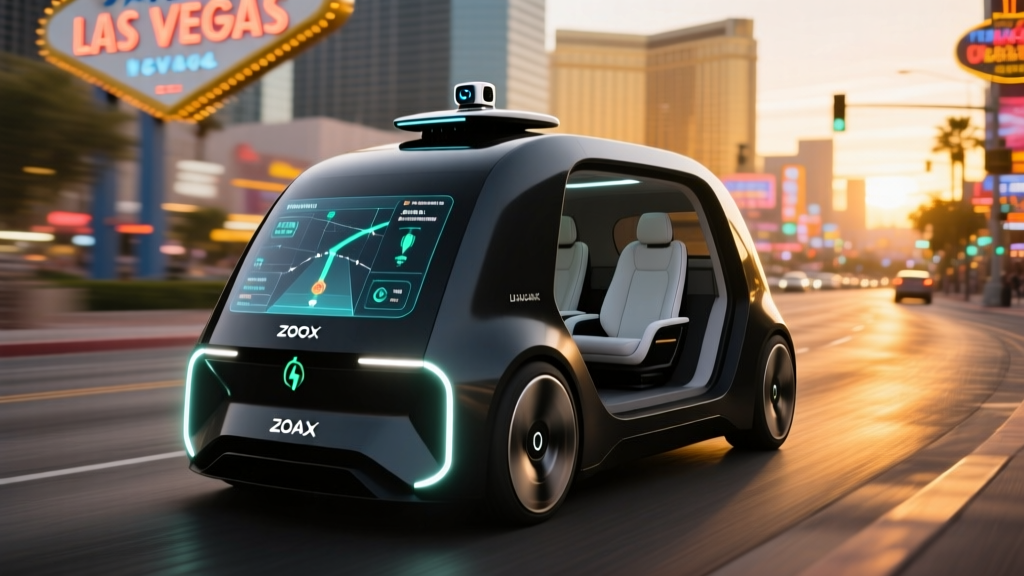
Las Vegas has become one of the most active proving grounds for driverless robotaxi services in the United States. Among the operators testing and deploying on the Strip and surrounding streets, Amazon-owned Zoox stands out for its purpose-built, bidirectional vehicle — a compact carriage-style pod with no steering wheel or pedals. If you've been searching for Zoox rides Las Vegas details, this guide covers exactly where the service operates, what it costs, how safe the vehicles are, and what you can realistically expect from a ride in 2026.
Unlike Tesla's Full Self-Driving (Supervised) or GM's Super Cruise — which are SAE Level 2 driver-assist systems requiring constant human oversight — Zoox operates a Level 4 robotaxi service. There is no driver in the vehicle, no steering wheel, and no expectation that a passenger will intervene. That distinction matters enormously for safety, regulation, and the rider experience.
What Zoox Actually Is: A Level 4 Robotaxi Explained
SAE Automation Level: Level 4 (High Automation)
Zoox vehicles operate at SAE Level 4 within their approved operational design domain (ODD). This means the vehicle handles all driving tasks — steering, braking, acceleration, navigation, and edge-case response — without any human input, within geofenced areas and conditions approved by regulators. If the system encounters a scenario it cannot handle, it is designed to execute a minimal-risk maneuver (pulling over safely) rather than handing control to a passenger. This is fundamentally different from Level 2 systems like Tesla Autopilot or Ford BlueCruise, where the human driver remains legally and operationally responsible.
Zoox was founded in 2014 and acquired by Amazon in 2020 for approximately $1.3 billion. The company developed both its own autonomous driving software stack and a ground-up vehicle platform — the Zoox Gen 5 — rather than retrofitting an existing production car. The Gen 5 vehicle is a symmetrical, bidirectional pod that can travel forward or backward with equal capability, seats up to four passengers face-to-face, and is engineered specifically for dense urban environments.
| Level | Name | Who Drives | Examples |
|---|---|---|---|
| Level 0 | No Automation | Human | Traditional vehicles |
| Level 1 | Driver Assistance | Human (system assists steering OR speed) | Adaptive cruise control, lane-keep |
| Level 2 | Partial Automation | Human (system assists steering AND speed) | Tesla Autopilot/FSD Supervised, Ford BlueCruise, GM Super Cruise |
| Level 3 | Conditional Automation | System (human must be ready to take over) | Mercedes DRIVE PILOT (limited markets, low speed) |
| Level 4 | High Automation | System (no human needed within ODD) | Zoox, Waymo One |
| Level 5 | Full Automation | System (everywhere, all conditions) | Not commercially deployed anywhere |
Where Can You Get Zoox Rides in Las Vegas Right Now?
Zoox began testing vehicles on public roads in Las Vegas in 2023, initially with safety operators onboard, and expanded to driverless operations in phases. As of early 2026, Zoox operates a limited public ride-hailing service in Las Vegas, but availability is restricted compared to established competitors like Waymo.
| Detail | Status |
|---|---|
| City | Las Vegas, Nevada |
| Service Type | Employee/invite-only + limited public access via Zoox app |
| Geofenced Area | Portions of the Las Vegas Strip corridor, downtown Las Vegas, and select surrounding arterials |
| Operating Hours | Limited hours (not 24/7 — typically daytime and early evening) |
| Other Active Cities | Foster City, CA (HQ testing); San Francisco, CA (limited); Austin, TX (testing) |
| Public Availability | Waitlist/approval required — not yet open-ride like Waymo in Phoenix/SF/LA |
The key takeaway: Zoox is operating driverless vehicles on Las Vegas roads, but as of 2026, the service is not yet as broadly accessible as Waymo One. Riders typically need to be approved through the Zoox app, and the geofenced service area covers specific corridors rather than the entire metro area. The Las Vegas Strip itself presents unique challenges — extreme pedestrian density, construction zones, and complex multi-lane intersections — which makes Zoox's phased rollout deliberate.
For comparison, Waymo One operates more broadly in Phoenix, San Francisco, and Los Angeles with open public access via the Waymo app. If you're visiting Vegas and want a guaranteed robotaxi ride today, Waymo's service (where available) or traditional rideshare remain your most reliable options.
Zoox Vehicle Specs and Technology Stack
The Zoox Gen 5 vehicle is unlike anything else on the road. It's not a modified SUV or sedan — it's a purpose-built robotaxi from the ground up, designed around the premise that no human will ever sit in a driver's seat.
Zoox Gen 5 Vehicle Specifications
| Specification | Detail |
|---|---|
| Vehicle Type | Purpose-built bidirectional robotaxi (no steering wheel/pedals) |
| Passenger Capacity | 4 (face-to-face seating) |
| Battery | Lithium-ion pack (exact kWh not publicly disclosed; estimated 70-85 kWh usable) |
| Range | Up to ~16 hours of continuous operation per charge cycle (per Zoox) |
| Top Speed | 75 mph (software-limited) |
| Drive | Dual-motor all-wheel drive, four-wheel steering |
| Sensor Suite | Lidar, radar, cameras (redundant 360° coverage) |
| Compute | Custom onboard compute platform with redundant systems |
| Dimensions | Compact footprint (~length of a Smart Fortwo, taller profile) |
Sensor and Software Architecture
Zoox uses a multi-modal sensor fusion approach — combining lidar, radar, and cameras — which is fundamentally different from Tesla's camera-only ("Tesla Vision") approach. Here's what each layer does:
- Lidar: Multiple lidar units provide high-resolution 3D point clouds of the environment, enabling precise distance measurement to objects regardless of lighting conditions. This is critical for nighttime operation and detecting pedestrians at range.
- Cameras: A surround-camera array handles object classification (pedestrian vs. cyclist vs. vehicle), traffic light state detection, and signage recognition.
- Radar: Long-range and short-range radar units detect velocity of moving objects and perform reliably in rain, fog, and other conditions where lidar and cameras can degrade.
- HD Maps + Geofencing: Zoox pre-maps every inch of its operational domain at centimeter-level precision. The vehicle localizes itself within this map in real-time. If it exits the geofence or encounters unmapped construction, it is designed to stop safely.
- Prediction & Planning: Zoox's AI stack predicts the behavior of surrounding agents (pedestrians, other vehicles, cyclists) and plans trajectories multiple seconds ahead, with continuous re-planning at high frequency.
The bidirectional capability is a practical differentiator. Because the vehicle can drive equally well in either direction, it can navigate tight urban spaces, pull out of dead-end situations, and avoid unnecessary multi-point turns that would be required by a conventional vehicle layout. Four-wheel steering further reduces its turning radius — an advantage on congested city streets.
How to Request a Zoox Ride and What It Costs
Riding in a Zoox vehicle in Las Vegas currently requires access through the Zoox mobile app, which operates on a waitlist/invitation model for public riders. This is not yet a fully open marketplace like Uber or Lyft.
Pricing Structure
Zoox has not published a standard per-mile or per-minute rate card for Las Vegas as of early 2026, largely because the service is still in limited-access mode. However, based on Zoox's stated pricing approach and comparable robotaxi pricing from Waymo, here's what riders can expect:
| Service | Estimated Cost (3-mile trip) | Pricing Model | Surge Pricing |
|---|---|---|---|
| Zoox (Las Vegas) | ~$8–$14 (estimated, based on Waymo comparables) | Distance + time; promotional/discounted rides during ramp-up | No surge pricing (fixed algorithm) |
| Waymo One (where available) | ~$9–$15 | Distance + time + demand factor | Limited dynamic pricing |
| UberX (Las Vegas) | ~$10–$18 | Distance + time + demand | Yes (surge during events/peak) |
| Lyft (Las Vegas) | ~$10–$17 | Distance + time + demand | Yes (prime-time pricing) |
Key pricing observations:
- No driver tip required: There's no human driver, so the 15-20% tip expectation disappears. This alone can make robotaxi rides 15-20% cheaper than an equivalent rideshare trip.
- No surge spikes: Robotaxi pricing doesn't typically surge 3-5x during events like CES or New Year's Eve on the Strip — a scenario where Uber/Lyft prices in Vegas regularly spike dramatically.
- Promotional pricing: During the ramp-up phase, Zoox (and Waymo before it) has offered heavily discounted or free rides to early adopters to build ridership data and public familiarity.
To request a ride: download the Zoox app, create an account, join the waitlist for Las Vegas, and if approved, set your pickup and drop-off within the geofenced zone. The vehicle arrives autonomously, unlocks its doors when you're verified, and the ride begins. There's an in-ride screen showing your route, and a "stop" button if you need to end the ride early.
Zoox Safety Record: What the Data Shows
Zoox Safety Data — Available Figures
As a Level 4 operator, Zoox is required to report disengagement and incident data to the National Highway Traffic Safety Administration (NHTSA) and, in California, to the DMV. Key data points available through 2025-2026 reporting:
- Testing miles: Zoox has accumulated hundreds of thousands of autonomous miles across its test fleet in Foster City, San Francisco, Las Vegas, and Austin. Exact cumulative figures are reported periodically via California DMV disengagement reports.
- Disengagement rate: In its most recent California DMV report, Zoox reported disengagement rates (instances where a safety operator took manual control) that have trended downward year-over-year, consistent with system maturation. Specific rates vary by operational domain complexity.
- At-fault collisions: Through early 2026, Zoox has not reported a serious-injury at-fault collision during driverless (no safety operator) operations. Minor contact incidents during testing phases have been reported per regulatory requirements.
- NHTSA Standing General Order: Under NHTSA's Standing General Order (SGO), all Level 2+ and Level 4 operators must report crashes. Zoox data is publicly accessible via NHTSA's AV crash reporting database.
For context on robotaxi safety broadly: Waymo, the most data-rich Level 4 operator, published a peer-reviewed study showing that its vehicles were involved in 85% fewer injury-causing crashes per million miles compared to human-driven benchmarks in the same geographies. Zoox has not published an equivalent large-scale study, largely because its driverless fleet miles are lower than Waymo's. However, the sensor-redundant architecture (lidar + radar + cameras, with hardware-level redundancy) is consistent with industry best practices for Level 4 safety cases.
The Las Vegas environment presents specific safety challenges: high pedestrian volumes (especially intoxicated pedestrians near the Strip at night), frequent construction zone changes, and extreme summer heat that can stress vehicle thermal management systems. Zoox's phased rollout — limiting hours and geofenced zones — reflects a cautious approach to these edge cases.
Regulatory Landscape: Who Approves Zoox Operations?
Robotaxi operations in the United States require approval at multiple levels of government. Zoox's Las Vegas operations are governed by Nevada state law and federal oversight.
Federal Level
- NHTSA: Oversees vehicle safety standards. Zoox received a notable exemption from certain Federal Motor Vehicle Safety Standards (FMVSS) that assume a human driver (e.g., requirements for a steering wheel, mirrors, and a traditional windshield). This exemption was critical for the Gen 5 vehicle's unconventional design.
- Standing General Order (SGO): Requires crash reporting for all vehicles equipped with SAE Level 2+ through Level 5 systems.
State Level — Nevada
- Nevada was the first U.S. state to pass autonomous vehicle legislation (2011), and the Nevada DMV issues autonomous vehicle testing and deployment permits.
- Zoox holds a Nevada autonomous vehicle testing permit and has been authorized for driverless operations in designated areas.
- Nevada's regulatory framework is generally considered favorable to AV deployment, with fewer restrictions than California's more cautious CPUC/DMV dual-permit system.
Local Level — Las Vegas / Clark County
- Local jurisdictions control road access, permitting for commercial ride-hailing, and coordination with traffic management centers. Zoox coordinates with local authorities on geofencing boundaries and construction-zone data sharing.
For riders, the regulatory framework means: the vehicle you're riding in has been permitted, insured, and is subject to ongoing reporting requirements. It is not an unregulated experiment.
Current Limitations of Zoox in Las Vegas
What Zoox Cannot Do (2026)
- Drive outside its geofence: The vehicle will not operate beyond its pre-mapped, regulator-approved service area. If your destination falls outside the zone, the app won't let you book the ride.
- Operate in severe weather: While Las Vegas rarely sees extreme weather, heavy monsoon rain or dust storms (haboobs) can degrade lidar and camera performance. Zoox vehicles are designed to pull over safely if sensor confidence drops below threshold.
- Handle all construction zones: Temporary lane shifts, unpaved detours, and flagger-directed traffic remain edge cases. The vehicle may choose to reroute or stop and wait rather than proceed through an ambiguous construction area.
- Pick up at airports or venues with restricted access: Harry Reid International Airport (LAS) and certain private venues may not be accessible to Zoox vehicles due to access agreements and infrastructure constraints.
- Accommodate wheelchairs or large cargo: The Gen 5 vehicle's compact cabin is optimized for four seated passengers with personal items. It does not currently accommodate wheelchairs, large luggage, or pets (service animals excepted).
- Provide 24/7 service: Operating hours are limited, partly due to fleet size, maintenance cycles, and the complexity of nighttime Strip operations.
These limitations are inherent to all current Level 4 robotaxi services, not unique to Zoox. Waymo faces similar geofencing and weather constraints in its markets. The difference is one of degree: Waymo has had more years of public operation to expand its geofence and edge-case handling, while Zoox is earlier in its deployment curve.
Zoox vs. Waymo vs. Rideshare in Las Vegas: Decision Framework
Choose Your Ride Based on Your Situation
Choose Zoox if: You've been approved on the app, your trip falls within the geofenced zone, and you want to experience a purpose-built Level 4 robotaxi with no steering wheel. The novelty and technology experience are genuine draws.
Choose Waymo if: You need broader coverage in a city where Waymo One is fully public (Phoenix, SF, LA — and potentially expanding Vegas coverage). Waymo has more operational miles, a more mature public app, and a published safety record.
Choose Uber/Lyft if: You need to go outside robotaxi geofences (airport runs, suburban destinations, Henderson, Summerlin), you're traveling with large luggage or a group larger than four, or you need a ride at 2 AM after a show.
Frequently Asked Questions
Is Zoox really self-driving, or is there a hidden driver?
Zoox is genuinely self-driving at SAE Level 4. There is no steering wheel, no pedals, and no human driver — visible or hidden — in the vehicle. The vehicle operates autonomously within its approved geofenced area. This is fundamentally different from Tesla's Full Self-Driving (Supervised), which is a Level 2 system that requires a licensed, attentive driver behind the wheel at all times.
How much does a Zoox ride cost compared to Uber?
Zoox has not published a fixed rate card for Las Vegas as of early 2026, as the service is still in limited-access mode. Based on comparable robotaxi pricing from Waymo, expect roughly $8–$14 for a typical 3-mile urban trip — competitive with UberX but without surge pricing or tip expectations. During promotional periods, rides may be heavily discounted or free.
Is Zoox available to the public in Las Vegas?
Not fully. As of 2026, Zoox operates in Las Vegas on a limited-access basis. You need to download the Zoox app, join the waitlist, and be approved. The service area is geofenced to specific corridors. It is not yet an open, on-demand service comparable to Waymo One in Phoenix or San Francisco.
How safe are Zoox vehicles compared to human drivers?
Zoox has not reported a serious-injury at-fault collision during driverless operations through early 2026. The vehicle uses redundant lidar, radar, and camera sensors — a more robust approach than camera-only systems. However, Zoox's total driverless fleet miles are lower than Waymo's, so the statistical sample is smaller. For reference, Waymo's published data shows an 85% reduction in injury-causing crashes per million miles vs. human benchmarks in comparable geographies. All Zoox incidents are reported to NHTSA under the Standing General Order.
Can Zoox drive me from the Las Vegas Strip to the airport?
Likely not yet. Harry Reid International Airport access requires specific agreements and infrastructure, and the airport may fall outside Zoox's current geofenced service area. Check the Zoox app for your specific pickup and drop-off — it will only confirm rides within the approved zone.
What happens if the Zoox vehicle encounters a problem mid-ride?
Zoox vehicles are designed to execute a "minimal-risk condition" maneuver if they encounter a scenario they cannot resolve — typically pulling to the side of the road and stopping safely. Remote assistance operators can monitor and provide guidance, but they do not "joystick" the vehicle in real-time. Passengers have an in-cabin stop button and can contact support via the in-ride screen or app.
Does Zoox operate in other cities besides Las Vegas?
Yes. Zoox also tests and operates in Foster City, California (its headquarters), San Francisco, and Austin, Texas. Las Vegas is one of the key early deployment cities due to Nevada's AV-friendly regulatory environment and the high volume of potential riders on and near the Strip.
The Bottom Line on Zoox Rides in Las Vegas
Zoox represents one of the most ambitious approaches to autonomous urban transportation: a vehicle designed from day one with no human driver in mind, operating at SAE Level 4 on public roads. In Las Vegas, the service is real and operational as of 2026, but it remains in a limited-access phase with a restricted geofence and approval-required ridership.
For EV and autonomous vehicle enthusiasts visiting Las Vegas, getting approved for a Zoox ride is worth the effort — it's one of the few places in the world where you can experience a truly driverless, purpose-built robotaxi on public roads. For practical daily transportation in Vegas, traditional rideshare and the expanding Waymo network remain more broadly accessible.
The trajectory is clear: Zoox, backed by Amazon's resources and a multi-year testing program, is building toward broader public access. The pace of expansion will depend on safety data accumulation, regulatory approvals, fleet scaling, and the company's ability to handle the uniquely chaotic driving environment of the Las Vegas Strip. For now, check the Zoox app, join the waitlist, and keep your expectations calibrated to the reality of where Level 4 robotaxi deployment stands today.