What Is Zoox and Where Does It Fit in the Robotaxi Landscape?
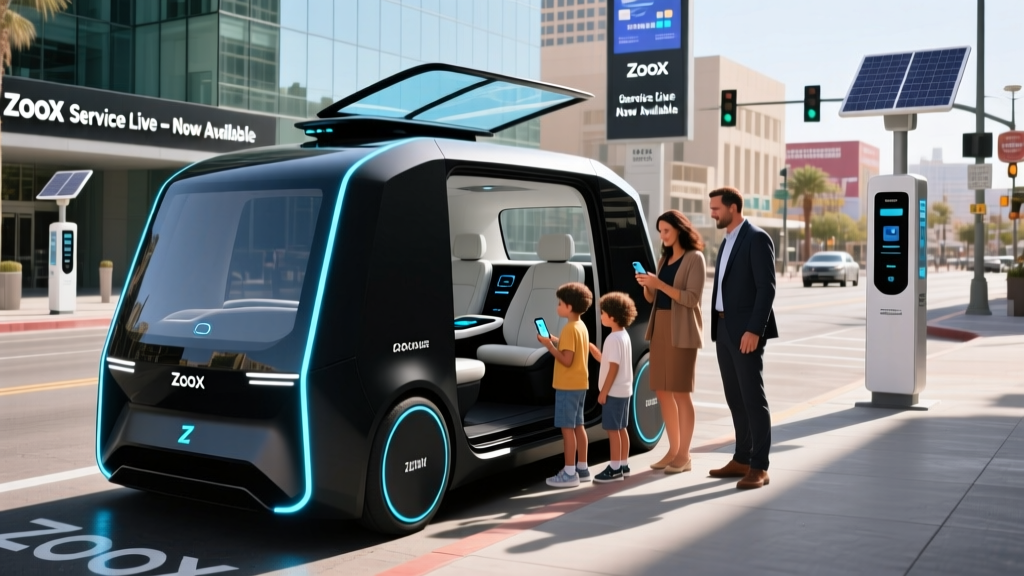
Zoox, the autonomous vehicle subsidiary owned by Amazon since its 2020 acquisition, operates a purpose-built robotaxi — a bidirectional, carriage-style electric vehicle with no steering wheel, pedals, or driver's seat. Unlike retrofitted SUVs used by some competitors, the Zoox vehicle was engineered from the ground up for driverless passenger service. In Las Vegas, Zoox has moved from limited testing to a phased public rider program, making it one of the few cities where you can actually experience a Level 4 autonomous ride today.
SAE Automation Level: Level 4 — High Automation
Zoox's robotaxi operates at SAE Level 4, meaning the vehicle performs all driving tasks without human intervention within its defined operational design domain (ODD) — specific geofenced areas under mapped conditions. This is fundamentally different from Level 2 driver-assist systems like Tesla Autopilot or GM Super Cruise, which require constant driver supervision. In a Zoox vehicle, there is no driver to supervise. The system handles all dynamic driving tasks, including edge-case routing and emergency maneuvering, within its service area.
Where Can You Get a Zoox Ride in Las Vegas Right Now?
Zoox's Las Vegas operations have expanded incrementally since initial testing began on public roads. As of early 2026, the service operates within a defined geofence covering key corridors. Access to rides is managed through the Zoox app, though availability may still be limited to invited riders or those on a waitlist depending on the current phase of deployment.
| Parameter | Details |
|---|---|
| City | Las Vegas, Nevada |
| Service Status | Active — phased public rider program |
| Geofenced Area | Select corridors including parts of the Las Vegas Strip area and surrounding downtown zones |
| Operating Hours | Limited hours; varies by deployment phase |
| How to Access | Zoox mobile app (iOS/Android); waitlist or invitation may apply |
| Other Active Zoox Cities | San Francisco (Bay Area), with Foster City, CA as HQ testing ground |
Unlike Waymo, which has opened broader public access in Phoenix and San Francisco, Zoox's rollout strategy has been more measured. The company prioritizes controlled expansion, adding road segments to its operational design domain only after extensive validation. If you're visiting Las Vegas and want to try a Zoox ride, download the app well in advance and check for ride eligibility — you may need to join a waitlist.
Zoox vs. Uber and Lyft: Pricing and Ride Experience
One of the most common questions from prospective riders: how much does a Zoox ride cost compared to conventional rideshare? During its rider-program phases, Zoox has historically offered rides at no charge or at heavily subsidized rates to build operational data and public familiarity. As the service matures toward full commercialization, pricing is expected to compete directly with Uber and Lyft on comparable routes.
| Factor | Zoox (Las Vegas) | Uber/Lyft (Las Vegas) |
|---|---|---|
| Current Pricing Model | Free/subsidized during rider program phases | Dynamic pricing: $8–$25+ for typical Strip-area trips |
| Surge Pricing | Not currently applicable | Yes — can 2x–3x during events, weekends |
| Tipping | No driver to tip | Expected/customary ($2–$5+) |
| Vehicle Type | Purpose-built Zoox EV (no steering wheel) | Driver's personal vehicle (varies widely) |
| Ride Capacity | Up to 4 passengers (facing seating) | Typically 4 passengers |
| Estimated Future Commercial Price | Expected competitive with UberX/Lyft Standard (~$10–$18 per trip) | $10–$18 average for mid-range Strip trips |
The long-term economic thesis for robotaxi operators is compelling: remove the driver (who typically earns 60–75% of the fare), and the per-mile cost drops significantly. Zoox's purpose-built vehicle is designed for high utilization — potentially running 16–20 hours per day with automated charging and cleaning cycles. Whether those savings get passed to riders or retained as margin remains a strategic question as the market develops.
Zoox Vehicle Technology Stack: Sensors, Compute, and Design
The Zoox vehicle is not a modified production car with bolted-on sensors. It's a clean-sheet design optimized for autonomous operation and passenger experience. Understanding the technology stack helps explain both the vehicle's capabilities and its current limitations.
Sensor Suite
- LiDAR: Multiple solid-state and/or spinning LiDAR units providing 360° high-resolution 3D point clouds. LiDAR gives the vehicle precise depth perception independent of lighting conditions — a critical advantage over camera-only approaches at night or in high-glare scenarios.
- Cameras: A distributed array of high-dynamic-range cameras covering 360° for object classification, traffic-light state detection, lane-marking recognition, and semantic understanding of the driving scene.
- Radar: Multiple radar units for velocity detection of moving objects, performance in rain and fog where LiDAR and cameras degrade, and redundancy in object tracking.
- Microphones: External microphones to detect emergency-vehicle sirens — a sensor modality often overlooked but critical for urban driving.
Compute and Decision-Making
Onboard high-performance computing hardware processes sensor fusion in real time, running perception, prediction, and planning algorithms. The vehicle maintains a continuously updated world model — tracking every pedestrian, cyclist, vehicle, and obstacle in its environment, predicting their likely future trajectories, and planning safe paths accordingly.
Vehicle Design
- Bidirectional: the vehicle can drive equally well in either direction, simplifying maneuvers like three-point turns and enabling flexible routing in tight urban spaces.
- Four-wheel steering: enables tight turning radii and crab-style lateral movements.
- Carriage-style seating: four passengers face each other in a symmetrical interior with no driver's cockpit.
- Battery electric: purpose-built EV powertrain, though Zoox has not published detailed battery capacity (kWh) or range specs publicly.
This multi-sensor approach — LiDAR plus cameras plus radar — stands in contrast to Tesla's camera-only ("Tesla Vision") philosophy. The redundancy of overlapping sensor modalities is a deliberate safety choice common across Level 4 operators including Waymo and Cruise, ensuring that if one sensor type degrades (e.g., cameras in fog), others maintain perception capability.
Safety Data: What the Numbers Actually Show
Safety is the central question for any robotaxi service. Zoox, like all autonomous vehicle operators in California and Nevada, is required to report disengagement data, collision reports, and operational metrics to regulators. Here's what is known from publicly available filings and reports.
Zoox Safety Metrics — Available Data
- California DMV Disengagement Reports: Zoox files annual disengagement reports with the California DMV, documenting instances where a safety driver (during testing phases) had to take control. As Zoox has transitioned to driverless operations, these metrics shift toward remote-assistance intervention rates.
- NHTSA Standing General Order: Under NHTSA's Standing General Order, all Level 2+ and ADS-equipped vehicle operators must report crashes involving their vehicles. Zoox is subject to this requirement.
- Testing Mileage: Zoox has accumulated hundreds of thousands of autonomous testing miles across its California and Nevada operations, though exact cumulative mileage figures are not always broken out by city in public filings.
- Collision Record: As of available public records, Zoox has reported minor incidents consistent with urban testing operations — primarily low-speed contacts during the testing phase with safety drivers present. No fatalities have been attributed to Zoox vehicle operations.
For context, Waymo — the most data-transparent robotaxi operator — has published peer-reviewed research showing its vehicles were involved in 85% fewer injury-causing crashes per million miles compared to human benchmarks in their operating areas. Zoox has not yet published equivalent comparative studies at scale, partly because its commercial mileage base is smaller. As Zoox accumulates more driverless passenger miles in Las Vegas and San Francisco, expect more robust safety-performance data to emerge.
The broader safety case for robotaxis rests on eliminating human failure modes: distraction, impairment, fatigue, and speeding. Whether the technology has matured enough to outperform attentive human drivers across all edge cases remains the central engineering challenge — and the reason geofencing and operational limits exist.
Regulatory Landscape: Who Approves Robotaxi Operations?
Operating a driverless robotaxi in the United States requires navigating a patchwork of state and federal regulations. There is no single federal license for autonomous vehicle operations; instead, authority is split across multiple agencies and jurisdictions.
Nevada's Framework
Nevada was one of the first states to legislate autonomous vehicle testing and deployment, with laws dating back to 2011 (NRS 482A). The Nevada Department of Motor Vehicles issues testing and deployment permits. Operators must demonstrate insurance coverage, submit safety plans, and comply with reporting requirements. Las Vegas, as a municipality, can impose additional operational constraints on where and when robotaxis may operate within city limits.
Federal Oversight
At the federal level, the National Highway Traffic Safety Administration (NHTSA) sets vehicle safety standards (FMVSS) and can issue exemptions for vehicles like the Zoox that lack traditional controls (steering wheel, mirrors, pedals). Zoox received a notable exemption from NHTSA allowing its purpose-built vehicle to operate without certain FMVSS requirements designed for human-driven cars — a critical regulatory milestone that validated the vehicle's design approach.
Key Regulatory Bodies
- Nevada DMV: Issues autonomous vehicle testing and deployment permits
- NHTSA: Vehicle safety standards, crash reporting, FMVSS exemptions
- Las Vegas municipal authorities: Local operational permissions, geofencing agreements
- California DMV and CPUC: Parallel oversight for Zoox's Bay Area operations
Current Limitations: Where Robotaxis Still Fall Short
Level 4 autonomy is impressive within its operational design domain — but that domain has real boundaries. Understanding the limitations is essential for setting realistic expectations.
Known Operational Constraints
- Geofencing: Zoox vehicles operate only within pre-mapped, approved areas. Request a ride outside the geofence and the system will decline. The vehicle cannot improvise routes through unmapped territory.
- Weather Sensitivity: Heavy rain, dust storms (relevant in Las Vegas), or extreme glare can degrade sensor performance. While LiDAR and radar handle some conditions better than cameras alone, severe weather may trigger operational pauses or speed reductions.
- Construction Zones: Unexpected road closures, lane shifts, and temporary traffic-control setups remain challenging. If the construction zone isn't reflected in the vehicle's map data, the system may reroute conservatively or request remote assistance.
- Special Events: Large-scale events on or near the Las Vegas Strip (e.g., Formula 1, New Year's Eve, major conventions) create pedestrian densities and traffic patterns that may exceed the system's validated parameters. Operators may temporarily restrict service in affected zones.
- Pickup/Dropoff Precision: Robotaxis use designated or validated pickup points rather than pulling up to an arbitrary curb. You may need to walk a short distance to a confirmed stop location.
- No Highway Operations (Currently):strong> Most robotaxi services, including Zoox's current deployment, focus on surface streets. High-speed highway driving introduces different risk profiles and regulatory requirements that are not yet part of typical robotaxi ODDs.
- Limited Operating Hours: Depending on the deployment phase, Zoox may not operate 24/7. Night operations require validated sensor performance under all lighting conditions.
These limitations are not unique to Zoox — they apply broadly across the Level 4 robotaxi industry. Waymo, Cruise (prior to its 2024 operational pause and subsequent relaunch), and other operators face the same edge-case challenges. The difference between a compelling demo and a reliable daily transportation service is how gracefully the system handles these boundary conditions.
Is a Zoox Ride Truly Self-Driving — or Is Someone Still Watching?
Yes, a Zoox ride is genuinely driverless in the sense that there is no human in the vehicle capable of driving. There is no steering wheel, no pedals, and no safety driver. However, "driverless" does not mean "unsupervised."
Zoox employs remote-assistance operators — trained personnel monitoring vehicle fleets from operations centers. These operators do not "drive" the vehicle in real time (the latency of remote control makes direct steering impractical and unsafe). Instead, they provide high-level guidance when the vehicle encounters an ambiguous scenario it cannot resolve autonomously — for example, confirming whether a police officer's hand signal means "stop" or "proceed," or approving a route around an unexpected obstacle.
This is a critical distinction from Level 2 systems like Tesla's Full Self-Driving (Supervised), where the human in the driver's seat is legally and practically responsible for all driving decisions. In a Zoox, the autonomous driving system is the driver. The remote-assistance layer is a safety net, not a primary control mechanism.
Frequently Asked Questions
Where can I use Zoox right now?
Zoox operates its rider program in Las Vegas, Nevada, and the San Francisco Bay Area (including Foster City). Access may be limited to invited riders or waitlist members. Download the Zoox app and check current availability for your location.
How much does a Zoox ride cost compared to Uber or Lyft?
During its phased rider-program deployment, Zoox has offered rides free or at subsidized rates. As the service moves toward full commercial operation, pricing is expected to be competitive with UberX and Lyft Standard — roughly $10–$18 for typical mid-range trips in Las Vegas. There's no driver to tip.
How safe are Zoox robotaxis?
Zoox reports to NHTSA under the Standing General Order for crash reporting and files disengagement data with the California DMV. Public records show minor low-speed incidents during testing phases and no reported fatalities. Comprehensive comparative safety studies at scale (like those published by Waymo) are expected as Zoox accumulates more driverless passenger miles.
What are the current limitations of Zoox service?
Zoox operates within a geofenced area and cannot travel outside pre-mapped zones. Service may be affected by severe weather, unexpected construction, major events, and limited operating hours. Pickup and dropoff occur at validated locations, not arbitrary addresses. Highway driving is not currently part of the service.
Is Zoox really self-driving, or is there a human controlling it?
Zoox is SAE Level 4 — fully driverless within its operational domain. There is no human driver in the vehicle. Remote-assistance operators monitor the fleet and can provide high-level guidance in ambiguous scenarios, but they do not steer or control the vehicle in real time.
What kind of vehicle is the Zoox robotaxi?
The Zoox vehicle is a purpose-built, bidirectional battery-electric vehicle with no steering wheel or pedals. It seats up to four passengers in a carriage-style facing configuration, features four-wheel steering, and uses a multi-sensor suite including LiDAR, cameras, radar, and microphones.
Can I hail a Zoox on the Las Vegas Strip?
Zoox's geofenced service area includes select corridors in Las Vegas, but the exact boundaries depend on the current deployment phase. Check the Zoox app for real-time service-area maps and pickup-point availability.