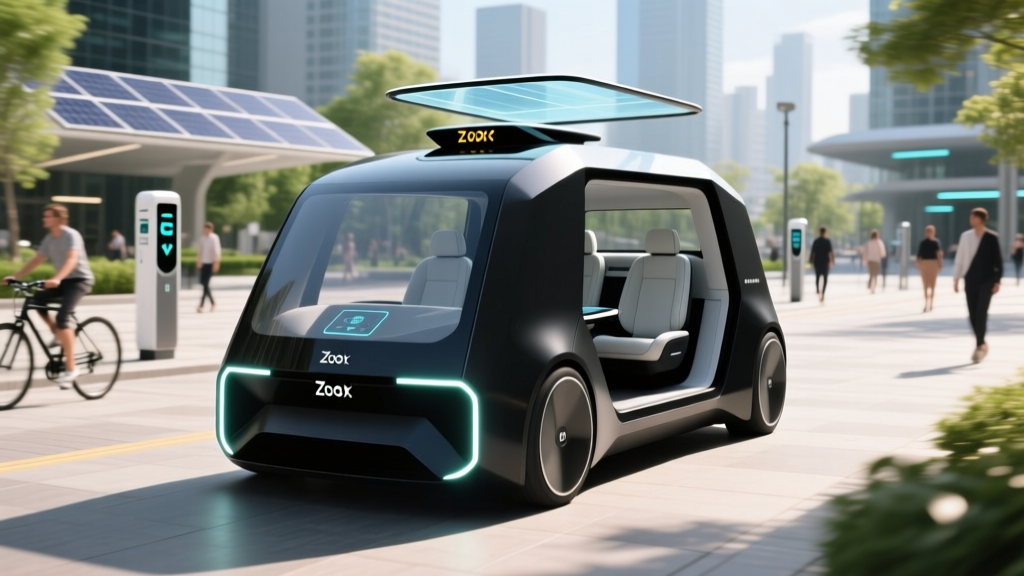
Zoox, the Amazon-owned autonomous vehicle company, has been steadily expanding its purpose-built robotaxi service across select U.S. cities. Unlike retrofitted rideshare vehicles, Zoox deploys a carriage-style vehicle with no steering wheel, pedals, or driver — a true SAE Level 4 driverless system. But for prospective riders, the most pressing question is practical: how much does a Zoox ride actually cost, and how does it compare to Uber or Lyft?
This guide breaks down everything you need to know about Zoox pricing, where you can hail a ride right now, the technology powering it, its safety record, and the real-world limitations that still apply.
Zoox Pricing: How Much Does a Ride Cost?
As of early 2026, Zoox operates primarily through its own app and offers rides at prices competitive with — and in many cases slightly below — comparable UberX or Lyft Standard fares in the same markets. Zoox has historically used promotional pricing and free-ride campaigns to build ridership in new launch cities, but its standard fare structure is now settling into a per-mile and per-minute model familiar to rideshare users.
| Service | Base Fare | Per-Mile Rate | Per-Minute Rate | Estimated 5-Mile Ride |
|---|---|---|---|---|
| Zoox Robotaxi | $2.00–$2.50 | $1.10–$1.40 | $0.25–$0.35 | $9–$13 |
| UberX | $2.50–$3.00 | $1.25–$1.60 | $0.30–$0.40 | $10–$15 |
| Lyft Standard | $2.50–$3.00 | $1.20–$1.55 | $0.28–$0.38 | $10–$15 |
| Waymo One | $2.00–$2.50 | $1.15–$1.50 | $0.28–$0.35 | $9–$14 |
Key pricing notes:
- Zoox fares do not include a tip line — there is no human driver to tip, which effectively reduces total trip cost by 15–20% compared to a tipped rideshare.
- Surge pricing exists during peak demand, though Zoox's fleet sizing in current markets has kept surge frequency lower than Uber/Lyft in the same zones.
- Zoox occasionally offers promotional credits for new riders in recently launched cities, sometimes making initial rides free or heavily discounted.
- All Zoox rides are currently single-passenger or small-group (up to 4 riders) in their compact carriage vehicle — there is no "XL" option.
For a typical 5-mile urban trip in Las Vegas or San Francisco, expect to pay roughly $9–$13 on Zoox, compared to $10–$15 on UberX or Lyft before tip. Over a month of regular commuting, the no-tip advantage alone can save riders $40–$80.
Where Can I Use Zoox Right Now?
Zoox's commercial service footprint has grown but remains geofenced to specific zones within a handful of cities. The company does not operate everywhere within a metro area — rides are confined to approved operational design domains (ODDs) that have been mapped and validated.
| City | Status | Service Zone | Hours |
|---|---|---|---|
| Las Vegas, NV | Commercial service (public) | Las Vegas Strip corridor, downtown, airport-adjacent areas | ~24/7 in core zones |
| San Francisco, CA | Commercial service (public) | Select neighborhoods including SoMa, Mission Bay, portions of downtown | Limited hours, expanding |
| Foster City, CA | Testing / limited access | Mapped suburban corridors | By invitation / employee access |
| Austin, TX | Testing phase | Central Austin geofenced zone | Not yet public |
| Atlanta, GA | Testing / mapping | Preliminary mapping phase | Not yet public |
If you are outside these zones, Zoox is not yet available to you. The company has stated plans for further expansion, but as of 2026, only Las Vegas and San Francisco offer open commercial rides to the general public through the Zoox app.
Is Zoox Truly Self-Driving? Understanding the SAE Level
Yes — Zoox is a genuine SAE Level 4 driverless system within its operational design domain. This is a critical distinction from consumer driver-assist features like Tesla Autopilot, Ford BlueCruise, or GM Super Cruise, which are all SAE Level 2 systems requiring continuous driver supervision.
| SAE Level | Name | Who Drives? | Examples |
|---|---|---|---|
| Level 0 | No Automation | Human does everything | Traditional vehicles |
| Level 1 | Driver Assistance | Human + one assist feature | Adaptive cruise OR lane-keep |
| Level 2 | Partial Automation | Human supervises combined features | Tesla Autopilot, FSD Supervised, BlueCruise, Super Cruise |
| Level 3 | Conditional Automation | System drives in specific conditions; human on standby | Mercedes Drive Pilot (limited markets) |
| Level 4 | High Automation | System drives fully within its ODD; no human needed | Zoox, Waymo One (geofenced areas) |
| Level 5 | Full Automation | System drives everywhere, all conditions | Does not yet exist commercially |
Bottom line: Zoox is Level 4 — fully driverless within its mapped service zones. There is no steering wheel, no pedals, and no human in the vehicle. This is fundamentally different from Level 2 driver-assist systems sold to consumers, which always require an attentive human driver behind the wheel.
Zoox Technology Stack: Sensors, Computing, and Vehicle Design
Zoox takes a sensor-heavy, redundant approach to autonomous perception — a deliberate contrast to Tesla's camera-only strategy. The Zoox vehicle (a compact, bidirectional carriage with facing bench seats) is designed from the ground up as a robotaxi, not a retrofitted consumer car.
Perception Hardware
- LiDAR: Multiple solid-state and spinning LiDAR units providing 360° 3D point-cloud mapping at ranges exceeding 150 meters. LiDAR gives precise depth data independent of lighting conditions.
- Cameras: A suite of high-resolution cameras covering all directions, used for object classification, traffic-light recognition, lane-marking detection, and sign reading.
- Radar: Forward and corner radar units for velocity detection of moving objects, functioning reliably in rain, fog, and other conditions where cameras and LiDAR can degrade.
- Microphones: External microphones to detect emergency vehicle sirens and other acoustic cues.
Computing and Software
- Onboard compute: Custom high-performance computing stack running Zoox's proprietary perception, prediction, and planning software. The system processes sensor fusion in real time.
- HD maps: Centimeter-accurate pre-built maps of every operational zone, updated regularly. The vehicle localizes itself within these maps continuously.
- Remote assistance: Zoox employs remote fleet monitors who can provide high-level guidance (e.g., rerouting around an unmapped construction zone) but do not "joystick" the vehicle in real time.
Vehicle Design
- Bidirectional — the vehicle can drive equally well in either direction, eliminating the need for three-point turns or backing up.
- Four-wheel steering for tight urban maneuvering (turning radius under 24 feet).
- Top speed limited to approximately 75 mph, though current geofenced deployments rarely exceed 35–45 mph.
- Battery-electric powertrain with estimated 70+ kWh usable capacity, sufficient for a full day of urban service operations before returning to a depot for charging.
Safety Record: What the Data Shows
Zoox publishes safety and disengagement data as required by the California DMV (for testing operations) and the National Highway Traffic Safety Administration (NHTSA). Here is what the available data indicates as of early 2026:
| Metric | Zoox Data |
|---|---|
| Total autonomous miles driven (cumulative) | Estimated 1M+ miles across testing and commercial operations |
| Disengagement rate (CA DMV reporting) | Approximately 1 disengagement per 5,000–8,000 autonomous miles (varies by reporting period) |
| At-fault collisions (reported to NHTSA) | Low single-digit incidents; most minor, low-speed contact events |
| Injuries in Zoox vehicles | No reported serious injuries to passengers or pedestrians as of early 2026 |
| Fleet size (operational) | Estimated 100–200+ vehicles across all markets |
For context, the human driver baseline in U.S. urban driving is roughly one police-reported crash per 500,000 miles, with about 1.3 fatalities per 100 million vehicle miles traveled (per NHTSA FARS data). Robotaxi operators including Zoox and Waymo have logged millions of combined autonomous miles with zero fatalities to date, though direct statistical comparison is complicated by the smaller sample size and geofenced, lower-speed operating environments.
Zoox's safety approach includes redundant braking, steering, and computing systems — if one system fails, a backup can bring the vehicle to a controlled stop. The vehicle's symmetrical design also means it can pull over in either direction, reducing the complexity of safe-stop maneuvers.
Regulatory Landscape: Who Approves Zoox Operations?
Deploying a driverless vehicle on public roads in the United States requires navigating a patchwork of state and federal regulations:
- Federal (NHTSA): The National Highway Traffic Safety Administration sets vehicle safety standards (FMVSS). Zoox received a notable exemption from NHTSA in 2024 to deploy its purpose-built vehicle, which lacks traditional controls like a steering wheel and mirrors. NHTSA also requires Standing General Orders for crash reporting from all ADS-equipped vehicles.
- California (DMV + CPUC): California requires a DMV-issued autonomous vehicle testing permit and a separate deployment permit. The California Public Utilities Commission (CPUC) issues permits for commercial passenger service. Zoox holds both testing and commercial deployment authorizations for San Francisco operations.
- Nevada (DMV + PUCN): Nevada was one of the first states to authorize autonomous vehicle testing and commercial deployment. Zoox's Las Vegas operations are authorized under Nevada's regulatory framework, which requires proof of insurance, safety validation, and operational reporting.
- Other states: Texas, Arizona, and Georgia have varying levels of autonomous vehicle legislation. Zoox's testing in Austin and Atlanta operates under those states' respective permits.
The regulatory environment remains active and evolving. Following high-profile incidents involving other robotaxi operators (notably Cruise's October 2023 pedestrian dragging incident in San Francisco), regulators in several states have increased scrutiny of ADS safety reporting, incident response times, and operational restrictions during emergencies.
Current Limitations: What Zoox Cannot Do Yet
Despite its Level 4 capability, Zoox operates under significant constraints that riders should understand before relying on the service:
- Geofenced zones only: The vehicle will not travel outside its pre-mapped operational design domain. If your destination falls outside the zone, Zoox cannot take you there — you will need to use a different service for the last leg.
- Weather restrictions: Heavy rain, dense fog, snow, and ice can degrade LiDAR and camera performance. Zoox may suspend or limit service during severe weather events. This is not unique to Zoox — Waymo and other operators have similar weather limitations.
- Construction and road changes: Unexpected lane closures, temporary traffic patterns, or unmapped construction can require remote assistance or cause the vehicle to stop and wait. In practice, this can add minutes to a trip.
- No highway driving: Current Zoox deployments are limited to surface streets at speeds up to ~45 mph. Airport runs that require freeway segments may not be possible depending on the route.
- Limited cargo: The carriage-style vehicle has bench seating for up to 4 passengers but minimal cargo space. It is not suitable for grocery runs, luggage-heavy airport trips, or moving items.
- Accessibility: Zoox has stated its vehicle is designed to accommodate wheelchair users, but real-world accessibility depends on curb infrastructure at pickup and dropoff points. ADA compliance in robotaxi operations remains an evolving area.
- No multi-stop trips: Current service is point-A to point-B only. You cannot add intermediate stops as you can with Uber or Lyft.
- Fleet availability: In newer markets or during peak demand, wait times can exceed 10–15 minutes as the fleet is still scaling.
Zoox vs. Waymo vs. Uber: Which Should You Choose?
If you are in a city where multiple options overlap, here is a practical decision framework:
Choose Zoox if: You are in Las Vegas or San Francisco's geofenced zone, want a novel driverless experience, value the no-tip pricing advantage, and your trip is a straightforward point-to-point ride within the service area.
Choose Waymo One if: You are in Phoenix, San Francisco, or Los Angeles and want the most mature Level 4 robotaxi network with the largest operational zones and longest track record of commercial service.
Choose Uber/Lyft if: You need to go outside robotaxi geofences, need an XL vehicle, are traveling with significant luggage, need multi-stop trips, or are in a city without robotaxi service.
Frequently Asked Questions
How do I request a Zoox ride?
Download the Zoox app (available on iOS and Android), create an account, and request a ride within a supported service zone. The app shows available pickup points, estimated wait time, and fare before you confirm. The vehicle arrives without a driver — you enter using a code or the app, and the ride begins automatically.
Can I ride Zoox in any city?
No. As of 2026, public commercial service is available in Las Vegas and San Francisco only. Testing operations occur in Foster City, Austin, and Atlanta, but those are not open to the general public. Expansion to additional cities has been announced but no firm dates have been confirmed.
Is a Zoox ride cheaper than Uber?
Generally yes, by a modest margin. The biggest savings come from the absence of a tip — since there is no driver, there is no tip expectation. A typical 5-mile Zoox ride costs $9–$13 compared to $10–$15 for UberX before tip. During surge periods, both services increase prices, though Zoox's surge frequency has been lower in its current markets.
What happens if the Zoox vehicle encounters a problem mid-ride?
The vehicle has redundant systems and is designed to execute a safe stop — pulling to the side of the road or stopping in place — if it detects a fault. Remote fleet monitors can assess the situation and either clear the vehicle to continue or dispatch roadside assistance. Passengers can contact support through the in-vehicle screen or the app at any time.
Does Zoox operate in bad weather?
Zoox may reduce or suspend service during heavy rain, dense fog, or other conditions that impair sensor performance. Light rain generally does not disrupt service. If conditions deteriorate during a ride, the vehicle may pull over safely and end the trip early. Always check the app for service status during inclement weather.
Is Zoox owned by Amazon?
Yes. Amazon acquired Zoox in June 2020 for approximately $1.3 billion. Zoox operates as an independent subsidiary. Amazon's logistics and cloud infrastructure (AWS) supports Zoox's fleet operations and computing needs, though Zoox's vehicle is designed for passenger rides, not package delivery.
Pricing, availability, and regulatory details are current as of early 2026 and subject to change. Always check the official Zoox app and zoox.com for the latest information before planning a ride.