Can You Actually Get a Zoox Pickup in Las Vegas Right Now?
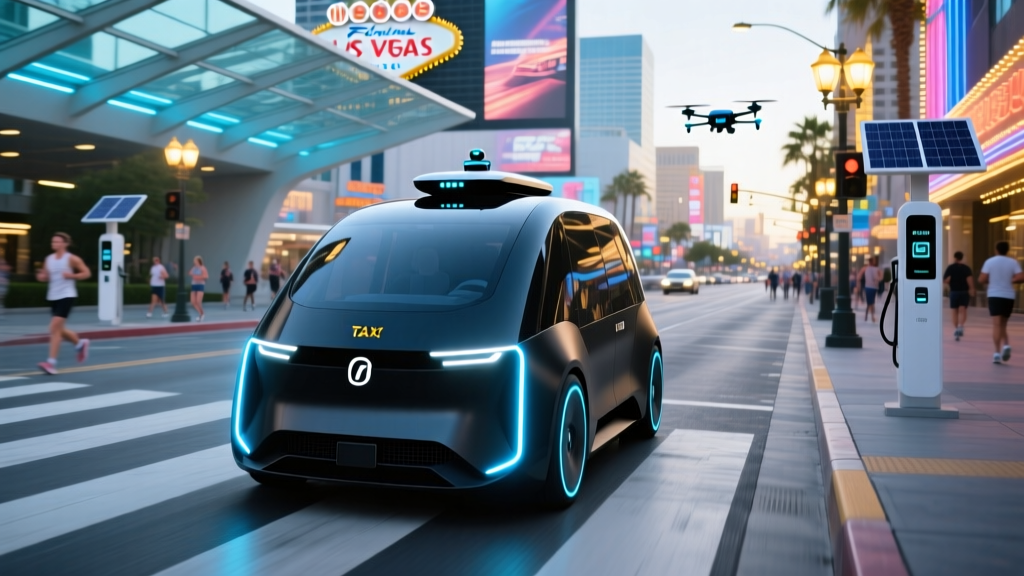
If you've been searching for a Zoox pickup Las Vegas ride, you're not alone. The Amazon-backed autonomous vehicle company selected Las Vegas as one of its first commercial markets, and the distinctive, steering-wheel-free Zoox carriage has become a recognizable sight on and around the Strip. But availability, access, and what the experience actually looks like in 2026 differ significantly from the marketing previews you may have seen.
This guide covers exactly where Zoox operates in Las Vegas today, how to request a ride, what it costs compared to traditional rideshare, the safety record backed by real data, and the hard limitations you need to know before relying on it for airport transfers or late-night hotel hops.
Zoox operates at SAE Level 4 — high automation within a defined operational design domain (ODD). There is no human driver in the vehicle, no steering wheel, and no pedals. The system handles all driving tasks within its geofenced service area. This is fundamentally different from Level 2 driver-assist systems like Tesla Autopilot or Ford BlueCruise, which require continuous human supervision. At Level 4, the vehicle is the driver — but only within approved zones and conditions.
Where Zoox Operates in Las Vegas (2026 Service Map)
Zoox's Las Vegas service area is a defined geofence covering high-density corridors rather than the entire metro area. As of early 2026, the operational zone includes:
| Zone | Coverage | Notes |
|---|---|---|
| Las Vegas Strip corridor | Mandalay Bay to The Strat | Primary zone; hotel pickup/dropoff at designated spots |
| Downtown / Fremont Street | Limited coverage area | Expanded in late 2025; check app for exact boundaries |
| Convention Center | Las Vegas Convention Center & surrounds | Active during major events (CES, SEMA) |
| Harry Reid International Airport (LAS) | Not yet available | Airport rideshare zones not yet approved for driverless ops |
| Suburbs (Summerlin, Henderson) | No coverage | Outside ODD geofence |
Key practical note: Zoox vehicles pick up and drop off at designated locations — typically hotel rideshare zones, specific street corners, or venue entrances. You cannot flag one down or request a mid-block stop. The app shows available pickup points when you enter your destination.
Zoox also operates in the San Francisco Bay Area (its headquarters market) and has been expanding testing in additional cities. For the latest official service map, check the Zoox ride page directly.
How to Request a Zoox Ride and What It Costs
Getting a Zoox pickup in Las Vegas works through the Zoox mobile app, available on iOS and Android. The process mirrors standard rideshare with a few differences:
- Download and verify: Create an account, verify your identity, and agree to the rider terms.
- Set your destination: Enter your pickup and dropoff. The app confirms both are within the geofenced service area.
- Wait for assignment: Zoox dispatches the nearest available carriage. Wait times typically run 3–8 minutes within the Strip corridor during operating hours.
- Board and go: The vehicle arrives, doors open automatically (or via app), and you select your seat. There's no driver to greet you — an in-cabin screen confirms your ride and provides a help button.
Operating hours in Las Vegas are not yet 24/7. Zoox typically runs from early morning through late evening, with exact hours varying by demand and regulatory approval. Check the app for current availability windows.
Zoox vs. Uber and Lyft: Pricing Comparison
| Service | Base Fare | 2-Mile Strip Ride (est.) | Surge Pricing | Tip Expected |
|---|---|---|---|---|
| Zoox | Competitive with rideshare | $8–$15 | Yes, during peak demand | No (no driver) |
| UberX | Standard | $10–$18 | Yes, frequent on Strip | Yes (15–20%) |
| Lyft Standard | Standard | $10–$17 | Yes, frequent on Strip | Yes (15–20%) |
| Waymo (SF/Phoenix — not Vegas) | Comparable | $8–$14 | Moderate | No |
Zoox has generally priced rides to be competitive with UberX and Lyft Standard, with the structural advantage of no driver tip. During Zoox's initial launch phases, the company has offered promotional pricing and free ride credits to build ridership. Exact fares appear in-app before you confirm your ride — there's no guessing.
The Zoox Vehicle: Purpose-Built, Not a Retrofit
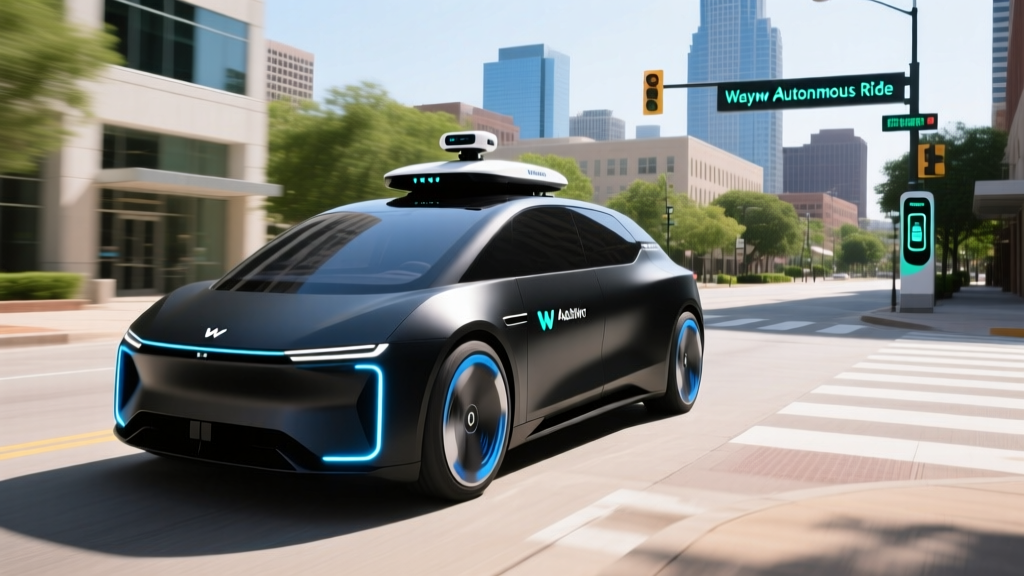
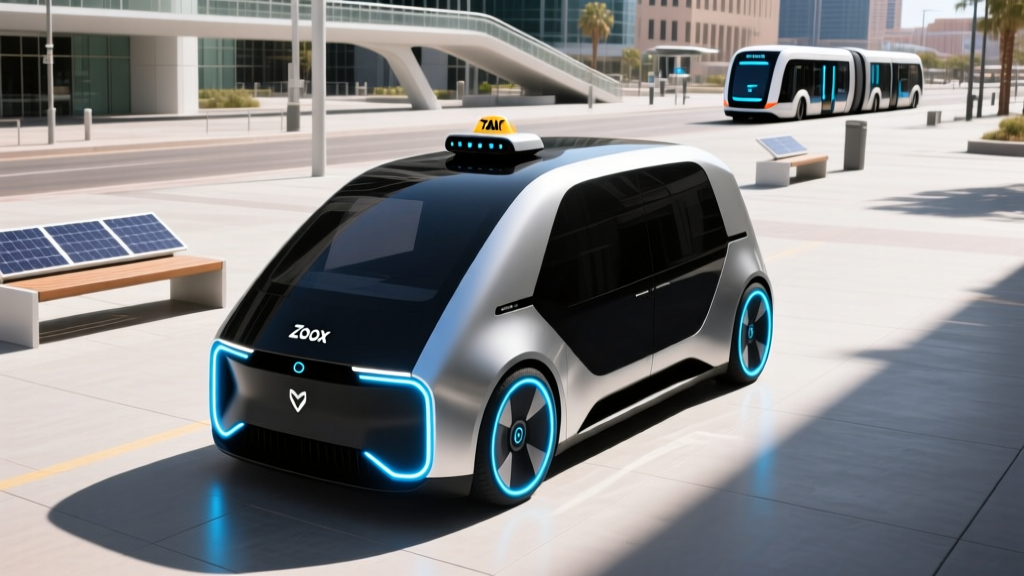
Unlike Waymo, which outfits Jaguar I-PACE SUVs and Chrysler Pacifica minivans with sensor arrays, Zoox designed its vehicle from the ground up as a robotaxi. The result is a compact, symmetrical carriage with no front or back — it can drive equally well in either direction.
- LiDAR: Multiple solid-state and spinning LiDAR units providing 360° 3D point-cloud mapping at range
- Cameras: High-resolution camera array covering all directions for object classification, traffic light state, and signage reading
- Radar: Forward and surround radar for velocity detection of other objects, especially in low-visibility conditions
- Compute: Onboard high-performance computing running Zoox's proprietary perception, prediction, and planning stack
- Connectivity: Cellular connection for remote assistance fallback (teleoperations support, not remote driving)
- Geofencing: HD-mapped operational domain — the vehicle will not operate outside its approved, pre-mapped zone
The multi-sensor approach contrasts with Tesla's camera-only FSD system. Zoox's LiDAR + camera + radar fusion provides redundancy: if one sensor modality degrades (camera glare, heavy rain on LiDAR), others compensate.
The cabin seats four passengers facing each other in a booth-style arrangement. There are no driver controls, no steering wheel, and no pedals. Each seat has a personal screen, climate controls, and a help button that connects to a remote support agent. The vehicle is fully electric — battery capacity and range figures have not been publicly detailed in the same way consumer EVs report EPA ratings, but the carriage is designed for continuous urban duty cycles with opportunity charging between shifts.
Safety Record: What the Data Shows
Robotaxi safety is the question every potential rider asks, and it deserves a data-driven answer rather than marketing reassurance.
- Miles driven (Zoox, all markets): Zoox has accumulated hundreds of thousands of driverless miles across its testing and commercial operations in Las Vegas and the Bay Area. Exact cumulative figures are reported to NHTSA and California DMV as required.
- Contact incidents: Zoox has reported minor low-speed contact events during testing and early operations — consistent with the industry-wide pattern where most robotaxi incidents involve other human-driven vehicles rear-ending or sideswiping the autonomous vehicle at low speeds.
- Disengagement/intervention rates: Zoox reports remote-assistance intervention data to regulators. Rates have trended downward as the system's software improves and the geofenced ODD is refined, but specific per-thousand-mile figures are updated periodically in regulatory filings.
- NHTSA Standing General Order: All Level 4 operators, including Zoox, are required under NHTSA's Standing General Order to report crashes involving ADS-equipped vehicles within 24 hours for serious incidents and monthly for all others.
For comparison context: Waymo, the most mature robotaxi operator in the US, has published peer-reviewed data showing its vehicles are involved in fewer injury-causing crashes per million miles than human benchmarks in the same urban environments. Zoox has not yet published equivalent comparative studies at the same scale, largely because its commercial fleet and mileage are smaller. The IIHS and NHTSA continue to monitor and evaluate ADS safety data as the industry scales.
What this means for riders: Zoox vehicles follow traffic laws strictly — they do not speed, they yield conservatively, and they will stop and wait rather than make an aggressive maneuver. This can make rides feel slower or more cautious than a human driver, particularly at complex intersections or during lane merges. That conservatism is a feature, not a bug, for safety.
Regulatory Landscape: Who Approves Robotaxi Operations?
Robotaxi deployment in the United States is governed by a patchwork of state and local authorities, not a single federal permit.
Nevada: The Nevada Department of Motor Vehicles (DMV) and the Nevada Legislature established the framework for autonomous vehicle testing and deployment. Nevada law permits driverless operations with appropriate testing permits and insurance requirements. Local jurisdictions (Clark County, the City of Las Vegas, and the City of Paradise, which encompasses much of the Strip) coordinate on operational details like pickup zones and traffic integration.
Federal (NHTSA): At the federal level, NHTSA regulates vehicle safety standards. Zoox received a notable exemption from certain Federal Motor Vehicle Safety Standards (FMVSS) that presuppose a human driver — things like mirrors, a steering wheel, and a traditional windshield. This exemption was necessary because the Zoox carriage, by design, has none of these.
California (comparison): In California, the DMV issues testing permits and the California Public Utilities Commission (CPUC) issues commercial deployment permits. Zoox holds permits in both states. The regulatory process is lengthy and requires demonstrating safety performance before expansion is approved.
Current Limitations: What Zoox Cannot Do (Yet)
- Geofence boundaries: The vehicle will not travel outside its mapped ODD. If your destination is outside the zone, the app will not let you book. There is no override.
- Airport service: Harry Reid International Airport does not currently permit driverless robotaxi pickups. You'll still need Uber, Lyft, or a taxi for airport transfers.
- Weather constraints: Las Vegas is generally favorable (dry, well-marked roads), but during heavy monsoon rain or dust storms, Zoox may suspend operations. LiDAR and camera performance degrades in heavy particulate conditions.
- Construction zones: Unexpected lane closures, temporary barriers, or unmapped construction can cause the vehicle to stop and request remote assistance. Expect occasional delays in rapidly changing road environments.
- Operating hours: Service is not 24/7. Late-night rides after clubs close may not be available depending on current operational windows.
- Accessibility: The Zoox carriage accommodates standard passengers, but wheelchair accessibility and accommodation for mobility devices may be limited compared to WAV (wheelchair-accessible vehicle) options on Uber/Lyft. Check with Zoox directly for ADA accommodation details.
- No multi-stop rides: You book point A to point B. Intermediate stops (grabbing a friend, picking up food) are not supported.
- Passenger capacity: Maximum four passengers. Larger groups need multiple vehicles or a traditional rideshare XL option.
How Zoox Compares to Waymo and Other Robotaxi Services
Zoox is not the only robotaxi option in the US, though it is the primary Level 4 driverless service available in Las Vegas. Here's how the major players compare nationally:
| Operator | SAE Level | Vehicle | Primary Markets | Driver Present? |
|---|---|---|---|---|
| Zoox | Level 4 | Zoox Carriage (purpose-built) | Las Vegas, San Francisco Bay Area | No |
| Waymo | Level 4 | Jaguar I-PACE, Chrysler Pacifica (retrofitted) | Phoenix, San Francisco, Los Angeles, Austin | No |
| Cruise | Level 4 | Chevrolet Bolt (retrofitted), Origin (announced) | Limited restart — Phoenix, Dallas (scaled back post-2023 incident) | No (where active) |
| Tesla (Robotaxi concept) | Level 2 (current FSD Supervised) | Model 3/Y (consumer vehicles) | Not commercially available as robotaxi | Yes — driver required |
The distinction between Zoox and Waymo is primarily in vehicle design: Zoox's purpose-built carriage offers a unique rider experience (facing seats, no driver area), while Waymo uses familiar production SUVs and minivans. Both operate at Level 4 with no driver, both use LiDAR-camera-radar fusion, and both are geofenced to approved zones.
Frequently Asked Questions
Is Zoox truly self-driving or is there a remote driver?
Zoox vehicles have no one in the driver's seat — no steering wheel, no pedals, no human behind the wheel. The vehicle drives itself using its onboard AI system within its approved geofence. Remote support agents can assist if the vehicle encounters a situation it cannot resolve (like an unmapped construction zone), but they do not "drive" the vehicle in real-time the way a teleoperation joystick might suggest. The remote agent can authorize a path or provide guidance, but the vehicle's own system executes the driving.
How much does a Zoox ride cost compared to Uber?
Zoox pricing is generally competitive with UberX and Lyft Standard for equivalent distances. A typical 2-mile ride along the Las Vegas Strip costs roughly $8–$15. The advantage over traditional rideshare is that there is no driver to tip, which can save 15–20% on the total fare. Surge pricing applies during high-demand periods.
Can I take a Zoox to the Las Vegas airport?
Not currently. Harry Reid International Airport (LAS) does not permit driverless robotaxi pickups or dropoffs as of early 2026. You'll need to use Uber, Lyft, a taxi, or the RTC transit system for airport transfers.
What happens if the Zoox vehicle gets confused or stops?
If the vehicle encounters a scenario it cannot resolve — an unusual obstruction, complex temporary construction, or an emergency situation — it will stop safely, and the onboard system will connect to a remote support agent. The agent can assess the situation and authorize a safe path forward. Each cabin has a help button for passengers to request assistance at any time. In an emergency, 911 can be contacted through the in-cabin system.
How safe are robotaxis compared to human drivers?
Published data from Waymo (the largest US robotaxi operator) indicates lower rates of injury-causing crashes per million miles compared to human benchmarks in equivalent urban environments. Zoox has not published equivalent peer-reviewed comparative data at the same scale due to smaller fleet size and fewer cumulative miles. Both operators are subject to NHTSA crash reporting requirements. Robotaxis follow traffic laws strictly and do not speed, drink, or text — but they can behave conservatively in ways that occasionally frustrate human drivers sharing the road.
Is Zoox available 24 hours a day?
No. Zoox operates during defined hours that vary by market and demand. In Las Vegas, service typically runs from early morning through late evening. Check the Zoox app for current operating hours, especially if you're planning rides after midnight.
Can I use Zoox if I use a wheelchair?
The Zoox carriage was designed with a low floor and wide-opening doors, but specific wheelchair accommodation and ADA compliance details should be confirmed directly with Zoox before relying on the service. Traditional rideshare WAV (wheelchair-accessible vehicle) options on Uber and Lyft may offer more guaranteed accessibility for mobility-device users.