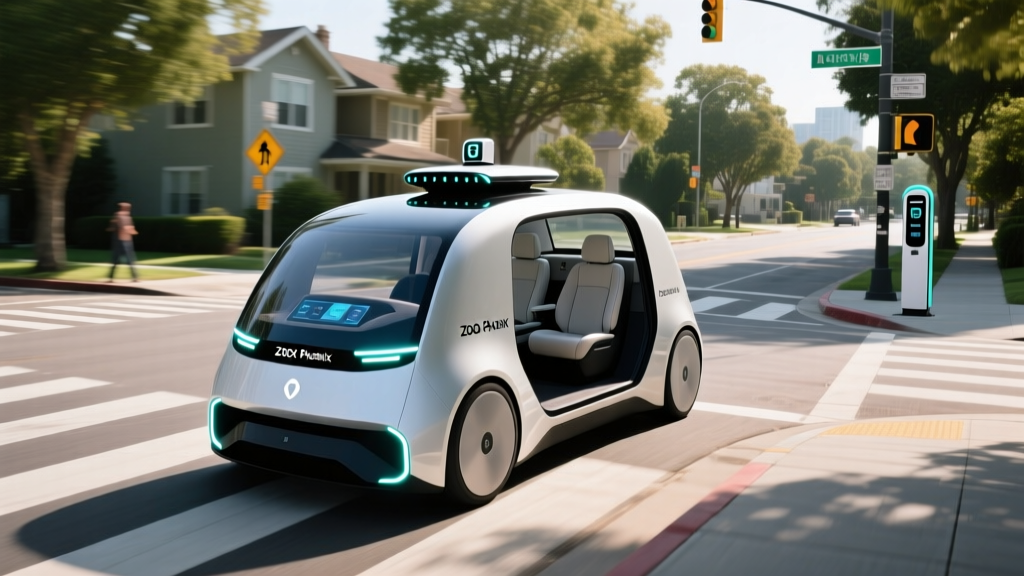
Amazon's Zoox has been steadily expanding its purpose-built robotaxi beyond its initial Las Vegas and California testing grounds, and Phoenix has emerged as a key market for the company's driverless ambitions. Unlike retrofitted SUVs from competitors, the Zoox vehicle is engineered from the ground up with no steering wheel, no pedals, and no driver's seat — a genuine Level 4 autonomous platform designed exclusively for passenger transport.
If you've searched for "Zoox Phoenix" wondering whether you can hail one today, how safe the service actually is, or what the ride experience costs compared to Uber and Lyft, this guide breaks down every detail with concrete data — not marketing promises.
What Is Zoox and What Autonomy Level Does It Operate At?
Zoox, acquired by Amazon in 2020 for approximately $1.3 billion, develops a fully integrated autonomous vehicle system — meaning the company designs both the vehicle hardware and the self-driving software stack together. The current Zoox vehicle is a compact, carriage-style robotaxi with bidirectional driving capability (it can move equally well in either direction), four-wheel steering, and a top speed of 75 mph.
Zoox operates at SAE Level 4, meaning the vehicle performs all driving tasks within its defined operational design domain (ODD) — specific geofenced areas under mapped conditions — with no human driver present and no expectation of passenger intervention. This is fundamentally different from Level 2 systems like Tesla Autopilot or GM Super Cruise, which require an attentive human driver behind the wheel at all times. Zoox passengers are riders, not drivers.
| Level | Name | Who Drives? | Example |
|---|---|---|---|
| Level 2 | Partial Automation | Human (hands may leave wheel briefly) | Tesla Autopilot, Ford BlueCruise |
| Level 3 | Conditional Automation | System (human must take over on request) | Mercedes DRIVE PILOT (limited markets) |
| Level 4 | High Automation | System (no human needed in ODD) | Zoox, Waymo One |
| Level 5 | Full Automation | System (everywhere, all conditions) | Does not exist commercially |
Where Can I Use the Zoox Robotaxi Service Right Now?
Zoox's commercial service availability has expanded incrementally, but access remains geofenced and limited compared to traditional rideshare. As of 2026, here is the current operational status by market:
| City | Status | Access Type | Notes |
|---|---|---|---|
| Las Vegas, NV | Operational | Invite-only / waitlist | Las Vegas Strip corridor; first commercial market |
| Foster City, CA | Operational | Employee / invite-only | Zoox HQ area; Bay Area testing zone |
| San Francisco, CA | Testing / limited rides | Restricted access | Permitted by CPUC for driverless testing |
| Phoenix, AZ | Testing / pre-commercial | Limited access | Active mapping and validation; public rides not yet broadly available |
| Austin, TX | Announced / testing | Not public | Expansion market; timeline TBD |
While Zoox has been actively testing and mapping roads in the Phoenix metropolitan area, a fully open, on-demand public robotaxi service comparable to Waymo One in Phoenix is not yet broadly available as of early 2026. Zoox's Phoenix operations are in the validation and pre-commercial phase. If you're in Phoenix and want a driverless robotaxi today, Waymo One remains the established option. Zoox access in Phoenix is currently limited to select participants and employees. Check the official Zoox website for the latest availability updates.
Zoox Technology Stack: Sensors, Computing, and the Purpose-Built Vehicle
The Zoox robotaxi differs fundamentally from competitors like Waymo (which retrofits Jaguar I-PACE SUVs) and Cruise (which used modified Chevrolet Bolts). Zoox designed its vehicle from scratch as a symmetric, bidirectional passenger pod. Here's what powers it:
Sensor Suite
- LiDAR: Multiple solid-state and spinning LiDAR units providing 360° 3D point-cloud mapping. LiDAR gives precise distance measurement independent of lighting conditions — a key advantage over camera-only approaches.
- Cameras: A comprehensive array of high-resolution cameras covering all directions for object classification, traffic-light recognition, lane detection, and semantic understanding.
- Radar: Long-range and short-range radar units for velocity detection, adverse-weather penetration, and redundancy.
- Microphones: External audio sensors to detect emergency vehicle sirens and other acoustic cues.
Compute and Software
- Onboard AI compute: Custom high-performance computing platform running Zoox's full perception, prediction, and planning stack in real time — no remote teleoperation for routine driving decisions.
- HD mapping: Centimeter-precision maps of every operational road, updated continuously. The vehicle localizes within these maps using LiDAR and visual odometry.
- Prediction engine: Machine-learning models trained on millions of miles of urban driving data to predict pedestrian, cyclist, and vehicle behavior.
Vehicle Specifications
- Configuration: 4 passengers, face-to-face seating, no steering wheel or pedals
- Drivetrain: All-electric, all-wheel drive with four-wheel steering
- Top speed: 75 mph
- Bidirectional: Can drive equally in either direction — no traditional "front" or "rear"
- Battery: Purpose-built pack designed for high-utilization fleet duty cycles (exact kWh not publicly disclosed)
The multi-sensor fusion approach — combining LiDAR, cameras, and radar — is the industry consensus for Level 4 safety redundancy. This contrasts with Tesla's camera-only FSD approach, which operates at Level 2 and still requires human supervision.
How Much Does Zoox Cost vs. Uber and Lyft?
Because Zoox's public service is still in limited rollout, comprehensive consumer pricing is not yet fully published the way Uber and Lyft display fares upfront. However, based on available data from early-access markets and Zoox's stated pricing strategy:
| Factor | Zoox (Current) | Waymo One (Phoenix) | Uber/Lyft |
|---|---|---|---|
| Pricing model | Free/subsidized during early access | Per-ride fare (comparable to UberX) | Dynamic surge pricing |
| Estimated per-mile cost (future) | Target: competitive with rideshare | ~$1.00–$1.50/mi | ~$1.00–$2.00/mi (varies by surge) |
| Tipping | No (no driver) | No (no driver) | Expected ($2–$5 typical) |
| Surge pricing | Not implemented | Minimal surge | Frequent during peak hours |
| Wait times | Limited fleet = longer waits | 3–8 min (Phoenix) | 2–10 min |
Zoox has indicated that its long-term pricing goal is to undercut traditional rideshare by eliminating the driver cost (which represents roughly 60–70% of a typical Uber/Lyft fare). During early-access phases in Las Vegas and California, rides have been offered free or at heavily subsidized rates to build ridership data and public familiarity. Expect formal per-ride pricing once Phoenix reaches full commercial launch.
Zoox Safety Record: What the Data Actually Shows
Safety is the single most scrutinized aspect of robotaxi operations. Here's what is publicly documented about Zoox's safety performance:
Zoox Safety Data Points
- Testing miles: Zoox has accumulated millions of autonomous testing miles across Nevada, California, and other markets. Exact cumulative figures are reported to NHTSA and the California DMV as required.
- Disengagement reports: In California, Zoox files annual disengagement reports with the DMV documenting how often a safety driver (during the testing phase) needed to take control. Zoox's disengagement rate has improved year-over-year, though it has historically trailed Waymo's rate per 1,000 miles.
- No reported at-fault collisions: As of early 2026, Zoox has not been involved in a publicly reported at-fault collision during driverless (no safety driver) operations. During earlier testing phases with safety drivers present, minor contact incidents were reported to regulators as required.
- NHTSA Standing General Order: Zoox is subject to NHTSA's Standing General Order requiring all ADS-equipped vehicle operators to report crashes within 24 hours. Check NHTSA's ADS crash reporting portal for the latest incident data.
- Vehicle safety design: The Zoox vehicle includes a proprietary airbag system designed for its face-to-face seating layout, a reinforced battery structure, and crumple zones engineered for bidirectional impacts.
For context, Waymo — the most established robotaxi operator — has published peer-reviewed data showing its vehicles are involved in injury-causing crashes at roughly 85% lower rates than human benchmarks in comparable urban environments. Zoox has not yet published equivalent peer-reviewed studies, which is a gap worth noting. The company's safety case rests heavily on its multi-sensor redundancy, extensive simulation testing (billions of simulated miles), and conservative operational design domain restrictions.
Current Limitations: What Zoox Cannot Do Yet
Level 4 autonomy is powerful but bounded. Here are the real, current limitations of the Zoox robotaxi system:
Operational Limitations
- Geofencing: Zoox vehicles operate only within pre-mapped, approved zones. You cannot hail a Zoox to a destination outside the geofence — the vehicle will not operate on unmapped roads.
- Weather restrictions: Heavy rain, flooding, dust storms (relevant in Phoenix's monsoon season), and reduced-visibility conditions can trigger service suspension or route avoidance. The system may pull over safely if conditions degrade beyond its ODD.
- Construction zones: While Zoox can handle some temporary lane shifts, major unmapped construction can cause the vehicle to stop and request remote guidance or reroute.
- Highway driving: Zoox's current operational profile focuses on urban and suburban surface streets. Highway operation at sustained high speeds is part of the vehicle's 75 mph capability but may not be enabled in all markets.
- No wheelchair accessibility: The current Zoox vehicle design does not accommodate wheelchair users — a significant accessibility gap that the company has acknowledged and stated it plans to address in future vehicle iterations.
- Limited fleet size: Even in operational markets, the number of Zoox vehicles on the road is small compared to Uber/Lyft driver pools, meaning longer wait times and limited coverage.
- Pets and extra cargo: The compact vehicle design accommodates four passengers with limited luggage space. Large items, pet carriers, or group sizes above four are not supported.
Phoenix-specific considerations include the summer monsoon season (July–September), which can produce sudden heavy rain, haboobs (dust storms), and flash flooding — conditions that challenge sensor systems and may cause service interruptions. The extreme summer heat (regularly exceeding 110°F) also impacts battery thermal management, though Zoox engineers have validated the vehicle for desert operating conditions.
Regulatory Landscape: Who Approves Zoox Operations?
Robotaxi deployment in the United States involves a patchwork of federal, state, and local regulators:
- Federal (NHTSA): The National Highway Traffic Safety Administration sets vehicle safety standards. Zoox received a special exemption from NHTSA to deploy its purpose-built vehicle, which doesn't meet certain standards written for human-driven cars (e.g., steering wheel and mirror requirements). NHTSA also mandates crash reporting via its Standing General Order.
- Arizona: Arizona has been one of the most permissive states for autonomous vehicle testing and deployment. Governor Doug Ducey's 2018 executive order established a framework for AV testing without a special permit requirement, though operators must meet insurance and reporting obligations. The Arizona Department of Transportation oversees AV operations.
- California (CPUC/DMV): In California, the Department of Motor Vehicles issues testing permits, while the California Public Utilities Commission (CPUC) regulates commercial passenger service. Zoox holds a CPUC permit for driverless testing — a prerequisite for commercial fares.
- Nevada: The Nevada DMV regulates AV testing and deployment. Zoox was among the first companies to receive approval for driverless commercial operations on the Las Vegas Strip corridor.
The regulatory environment remains dynamic. Following the Cruise robotaxi incident in San Francisco in late 2023 — where a Cruise vehicle dragged a pedestrian — several states and cities increased scrutiny of robotaxi operations. This regulatory tightening affected all operators, including Zoox, slowing expansion timelines industry-wide.
How to Actually Use the Zoox Service
For markets where Zoox is accepting riders (currently Las Vegas and limited California access), the process works as follows:
- Sign up: Download the Zoox app or join the waitlist at zoox.com. Access is currently invitation-based or waitlist-driven.
- Request a ride: Within the geofenced service area, enter your pickup and drop-off locations. The app confirms whether both points are within the operational zone.
- Vehicle arrival: The Zoox vehicle pulls to your location. There's no driver — the doors unlock automatically when the vehicle confirms it's safe to board.
- The ride: Face-to-face seating for up to four passengers. An in-vehicle screen displays the route, speed, and detected objects in real time. Riders can control climate and music. A "stop" button is available for emergencies.
- Completion: The vehicle arrives at your destination and doors unlock when stopped in a safe location.
The experience is notably different from a traditional rideshare: no driver conversation, no rating the driver, no tipping. The vehicle interior is designed for comfort and transparency — passengers can see the road from any seat and watch the autonomous system navigate in real time on the display.
Frequently Asked Questions
Is Zoox truly self-driving, or is there a remote human controlling it?
Zoox is genuinely self-driving within its operational domain. There is no remote human "joysticking" the vehicle in real time. The onboard AI handles all driving decisions. Zoox does employ remote assistance for edge cases — if the vehicle encounters an unusual situation it cannot resolve, a remote operator can provide high-level guidance (e.g., "proceed around the obstacle"), but this is not continuous remote driving.
Can I use Zoox in Phoenix right now?
Not broadly. As of early 2026, Zoox is in the testing and validation phase in Phoenix. Public on-demand rides are not yet available. Waymo One is the established driverless robotaxi option in the Phoenix metro area. Monitor the Zoox website for commercial launch announcements in Phoenix.
How does Zoox compare to Waymo in Phoenix?
Waymo One has been operating commercially in Phoenix since 2020 and covers a large geofenced area across the East Valley (Chandler, Tempe, Mesa, Scottsdale, and parts of Phoenix proper). Waymo uses retrofitted Jaguar I-PACE SUVs with a similar LiDAR-camera-radar sensor suite. Waymo has a far more established safety dataset, broader coverage, and open public access. Zoox's purpose-built vehicle offers a unique passenger experience (no steering wheel, face-to-face seating) but has a smaller operational footprint and less public riding data.
What happens if the Zoox vehicle encounters an emergency?
The vehicle is designed to execute a minimal-risk condition (MRC) — essentially pulling over safely — if it detects a system fault, encounters conditions beyond its capability, or if a passenger presses the stop button. Emergency services can be contacted through the in-vehicle system. Zoox maintains a fleet operations center that monitors vehicles in real time.
Is Zoox safe for solo riders at night?
Zoox vehicles operate with in-cabin cameras (for safety and security monitoring), a direct connection to the fleet operations center, and no human driver — eliminating the interpersonal safety concerns some riders experience with traditional rideshare. The vehicle will not deviate from its planned route, and all rides are logged and monitored.
How is Zoox funded, and will the service last?
Zoox is a wholly owned subsidiary of Amazon, which acquired the company in 2020 for approximately $1.3 billion and has invested substantially since. Amazon's financial backing provides long-term stability that independent startups lack, though Amazon's willingness to continue funding depends on Zoox demonstrating a path to commercial viability.
The Zoox Phoenix story is one of deliberate, methodical expansion rather than rapid rollout. The company's approach — building a custom vehicle, validating extensively before opening to the public, and expanding city by city — prioritizes safety over speed. For Phoenix residents eager to experience a true Level 4 robotaxi, Waymo One is the current option. Zoox's arrival as a broadly accessible service in Phoenix is a matter of when, not if — but "when" remains tied to regulatory approvals, validation milestones, and fleet scaling that the company has not yet put a public timeline on.