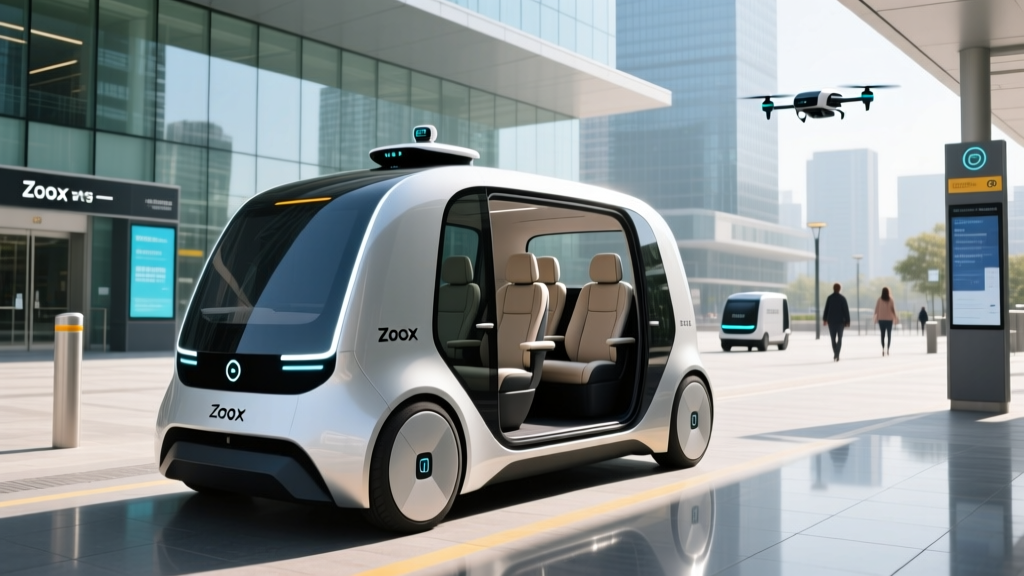
If you've seen a small, symmetrical, steering-wheel-free pod gliding through Las Vegas or San Francisco streets, you've likely spotted a Zoox robotaxi. The Amazon-owned autonomous vehicle company has been quietly expanding its driverless ride-hailing service, and one of the most common questions from prospective riders is simple: Zoox — how many passengers?
The short answer is four passengers, seated face-to-face in a carriage-style layout. But capacity is only part of the story. Whether you can actually hail one, what it costs, how safe the fleet really is, and what the vehicle's limitations look like in practice — that's where the details matter.
This guide breaks down everything current and prospective riders need to know about Zoox in 2026, from its SAE Level 4 autonomy credentials to real-world service availability and safety records.
Zoox Vehicle Specs: Passenger Capacity, Dimensions, and Design
The Zoox vehicle is a purpose-built robotaxi — not a retrofitted consumer car. It was engineered from the ground up for driverless ride-hailing, which explains its unusual proportions and bidirectional design.
| Specification | Detail |
|---|---|
| Passenger capacity | 4 (two forward-facing, two rear-facing) |
| Seating layout | Face-to-face carriage style, no driver seat |
| Steering wheel / pedals | None — fully driverless design |
| Doors | Power-sliding, one per side |
| Bidirectional driving | Yes — symmetrical front/rear, moves equally in either direction |
| Top speed | 75 mph (geofence-limited in service areas) |
| Battery | ~33 kWh usable (LFP chemistry, estimated) |
| Estimated range | ~60–80 miles per charge (city driving cycle) |
| Charging | DC fast charging; fleet depot charging between rides |
| Sensors | 360° lidar, cameras, radar — redundant perception stack |
| Wheelchair accessibility | Not currently available — a known limitation |
The four-passenger configuration means Zoox is best suited for small groups or individual riders. Unlike a Waymo-operated Jaguar I-PACE (which seats up to three passengers in a traditional layout with one front seat removed), Zoox's face-to-face arrangement maximizes social space but limits luggage room. Riders with large suitcases or more than four people will need a conventional rideshare.
SAE Automation Level: What Level 4 Really Means for Zoox
Zoox operates at SAE Level 4, meaning the vehicle handles all driving tasks within its defined operational design domain (ODD) — specific mapped areas under specific conditions — without any human driver onboard or remote intervention required for routine operations. There is no steering wheel, no pedals, and no expectation that a passenger will take control.
This is fundamentally different from SAE Level 2 systems like Tesla Autopilot, Ford BlueCruise, or GM Super Cruise, which require an attentive human driver ready to intervene at any moment. Zoox passengers are exactly that — passengers.
| Level | Name | Who Drives | Example |
|---|---|---|---|
| Level 2 | Partial Automation | Human (always) | Tesla Autopilot, BlueCruise |
| Level 3 | Conditional Automation | System in narrow conditions; human on standby | Mercedes DRIVE PILOT (limited markets) |
| Level 4 | High Automation | System fully (within ODD) | Zoox, Waymo |
| Level 5 | Full Automation | System everywhere, all conditions | Does not exist commercially |
The critical caveat: Level 4 does not mean "drives anywhere." Zoox's ODD is defined by its geofenced service areas, weather tolerances, and road-type limitations — all discussed below.
Where Can I Use Zoox Right Now? Service Availability in 2026
Zoox has been methodically expanding its operational footprint. As of early 2026, the service is live in the following areas, though availability within each city is limited to specific geofenced zones rather than citywide coverage.
| City / Region | Status | Service Area Notes |
|---|---|---|
| Las Vegas, NV | Live — public rides | Las Vegas Strip corridor and surrounding areas; expanded zone since 2024 launch |
| San Francisco, CA | Live — public rides | Select neighborhoods; phased expansion ongoing |
| Foster City, CA | Live — public rides | San Mateo County suburb; early testing ground now open to public |
| Los Angeles, CA | Testing / limited access | Not yet broadly open to public riders |
| Austin, TX | Testing | Pre-commercial operations |
| Atlanta, GA | Testing | Pre-commercial operations |
Riders in Las Vegas and the San Francisco Bay Area can currently request rides through the Zoox app. The Las Vegas deployment is the most mature, with service along the Strip and adjacent corridors making it practical for tourists and convention attendees.
Important: Service expansion timelines are subject to regulatory approval at both the state and federal level. Announced future cities should not be treated as live service areas. Always check the Zoox ride page for current availability.
How to Ride Zoox: App, Hailing, and Pricing vs. Uber and Lyft
Using Zoox is designed to feel like a conventional rideshare experience, with a few notable differences:
- Download the Zoox app (iOS/Android) and create an account.
- Set your pickup and drop-off within the geofenced service area.
- Wait for your vehicle — the app shows the approaching Zoox pod and identifies it by a unique marker.
- Unlock and board — the doors open automatically when the vehicle confirms your identity.
- Ride — interior screens show your route, and you can control climate and music.
Zoox Pricing Compared to Rideshare
Zoox has been offering rides at highly competitive rates — and in some markets during promotional periods, rides have been free or heavily subsidized as the company builds ridership data and public familiarity. As commercial pricing solidifies in 2026, here's how Zoox generally compares:
| Service | Estimated Fare Range | Surge Pricing | Tipping |
|---|---|---|---|
| Zoox | $0–$12 (promotional/commercial rates vary by market) | Not currently implemented | No driver to tip |
| UberX | $10–$22 | Yes — can 1.5x–3x during peak | Expected (15–20%) |
| Lyft | $10–$20 | Yes — Prime Time pricing | Expected (15–20%) |
| Waymo One | $8–$18 | Yes — wait-time and demand pricing | No driver to tip |
The no-tip, no-surge structure is a meaningful advantage for robotaxi services. A $10 Zoox ride stays $10 regardless of whether it's Friday night on the Strip. However, availability is limited by fleet size — you may experience longer wait times than Uber or Lyft during peak demand.
Safety Record: What the Data Actually Shows
Robotaxi safety records are reported to the National Highway Traffic Safety Administration (NHTSA) and, in California, to the DMV via disengagement and collision reports. Zoox's fleet has accumulated millions of driverless miles, but its total mileage remains significantly smaller than Waymo's 30+ million autonomous miles.
Evaluating robotaxi safety requires nuance. Here's what we know about Zoox's safety profile:
- No human driver onboard: All reported miles are fully driverless (Level 4), meaning safety data reflects the autonomous system's performance without a human safety net.
- Low-speed urban operations: Zoox primarily operates at speeds under 45 mph in mapped urban environments, which reduces crash severity when incidents do occur.
- Conservative driving behavior: The system is programmed for cautious maneuvers — yielding liberally, maintaining following distance, and pulling over when uncertain.
- NHTSA Standing General Order: Zoox, like all ADS operators, is required to report crashes involving their vehicles. Public NHTSA data has shown Zoox incidents to be predominantly low-severity, low-speed contacts — often rear-end collisions where the Zoox vehicle was stationary or moving slowly and was struck by a human-driven vehicle.
- California DMV disengagement reports: In California testing phases, Zoox reported disengagement rates (instances where a remote operator or system intervention was needed) that improved year-over-year, though direct comparison across companies is unreliable due to differing ODD definitions and reporting methodologies.
Context matters: Human drivers in the U.S. experience roughly 5.5 police-reported crashes per million vehicle miles (per IIHS data). Robotaxis operate in dense urban environments where minor contact rates are inherently higher, and they report incidents more rigorously than human drivers. Direct apples-to-apples comparison remains an open challenge in the industry.
Technology Stack: How Zoox Sees and Navigates the World
Zoox uses a sensor-fusion approach to perception — meaning it combines multiple sensor types rather than relying on a single modality. This stands in contrast to Tesla's camera-only ("Tesla Vision") approach for its FSD system.
- Lidar: Multiple lidar units provide 360° 3D point-cloud mapping of the environment, accurate to centimeter resolution. Lidar excels at precise distance measurement regardless of lighting.
- Cameras: High-resolution camera arrays provide color, texture, and sign/traffic-light recognition — information lidar alone cannot provide.
- Radar: Radar sensors detect object velocity and perform reliably in rain, fog, and other conditions where lidar and cameras degrade.
- HD Maps: Zoox pre-maps every inch of its service area at centimeter-level accuracy. The vehicle localizes itself within this map in real time.
- Redundant compute: Dual computing platforms ensure that if one system fails, the other can bring the vehicle to a safe stop.
- Geofencing: The vehicle will only operate within its validated, pre-mapped ODD. If it approaches the geofence boundary, it will not proceed.
This multi-sensor redundancy is a hallmark of Level 4 robotaxi design. Each sensor compensates for the others' weaknesses: lidar for precision distance, cameras for semantic understanding, radar for velocity and weather resilience. The trade-off is cost — a Zoox vehicle's sensor suite and compute hardware likely add tens of thousands of dollars to the unit cost compared to a camera-only approach.
Current Limitations: What Zoox Cannot Do
Level 4 autonomy is powerful but bounded. Zoox riders should understand these real-world constraints before relying on the service:
- Geofence boundaries: You cannot hail a Zoox to or from locations outside the mapped service area. If your destination is 200 feet past the geofence, the vehicle will not go there.
- Weather restrictions: Heavy rain, flooding, snow, and dense fog can exceed the system's ODD. Zoox may suspend service or restrict routes during severe weather — unlike a human driver who can push through with caution.
- No highway driving: Zoox operates on surface streets within its service zones. Airport runs or interstate commutes are not supported.
- Wheelchair inaccessibility: The current Zoox vehicle does not accommodate wheelchair users, a significant gap that the company has acknowledged but not yet resolved in production vehicles.
- Limited cargo space: With four passengers and no trunk, luggage capacity is minimal. This is a people-mover, not a cargo hauler.
- Construction zones and edge cases: Unexpected road configurations, temporary detours, or unmapped construction can cause the vehicle to stop and request remote guidance or reroute.
- Fleet size and wait times: Zoox fleets are small compared to Uber/Lyft driver networks. Wait times of 10–20+ minutes are common, especially outside peak deployment hours.
- No stops or multi-destination trips: Unlike Uber, you generally cannot add a stop along the way. It's point A to point B within the geofence.
Regulatory Landscape: Who Approves Zoox Operations?
Robotaxi operations in the U.S. sit at the intersection of federal and state regulation, and the framework is still evolving:
- NHTSA (federal): Oversees vehicle safety standards. Zoox received an exemption from certain Federal Motor Vehicle Safety Standards (FMVSS) that assume a human driver — things like steering wheels, mirrors, and pedals. This exemption is necessary for the vehicle's driverless design to be street-legal.
- State DMVs and PUCs: In California, the DMV issues testing permits, while the California Public Utilities Commission (CPUC) authorizes commercial ride-hailing operations. Zoox holds the necessary permits for both testing and commercial service in its California markets.
- Nevada: Nevada's regulatory framework for autonomous vehicles is among the most permissive in the country, which partly explains why Las Vegas was Zoox's first major public deployment city.
- Local municipalities: City governments and transportation authorities can influence where robotaxis operate through permitting, lane restrictions, and pickup/dropoff zone designations.
The regulatory environment remains fragmented. A robotaxi company approved in California may need entirely separate approvals to operate in Texas or Georgia, and each jurisdiction's political appetite for driverless vehicles varies considerably.
Zoox vs. Waymo: A Quick Robotaxi Comparison
| Attribute | Zoox | Waymo One |
|---|---|---|
| Vehicle | Purpose-built Zoox pod (no steering wheel) | Jaguar I-PACE (retrofitted SUV) |
| Passenger capacity | 4 | 3 (front passenger seat blocked) |
| SAE Level | Level 4 | Level 4 |
| Live service cities | Las Vegas, San Francisco, Foster City | Phoenix, San Francisco, Los Angeles, Austin |
| Total driverless miles (est.) | Millions (smaller fleet) | 30+ million |
| Highway capable | No | Limited (some highway segments) |
| Pricing model | Competitive/promotional | Comparable to UberX/Lyft |
| Parent company | Amazon | Alphabet (Google) |
Waymo has a substantial head start in fleet size, total miles driven, and city coverage. Zoox differentiates with its purpose-built vehicle — designed for passenger comfort rather than retrofitting a consumer SUV — and Amazon's logistics and capital resources backing the operation.
Frequently Asked Questions
How many passengers can a Zoox robotaxi hold?
Four passengers, seated face-to-face in a carriage-style layout. There is no driver seat, steering wheel, or pedals. All four seats are for riders.
Is Zoox truly self-driving or is there a remote human controlling it?
Zoox operates at SAE Level 4, meaning the vehicle drives itself fully within its geofenced service area with no human driver onboard. Remote fleet operators can provide guidance in unusual situations (like an unexpected road closure), but they do not "joystick" the vehicle in real time. The AI handles all routine driving.
How much does a Zoox ride cost compared to Uber or Lyft?
Zoox has offered free or heavily discounted rides during its launch phases. As commercial pricing matures, fares are expected to be competitive with or slightly below UberX/Lyft rates, with the added advantage of no surge pricing and no tipping. Exact pricing varies by market.
Where can I ride a Zoox robotaxi in 2026?
Public rides are currently available in Las Vegas (Strip corridor), San Francisco (select neighborhoods), and Foster City, California. Testing operations are underway in Los Angeles, Austin, and Atlanta, but these are not yet open to general public riders.
How safe are Zoox robotaxis?
Zoox vehicles have accumulated millions of driverless miles with a safety record consisting primarily of low-severity, low-speed incidents — often being rear-ended by human drivers while stationary. The system is designed for conservative, defensive driving. Full safety data is reported to NHTSA under the Standing General Order for ADS-equipped vehicles.
Can Zoox drive in rain or bad weather?
Zoox can handle light rain, but the service may be restricted or suspended during heavy rain, flooding, snow, or dense fog. The vehicle's ODD defines weather boundaries, and the system will not operate outside them — unlike a human driver who can choose to proceed with caution.
Can I bring luggage or a car seat in a Zoox?
Luggage space is very limited with four passengers aboard — think backpacks or small bags, not suitcases. Child car seat compatibility has not been broadly established. For airport runs with luggage, a conventional rideshare remains the practical choice.
Is Zoox available 24/7?
Service hours vary by market and are not necessarily round-the-clock. Check the Zoox app for current operating hours in your city.