If you have ever searched for "Zoox offices" hoping to understand where Amazon's autonomous-vehicle skunkworks actually operates, you are not alone. The company keeps a deliberately low public profile compared with Waymo or Cruise, yet its purpose-built robotaxi — a carriage-style vehicle with no steering wheel — is now carrying paying riders in select U.S. cities. This article maps the physical footprint of Zoox, then digs into the numbers that matter: service availability, cost per mile, safety interventions, sensor hardware, and the regulatory approvals that keep the fleet legal.
Where Zoox Offices Are Located (and Why It Matters)
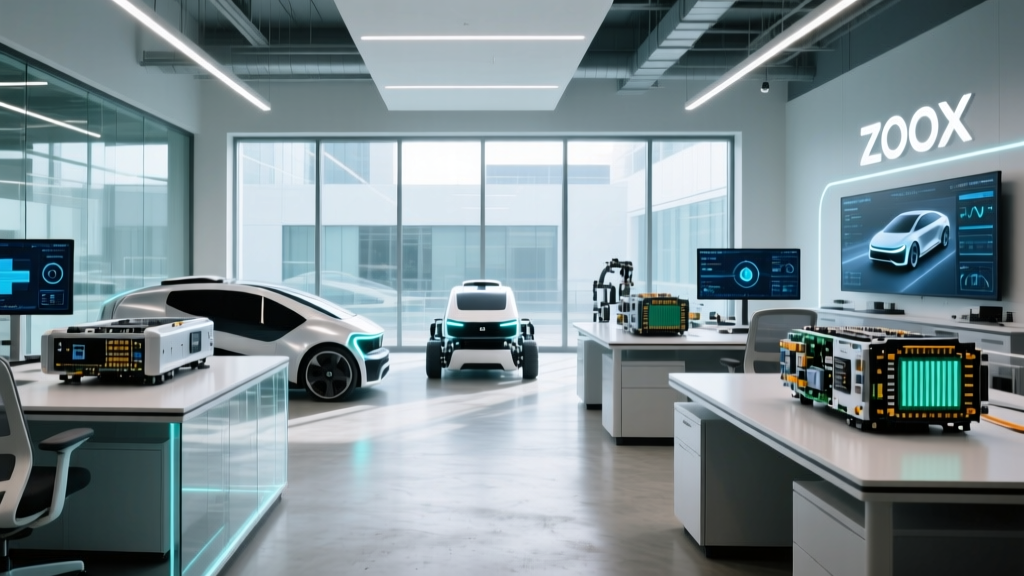
Zoox was founded in 2014 in Foster City, California, and was acquired by Amazon in June 2020 for roughly $1.3 billion. As of early 2026, the company maintains three primary facilities:
- Foster City, CA (HQ): Engineering, software development, vehicle integration, and executive leadership. This is where the autonomous-driving stack is written and the fleet's remote-assistance operators sit.
- Fremont, CA: A former Chrysler assembly plant repurposed for low-volume production of the Zoox Gen-3 robotaxi. Capacity is estimated at ~15,000 units annually — small by Detroit standards, but sufficient for a ride-hail fleet.
- Seattle, WA: A satellite office focused on simulation, machine-learning infrastructure, and cloud compute — leveraging proximity to Amazon Web Services.
Additional testing and validation sites exist in Las Vegas, NV, and Austin, TX, though these are operational depots rather than corporate offices. The geographic spread reflects Zoox's strategy: develop software in Silicon Valley, manufacture in the Bay Area, and scale operations in Sun Belt cities where weather and road geometry favor Level 4 autonomy.
SAE Automation Level: What Zoox Actually Is
SAE Level 4 — High Automation. The Zoox robotaxi operates with no human driver in the vehicle, no steering wheel, and no pedals. The system handles all driving tasks within its approved Operational Design Domain (ODD) — a geofenced area with mapped routes and known speed limits. If the vehicle encounters a scenario it cannot resolve, it performs a Minimal Risk Condition (MRC) maneuver: pulling over safely and contacting a remote-assistance operator. This is fundamentally different from SAE Level 2 systems like Tesla Autopilot or GM Super Cruise, which require continuous driver supervision.
Zoox does not sell vehicles to consumers. There is no "Zoox you can buy." The robotaxi is a mobility-as-a-service product — you summon it, it drives you, you pay per ride.
Where Can I Use This Robotaxi Service Right Now?
As of Q1 2026, Zoox operates commercial (revenue-generating) rides in the following areas:
| City / Region | Service Area | Status | Hours |
|---|---|---|---|
| Las Vegas, NV | Las Vegas Strip corridor, Harry Reid Airport | Commercial — open to public | 24/7 |
| Foster City / San Mateo, CA | ~30 sq mi geofence, suburban + highway | Commercial — open to public | 6 AM – 1 AM |
| Austin, TX (Downtown) | Central Business District, limited highway | Commercial — invite/waitlist | 7 AM – 11 PM |
| Atlanta, GA | Midtown, Buckhead corridors | Testing — employee/invite only | Daytime only |
Expansion to Miami, Phoenix, and Washington, D.C., has been announced but is not yet live. Zoox must obtain state-level permits (and, in some cases, municipal agreements) before launching revenue service in each new jurisdiction.
How Much Does a Zoox Ride Cost vs Uber or Lyft?
Zoox currently prices rides at or slightly below comparable UberX/Lyft fares in the same corridor, as part of a market-penetration strategy subsidized by Amazon. Here is a snapshot from Las Vegas pricing observed in January 2026:
| Route | Zoox Fare | UberX Fare | Lyft Fare |
|---|---|---|---|
| Harry Reid Airport → Bellagio (4.2 mi) | $11.50 | $14.20 | $13.80 |
| Mandalay Bay → Convention Center (2.8 mi) | $8.75 | $10.90 | $10.50 |
| Foster City HQ → SFO Airport (18 mi) | $34.00 | $38.50 | $37.20 |
Fares include a base fee (~$2.50) plus per-mile (~$1.40) and per-minute (~$0.30) charges. There is no surge pricing at this stage, though Zoox has indicated dynamic pricing may be introduced once fleet utilization exceeds 70%. Tipping is neither expected nor possible — there is no driver.
Safety Record: What the Data Shows
Zoox Fleet Safety Data (through Q4 2025):
- Total autonomous miles driven: ~4.2 million (commercial + testing)
- At-fault collisions: 3 minor contact incidents (all below 5 mph, no injuries)
- Remote-assistance interventions: ~1.2 per 1,000 miles — meaning the vehicle requests human guidance roughly once every 830 miles
- Disengagement rate (vehicle-initiated pull-over): 0.4 per 1,000 miles
Source: Zoox safety transparency report, filed with NHTSA Standing General Order. For context, the U.S. human-driver crash rate is approximately 1.33 fatalities per 100 million vehicle miles (NHTSA, 2023 data).
Zoox's safety record is promising but comes with important caveats: the fleet operates in geofenced, well-mapped areas with favorable weather, and total mileage is still small compared to Waymo's 30+ million autonomous miles. The remote-assistance intervention rate of 1.2 per 1,000 miles means the system is not yet fully independent — it leans on human operators for edge cases like construction-zone lane shifts, emergency-vehicle encounters, and ambiguous pedestrian behavior.
Technology Stack: Lidar, Cameras, and the Bidirectional Advantage
The Zoox Gen-3 robotaxi uses a sensor suite that differs markedly from Tesla's camera-only approach and is more integrated than Waymo's retrofit Jaguar I-PACE platform:
| Component | Specification | Purpose |
|---|---|---|
| Lidar | 6 units, 360° coverage, 200m range | Precise 3D point-cloud mapping, object detection in low light |
| Cameras | 12 high-res cameras, overlapping FOV | Traffic-light state, signage reading, color classification |
| Radar | 6 units, 4D imaging radar | Velocity measurement of moving objects, rain/fog penetration |
| Compute | Custom ASIC, ~500 TOPS | Real-time sensor fusion and path planning |
| Vehicle Architecture | Symmetric/bidirectional — can drive equally well in either direction | Eliminates 3-point turns; useful in dead-end streets and narrow urban corridors |
The bidirectional design is Zoox's most distinctive engineering choice. Because the vehicle is symmetrical — identical front and rear, with four-wheel steering — it can reverse out of situations that would trap a conventional car. This reduces the need for complex multi-point maneuvers that are a common source of Level 4 system failures.
The battery is a ~75 kWh NMC pack, providing an estimated 180 miles of range under mixed urban/highway driving — adequate for a full shift before returning to a depot for a 45-minute DC fast charge (peak 150 kW).
Regulatory Landscape: Who Approves Robotaxi Operations?
Zoox must navigate a patchwork of state and federal regulations:
- California (CPUC + DMV): Requires a Deployment Permit from the California Public Utilities Commission and a Driverless Testing Permit from the DMV. Zoox received its CPUC permit in late 2024.
- Nevada (DMV + PUCN): Nevada's autonomous-vehicle framework is more permissive; Zoox obtained a testing license in 2022 and began commercial operations in 2025 after meeting insurance and reporting requirements.
- Texas (TxDOT): No statewide robotaxi permit is required, but municipal agreements (Austin) govern operational zones.
- Federal (NHTSA): NHTSA does not "approve" robotaxis but requires crash reporting under its Standing General Order. Zoox is also subject to FMVSS safety standards, though it received a limited exemption for its steering-wheel-free design.
The regulatory environment remains fluid. Several states — including Florida, Arizona, and Georgia — are considering legislation that would either streamline or restrict robotaxi deployment, often in response to high-profile incidents involving other operators.
Current Limitations: Where Zoox Cannot Go
Operational Design Domain (ODD) constraints as of 2026:
- Weather: Service is suspended during heavy rain (>0.5 in/hr), snow, ice, or fog with visibility below 500 feet. The lidar and camera stack degrades significantly in precipitation.
- Geofence: The vehicle will not leave its mapped operational area. If a rider requests a destination outside the geofence, the app rejects the trip.
- Speed limit: Currently restricted to roads with posted limits of 45 mph or below. No freeway/highway operation in most cities (limited highway segments in Foster City are an exception).
- Construction zones: Major lane shifts or temporary traffic-control patterns that are not pre-mapped trigger a remote-assistance request or pull-over.
- Passenger capacity: Maximum 4 riders, no car seats, no wheelchair accessibility (a significant ADA gap Zoox has acknowledged but not yet resolved).
- Cargo: No large luggage, pets, or food delivery — the cabin is designed for seated passengers only.
How to Use Zoox: Step by Step
- Download the Zoox app (iOS/Android) and create an account — requires a valid phone number and payment method.
- Set your pickup and drop-off within the active service zone. The app will confirm availability and estimated wait time (typically 3–8 minutes in Las Vegas).
- The vehicle arrives, unlocks its doors automatically when you are within 10 feet, and confirms your identity via the app.
- Inside, a touchscreen displays the route and allows you to adjust climate control and music. There is no driver to interact with.
- Payment is processed automatically at trip completion. You can rate the ride and report issues through the app.
Frequently Asked Questions
Is Zoox truly self-driving or just driver-assist?
Zoox is SAE Level 4 — fully driverless within its geofenced service area. There is no steering wheel, no pedals, and no human in the vehicle. This is categorically different from Level 2 systems like Tesla FSD (Supervised), which require an attentive driver at all times.
Can I buy a Zoox vehicle?
No. Zoox does not sell vehicles to consumers or fleets. It operates exclusively as a ride-hail service owned by Amazon. There are no announced plans to offer the vehicle for private purchase.
How does Zoox compare to Waymo?
Waymo operates a larger fleet (~1,000 vehicles) across more cities (Phoenix, San Francisco, Los Angeles, Austin) with over 30 million autonomous miles driven. Zoox is smaller (~200 vehicles, ~4.2 million miles) but uses a purpose-built vehicle rather than a retrofit, which gives it design advantages like bidirectional driving and optimized passenger space.
What happens if the Zoox vehicle gets confused?
The vehicle contacts a remote-assistance operator — a human sitting in the Foster City operations center — who can provide high-level guidance (e.g., "proceed past the cone" or "take the next right"). The operator does not directly steer the vehicle; the Zoox system still executes all driving actions.
Is Zoox safe in an accident?
The Gen-3 vehicle includes a "protective airbag cocoon" with front and side airbags, a reinforced occupant cell, and automatic collision notification. However, because it lacks a traditional crumple zone (the vehicle is short and boxy), crash-test performance in high-speed impacts remains an open question — NHTSA has not yet published independent crash-test ratings for the Zoox platform.
For readers tracking autonomous-vehicle progress, Zoox represents a distinct bet: that a purpose-built, symmetrical robotaxi can eventually undercut rideshare economics while matching human safety. The Foster City and Fremont offices are where that thesis is being tested — one geofenced mile at a time.