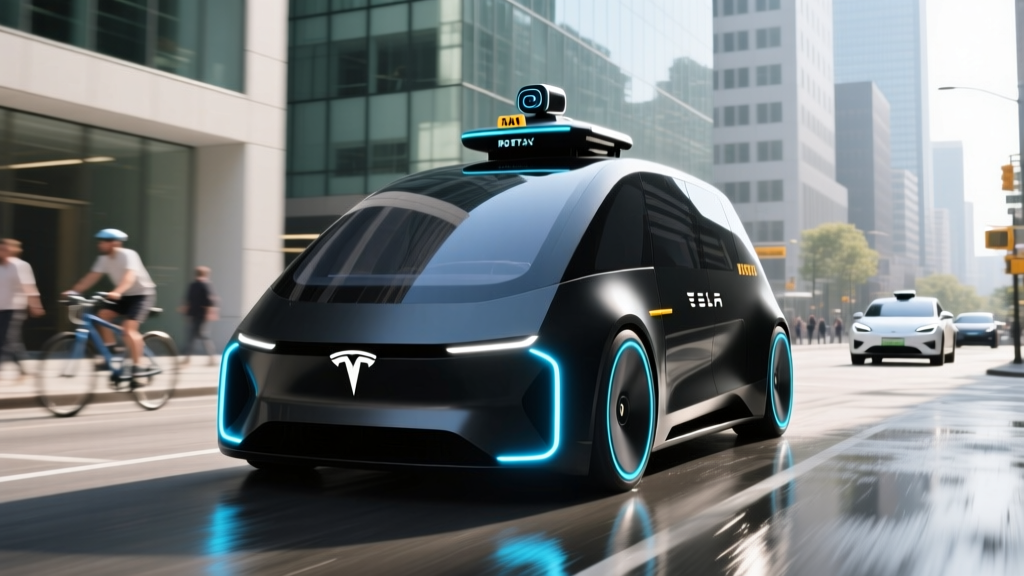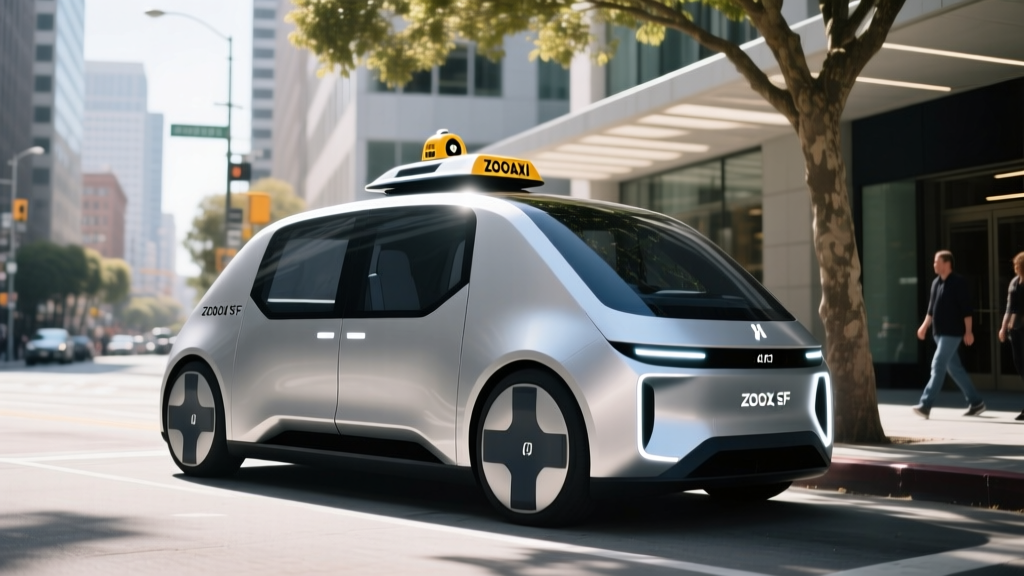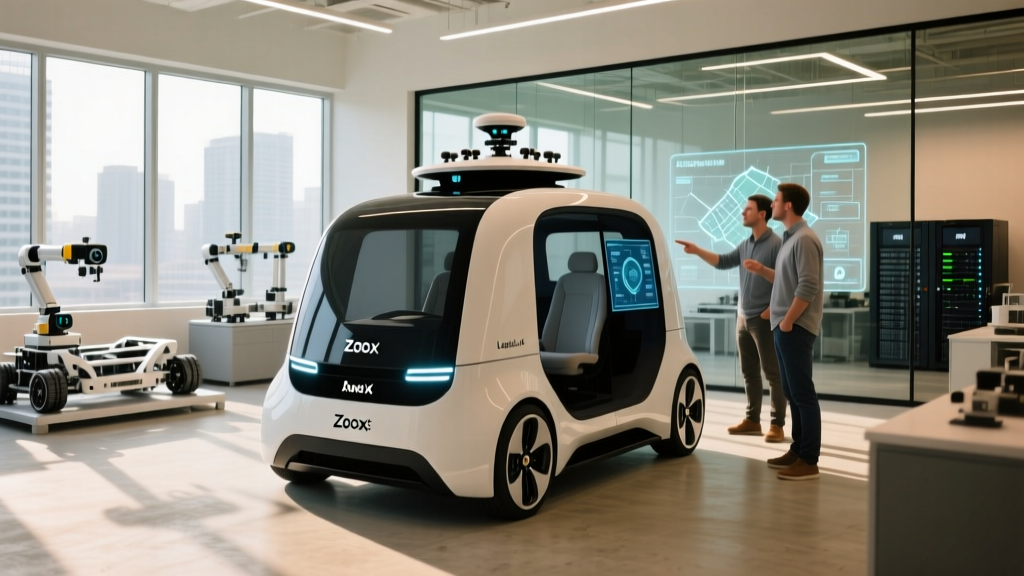
When people search for the Zoox office, they're usually trying to understand one of two things: where the Amazon-backed robotaxi company is physically headquartered, or — more importantly — what kind of autonomous-driving engineering is actually happening inside those walls. As of early 2026, Zoox operates from a primary campus in Foster City, California, with additional engineering and testing footprints across the Bay Area and beyond. But the real story isn't the real estate; it's the purpose-built, bidirectional, Level 4 robotaxi that Zoox has been developing, testing, and now deploying for public riders.
This guide breaks down what Zoox's office operations actually produce: the vehicle platform, the sensor suite, the safety record, the cities where you can hail a ride today, and the regulatory framework that governs every mile. If you're evaluating robotaxi services or tracking the autonomous-vehicle industry, this is the operational picture as of 2026.
Where the Zoox Office Is Located and What Happens There
Zoox was founded in 2014 and acquired by Amazon in 2020 for approximately $1.3 billion. The company's headquarters remains in Foster City, California, a peninsula city roughly halfway between San Francisco and San Jose. This is where the bulk of Zoox's software engineering, vehicle design, simulation, and fleet-operations teams are based.
Beyond the Foster City HQ, Zoox maintains testing and operations facilities tied to its active deployment cities. As the company has expanded commercial service, it has established local fleet depots, maintenance bays, and remote-assistance centers in each market. These satellite offices handle the day-to-day logistics of keeping a driverless fleet on the road: vehicle cleaning, sensor calibration, battery charging, and remote-operator staffing.
The Foster City campus itself is notable because it houses both software teams and hardware-integration labs under one roof. Zoox's approach — building the vehicle and the autonomy stack simultaneously, rather than retrofitting an existing car — means the office space includes vehicle-assembly areas, sensor-test rigs, and simulation clusters alongside standard engineering workstations.
SAE Automation Level: What Level 4 Actually Means for Zoox
Before discussing what comes out of the Zoox office, it's critical to understand the automation level the company targets. Zoox operates at SAE Level 4 — high automation — within defined operational design domains (ODDs). This is fundamentally different from the Level 2 systems consumers buy in production cars.
| Level | Name | Driver Required? | Examples |
|---|---|---|---|
| Level 0 | No Automation | Full-time human driver | Basic cruise control |
| Level 1 | Driver Assistance | Yes — hands on wheel | Adaptive cruise OR lane-keep |
| Level 2 | Partial Automation | Yes — must supervise at all times | Tesla Autopilot, GM Super Cruise, Ford BlueCruise |
| Level 4 | High Automation | No driver in defined ODD | Zoox, Waymo (geofenced areas) |
| Level 5 | Full Automation | No driver, any condition | Does not exist commercially |
Zoox vehicles have no steering wheel, no pedals, and no driver seat. The system handles all driving tasks within its approved geofenced service area. If the system encounters a scenario it cannot handle, it is designed to execute a minimal-risk maneuver (pull over safely) rather than hand control to a passenger.
This distinction matters enormously. When you step into a Zoox vehicle, there is nobody in the front seat. There is no expectation that you will intervene. This is not driver-assist — it is driverless, within the operational boundaries approved by regulators.
Zoox Robotaxi Technology Stack: Sensors, Compute, and the Purpose-Built Vehicle
What engineers inside the Zoox office have built is a full-stack autonomy system married to a custom vehicle. Here's the technology breakdown:
Vehicle Platform
- Form factor: Symmetrical, bidirectional — the vehicle can drive equally well in either direction, eliminating the need for three-point turns or backing up in tight urban spaces.
- Seating: Four passengers, face-to-face (no forward-facing driver position).
- Powertrain: Fully electric (BEV), battery pack integrated into the vehicle floor.
- Top speed: Approximately 75 mph (designed for urban/suburban use, not highway interstates).
- Dimensions: Compact footprint — roughly the length of a subcompact car but taller, optimizing interior volume over road space.
Sensor Suite (Redundant, Multi-Modal)
- LiDAR: Multiple solid-state and spinning LiDAR units providing 360° 3D point-cloud mapping. Zoox uses LiDAR as a primary perception layer — unlike Tesla's camera-only approach.
- Cameras: High-resolution camera array covering all directions, used for object classification, traffic-light recognition, and lane detection.
- Radar: Forward and surround radar for velocity estimation and all-weather object detection.
- Redundancy: Each sensor modality can independently detect critical objects. If one LiDAR unit degrades, cameras and radar provide overlapping coverage.
Compute and Software
- Onboard compute: Custom high-performance computing platform running Zoox's perception, prediction, and planning stack in real time.
- HD mapping: Zoox builds and maintains centimeter-accurate maps of every deployment zone, updated continuously.
- Remote assistance: If the vehicle encounters an ambiguous scenario (e.g., a construction zone with conflicting signage), it can request guidance from a remote human operator at a Zoox operations center. The remote operator does not "drive" the vehicle — they provide high-level guidance (e.g., "the lane shift is to the left"), and the vehicle executes the maneuver.
The decision to build a custom vehicle rather than retrofit a production car (the approach Waymo took with the Chrysler Pacifica and Jaguar I-PACE) gives Zoox's engineering teams in Foster City tighter integration between the sensor package and the vehicle architecture. Every sensor is designed into the body from the start, rather than bolted on afterward.
Where Can You Use Zoox Right Now? Service Availability by City
As of early 2026, Zoox's commercial robotaxi service operates in a limited but expanding set of markets. Here's the current availability picture:
| City / Region | Status | Service Area Notes |
|---|---|---|
| Las Vegas, NV | Commercial service (public riders) | Initial deployment zone along the Las Vegas Strip corridor and surrounding downtown areas. Zoox launched its first public paid rides here. |
| San Francisco Bay Area, CA | Testing + limited public access | Foster City HQ zone and portions of San Francisco used for development testing. Employee and invited-rider programs. |
| Austin, TX | Testing / early deployment | Announced as an expansion market. Testing on public roads with safety operators during pre-commercial phase. |
| Atlanta, GA | Announced / planned | Identified as a future market. Not yet accepting public riders as of early 2026. |
Zoox's rollout strategy is deliberately cautious. Each new city requires HD mapping, regulatory approval, local fleet infrastructure, and extensive testing before commercial service begins. The Las Vegas deployment was chosen partly because of its relatively predictable road geometry, consistent weather, and high density of short-distance tourist trips — an ideal robotaxi use case.
If you're near a Zoox office in Foster City, you may see test vehicles on the road, but commercial rides are currently concentrated in Las Vegas. Check the Zoox ride page for the most current availability.
Pricing: Zoox Robotaxi vs. Uber and Lyft
One of the most common questions about robotaxis is cost. Here's how Zoox pricing compares to traditional rideshare in its active markets:
| Service | Typical Short Trip (3-5 mi) | Pricing Model | Surge Pricing? |
|---|---|---|---|
| Zoox | ~$8–$15 (introductory pricing; some promotional free rides) | Distance/time-based fare via Zoox app | No surge pricing currently |
| UberX | ~$10–$20 (varies by market and time) | Base + per-mile + per-minute | Yes — dynamic surge |
| Lyft | ~$10–$18 | Base + per-mile + per-minute | Yes — dynamic surge |
| Waymo One | ~$10–$20 | Distance/time-based, similar to rideshare | Limited surge in peak demand |
During its initial Las Vegas launch phase, Zoox offered promotional and heavily discounted rides to build ridership data and public familiarity. As the service matures, pricing is expected to settle in the range of conventional rideshare — with the long-term advantage that removing the human driver eliminates the largest single cost in the rideshare equation (driver compensation typically represents 60-75% of a ride fare).
To use Zoox, you download the Zoox app, request a ride, and walk to the designated pickup point. The vehicle arrives, you tap to unlock the doors, and the ride proceeds with no human driver present. The experience is closer to an elevator ride than a taxi — you sit, the vehicle navigates, and you arrive.
Safety Record: What the Data Actually Shows
Safety is the single most scrutinized dimension of any robotaxi operation. Here's what we know about Zoox's safety record based on publicly reported data and regulatory filings as of early 2026:
Zoox Safety Data Snapshot
- Testing miles accumulated: Hundreds of thousands of autonomous miles driven across California and Nevada test zones (exact cumulative figure updated periodically by Zoox and reported to NHTSA and the California DMV).
- Reported collisions: Zoox, like all autonomous-vehicle testers in California, files collision reports with the California DMV for any incident involving contact. The majority of reported incidents across the AV industry involve other human-driven vehicles striking the robotaxi (rear-end collisions at stops, sideswipes in merge zones) — not the robotaxi initiating contact.
- Disengagement rate: California DMV disengagement reports track how often a safety driver (during testing phases) had to take over. Zoox's disengagement rates have improved over successive testing years, consistent with system maturation, though direct cross-company comparison is unreliable due to differing ODD definitions and testing conditions.
- NHTSA standing: Zoox is subject to NHTSA's Standing General Order requiring crash reporting for all vehicles operating with SAE Level 2+ or higher automation systems.
Sources: California DMV Disengagement Reports, NHTSA AV Safety.
It's worth noting that Zoox's commercial fleet in Las Vegas operates without a safety driver — meaning the safety data from commercial operations is a purer test of the system than testing-phase data with a human backup. To date, Zoox has not been involved in a widely publicized serious-injury incident during commercial operations, though the company's smaller fleet size means the total exposure (vehicle-miles) is significantly less than Waymo's much larger commercial fleet in Phoenix and San Francisco.
For context, the Insurance Institute for Highway Safety (IIHS) and NHTSA continue to monitor robotaxi safety data as the industry scales. The broader question — whether Level 4 robotaxis are safer than human drivers — requires billions of vehicle-miles of data to answer with statistical confidence. The industry hasn't reached that threshold yet.
Regulatory Landscape: Who Approves Robotaxi Operations
Zoox's ability to operate commercially depends on a patchwork of state and federal approvals. The teams inside the Zoox office include regulatory-affairs specialists who navigate this landscape:
- California (CPUC + DMV): The California Public Utilities Commission (CPUC) issues permits for driverless commercial passenger service. The DMV handles testing permits and disengagement reporting. Zoox holds the necessary California permits for testing and has pursued commercial-service authorization.
- Nevada (DMV + PUCN): Nevada was one of the first states to create an autonomous-vehicle testing and deployment framework. Zoox's Las Vegas commercial service operates under Nevada's regulatory regime, which requires demonstration of system safety, insurance coverage, and compliance with local traffic laws.
- Texas: Texas has a relatively permissive AV regulatory environment, with no specific state-level permit required for testing (though local coordination is standard). Zoox's Austin operations leverage this framework.
- Federal (NHTSA): At the federal level, NHTSA regulates vehicle safety standards. Zoox's purpose-built vehicle — which has no steering wheel or mirrors — required an exemption from certain Federal Motor Vehicle Safety Standards (FMVSS) that assume a human driver. NHTSA has granted limited exemptions to AV manufacturers for vehicles meeting alternative safety criteria.
This regulatory fragmentation means Zoox essentially needs to re-prove its safety case in each new jurisdiction. The work done at the Foster City office includes not just engineering but extensive documentation, simulation evidence, and safety-case arguments submitted to each regulator.
Current Limitations: What Zoox Robotaxis Cannot Do
Level 4 autonomy is powerful within its domain, but that domain has hard boundaries. Here are the current limitations of Zoox's service:
Operational Limitations
- Geofencing: Zoox vehicles operate only within pre-mapped, approved zones. If your destination falls outside the geofence, the ride cannot be requested. The geofence expands over time but is not citywide in any market.
- Weather constraints: Heavy rain, flooding, snow, and dense fog can degrade sensor performance. Zoox vehicles may suspend service or refuse certain routes during adverse weather. Las Vegas's dry climate is partly why it was chosen as the first commercial market.
- Speed limits: The Zoox vehicle is designed for urban and suburban roads, with a top speed around 75 mph. It does not operate on high-speed limited-access highways in most deployment scenarios.
- Construction zones: While the system can handle some construction-zone scenarios, heavily altered road geometries may trigger a remote-assistance request or cause the vehicle to pull over and wait.
- No intercity trips: Zoox is a point-to-point urban mobility service, not a highway cruiser. You cannot take a Zoox from Las Vegas to Los Angeles.
- Limited fleet size: Compared to Uber or Lyft's thousands of drivers in any major city, Zoox's fleet is measured in dozens to low hundreds of vehicles. Wait times can be longer, and coverage is sparser.
- Accessibility: Zoox's vehicle design includes considerations for wheelchair accessibility, but real-world availability of accessible vehicles in the active fleet may be limited during early deployment phases.
These limitations aren't unique to Zoox — they apply to every Level 4 robotaxi operator today. The gap between "self-driving in a geofenced urban zone in good weather" and "self-driving everywhere in all conditions" (SAE Level 5) remains enormous, and no company has closed it.
Is This Truly Self-Driving or Just Advanced Driver-Assist?
This question deserves a direct answer: Zoox is genuinely driverless. There is no human in the vehicle. There is no steering wheel for a passenger to grab. The system makes all driving decisions within its operational domain.
This is categorically different from Tesla's FSD (Supervised), GM's Super Cruise, or Ford's BlueCruise, all of which are SAE Level 2 systems that require an attentive human driver ready to take over at any moment. Consumer Level 2 systems are impressive driver-assist features, but they are not autonomy. The legal and operational responsibility remains with the human.
With Zoox, the legal responsibility for driving sits with Zoox (and its parent company, Amazon). If the vehicle causes a collision, Zoox's insurance and liability framework responds — not the passenger's. This is a fundamental shift that Level 4 enables and Level 2 does not.
What the Zoox Office Means for the Future of Robotaxis
The Foster City headquarters and its satellite operations represent one of the most capital-intensive approaches to autonomous mobility: building both the vehicle and the brain from scratch, under one corporate roof, backed by Amazon's resources. Whether that integrated approach produces a more reliable, scalable robotaxi than competitors who partner with existing automakers is a question the market will answer over the next several years.
For consumers, the practical takeaway is this: if you're in Las Vegas and within the Zoox geofence, you can hail a genuinely driverless ride today. The experience is real, the safety data is accumulating, and the pricing is competitive with rideshare. But the service area is small, the fleet is limited, and the system works within well-defined constraints. Robotaxis are no longer a demo — they're a transportation option. They're just not yet a ubiquitous one.
Frequently Asked Questions
Where is the main Zoox office?
Zoox's headquarters is in Foster City, California, on the San Francisco Peninsula. The company also has testing and fleet-operations facilities in its deployment cities, including Las Vegas, Nevada, and Austin, Texas.
Can I visit the Zoox office or get a tour?
Zoox does not offer public tours of its Foster City headquarters. The facility is an active engineering and vehicle-integration campus. Public interaction with Zoox occurs through its rider app in active service cities.
How much does a Zoox robotaxi ride cost compared to Uber?
Zoox pricing is generally comparable to or slightly below UberX and Lyft for equivalent short urban trips (roughly $8–$15 for a 3–5 mile ride). During promotional periods, Zoox has offered free or heavily discounted rides. Unlike Uber and Lyft, Zoox does not currently implement surge pricing.
Is Zoox safer than a human driver?
Definitive statistical comparison requires billions of vehicle-miles of data, which the robotaxi industry has not yet accumulated. Zoox's commercial safety record to date has not included widely reported serious-injury incidents, but its total fleet miles are far lower than human-driver baselines. NHTSA and state regulators continue to monitor and collect data.
Does the Zoox vehicle have a steering wheel?
No. The Zoox purpose-built robotaxi has no steering wheel, no pedals, and no driver seat. It is a fully bidirectional, symmetrical vehicle designed exclusively for autonomous operation.
What happens if a Zoox vehicle encounters a situation it can't handle?
The vehicle is designed to execute a minimal-risk maneuver — typically pulling over to a safe stop — and can request remote assistance from a Zoox operations center. A remote operator provides high-level guidance (e.g., confirming a lane shift), and the vehicle's system executes the driving actions.
What cities does Zoox operate in as of 2026?
Zoox's primary commercial service is in Las Vegas, Nevada. The company conducts testing and limited operations in the San Francisco Bay Area and Austin, Texas, with Atlanta announced as a future market. Service availability expands over time — check the Zoox app for current coverage.
Is Zoox owned by Amazon?
Yes. Amazon acquired Zoox in June 2020 for approximately $1.3 billion. Zoox operates as a standalone subsidiary within Amazon.