Zoox is one of the few companies building a fully autonomous ride-hail service from the ground up — not retrofitting a production car, but designing a purpose-built, bidirectional, steering-wheel-free vehicle. Backed by Amazon since its 2020 acquisition, Zoox has quietly expanded its engineering footprint while slowly rolling out commercial rides. If you're researching Zoox — whether as a prospective rider, a job seeker, or an industry watcher — you'll want to know two things: where the company operates its engineering offices, and where you can actually hail a ride.
This guide maps Zoox office locations, breaks down the current state of its robotaxi service, and gives you the real numbers on safety, pricing, technology, and limitations.
Zoox Office Locations: Engineering Hubs and Test Sites
Zoox maintains several key facilities across the United States, each serving a distinct function in the development, testing, and deployment of its autonomous vehicle platform.
| Location | Primary Function | Notes |
|---|---|---|
| Foster City, California | Headquarters — core engineering, software, vehicle design | Main campus; largest concentration of Zoox staff. Located in the San Francisco Bay Area's autonomous-vehicle corridor. |
| San Francisco, California | Operations hub — commercial ride deployment, fleet management | Base for Zoox's commercial robotaxi service in SF; also a primary urban testing zone. |
| Las Vegas, Nevada | Operations and testing — commercial rides, desert-climate validation | Zoox launched early employee rides here; now a public-facing service area. |
| Seattle, Washington | Software engineering — machine learning, perception, simulation | Leverages Amazon's local talent pool; focused on AI/ML pipeline development. |
| Austin, Texas | Engineering and testing expansion | Announced as a development site; supports road testing in Texas traffic environments. |
These locations reflect Zoox's strategy of keeping core R&D in the Bay Area while deploying and validating its vehicles in geographically and climatically diverse cities. If you're looking at Zoox careers, Foster City and Seattle offer the densest engineering roles, while San Francisco and Las Vegas are where operations and fleet logistics concentrate.
Where Can You Ride a Zoox Robotaxi Right Now?
Zoox's commercial service has expanded gradually, and access remains limited to specific geofenced zones within select cities. Here's the current availability as of early 2026:
| City | Service Status | Access Model | Operating Zone |
|---|---|---|---|
| Las Vegas, NV | Commercial rides active | Zoox app — invite/waitlist, expanding to broader public | Geofenced corridor near the Las Vegas Strip and downtown |
| San Francisco, CA | Commercial rides active | Zoox app — waitlist-based, phased public rollout | Select neighborhoods; zone expands periodically |
| Foster City, CA | Employee/internal testing rides | Not open to general public | Around Zoox headquarters and adjacent roads |
| Austin, TX | Testing phase — no public rides | N/A | Limited test routes |
Where can I use this robotaxi service right now? Your best options are Las Vegas and San Francisco, and even there, access is gated through the Zoox app waitlist. Zoox does not operate in Phoenix, Los Angeles, or any East Coast city as of this writing — despite frequent speculation about expansion timelines.
Unlike Waymo, which has scaled to tens of thousands of paid rides per week across multiple cities, Zoox is still in early commercial deployment. Expect wait times for ride access to be longer, and operating zones to be smaller.
Is Zoox Truly Self-Driving? Understanding the SAE Level
SAE Automation Level: Level 4 (High Automation)
Zoox's purpose-built vehicle has no steering wheel, no pedals, and no driver's seat. There is no human behind the wheel — not even a safety operator. The vehicle handles all driving tasks within its geofenced operational design domain (ODD) without human intervention. This is fundamentally different from Tesla's Full Self-Driving (Supervised), GM's Super Cruise, or Ford's BlueCruise, which are all SAE Level 2 systems requiring continuous driver attention.
Level 4 means the system is fully responsible for driving within defined conditions (specific geography, weather parameters, speed limits). If conditions fall outside the ODD, the vehicle is designed to pull over safely rather than hand control to a passenger.
This distinction matters enormously. Consumer vehicles with Level 2 assist still place legal and safety responsibility on the human driver. Zoox's Level 4 robotaxi places that responsibility on the company and its software — a radically different liability and engineering model.
Zoox Vehicle and Technology Stack
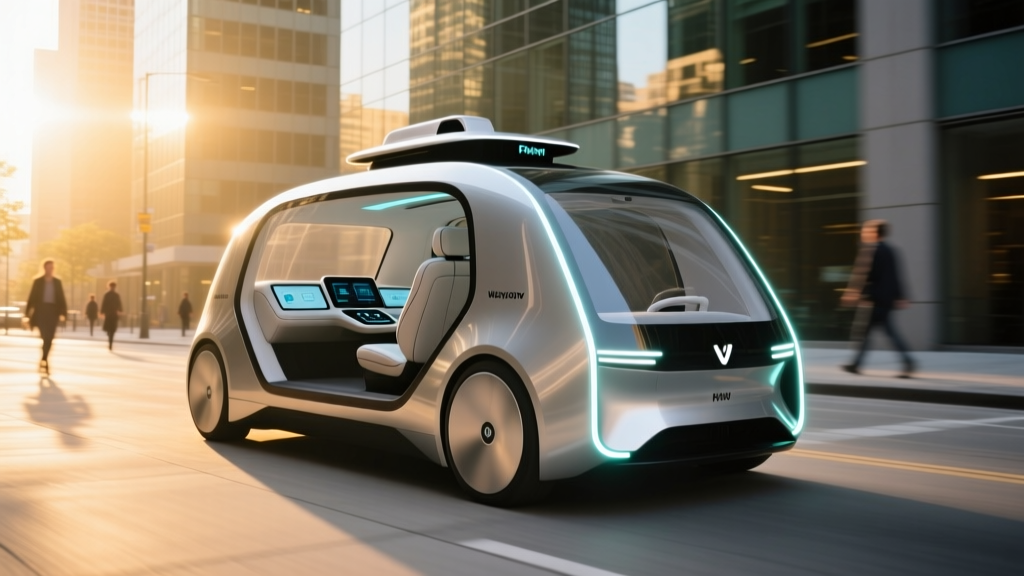
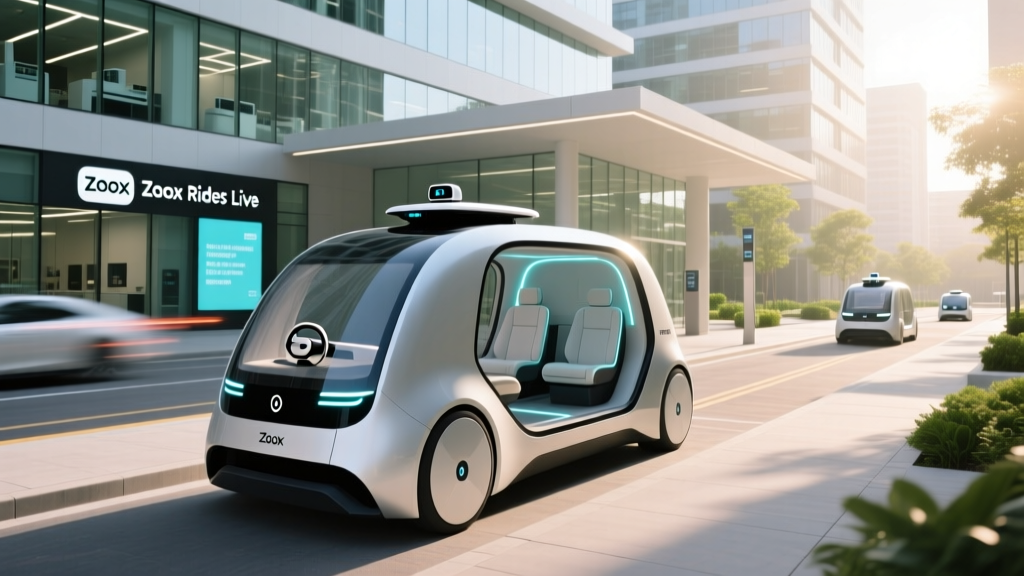
Zoox didn't adapt a Chevy Bolt or a Jaguar I-PACE. The company designed a carriage-style, bidirectional vehicle from scratch — meaning it can drive equally well in either direction, with no defined "front" or "rear." Here's what powers it:
Sensor Suite
- LiDAR: Multiple solid-state and spinning LiDAR units providing 360° 3D point-cloud mapping. Zoox uses LiDAR as a primary perception layer, unlike Tesla's camera-only approach.
- Cameras: High-resolution camera arrays covering all directions for object classification, traffic-light recognition, and lane detection.
- Radar: Forward and surround radar for velocity detection and adverse-weather redundancy.
- Microphones: External audio sensors to detect emergency vehicle sirens and other acoustic cues.
Compute and Software
- Custom onboard compute platform running Zoox's proprietary perception, prediction, and planning stack.
- HD maps maintained for every operational zone — the vehicle doesn't navigate unknown roads.
- Continuous simulation environment for testing edge cases before software deployment.
Vehicle Specifications (Purpose-Built Zoox Vehicle)
- Seating: 4 passengers, facing each other (no driver seat)
- Bidirectional: Symmetrical design — drives in either direction
- Top speed: ~75 mph (electronically limited)
- Battery: All-electric; exact kWh capacity not publicly disclosed
- Charging: Fleet depot charging (not customer-facing)
The LiDAR-first approach gives Zoox a depth-perception advantage in complex urban scenes — construction zones, occluded pedestrians, irregular intersections — at the cost of higher per-vehicle hardware expense. This is a deliberate trade-off for a fleet operator that doesn't need to sell vehicles to consumers at a competitive MSRP.
How Much Does a Zoox Ride Cost vs. Uber or Lyft?
Zoox has not published a fixed per-mile or per-minute rate card the way Waymo occasionally references in its marketing. During its early commercial phase, Zoox has offered rides at subsidized introductory rates or free to waitlisted riders to build operational experience.
| Service | Typical Cost (3-mile urban trip) | Pricing Model | Availability |
|---|---|---|---|
| Zoox | Introductory: free–$5 (promotional) | App-based; long-term pricing TBD | Las Vegas, San Francisco (waitlist) |
| Waymo One | $8–$15 | Per-mile + per-minute, surge pricing | Phoenix, SF, LA, Austin |
| UberX | $10–$18 | Dynamic pricing, per-mile + per-minute | Nationwide |
| Lyft | $10–$17 | Dynamic pricing, per-mile + per-minute | Nationwide |
How much does it cost vs Uber/Lyft? Right now, Zoox rides are effectively subsidized to encourage adoption and gather operational data. Long-term, Zoox has signaled that its unit economics target pricing competitive with traditional rideshare — the thesis being that removing the driver (who typically earns 60–75% of the fare) creates margin room to undercut human-driven services. Whether that materializes at scale depends on fleet utilization rates, vehicle maintenance costs, and remote-assistance overhead.
For comparison, Waymo's published fares in Phoenix and San Francisco generally land within 10–20% of UberX pricing for equivalent routes, with occasional promotional discounts.
Zoox Safety Record: What the Data Shows
Key Safety Data Points (as reported through 2025–2026):
- Miles driven autonomously: Zoox has accumulated millions of autonomous miles across its test and commercial fleets, though the company does not publish a live mileage counter the way Waymo does (Waymo surpassed 50 million autonomous miles in 2024).
- Disengagement reports: In California, Zoox files annual disengagement reports with the DMV. Disengagement rates have trended downward year over year, indicating improving system reliability, though exact figures vary by reporting period and operational zone complexity.
- Reported incidents: Zoox vehicles have been involved in minor incidents typical of urban testing fleets (low-speed contact, other-driver fault in most cases). No fatalities or serious injuries have been attributed to Zoox robotaxi operations as of early 2026.
- NHTSA Standing General Order: Zoox is subject to federal crash-reporting requirements for ADS-equipped vehicles. Reports are filed with NHTSA as mandated.
How safe are robotaxis? The honest answer is that Zoox's commercial mileage is still far too low to draw statistically rigorous comparisons with human drivers or even with Waymo's much larger fleet. Waymo's published safety data (covering 50+ million miles) suggests its vehicles are involved in police-reported crashes at a lower rate than human benchmarks in comparable urban environments. Zoox has not yet published an equivalent large-scale safety study.
What we can say: Zoox's sensor-heavy approach (LiDAR + cameras + radar) provides triple-redundant perception, and the vehicle's low top speed in urban zones reduces kinetic energy in any potential collision. The absence of a steering wheel also means there is no scenario where a distracted "safety driver" fails to intervene — the system is either capable or it pulls over.
For context on robotaxi safety broadly, the IIHS and NHTSA continue to monitor ADS operations, and California's DMV publishes annual disengagement data that offers a (imperfect) proxy for system maturity.
Regulatory Landscape: Who Approves Zoox Operations?
Robotaxi deployment in the United States requires navigating a patchwork of state and local regulations. There is no single federal "robotaxi license." Here's how the framework currently works:
- California (CPUC + DMV): The California Public Utilities Commission issues permits for commercial autonomous ride-hail services. The DMV separately manages testing permits and disengagement reporting. Zoox holds both testing and commercial deployment permits in California.
- Nevada (DMV + PUCN): Nevada has been more permissive toward AV deployment. Zoox received approval to operate commercial rides in Las Vegas, benefiting from the state's relatively streamlined regulatory process.
- Federal (NHTSA): The National Highway Traffic Safety Administration sets vehicle safety standards (FMVSS). Zoox's purpose-built vehicle, lacking traditional controls, required an FMVSS exemption petition — which NHTSA granted, allowing the vehicle to operate without a steering wheel or mirrors under specific conditions.
- Texas: Texas has AV testing legislation, but commercial robotaxi rules vary by municipality. Zoox's Austin presence remains in the testing phase.
The regulatory environment is evolving. Some cities welcome robotaxis as a road-safety improvement; others (notably San Francisco, during 2023–2024 incidents involving Cruise and Waymo) have pushed back with operational restrictions. Zoox's slower, more cautious rollout strategy may help it avoid the political friction that has hampered competitors.
Current Limitations: What Zoox Cannot Do
Level 4 autonomy is powerful — but it is bounded. Zoox's system operates within strict constraints, and understanding these is critical for anyone considering a ride.
- Geofencing: Zoox vehicles operate only within pre-mapped, approved zones. Request a ride outside the geofence and the app will not allow it. The vehicle physically cannot navigate unmapped roads.
- Weather restrictions: Heavy rain, fog, snow, or ice can degrade LiDAR and camera performance. Zoox will suspend service in severe weather rather than operate at reduced capability.
- Construction and road closures: While Zoox's HD maps are updated regularly, sudden construction zones or emergency road closures can cause the vehicle to stop and wait for remote guidance or reroute conservatively.
- No highway driving: Current Zoox operations are urban/suburban. The vehicle is capable of ~75 mph but is not deployed on freeways in commercial service.
- Limited passenger capacity: The 4-seat configuration means no group rides larger than four, and no wheelchair-accessible vehicle option is currently available.
- No stops en route: Unlike an Uber where you can ask the driver to stop at a convenience store, Zoox rides are point-A to point-B with no intermediate stops.
- Waitlist access: You cannot simply download the app and ride. Access is gated, and wait times for approval vary by city.
What are the current limitations? In short: Zoox works well for short, predictable urban trips within its service zone in clear weather. It does not replace a personal vehicle, it does not operate in storms, and it will not take you to a destination outside its approved map. These are engineering and regulatory realities, not temporary bugs — expanding the ODD requires additional mapping, testing, validation, and regulatory approval for each new zone.
Zoox vs. Waymo vs. Cruise: Where They Stand
Zoox is not the only Level 4 robotaxi operator in the US. Here's a quick landscape comparison:
| Attribute | Zoox | Waymo | Cruise (GM) |
|---|---|---|---|
| Vehicle | Purpose-built, no steering wheel | Jaguar I-PACE (modified), Zeekr (upcoming) | Origin (purpose-built); Bolt EV (retired from service) |
| SAE Level | Level 4 | Level 4 | Level 4 |
| Commercial cities | Las Vegas, San Francisco | Phoenix, San Francisco, Los Angeles, Austin | Limited — resuming post-2024 suspension |
| Weekly paid rides (est.) | Hundreds (early stage) | 50,000+ (2025 figures) | Ramping slowly |
| Parent company | Amazon | Alphabet (Google) | General Motors |
| Sensor approach | LiDAR + cameras + radar | LiDAR + cameras + radar | LiDAR + cameras + radar |
Waymo is the clear volume leader, with the most cities, the most rides, and the most published safety data. Zoox's differentiation lies in its purpose-built vehicle — no compromises from adapting a consumer car — and Amazon's deep pockets for long-haul investment. Cruise, following its serious pedestrian incident in San Francisco in late 2023 and subsequent operational suspension, has been cautiously restarting in limited markets.
Frequently Asked Questions
Where are Zoox's main offices?
Zoox is headquartered in Foster City, California, with additional engineering offices in Seattle, Washington, and operational hubs in San Francisco, Las Vegas, and Austin, Texas. The Foster City campus is the largest facility and houses core vehicle engineering, software development, and executive leadership.
Can I ride in a Zoox robotaxi today?
Yes, but access is limited. Commercial rides are available in Las Vegas and San Francisco through the Zoox app, which operates on a waitlist/invite basis. You cannot hail a Zoox on demand the way you would an Uber.
Is Zoox self-driving or does it have a safety driver?
Zoox is a true SAE Level 4 robotaxi with no steering wheel, no pedals, and no human driver on board. The vehicle handles all driving tasks within its operational zone autonomously. This is fundamentally different from Level 2 driver-assist systems like Tesla FSD (Supervised) or GM Super Cruise, which require a human driver's continuous attention.
How much will a Zoox ride cost long-term?
Zoox has not published long-term pricing. During its initial rollout, rides are heavily subsidized or free. The company's stated goal is to price competitively with Uber/Lyft, leveraging the absence of a human driver to maintain margins. Expect pricing to settle in the $8–$15 range for typical urban trips once the service matures.
Has Zoox been in any accidents?
Zoox vehicles have been involved in minor low-speed incidents typical of urban AV testing, with most attributed to other human drivers. As of early 2026, no fatalities or serious injuries have been reported in Zoox operations. The company reports incidents to NHTSA under the Standing General Order for ADS-equipped vehicles.
Why doesn't Zoox operate in more cities?
Each new city requires HD mapping, regulatory approval (state and sometimes municipal), fleet deployment, and validation testing. Zoox has chosen a slower, more methodical expansion than competitors like Waymo, prioritizing safety validation over rapid geographic scaling. Amazon's financial backing allows this patient approach.
Does Zoox use LiDAR or cameras?
Both, plus radar. Zoox employs a multi-sensor fusion approach: LiDAR for precise 3D depth mapping, cameras for object classification and traffic-signal recognition, and radar for velocity detection and weather resilience. This is the same sensor philosophy used by Waymo and Cruise, and it contrasts with Tesla's camera-only approach for its consumer driver-assist systems.
Can Zoox drive on highways?
The vehicle is technically capable of speeds up to ~75 mph, but current commercial operations are restricted to urban and suburban streets within geofenced zones. Highway deployment would require additional validation and regulatory approval.
Zoox represents one of the most ambitious bets in autonomous mobility — a company that didn't just write self-driving software, but designed an entirely new kind of vehicle around it. Its office footprint from Foster City to Las Vegas reflects that dual mission: engineer the AI, then engineer the machine that carries it. For riders, the service is real but still early. For the industry, Zoox's purpose-built approach may define what robotaxis look like a decade from now — if the company can scale as effectively as it has designed.