What the Zoox Map in Las Vegas Actually Covers
If you've searched for the Zoox map Las Vegas service area, you're likely trying to figure out where Amazon's purpose-built robotaxi can actually pick you up. As of early 2026, Zoox operates a commercial, driverless ride-hail service across a defined geofenced zone on and around the Las Vegas Strip — but that zone has hard boundaries, and understanding them is the difference between catching a free autonomous ride and standing on a sidewalk wondering why the app won't let you book.
Zoox is one of only two companies (alongside Waymo) currently operating true SAE Level 4 driverless robotaxi services in the United States. That distinction matters enormously. Unlike Tesla's FSD (Supervised) or GM's Super Cruise — both Level 2 systems that require an attentive driver behind the wheel — Zoox vehicles have no steering wheel, no pedals, and no human fallback. The vehicle handles all driving tasks within its approved Operational Design Domain (ODD), or it pulls over safely.
| Level | Description | Example |
|---|---|---|
| Level 2 | Driver-assist; human must supervise | Tesla Autopilot, FSD Supervised, BlueCruise |
| Level 3 | Conditional automation; human on standby | Mercedes Drive Pilot (limited markets) |
| Level 4 | Driverless within defined ODD; no human needed | Zoox, Waymo |
| Level 5 | Full autonomy everywhere, all conditions | Does not exist commercially |
Where Can You Use Zoox Right Now?
Zoox's Las Vegas service area centers on the tourist corridor but extends beyond a narrow Strip-only footprint. Here's a breakdown of where the service operates as of 2026:
| City | Status | Service Area | Public Access |
|---|---|---|---|
| Las Vegas | Commercial operations | Strip corridor + downtown Fremont St. zone (~12 sq mi) | Open via Zoox app (waitlist may apply) |
| San Francisco | Commercial operations | Select neighborhoods (~15 sq mi) | Open via Zoox app |
| Foster City, CA | Testing / limited rides | Defined test zone | Invite-only |
| Austin, TX | Testing (announced expansion) | TBD | Not yet public |
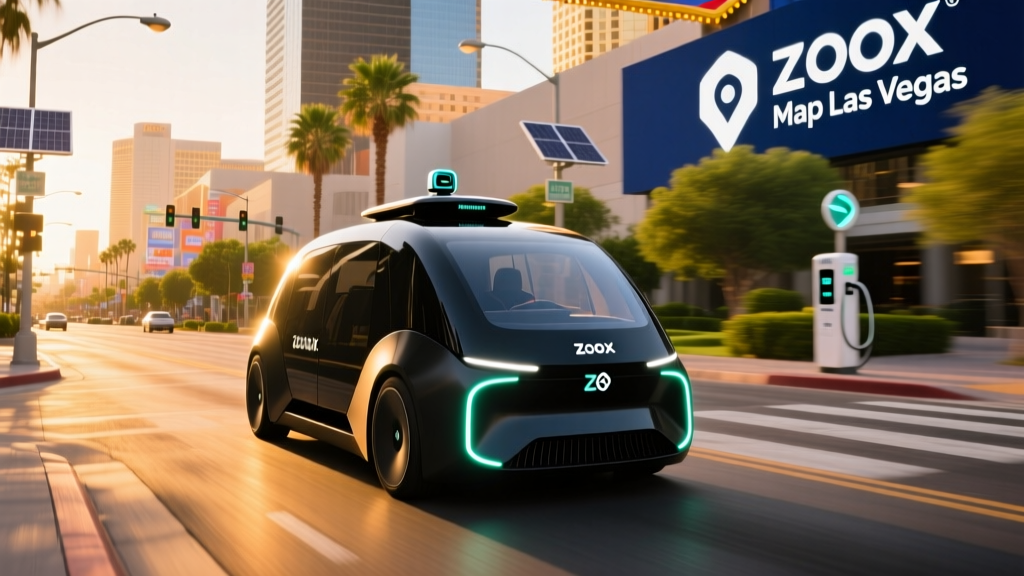
In Las Vegas specifically, the Zoox geofence covers the major resort corridor from roughly Mandalay Bay in the south to the Stratosphere in the north, with east-west coverage extending to include key hotel entrances, the Convention Center, and portions of the downtown Fremont Street area. The Zoox ride app displays the live service boundary — if your pickup or drop-off falls outside the polygon, the app will not let you book.
- McCarran/Harry Reid International Airport pickups are not currently available.
- Suburban Henderson and Summerlin are outside the ODD.
- The vehicle will refuse trips that cross the geofence boundary — there is no manual override.
How to Book a Zoox Ride (and What It Costs)
Riding in Zoox is closer to a traditional ride-hail experience than you might expect, with one key difference: there's no driver to rate, tip, or make small talk with.
- Download the Zoox app (iOS/Android) and create an account.
- Set your pickup and drop-off — both must fall within the Las Vegas geofence.
- Confirm your ride. The app shows the vehicle's approach in real time.
- Board the vehicle. The Zoox carriage-style vehicle has facing bench seats for up to four passengers. Doors open automatically when the vehicle stops at your pickup point.
- Ride. A screen displays the route and sensor view. An in-cabin camera monitors for safety. You can communicate with a remote fleet-assistance agent at any time via a button in the cabin.
Zoox Pricing vs. Uber and Lyft in Las Vegas
As of 2026, Zoox has been offering rides at no cost to riders during its initial commercial rollout phase in both Las Vegas and San Francisco. This is a deliberate market-capture strategy — the company is prioritizing ride volume and data collection over revenue. Here's how that compares to typical rideshare pricing on the Strip:
| Service | Typical Fare | Surge Pricing? | Tip Expected? |
|---|---|---|---|
| Zoox | $0 (promotional) | No | No |
| UberX | $12–$22 | Yes (1.2x–2.5x) | Yes ($2–$5) |
| Lyft Standard | $11–$20 | Yes (Prime Time) | Yes ($2–$5) |
| Waymo One (where available) | $10–$18 | Limited | No |
The critical caveat: Zoox's free-ride model is not permanent. Once the company transitions to paid fares, industry analysts project pricing comparable to UberX/Lyft Standard, likely in the $10–$20 range for typical Strip trips. Zoox has not published a long-term pricing schedule.
The Zoox Vehicle and Technology Stack
Zoox's approach to autonomy is fundamentally different from both Tesla's camera-centric vision and Waymo's retrofitted Jaguar/Zeekr platform. Zoox designed its vehicle from the ground up as a robotaxi — the so-called "carriage" — with no steering wheel, no pedals, and bidirectional driving capability (it can travel forward or backward equally well).
- LiDAR: Multiple solid-state and spinning LiDAR units providing a 360° 3D point cloud with range exceeding 150 meters. LiDAR is the primary perception backbone, unlike Tesla's camera-only approach.
- Cameras: A suite of high-resolution cameras covering all directions, used for object classification, lane detection, traffic-light state recognition, and redundancy.
- Radar: Forward- and corner-mounted radar units for velocity detection and all-weather object tracking (rain, fog, dust).
- Compute: Custom onboard compute platform running Zoox's proprietary prediction, planning, and control software. Redundant systems ensure that if one compute path fails, a backup takes over immediately.
- HD Maps: Centimeter-precision pre-mapped routes within the geofence. The vehicle localizes against these maps in real time, cross-referencing LiDAR point clouds with the stored map.
- V2I / Remote Assistance: When the vehicle encounters an edge case it cannot resolve (e.g., a construction zone with conflicting signage), it can request remote guidance from a human fleet-assistance agent. The agent provides a high-level plan; the vehicle still executes the driving.
The LiDAR-first approach is a direct contrast to Tesla's pure-vision FSD stack. Zoox's position — shared by Waymo and most commercial L4 operators — is that LiDAR provides an essential depth-perception and redundancy layer that cameras alone cannot reliably supply, especially at night or in high-glare conditions common on the Las Vegas Strip.
Safety Record: What the Data Actually Shows
Robotaxi safety is the most scrutinized topic in autonomous vehicles, and Zoox's record requires context. Here's what we know from public filings and NHTSA Standing General Order crash reports:
- Total driverless miles (all cities): Estimated 1.5+ million miles in fully autonomous mode (no safety driver), based on company disclosures and DMV filings.
- NHTSA-reported incidents: A small number of low-severity contact events reported under the Standing General Order. Most involved low-speed interactions with other road users (e.g., minor sideswipe at an intersection, vehicle struck while stopped). No reported serious injuries to Zoox passengers or pedestrians in publicly available data.
- Disengagement rate: Not directly comparable to Waymo's public reports, as Zoox's remote-assistance model differs from traditional "disengagement" metrics. Zoox reports that remote-assistance interventions occur at a rate of roughly 1–3 per 1,000 miles in newer markets, decreasing as mapping and software improve.
- California DMV disengagement reports: Zoox files annual reports with the California DMV, though the company's Nevada operations are governed separately.
For comparison, Waymo — which has logged over 30 million driverless miles across multiple cities — reports a lower intervention rate, reflecting its longer operational history and larger fleet. Zoox's smaller fleet and more recent commercial launch mean its statistical sample is still maturing.
The honest assessment: robotaxi safety data across the industry is still limited compared to the billions of human-driven miles logged annually. What the available data does suggest is that Level 4 robotaxis in geofenced, well-mapped urban environments have a lower at-fault crash rate per mile than the average human driver in similar conditions, per analyses from the Insurance Institute for Highway Safety and academic studies. But these numbers come with wide confidence intervals due to smaller sample sizes.
Regulatory Landscape: Who Approves Zoox Operations?
Robotaxi operations in the U.S. require a patchwork of state and federal approvals. In Nevada, Zoox's path to commercial service involved several regulatory steps:
- Nevada DMV Autonomous Vehicle Permit: Nevada was one of the first states to legislate AV testing (2011) and commercial deployment. Zoox holds a Nevada Autonomous Vehicle permit allowing driverless testing and commercial ride-hail operations within approved zones.
- Nevada Public Utilities Commission (PUCN): Commercial passenger-carrying services require approval from the state's transportation network company regulator, analogous to how Uber/Lyft are licensed.
- Federal (NHTSA): At the federal level, Zoox received a notable exemption from NHTSA allowing its steering-wheel-free, pedal-free vehicle design to operate on public roads — a departure from Federal Motor Vehicle Safety Standards (FMVSS) that assume a human driver. This exemption is specific and limited in scope.
- Insurance: Zoox carries commercial liability insurance covering passengers and third parties, as required by Nevada law. Riders are covered without needing personal insurance for the trip.
This regulatory framework is notably different from California, where the California Public Utilities Commission (CPUC) and DMV jointly govern robotaxi operations — a process that has been more contentious, particularly in San Francisco, where public debate over robotaxi expansion has been intense.
Current Limitations: Where Zoox Falls Short
Level 4 autonomy is powerful, but it is not Level 5. The "4" means the system is fully capable within its Operational Design Domain — and that domain has real boundaries.
- Geofence restrictions: The vehicle physically will not operate outside its mapped zone. No Strip-to-airport runs, no suburban trips.
- Weather sensitivity: While LiDAR and radar provide better all-weather performance than cameras alone, heavy rain, dense fog, or sandstorms (a real concern in Las Vegas) can degrade sensor performance. Zoox may temporarily suspend service or reduce speeds in adverse conditions.
- Construction zones: Major roadwork that alters lane configurations can confuse the HD map. The vehicle may stop and request remote assistance, adding minutes to your trip.
- Peak demand / availability: Zoox's fleet in Las Vegas is significantly smaller than Uber/Lyft's driver pool. During peak hours (weekend nights, convention weeks like CES), wait times can exceed 15–20 minutes, or the app may show no available vehicles.
- No highway operation: The Zoox vehicle is designed for urban speeds (typically up to ~35–45 mph within its ODD). It does not merge onto I-15 or US-95.
- Accessibility: While the carriage design includes a wheelchair-accessible variant, availability of accessible vehicles may be limited. Confirm in-app before relying on this feature.
- Night operations on poorly lit streets: While LiDAR doesn't need light, the vehicle's camera-based classification of pedestrians and cyclists in unlit areas off the main Strip corridor can be less confident, leading to more cautious (slower) driving behavior.
Is Zoox Truly Self-Driving, or Is It Driver-Assist?
This is the question that causes the most confusion in the EV and autonomy space, so let's be precise:
Zoox is a true SAE Level 4 driverless system. There is no human driver in the vehicle. There is no steering wheel. There are no pedals. You cannot "take over" because there is nothing to take over. The vehicle is fully responsible for all driving decisions within its approved zone, and if it encounters a situation it cannot handle, it executes a Minimal Risk Condition (MRC) — typically pulling to the curb and stopping — rather than handing control to a passenger.
This is categorically different from:
- Tesla FSD (Supervised): A Level 2 system. The driver must remain attentive, hands on or near the wheel, and is legally responsible for the vehicle's actions. NHTSA has investigated multiple Autopilot/FSD incidents, and the system requires continuous human oversight.
- GM Super Cruise / Ford BlueCruise: Level 2 hands-off systems on pre-mapped highways, but the driver must remain alert and is monitored by a cabin camera. These are not driverless.
- Mercedes Drive Pilot: A Level 3 system approved in limited markets (Nevada, California) for specific highway conditions up to 40 mph. The driver can disengage but must be ready to resume control within seconds when prompted. This is conditional automation, not full driverless operation.
If a company or headline tells you a consumer car is "self-driving," check the SAE level. As of 2026, only Zoox and Waymo operate commercially available Level 4 driverless services in the U.S. Everything else available to consumers is Level 2 or, in limited cases, Level 3.
Frequently Asked Questions
Where can I use the Zoox robotaxi service right now?
Zoox operates commercial driverless rides in Las Vegas (Strip corridor and downtown Fremont zone) and San Francisco (select neighborhoods). Foster City, CA is in testing with invite-only access. Austin, TX has been announced for future expansion but is not yet live for public rides.
How much does a Zoox ride cost compared to Uber or Lyft?
As of early 2026, Zoox rides are free during the company's promotional rollout period. A typical 3-mile Strip trip on UberX costs $12–$22 before tip and surge pricing. Zoox charges nothing and does not surge. Paid fares are expected eventually, likely at rideshare-comparable rates.
How safe are Zoox robotaxis based on real data?
Zoox has logged an estimated 1.5+ million driverless miles across its markets. NHTSA crash reports show a small number of low-severity incidents with no reported serious injuries. The at-fault crash rate appears lower than the human average in comparable urban conditions, but the sample size is still small relative to the billions of human-driven miles annually. Full safety data is available via NHTSA's Standing General Order database.
What are the current limitations of Zoox in Las Vegas?
The geofence does not include Harry Reid International Airport, suburban areas, or highways. The vehicle operates at urban speeds only (under ~45 mph). Service can be suspended in heavy rain or dust storms. Fleet size is limited, so wait times during peak convention periods can be long. Construction zones may trigger remote-assistance delays.
Is Zoox truly self-driving or is it driver-assist like Tesla FSD?
Zoox is SAE Level 4 — fully driverless with no steering wheel, no pedals, and no human driver in the vehicle. Tesla FSD (Supervised) is SAE Level 2, requiring continuous human attention and legal responsibility. These are fundamentally different systems operating under different regulatory frameworks.
Can I hail a Zoox on the street like a taxi?
No. Zoox rides must be booked through the Zoox app, similar to Uber or Lyft. You cannot flag one down. Both the pickup and drop-off must be within the approved geofence zone.
What happens if the Zoox vehicle encounters a problem during my ride?
The vehicle has redundant systems (dual compute, backup power, redundant braking). If it encounters an unresolvable situation, it will pull to the curb and stop (a Minimal Risk Condition). You can press an in-cabin button to speak with a remote fleet-assistance agent at any time. Emergency services can be dispatched if needed.