Zoox in Las Vegas: What You Need to Know Before You Ride
If you have been searching for Zoox locations Las Vegas and wondering whether Amazon's purpose-built robotaxi is actually available to hail on the Strip, the short answer is yes — but with important geographic and operational caveats. Zoox operates a commercial, fully driverless ride-hail service in select zones of Las Vegas, and understanding exactly where, when, and how it works is the difference between a seamless ride and a frustrating dead end.
Unlike Tesla's Full Self-Driving (Supervised) or GM's Super Cruise, which require an attentive human behind the wheel, Zoox is a Level 4 autonomous vehicle. There is no steering wheel, no pedals, and no driver seat. The vehicle handles the entire trip within its approved operational design domain (ODD) without any human intervention. This distinction matters enormously for riders setting expectations.
Zoox vehicles operate at SAE Level 4, meaning the system performs all driving tasks within a defined geofenced area without human oversight. This is fundamentally different from Level 2 driver-assist systems like Tesla Autopilot or Ford BlueCruise, where the driver must remain engaged and responsible. If the Zoox system encounters a scenario it cannot handle, it is designed to execute a minimal-risk maneuver (pull over safely) rather than hand control to a passenger.
Where Can I Ride Zoox in Las Vegas Right Now?
Zoox launched its commercial robotaxi service in Las Vegas in mid-2024, initially offering rides to a limited pool of employees and invited users before expanding to the general public through its app. As of early 2026, the service operates within a defined geofenced zone covering key corridors.
| Zone | Key Landmarks | Status |
|---|---|---|
| Las Vegas Strip Corridor | Mandalay Bay to The Venetian, major resort pickups | Active |
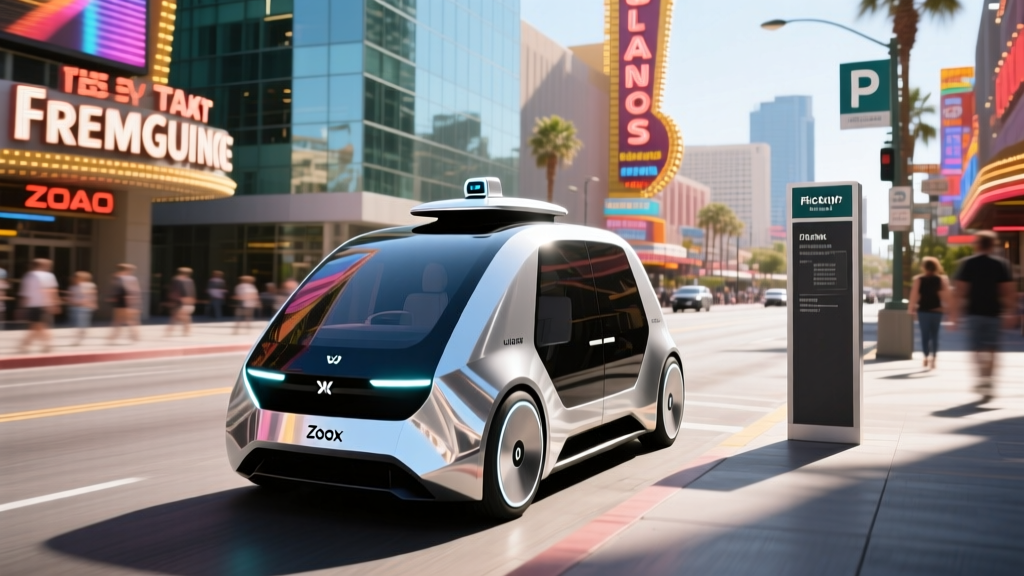
| Downtown / Fremont Area | Fremont Street Experience, Arts District | Active |
| Convention Center District | Las Vegas Convention Center, Westgate | Active |
| Harry Reid International Airport | Airport terminal pickups/drop-offs | Limited availability |
| Suburban Henderson / Summerlin | Residential areas outside core geofence | Not available |
The geofence is not a simple radius — it follows approved road segments mapped and validated by Zoox. You can request a ride from anywhere inside the zone via the Zoox app, but pickup and drop-off points must fall within the approved area. If your destination is outside the geofence, the app will not let you complete the booking.
Zoox also operates in the San Francisco Bay Area (its headquarters city), and has been testing in other markets. But Las Vegas remains its primary commercial robotaxi market outside California, chosen for its relatively predictable traffic patterns, wide roads, and high tourist volume.
How to Use Zoox and What It Costs vs. Uber and Lyft
Riding in a Zoox is straightforward but different from a typical rideshare experience. Here is the process:
- Download the Zoox app (iOS/Android) and create an account.
- Enter your pickup and destination — both must be within the Las Vegas geofence.
- Confirm your ride — the app shows an estimated arrival time and fare.
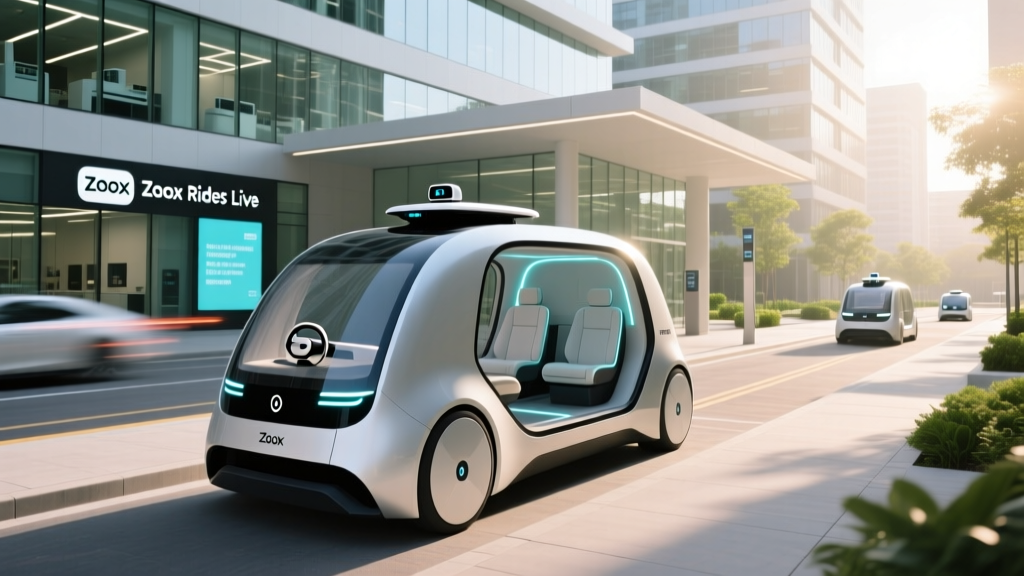
- Meet the vehicle — the Zoox robotaxi (a compact, carriage-style vehicle with no driver compartment) pulls up to your location.
- Unlock and board — scan your phone or use the app to unlock the doors. Seating is face-to-face for up to four passengers.
- Ride — the vehicle navigates autonomously. An in-app interface shows your route and a "stop" button for emergencies.
| Trip Scenario | Zoox | UberX | Lyft Standard |
|---|---|---|---|
| Strip hotel to Strip hotel (~3 mi) | $8–$12 | $12–$18 | $11–$17 |
| Strip to Downtown (~7 mi) | $15–$20 | $18–$28 | $17–$26 |
| Airport to Strip (~5 mi) | $12–$16 | $20–$30 | $18–$28 |
| Convention Center to hotel (~2 mi) | $6–$9 | $10–$15 | $9–$14 |
Zoox pricing is generally 20–40% lower than UberX or Lyft for comparable trips within its geofence. This is intentional — Zoox is subsidized by Amazon and is focused on building ridership and operational data rather than immediate profitability. Pricing may adjust as the service scales. Unlike Uber/Lyft, Zoox does not currently implement surge pricing during peak demand, though wait times can increase when vehicles are scarce.
One practical note: Zoox vehicles seat a maximum of four passengers and have limited cargo space. They are not suitable for airport runs with multiple large suitcases or group trips beyond four people.
How Safe Are Zoox Robotaxis? The Real Data
Safety is the single most important question for any prospective robotaxi rider. Zoox, like all autonomous vehicle operators in California and Nevada, is required to report disengagement data, collision reports, and operational metrics to regulators.
- Total autonomous miles driven: Over 1 million driverless miles across Las Vegas and San Francisco combined (NHTSA AV reporting)
- Reported collisions: Fewer than 10 minor-contact incidents reported to NHTSA under the Standing General Order for ADS-equipped vehicles — the majority being low-speed rear-end contacts where the Zoox vehicle was stationary or the other party was at fault
- Human rider injuries: Zero reported passenger injuries in commercial service as of early 2026
- Remote assistance rate: Zoox employs remote fleet monitors who can provide high-level guidance to vehicles in complex scenarios; the vehicle still executes all driving actions autonomously
For context, the National Highway Traffic Safety Administration (NHTSA) requires all Level 4 operators to file collision reports under a Standing General Order. Waymo, which operates at far greater scale in Phoenix, San Francisco, and Los Angeles, has logged tens of millions of driverless miles. Zoox's mileage is smaller because its commercial fleet is more limited, but the safety data available so far does not show a pattern of systemic failures.
The Zoox vehicle itself is engineered with safety as a primary differentiator. It features four-wheel steering (enabling a 4-foot turning radius and bidirectional driving), a crash-optimized cabin with no steering column or hard dashboard surfaces, and redundant braking, steering, and computing systems. The bidirectional capability means the vehicle can reverse out of a dead-end without performing a multi-point turn — a meaningful safety advantage in urban environments.
Zoox Technology Stack: Lidar, Cameras, and Geofencing
Zoox takes a sensor-fusion approach that is fundamentally different from Tesla's camera-only ("Tesla Vision") strategy. The Zoox robotaxi uses a comprehensive suite of overlapping sensors:
- Lidar: Multiple solid-state and spinning lidar units providing a 360-degree, high-resolution 3D point cloud out to ~200+ meters. Lidar is essential for precise distance measurement independent of lighting conditions.
- Cameras: A multi-camera array covering 360 degrees with overlapping fields of view, used for object classification, traffic light/signal recognition, and lane detection.
- Radar: Long- and short-range radar for velocity measurement of moving objects and performance in rain, fog, and dust — conditions where lidar and cameras degrade.
- Ultrasonic sensors: Short-range proximity detection for low-speed maneuvering, parking, and close-object avoidance.
- IMU and GPS: Inertial measurement units combined with high-precision GPS and HD map localization for centimeter-level positioning.
The geofencing approach is critical to understanding Zoox's operational model. The vehicle does not attempt to drive anywhere — it operates only on roads that have been HD-mapped, validated, and approved by Zoox's safety team. Every intersection, crosswalk, construction zone, and lane configuration within the geofence is pre-mapped. When the vehicle encounters a scenario outside its validated parameters (an unmapped road closure, for example), it will not improvise — it pulls over and contacts the remote fleet operations team.
This is a deliberate trade-off: geofencing limits where Zoox can operate, but it dramatically increases the system's reliability and safety within that zone. By contrast, Tesla's FSD (Supervised) aims for geographic ubiquity but requires continuous human oversight precisely because it cannot guarantee the same level of environmental certainty.
Regulatory Landscape: Who Approves Zoox Operations?
Robotaxi operations in the United States are governed by a patchwork of state and local regulations — there is no single federal license for driverless deployment.
In Nevada: The Nevada Department of Transportation (NDOT) and the Nevada Legislature established one of the earliest autonomous vehicle frameworks in the country (AB 511, enacted in 2011 and updated subsequently). Nevada allows fully driverless Level 4 operations without a safety driver, provided the operator meets testing, insurance, and reporting requirements. Zoox holds the necessary permits to operate commercially in Las Vegas.
In California: The California Department of Motor Vehicles (DMV) issues testing permits, while the California Public Utilities Commission (CPUC) regulates commercial passenger service. Zoox holds both a DMV testing permit and CPUC authorization for driverless commercial service in San Francisco.
Federal level: NHTSA regulates vehicle safety standards. The Zoox vehicle received a notable regulatory accommodation — NHTSA granted Zoox an exemption from certain Federal Motor Vehicle Safety Standards (FMVSS) that assume a human driver (such as requirements for a steering wheel, mirrors, and a driver-facing dashboard). This exemption, granted under NHTSA's ADS exemption process, is what allows the Zoox vehicle's unique carriage design to be street-legal.
For riders, the practical takeaway is that Zoox is operating legally under state-issued permits with regulatory oversight, insurance requirements, and mandatory incident reporting. It is not a test mule operating in a gray area — it is a permitted commercial transportation service.
Current Limitations: What Zoox Cannot Do
Understanding what a robotaxi cannot do is just as important as knowing what it can. Zoox's current limitations are real and affect trip planning:
- Geofence boundaries: If your destination falls outside the mapped zone, Zoox cannot take you there. There is no partial-autonomy fallback — the ride simply will not book.
- Weather restrictions: Heavy rain, flash flooding (a real concern in Las Vegas monsoon season, typically July–September), and dense fog can trigger service suspensions. The vehicle's lidar and cameras degrade in heavy precipitation, and Zoox will pause operations rather than risk degraded sensor performance.
- Construction zones: Major, unmapped road construction can force the vehicle to reroute or pull over. While Zoox updates its HD maps regularly, sudden lane closures or detours may exceed the system's real-time adaptability.
- No highway driving: Zoox currently operates on surface streets only. Highway-speed autonomous driving (65–80 mph) is not part of the current Las Vegas service.
- Limited cargo and accessibility: The vehicle seats four passengers face-to-face with limited trunk space. It is not wheelchair-accessible in its current configuration, and large items (golf clubs, multiple suitcases) may not fit.
- No pets (service animals excepted): Standard Zoox policy restricts non-service animals.
- Wait times: Fleet size is limited compared to Uber/Lyft. During peak convention or event periods, wait times of 10–20 minutes are common, versus 3–5 minutes for a traditional rideshare.
- Night operations: Zoox does operate at night in Las Vegas (a key advantage for Strip visitors), but extremely low-light scenarios combined with complex pedestrian behavior can result in more conservative driving behavior and longer trip times.
Zoox vs. Waymo: How the Two Robotaxi Services Compare
Waymo (Alphabet/Google) is the other major Level 4 robotaxi operator in the U.S., and riders in Las Vegas may wonder how the two compare. Waymo does not currently operate a commercial service in Las Vegas — its primary markets are Phoenix, San Francisco, Los Angeles, and Austin. So for Las Vegas visitors, Zoox is the only Level 4 driverless robotaxi option available.
Where both services overlap (San Francisco), the key differences are vehicle design and capacity. Waymo uses modified Jaguar I-PACE electric SUVs — conventional vehicles retrofitted with autonomous hardware — while Zoox uses its purpose-built carriage vehicle. Waymo's larger vehicle offers more cargo space and traditional forward-facing seating, while Zoox's purpose-built design offers tighter turning, bidirectional driving, and a cabin optimized for passengers rather than a driver who does not exist.
Frequently Asked Questions
Where can I use Zoox in Las Vegas right now?
Zoox operates within a geofenced zone covering the Las Vegas Strip corridor (roughly Mandalay Bay to The Venetian), the Downtown/Fremont Street area, and the Convention Center district. Airport service is available but limited. Suburban areas like Henderson and Summerlin are outside the geofence. Always check the Zoox app for real-time zone boundaries — they can expand or contract based on operational conditions.
How much does a Zoox ride cost compared to Uber or Lyft?
Zoox fares are typically 20–40% lower than UberX or Lyft for equivalent trips within the geofence. A 3-mile Strip hotel-to-hotel ride generally costs $8–$12 on Zoox versus $12–$18 on UberX. Zoox does not currently use surge pricing, though wait times may increase during peak demand. Pricing is subject to change as the service matures.
How safe are Zoox robotaxis — is there real data?
Zoox has logged over 1 million driverless miles across Las Vegas and San Francisco with fewer than 10 minor-contact incidents reported to NHTSA, the majority being low-speed situations where the other party was at fault. Zero passenger injuries have been reported in commercial service. The vehicle features redundant braking, steering, and compute systems, plus a crash-optimized cabin with no steering column. Full collision data is publicly available through NHTSA's AV reporting portal.
Is Zoox truly self-driving, or is there a driver somewhere?
Zoox is genuinely driverless — SAE Level 4. There is no steering wheel, no pedals, and no human driver in the vehicle. The system handles all driving tasks within its geofenced operational domain. Remote fleet monitors can provide high-level guidance if the vehicle encounters an unusual scenario, but the vehicle executes all driving actions autonomously. This is fundamentally different from Level 2 systems like Tesla FSD (Supervised), which require a human driver to remain engaged at all times.
What happens if the Zoox vehicle encounters a problem during my ride?
If the system encounters a scenario it cannot resolve (an unmapped road closure, a disabled vehicle blocking all lanes), it will execute a minimal-risk maneuver — typically pulling over to the side of the road safely. The vehicle's remote fleet operations team can then assess the situation and provide high-level routing guidance. Passengers can also use the in-app stop button or an in-vehicle intercom to contact support at any time.
Can I use Zoox to get to the Las Vegas airport?
Zoox offers limited service to and from Harry Reid International Airport (LAS), but availability depends on fleet capacity and current operational conditions. For guaranteed airport transfers, especially with early-morning or late-night flights, it is wise to have a backup plan with Uber, Lyft, or a traditional taxi.
Is the Zoox vehicle electric?
Yes. The Zoox robotaxi is a fully electric vehicle (BEV) with a battery pack designed for all-day urban operation. Zoox has not published official EPA range or battery kWh specifications for its purpose-built vehicle, as it is not a consumer vehicle — it is a fleet-operated robotaxi that returns to a depot for charging. The vehicle produces zero tailpipe emissions during operation.