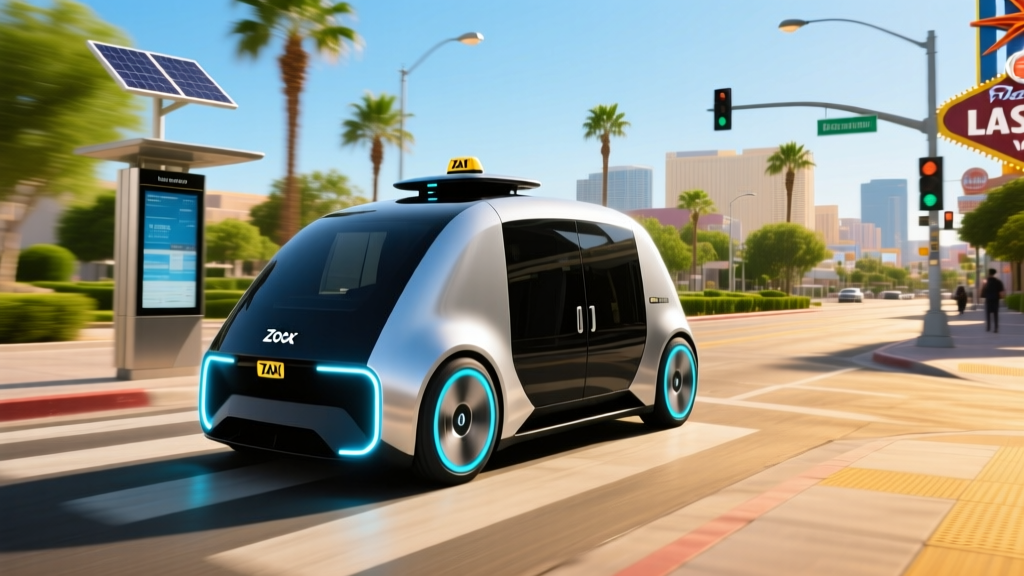
If you've searched for a Zoox Las Vegas stops map, you're likely planning a trip to the Strip and wondering whether Amazon's purpose-built robotaxi can actually replace your Uber. As of early 2026, Zoox operates a commercial, driverless ride-hail service on a defined geofenced corridor in Las Vegas — but it doesn't work like a traditional rideshare with door-to-door routing. Instead, Zoox uses a hub-and-stop model within its operational zone.
This guide maps out exactly where Zoox runs in Las Vegas, how the stop system works, what the ride costs, and — critically — what the vehicle can and cannot do. We'll also separate Zoox's true Level 4 autonomy from the Level 2 driver-assist systems you'll find in consumer EVs.
Zoox in Las Vegas: The Service Area and Stop System
Zoox launched its commercial driverless service in Las Vegas in mid-2025, initially covering a roughly 2.5-square-mile zone centered on the Las Vegas Strip corridor. Unlike Waymo's point-to-point model in Phoenix and San Francisco, Zoox uses a designated-stop system — passengers are picked up and dropped off at specific, pre-mapped locations rather than arbitrary addresses.
| Attribute | Detail |
|---|---|
| Service Status | Commercial, driverless (no safety operator) |
| Geofence Area | ~2.5 sq mi, Strip corridor + adjacent zones |
| Stop Type | Designated pickup/dropoff points (not door-to-door) |
| Operating Hours | ~8:00 AM – 12:00 AM, 7 days/week |
| Vehicle | Zoox Gen 3 purpose-built carriage (bidirectional, no steering wheel) |
| Max Speed | 45 mph (geofence-limited) |
| Passenger Capacity | 4 riders (facing each other, 2+2 seating) |
The designated stops are clustered around major destinations: casino-resort entrances, the Las Vegas Convention Center, and key intersections along Las Vegas Boulevard. When you request a ride through the Zoox app, it shows you the nearest available stop within the geofence — typically a walk of 1–3 blocks from your actual location.
Key Stop Clusters on the Strip
- Central Strip: Stops near Bellagio, Caesars Palace, The Venetian, and Wynn/Encore
- South Strip: Stops near MGM Grand, Aria, Mandalay Bay
- Convention Center District: Stops servicing LVCC's central and south halls
- Downtown Connector: Limited stops near the Arts District and Fremont East (expansion zone)
Zoox has indicated plans to expand the geofence northward toward downtown Las Vegas and southward toward the airport corridor through 2026, but as of publication, those areas are not yet live. Always check the app for current boundaries — the geofence is enforced by software and the vehicle will not operate outside it.
SAE Level 4: What "Self-Driving" Actually Means Here
It's essential to understand that Zoox's Las Vegas service is SAE Level 4 autonomy — a fundamentally different category than the Level 2 driver-assist features (Tesla Autopilot, Ford BlueCruise, GM Super Cruise) available in consumer vehicles.
| SAE Level | Definition | Examples | Driver Required? |
|---|---|---|---|
| Level 2 | Partial automation — steering + acceleration assisted | Tesla Autopilot, FSD (Supervised), BlueCruise, Super Cruise | Yes — hands on or eyes on, full liability on driver |
| Level 3 | Conditional automation — system drives in limited scenarios | Mercedes Drive Pilot (selected markets, <40 mph) | Conditionally — driver must be ready to resume |
| Level 4 | High automation — no driver needed within geofence | Zoox Las Vegas, Waymo One (Phoenix/SF/LA) | No — no steering wheel, no human intervention |
| Level 5 | Full automation — any road, any condition | Does not exist commercially | No |
The Zoox Gen 3 vehicle has no steering wheel, no pedals, and no driver's seat. It is engineered from the ground up as a passenger carriage. Within its Las Vegas geofence, the vehicle handles all driving tasks — navigation, lane changes, traffic signals, pedestrian detection, construction zones — without any human fallback. If the system encounters a scenario it cannot resolve, it pulls over safely and contacts a remote operations team rather than handing control to a passenger.
The Zoox Technology Stack: Lidar, Cameras, and Redundancy
Zoox takes a sensor-fusion approach that differs sharply from Tesla's camera-only FSD system. The Gen 3 vehicle carries a dense array of overlapping sensors designed for redundancy — if one sensor type degrades, others compensate.
Zoox Gen 3 Sensor Suite
- Lidar: Multiple solid-state and spinning lidar units providing 360° 3D point clouds, effective to ~150+ meters. Lidar is the primary depth-sensing layer and is unaffected by lighting conditions.
- Cameras: A surround camera array (8+ cameras) for object classification, traffic-light state detection, signage reading, and lane-line identification.
- Radar: Forward and corner radar units for velocity detection of moving objects and performance in rain or fog where lidar and cameras degrade.
- IMU / GPS / HD Maps: Inertial measurement units combined with RTK-corrected GPS and centimeter-accuracy HD maps of the geofenced zone. The vehicle "knows" the exact position of every curb, crosswalk, and stoplight before it arrives.
Compute: Custom Zoox AI hardware running dual-redundant compute stacks. If the primary computer faults, the secondary can execute a safe stop.
This sensor-fusion approach is standard across Level 4 operators (Waymo uses a similar lidar-camera-radar stack). The trade-off versus camera-only is cost and complexity — each Zoox vehicle carries well over $100,000 in sensor hardware — but the redundancy is what enables operation with no human in the loop.
Pricing: Zoox vs. Uber and Lyft on the Strip
One of the most common questions from Las Vegas visitors is whether Zoox undercuts traditional rideshare. The answer is nuanced: Zoox pricing is competitive with Uber/Lyft for short Strip hops, but the designated-stop model means you may need to walk a few blocks at either end.
| Service | Typical Fare (2–3 mi Strip trip) | Surge Pricing | Door-to-Door? | Wait Time |
|---|---|---|---|---|
| Zoox | $8–$14 | No dynamic surge (fixed pricing model) | No — designated stops | 3–8 min (app-quoted) |
| UberX | $10–$18 | Yes — can 2–3x during peak | Yes | 2–6 min |
| Lyft | $10–$17 | Yes — prime-time pricing | Yes | 2–7 min |
| Uber Black | $22–$35 | Yes | Yes | 3–8 min |
Zoox's pricing advantage is most apparent during high-demand periods — New Year's Eve, convention weeks, Saturday nights — when Uber and Lyft surge dramatically. Because Zoox uses a fixed pricing model without dynamic surging, a ride that costs $12 on a Tuesday afternoon still costs $12 at 11 PM on a Saturday. However, Zoox's fleet is currently small (estimated ~50–80 vehicles in Las Vegas), so wait times can stretch during peak demand, and the app may show no availability.
Practical tip: Zoox is best used for planned, non-urgent trips along the Strip corridor. For airport runs, heavy luggage, or door-to-door convenience, traditional rideshare remains more practical.
Safety Record: What the Data Shows
Robotaxi safety is the most scrutinized aspect of autonomous driving. Zoox, like all commercial Level 4 operators, is required to report disengagement data, collision reports, and operational metrics to state and federal regulators.
Zoox Safety Metrics (Available Data)
- Testing miles (cumulative): Over 2 million autonomous miles driven across all test markets (Las Vegas, San Francisco, Seattle, Austin) as of late 2025, per NHTSA ADS reporting.
- Commercial driverless miles (Las Vegas): Zoox has not published a granular city-by-city breakdown, but the Las Vegas operation began with a limited fleet in mid-2025 and scaled through late 2025.
- Reported at-fault collisions: As of early 2026, Zoox has not been involved in a reported at-fault injury collision during commercial driverless operations in Las Vegas. (NHTSA's Standing General Order requires all ADS operators to report crashes within 24 hours.)
- Remote-assist interventions: Zoox vehicles can request remote guidance when encountering ambiguous scenarios (e.g., an unflagged construction zone). The rate of these interventions has declined as the HD map and perception system are updated, but Zoox has not published a specific interventions-per-1,000-miles figure.
Note: Waymo, with a significantly larger fleet and longer operational history in Phoenix and San Francisco, has published more extensive safety data, including peer-reviewed analyses showing lower at-fault collision rates than human benchmarks. Zoox's smaller operational scale means statistically comparable data is not yet available.
For context, the National Highway Traffic Safety Administration (NHTSA) requires all Level 4 operators to submit crash reports under a Standing General Order. You can search NHTSA's database for specific incident reports. The Insurance Institute for Highway Safety (IIHS) has also begun evaluating ADS-equipped vehicles, though standardized crash-test ratings for purpose-built robotaxis like the Zoox Gen 3 (which lacks a traditional front crumple zone due to its symmetrical design) are still evolving.
Regulatory Landscape: Who Approves Zoox Operations?
Robotaxi operations in the United States sit at the intersection of federal vehicle safety standards and state-level deployment permits.
Federal Level
- NHTSA sets Federal Motor Vehicle Safety Standards (FMVSS). The Zoox Gen 3 received a notable exemption — it was the first vehicle without a steering wheel or pedals to be certified as compliant with FMVSS, following a multi-year petition process. NHTSA granted Zoox's exemption petition in 2024, allowing the carriage-style vehicle to operate commercially.
- NHTSA also mandates crash reporting via the Standing General Order for all Level 3+ vehicles.
State Level (Nevada)
- Nevada's Department of Motor Vehicles (DMV) issues autonomous vehicle testing and deployment permits. Zoox holds a commercial deployment permit for Clark County (Las Vegas).
- Nevada law (NRS 482A) allows fully driverless operation without a safety operator, provided the operator holds the appropriate permit and maintains insurance.
- The Nevada Public Utilities Commission (PUCN) has jurisdiction over certain aspects of for-hire transportation, and Zoox coordinates with local authorities on stop placement and traffic-flow integration.
This dual regulatory structure means Zoox can't simply expand to any city — it needs both vehicle certification at the federal level and a deployment permit from each state, and sometimes city-level agreements for stop placement and curb access.
Current Limitations: What Zoox Can't Do (Yet)
Level 4 autonomy within a geofence is a remarkable engineering achievement, but it comes with well-defined boundaries. Here's what you need to know before relying on Zoox in Las Vegas:
Operational Limitations
- Geofence only: The vehicle will not operate outside its ~2.5 sq mi mapped zone. No airport runs, no suburban hotel pickups, no Henderson or Summerlin trips.
- Designated stops, not door-to-door: You walk to and from stops. If your hotel isn't near a stop, the last quarter-mile is on foot — challenging in Las Vegas summer heat (often 105°F+).
- Weather constraints: While Las Vegas rarely sees rain, heavy monsoon downpours (typically July–September) can trigger service pauses. Lidar performance degrades in heavy precipitation. The vehicle will pull over safely and wait, but your ride may be delayed 15–45 minutes.
- Speed limit: The vehicle is capped at 45 mph and avoids high-speed arterial roads. It routes through lower-speed surface streets and boulevard frontage roads.
- No luggage accommodation: The Gen 3 carriage has limited cargo space. A couple of carry-ons fit; full-size suitcases or golf clubs do not.
- Accessibility: The Gen 3 is designed with a low floor and wide door opening, but wheelchair-accessible vehicle availability is limited. Check the app for WAV options.
- No highway driving: I-15, US-95, and other freeways are excluded from the geofence.
- Edge cases: Unmapped construction zones, temporary road closures for events (e.g., the Las Vegas Grand Prix circuit), and police-directed traffic can cause the vehicle to stop and request remote guidance, adding delay.
How to Use Zoox in Las Vegas: Step-by-Step
- Download the Zoox app (iOS/Android) and create an account. You'll need a valid phone number and payment method.
- Check availability: Open the map and confirm you're within the Las Vegas geofence. The app shows the service boundary as a shaded overlay.
- Select your stop: Tap your destination stop from the available options. The app shows your nearest pickup stop and walking distance.
- Request the ride: Confirm pickup. The app provides an estimated wait time (typically 3–8 minutes) and a fixed fare upfront.
- Walk to your pickup stop: The vehicle arrives and identifies itself via license plate and a confirmation code on the app. The doors unlock automatically when you're verified.
- Ride: The interior features two bench seats facing each other, a central screen showing the route, and climate controls. There is no driver — just you and up to three other passengers.
- Arrive and exit: The vehicle stops at your destination stop. Doors unlock, and you exit. Payment is processed automatically.
Is Zoox Worth It for Your Vegas Trip?
Zoox's Las Vegas service is a genuine Level 4 robotaxi experience — no safety operator, no steering wheel, fully autonomous within its geofence. For visitors who want a novel, affordable way to hop between Strip resorts without surge pricing, it's a compelling option. The fixed pricing model is its strongest advantage over Uber/Lyft during peak hours.
But the designated-stop model, limited geofence, and small fleet mean it can't fully replace traditional rideshare for most visitors. Think of Zoox as a complement to your transportation plan — ideal for a Saturday-afternoon hop from Bellagio to MGM Grand, less ideal for a 2 AM airport run with four suitcases.
Choose Zoox If:
- You're traveling light (backpack or small bag)
- Your origin and destination are both near designated stops on the Strip
- It's a high-demand period and Uber/Lyft are surging
- You want the experience of riding in a true driverless vehicle
Stick With Uber/Lyft If:
- You need airport transportation or travel outside the geofence
- You have heavy luggage or mobility needs not met by the current fleet
- You need door-to-door service in extreme heat
- It's very late at night and Zoox fleet availability is low
Frequently Asked Questions
Where can I use the Zoox robotaxi service right now?
As of early 2026, Zoox operates commercially in Las Vegas (Strip corridor geofence, ~2.5 sq mi). Zoox also has testing and limited commercial operations in San Francisco (SoMa and Mission Bay areas). The company has announced plans to expand to additional cities, but those services are not yet live. Check the Zoox app for the most current service map.
How much does a Zoox ride cost compared to Uber or Lyft?
Zoox fares for typical 2–3 mile Strip trips range from $8 to $14, with fixed pricing and no surge multiplier. UberX and Lyft for the same distance typically cost $10–$18, but can surge to $25+ during peak demand. Zoox's advantage is price stability; its disadvantage is the designated-stop model requiring short walks.
How safe are Zoox robotaxis — is there real data?
Zoox reports crash data to NHTSA under the Standing General Order. As of early 2026, no at-fault injury collisions have been reported during Zoox's commercial driverless operations in Las Vegas. However, Zoox's fleet is smaller and has fewer cumulative miles than Waymo's, so statistically robust comparison data is limited. The vehicle's sensor suite (lidar, cameras, radar) provides triple-redundant perception, and the system defaults to a safe stop when uncertain.
What are the current limitations of Zoox in Las Vegas?
The main limitations are: geofenced to ~2.5 sq mi on the Strip (no airport, no suburbs); designated stops only (not door-to-door); capped at 45 mph on surface streets (no freeway driving); limited cargo space; service pauses during heavy rain; and a small fleet that can mean longer waits during peak hours.
Is Zoox truly self-driving or is it driver-assist like Tesla Autopilot?
Zoox is SAE Level 4 — truly driverless within its geofence. The vehicle has no steering wheel, no pedals, and no human driver. This is fundamentally different from Tesla Autopilot, FSD (Supervised), Ford BlueCruise, and GM Super Cruise, which are all SAE Level 2 driver-assist systems requiring an attentive human driver at all times. With Zoox, you are a passenger — the system handles all driving tasks, and if it encounters a problem, it stops safely rather than asking you to take over.
Can I hail a Zoox on the street like a taxi?
No. Zoox rides must be requested through the Zoox mobile app. The vehicle will only stop at designated pickup points and will only unlock its doors for a verified passenger with an active reservation.
Does Zoox operate 24/7?
No. Current Las Vegas operating hours are approximately 8:00 AM to midnight, seven days a week. The overnight window is used for vehicle maintenance, charging, and map updates.