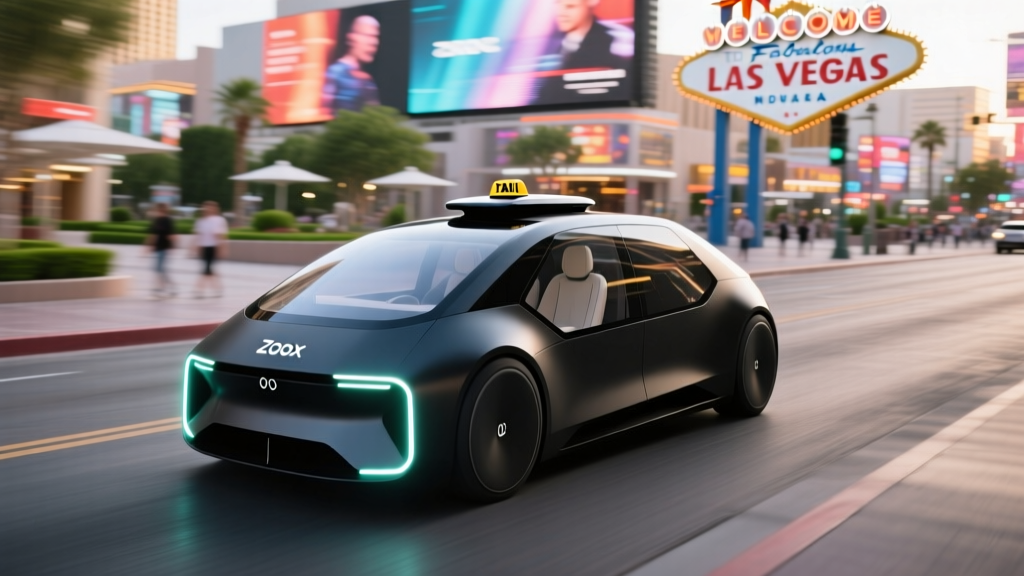
If you've been searching for a Zoox Las Vegas address or wondering where exactly you can hail one of Amazon's purpose-built, steering-wheel-free robotaxis in Sin City, you're not alone. Las Vegas was Zoox's first public testing ground and remains one of the few U.S. cities where fully driverless rides are available to everyday riders. But unlike pulling up to a fixed taxi stand, catching a Zoox ride requires understanding geofenced service zones, app-based hailing, and the current boundaries of Level 4 autonomy.
This guide covers exactly where Zoox operates in Las Vegas, what the ride experience costs, how the technology works under the hood, and what the safety data actually shows — so you can decide whether to summon one on your next Strip visit or daily commute.
Where Zoox Operates in Las Vegas: Service Areas and Pickup Zones
Zoox does not operate from a single fixed address like a dealership or taxi dispatch. Instead, it runs a geofenced, app-based ride-hail service across designated zones in Las Vegas. As of early 2026, the operational footprint covers a roughly 10-to-12-square-mile corridor that includes:
- The Las Vegas Strip corridor — from Mandalay Bay northward through the core resort zone to the Wynn/Encore area
- Downtown Las Vegas — including the Fremont Street Entertainment District and surrounding blocks
- Parts of Summerlin — select residential and commercial zones in the northwest valley
- Henderson expansion zones — limited areas added during late-2025 expansion phases
| City | Status | Approx. Geofence Area | Access Type |
|---|---|---|---|
| Las Vegas, NV | Live — public rides | ~10–12 sq mi (Strip, Downtown, Summerlin, parts of Henderson) | Open via Zoox app |
| San Francisco, CA | Live — public rides | ~8–10 sq mi (SoMa, Mission, parts of Financial District) | Open via Zoox app |
| Foster City, CA | Live — public rides | ~4 sq mi (core commercial/residential) | Open via Zoox app |
| Atlanta, GA | Testing — limited public | ~3 sq mi (Midtown corridor) | Waitlist / invite |
| Seattle, WA | Testing — closed | N/A | Internal / employee only |
To find out whether your specific Las Vegas hotel or destination is covered, download the Zoox app and enter the address. The app will confirm availability in real time, including any temporary zone restrictions due to construction, events, or weather.
How to Ride Zoox in Las Vegas: Step-by-Step
The process mirrors Uber or Lyft but with a few robotaxi-specific quirks:
- Download the Zoox app from the App Store or Google Play and create an account.
- Enter your pickup location. The app will show a map of the geofenced service area and confirm whether your location is inside it. Zoox vehicles typically pick up at curb-side locations — not inside parking garages or private driveways.
- Enter your destination. Both pickup and dropoff must be within the active geofence.
- Wait for dispatch. Typical wait times in the Strip corridor run 3–8 minutes during off-peak hours and 8–15 minutes during peak evening and weekend periods.
- Verify your ride. The app shows the vehicle's license plate and a unique ride code displayed on the Zoox vehicle's exterior screen. Enter the code on the vehicle's door panel to unlock.
- Buckle up and go. The vehicle has no steering wheel, pedals, or driver. Interior screens display the route, and you can communicate with Zoox's remote support team via an in-cabin button at any time.
Zoox Pricing vs. Uber and Lyft in Las Vegas
One of the most common questions from prospective riders: how much does a Zoox ride actually cost? As of 2026, Zoox uses a per-ride pricing model that is broadly competitive with UberX and Lyft Standard, though it varies by distance and demand.
| Service | Base Fare | Per-Mile Rate | Per-Minute Rate | Typical 3-Mile Ride |
|---|---|---|---|---|
| Zoox | $2.50 | $1.10 | $0.30 | $6.50–$8.00 |
| UberX | $2.80 | $1.25 | $0.35 | $7.50–$10.00 |
| Lyft Standard | $2.60 | $1.20 | $0.33 | $7.00–$9.50 |
| Waymo One (where available) | $2.75 | $1.15 | $0.32 | $7.00–$9.00 |
Important context: Zoox has periodically offered promotional pricing and free-ride campaigns in Las Vegas to build ridership and gather feedback. Check the app for current offers. Unlike Uber/Lyft, Zoox does not currently implement surge pricing — fares remain consistent regardless of demand, though wait times increase during peak periods.
Tipping is not expected (there is no driver), though the app does offer an option to rate your ride and provide feedback.
Safety Record: What the Data Actually Shows
Safety is the defining question for any robotaxi service. Zoox, like all autonomous vehicle operators in the U.S., is required to report disengagement and collision data to state regulators and the National Highway Traffic Safety Administration (NHTSA).
- Total autonomous miles driven (all cities): Estimated 1.5+ million driverless miles
- Reported at-fault collisions: A small number of low-speed incidents, primarily rear-end contacts at stoplights — no reported serious injuries to passengers or pedestrians
- Remote-assist interventions: Zoox vehicles can request remote guidance from human operators when encountering ambiguous scenarios (e.g., unusual construction zones, disabled vehicles blocking lanes). The rate of remote interventions has declined as the system's software matures.
- NHTSA Standing General Order: All Level 4 operators, including Zoox, must report crashes involving ADS-equipped vehicles. Data is publicly available via NHTSA's AV crash reporting portal.
For comparison, human drivers in the U.S. experience approximately 1.53 fatalities per 100 million vehicle miles traveled (per NHTSA 2023 data). Robotaxi fleets have not yet accumulated enough miles to draw statistically equivalent fatality-rate conclusions, but the available data from Zoox and competitors like Waymo suggests collision rates at or below human baselines in their operational geofences — with the caveat that these geofences avoid the most complex driving environments (highways, rural roads, severe weather zones).
Zoox's purpose-built vehicle also includes design features that conventional cars lack: four-wheel steering for tight urban maneuvers, airbags positioned for face-to-face seating, and a top speed limited to approximately 75 mph (though geofenced urban routes rarely exceed 45 mph).
Understanding Zoox's Autonomy Level: This Is Not Driver-Assist
Zoox operates at SAE Level 4, meaning the vehicle handles all driving tasks within its defined operational design domain (ODD) with no human driver present and no expectation of human takeover. This is fundamentally different from Level 2 systems like Tesla Autopilot, GM Super Cruise, or Ford BlueCruise, which require an attentive human driver behind the wheel at all times.
Level 4 does not mean the vehicle can drive anywhere in any condition. It means it can drive without a human within its specific geofence, under specific conditions (fair weather, mapped roads, speed limits within ODD).
| Level | Name | Who Drives? | Example |
|---|---|---|---|
| Level 0 | No Automation | Human only | Basic cruise control |
| Level 1 | Driver Assistance | Human (with steering OR speed assist) | Adaptive cruise, lane-keeping |
| Level 2 | Partial Automation | Human (must monitor at all times) | Tesla Autopilot, GM Super Cruise, Ford BlueCruise |
| Level 3 | Conditional Automation | System drives in limited scenarios; human on standby | Mercedes DRIVE PILOT (select highways, under 40 mph) |
| Level 4 | High Automation | System drives fully — no human needed — within geofence | Zoox, Waymo One |
| Level 5 | Full Automation | System drives everywhere, all conditions | Does not yet exist commercially |
Technology Stack: How Zoox Vehicles See and Navigate
Zoox takes a sensor-rich, multi-modal approach to perception — a deliberate contrast to Tesla's camera-only FSD architecture. The Zoox purpose-built vehicle (which replaced its earlier modified Toyota Highlander test fleet) is designed from the ground up for autonomous operation, with sensors positioned for 360-degree coverage and no blind spots.
- LiDAR: Multiple roof-mounted and bumper-level LiDAR units providing high-resolution 3D point clouds out to ~150+ meters. LiDAR is critical for depth perception in low-light conditions and for detecting objects that cameras might miss (e.g., a pedestrian partially occluded by a parked truck).
- Cameras: A surround-camera array covering all directions at high resolution, used for object classification, traffic-light state detection, sign reading, and lane marking identification.
- Radar: Forward and corner radar units for velocity detection of moving objects (vehicles, cyclists) and for redundancy in rain or fog where LiDAR performance can degrade.
- Ultrasonic sensors: Short-range proximity detection for low-speed maneuvers like curb approach and tight-space navigation.
- HD Mapping: Zoox relies on pre-built, centimeter-accurate maps of its geofenced areas. The vehicle localizes itself within these maps in real time, cross-referencing sensor data against known landmarks.
- Compute: Custom onboard computing hardware running Zoox's proprietary perception, prediction, and planning software stack. The system processes terabytes of sensor data per hour.
- Remote Assistance: When the vehicle encounters a scenario it cannot resolve autonomously (e.g., an unusual road closure with no clear detour), it can pause and request guidance from a remote human operator who provides a high-level plan — not direct steering control.
This sensor fusion approach — combining LiDAR, cameras, and radar — is shared by most Level 4 operators including Waymo and Cruise (pre-suspension). It provides redundancy that camera-only systems lack, though it comes at higher hardware cost per vehicle.
Regulatory Landscape: Who Approves Robotaxi Operations?
Robotaxi services in the U.S. operate under a patchwork of state and federal regulations. In Nevada, the regulatory framework is managed by the Nevada Department of Motor Vehicles (DMV), which was one of the first state agencies to establish autonomous vehicle testing and deployment rules.
- Nevada DMV: Issues autonomous vehicle testing and deployment permits. Operators must demonstrate safety cases, carry minimum insurance, and report collision and disengagement data.
- NHTSA (Federal): Oversees vehicle safety standards. Zoox received a notable exemption from certain Federal Motor Vehicle Safety Standards (FMVSS) — such as the requirement for a steering wheel and side mirrors — because its purpose-built vehicle has no human driver position. This exemption was granted under a special petition process.
- Local municipalities: Las Vegas and Clark County coordinate on road-access agreements, pickup/dropoff zones, and integration with existing transit infrastructure.
The regulatory environment remains actively evolving. California's CPUC and DMV have taken a more restrictive posture following Cruise's 2023 suspension in San Francisco, while Nevada has maintained a comparatively permissive framework that has allowed Zoox and other operators to scale service more steadily.
Current Limitations: Where Zoox Can't (Yet) Take You
Level 4 autonomy is powerful within its domain, but that domain has hard boundaries. Here are the current limitations riders should understand:
- Geofence boundaries: If your destination falls outside the mapped service zone, Zoox cannot take you there. The Strip corridor is well-covered, but suburban destinations beyond Summerlin or routes to the airport's interior terminals may not be available.
- Weather restrictions: Zoox vehicles reduce service or pause operations during heavy rain, flooding, or dust storms — conditions common in Las Vegas monsoon season (July–September). LiDAR and camera performance degrade in heavy precipitation.
- Construction zones: While the system handles routine construction with updated map data, sudden or unmarked road work can trigger remote-assist pauses, adding wait time to your trip.
- No highway driving: Zoox's Las Vegas geofence covers surface streets only. There are no freeway/highway routes available — the vehicle is designed for urban speeds up to ~45 mph in practice.
- Accessibility limitations: Zoox's purpose-built vehicle is designed with wheelchair accessibility in mind, but availability of wheelchair-accessible vehicles in the active fleet may be limited. Check the app for accessibility options.
- Passenger capacity: The Zoox vehicle seats up to four passengers in a face-to-face configuration. It does not accommodate large luggage, pet carriers (service animals excepted), or oversized items.
- Night operations: Zoox operates in Las Vegas during evening and nighttime hours (a key use case given the Strip's nightlife), but sensor performance and remote-assist availability may differ from daytime operations.
Frequently Asked Questions
Is there a specific Zoox Las Vegas address I can visit?
No. Zoox operates as an app-based, on-demand ride-hail service — there is no storefront, depot, or fixed pickup address. You request a ride through the Zoox app, and the vehicle comes to your curb-side location within the geofenced service area. Zoox's corporate and engineering offices are in Foster City, California, not Las Vegas.
How much does a Zoox ride cost compared to Uber or Lyft?
Zoox pricing is generally competitive with or slightly below UberX and Lyft Standard for equivalent distances. A typical 3-mile ride on or near the Strip costs roughly $6.50–$8.00. Unlike rideshare services, Zoox does not currently use surge pricing, so fares remain stable during peak demand — though wait times may be longer.
Is Zoox truly self-driving, or is there a hidden driver?
Zoox is genuinely driverless — SAE Level 4. There is no steering wheel, no pedals, and no human driver in the vehicle. The system handles all driving tasks within its geofenced zone. Remote human operators can provide guidance in unusual situations, but they do not directly steer or control the vehicle in real time.
How safe are Zoox robotaxis?
Zoox has accumulated an estimated 1.5+ million driverless miles across its operational cities with a small number of reported low-severity incidents and no reported serious passenger or pedestrian injuries. All crashes are reported to NHTSA under the Standing General Order. The safety record is encouraging but still statistically limited compared to the trillions of human-driven miles annually.
Can I take a Zoox to the Las Vegas airport?
As of early 2026, Zoox's Las Vegas geofence covers the Strip corridor, Downtown, and select suburban zones, but service to Harry Reid International Airport's terminal areas has been limited or unavailable. Check the Zoox app for real-time availability to airport-adjacent locations.
What happens if the Zoox vehicle encounters a problem during my ride?
Every Zoox vehicle has an in-cabin button that connects you to a live remote support agent. If the vehicle detects a system fault, it is designed to pull over safely. In the event of a collision or emergency, the vehicle contacts local emergency services automatically, and Zoox's operations center monitors the situation in real time.
Does Zoox operate in other cities besides Las Vegas?
Yes. As of 2026, Zoox offers public rides in Las Vegas, San Francisco, and Foster City, California. Testing programs (with limited or no public access) are active in Atlanta and Seattle. Expansion to additional cities is planned but timelines depend on regulatory approvals and operational readiness.