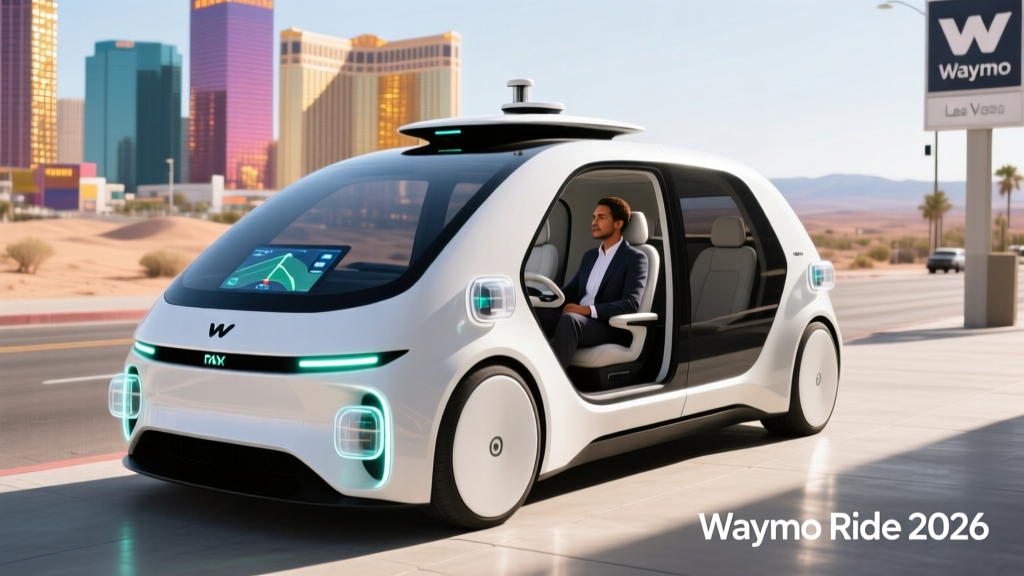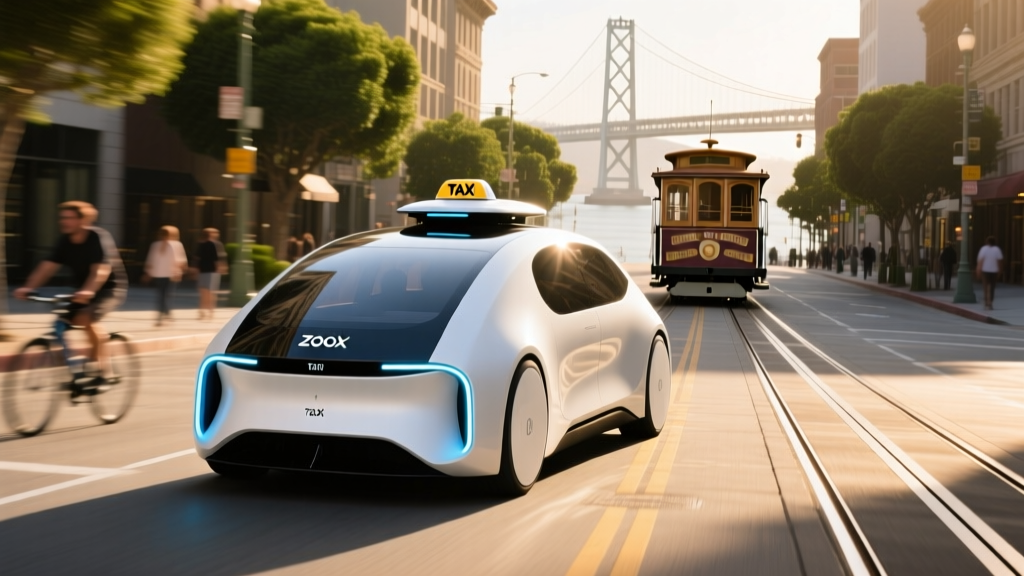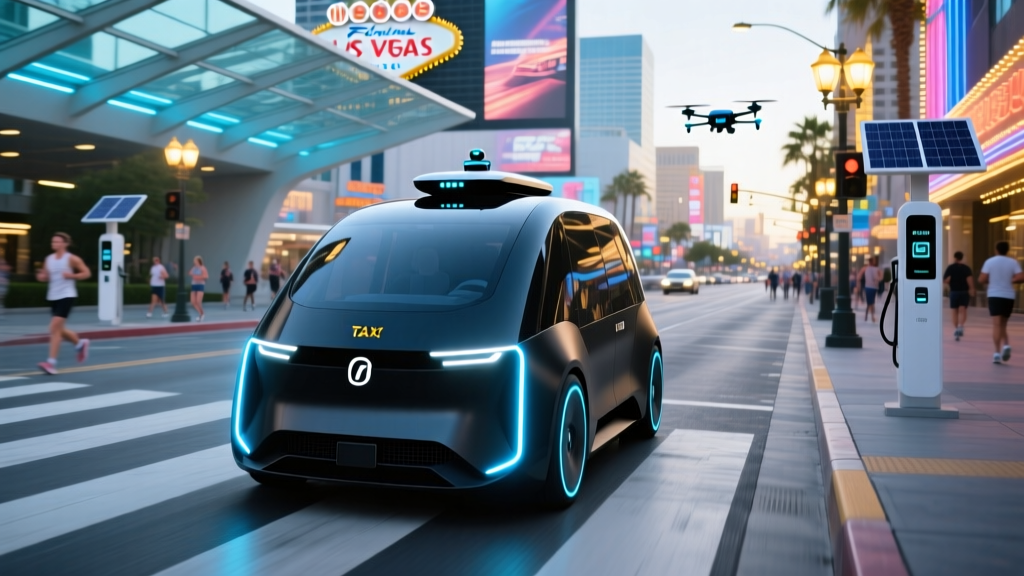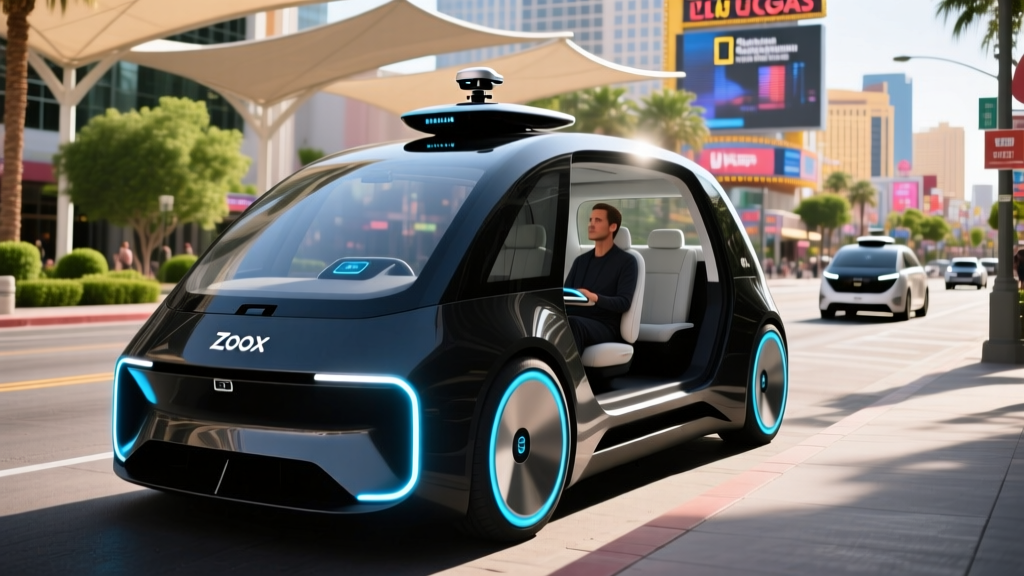
If you've spent any time near the Las Vegas Strip or the Arts District in the past year, you've likely noticed a peculiar vehicle: a compact, symmetrical pod with no steering wheel, no pedals, and passengers riding backward as often as forward. That's the Zoox robotaxi, and it represents one of the most ambitious bets in autonomous mobility — a ground-up vehicle designed exclusively for driverless ride-hailing.
But what exactly is Zoox in Las Vegas, and how does the service actually work in practice? Below, we break down the operational footprint, the technology, the safety record, and the real-world rider experience as of early 2026.
Zoox Explained: A Purpose-Built Level 4 Robotaxi
Zoox is an autonomous vehicle company founded in 2014 and acquired by Amazon in 2020 for roughly $1.3 billion. Unlike Waymo, which retrofits existing vehicles (currently the Jaguar I-PACE and Zeekr RT), Zoox designed its own vehicle from scratch — a carriage-style, bidirectional electric pod that can drive equally well in either direction without a traditional "front" or "rear."
SAE Automation Level: Level 4 (High Automation)
Zoox operates at SAE Level 4, meaning the vehicle performs all driving tasks within a defined operational design domain (ODD) — specific geofenced areas under specific conditions — with no human driver present and no expectation of human intervention. This is fundamentally different from Level 2 systems like Tesla Autopilot or GM Super Cruise, which require continuous driver supervision. Inside a Zoox pod, there is no steering wheel, no brake pedal, and no driver's seat. You are a passenger, period.
The Zoox vehicle is a battery-electric platform with a reported battery capacity of approximately 75 kWh (usable), dual electric motors providing all-wheel drive, and a top speed governed to around 75 mph. The vehicle's most distinctive engineering feature is its bidirectional capability: it can travel forward or backward at full speed, which simplifies maneuvers like three-point turns and dead-end egress.
Where Can You Ride Zoox in Las Vegas Right Now?
Zoox has been testing on public roads in Las Vegas since 2022 and began offering rides to members of the public through its early rider program in mid-2024. As of early 2026, the service operates in a defined geofenced zone covering key corridors:
| Zone | Key Areas Covered | Status |
|---|---|---|
| Las Vegas Strip Corridor | Major resorts from Mandalay Bay to Wynn/Encore | Active |
| Downtown / Arts District | Fremont East, 18b The Las Vegas Arts District | Active |
| Convention Center Area | LVCC, Westgate, surrounding hotels | Active |
| Airport Connector | Harry Reid International Airport (LAS) routes | Limited / Expanding |
The geofence is not the entire city. Zoox vehicles will not travel to suburban Henderson, Summerlin, or the far north Las Vegas Boulevard. If your destination falls outside the ODD, the app simply won't let you request the ride. The company has been incrementally expanding the boundary — typically adding a few square miles per quarter — but expansion requires mapping, regulatory approval, and validation miles.
Zoox also operates in the San Francisco Bay Area (its headquarters city), and has announced plans for additional markets, though Las Vegas and the Bay Area remain the primary operational cities as of this writing.
How to Use Zoox and What It Costs vs. Uber/Lyft
Riding Zoox requires downloading the Zoox app (available on iOS and Android), creating an account, and requesting a ride within the service zone. Wait times in Las Vegas have typically ranged from 3 to 12 minutes depending on time of day and proximity to the fleet concentration near the Strip.
| Service | Typical Strip-to-Downtown Fare | Surge Pricing | Tipping |
|---|---|---|---|
| Zoox (Early Rider Program) | $0 (free during beta) | None | Not applicable |
| UberX | $12–$22 | Yes (1.3x–3.5x common) | Expected |
| Lyft | $11–$20 | Yes (Prime Time pricing) | Expected |
| Waymo One (where available) | $10–$18 | Dynamic pricing active | Optional in-app |
As of early 2026, Zoox rides in Las Vegas remain free for participants in the early rider program. The company has not yet announced commercial pricing, though industry analysts expect fares comparable to or slightly below UberX once the service transitions to paid operations — likely subsidized initially to build ridership. Zoox has indicated it will eventually operate on a per-ride or per-mile commercial model, but no timeline or pricing structure has been publicly confirmed.
Inside the Zoox Pod: The Rider Experience
The Zoox vehicle seats four passengers in a face-to-face configuration — two forward-facing, two rear-facing. There is no driver compartment. Interior features include:
- Individual climate control vents per seat position
- Touchscreen panels for ride status, route visualization, and music selection
- Large glass panels on all sides for visibility (a deliberate design choice to reduce claustrophobia and let passengers see the road)
- Accessibility features including wheelchair-accessible variants in testing
- No steering wheel, pedals, or driver-facing mirrors — reinforcing the Level 4 experience
Rides feel notably different from a traditional car. The bidirectional driving means you might accelerate "backward" out of a pickup zone, which takes some adjustment. The acceleration is smooth and EV-typical, and the vehicle's handling in Las Vegas traffic has been described by most riders as cautious and deliberate — it does not make aggressive lane changes or tight gap merges.
The Technology Stack: Sensors, Compute, and Geofencing
Zoox's sensor suite is among the most comprehensive in the robotaxi industry, relying on sensor redundancy rather than a camera-only approach. Here is a breakdown of the technology stack:
| Sensor Type | Quantity | Function |
|---|---|---|
| LiDAR (roof-mounted) | Multiple units (360° coverage) | 3D point-cloud mapping, object detection to ~200m+ |
| Cameras | 16+ (overlapping FOVs) | Traffic light/signal recognition, lane markings, signage |
| Radar | Multiple units | Velocity detection, all-weather object tracking |
| Ultrasonic | Short-range array | Near-field obstacle detection, low-speed maneuvering |
| IMU / GNSS | Redundant units | Precise localization within HD maps |
Unlike Tesla's camera-only FSD approach, Zoox relies heavily on LiDAR as a primary perception layer, with cameras and radar providing redundant confirmation. The compute platform is proprietary and runs Zoox's full-stack autonomy software — perception, prediction, planning, and control — onboard the vehicle with real-time processing.
The system operates within a high-definition geofenced map. Zoox pre-maps every road in its operational domain to centimeter-level precision, and the vehicle continuously localizes itself against this map using LiDAR and GNSS. If the vehicle cannot confidently localize (for example, due to major construction that alters the road layout), it will pull over safely and request remote assistance — a process Zoox calls "guided teleoperation," where a remote operator can provide high-level guidance (not direct joystick driving).
Safety Record: What the Data Actually Shows
Zoox's safety record is still being established relative to Waymo's more mature fleet, but available data and regulatory filings provide some concrete figures:
Zoox Safety Data Points (Through Late 2025)
- Public road testing miles: Over 1 million autonomous miles driven across Las Vegas and the Bay Area combined (per Zoox disclosures and NHTSA filings)
- Disengagement rate: Zoox reports fewer than 1 disengagement per 1,000 autonomous miles in its mature Las Vegas geofence — meaning the system handles the vast majority of scenarios without remote assistance
- Reported incidents: Zoox has filed standing general orders with NHTSA for any crashes involving its ADS-equipped vehicles. As of late 2025, reported incidents have been low-speed and minor — primarily other vehicles contacting the Zoox pod in stop-and-go traffic
- No reported serious injuries to passengers or other road users in Zoox robotaxi operations as of this writing
Note: Zoox's fleet is smaller than Waymo's, so total mileage data is less statistically robust. Waymo has reported over 5 million autonomous miles with its own fleet. For context, see NHTSA's AV safety resources.
It's worth noting that the Las Vegas driving environment presents specific challenges: high pedestrian density on the Strip, aggressive ride-share and taxi drivers, frequent construction zones, and intense summer heat that can affect sensor performance. Zoox has acknowledged these conditions as part of its validation testing, and the company restricts operations during extreme weather events (monsoon rain, dust storms) when sensor confidence drops below threshold.
Regulatory Landscape: Who Approves Zoox Operations?
Autonomous vehicle operations in the United States are governed by a patchwork of federal and state regulations:
- Federal (NHTSA): The National Highway Traffic Safety Administration sets vehicle safety standards (FMVSS) and requires crash reporting via Standing General Orders for all ADS-equipped vehicles. Zoox received a notable exemption from certain FMVSS requirements (such as the mandate for a steering wheel and mirrors) to deploy its purpose-built vehicle — a significant regulatory milestone.
- State (Nevada): Nevada was one of the first states to pass AV-enabling legislation (2011). The Nevada Department of Motor Vehicles (DMV) issues autonomous vehicle testing and deployment permits. Zoox holds an active Nevada AV permit for both testing and limited commercial deployment.
- Local (Clark County / City of Las Vegas): Local jurisdictions manage road use, traffic management integration, and pickup/dropoff zone designations.
Zoox's FMVSS exemption for its purpose-built vehicle was a landmark moment — it was the first company to receive such an exemption for a vehicle with no manual driving controls. This sets Zoox apart from competitors who must work within vehicles originally designed for human drivers.
Current Limitations: What Zoox Cannot Do
Known Operational Constraints
- Geofence boundaries: Zoox will not travel outside its pre-mapped zone. Suburban and rural areas are not served.
- Weather restrictions: Heavy rain, dust storms, and dense fog can cause the system to limit or suspend operations. Las Vegas monsoon season (July–September) occasionally triggers service pauses.
- Construction zones: Major, unmapped road changes can force the vehicle to stop and request remote guidance, adding delay.
- No highway/freeway operation: Zoox currently operates on surface streets only. It does not merge onto I-15 or US-95.
- Limited fleet size: With a relatively small number of vehicles in Las Vegas, wait times during peak hours (Friday/Saturday nights, convention weeks) can exceed 15 minutes.
- No scheduled rides: Currently on-demand only — you cannot book a Zoox ride in advance for a specific time.
- No stops along the route: You cannot ask the vehicle to stop at an intermediate location (e.g., a drive-through or ATM).
Zoox vs. Waymo: How the Two Robotaxi Leaders Compare
| Attribute | Zoox (Las Vegas) | Waymo One (Las Vegas) |
|---|---|---|
| Vehicle | Purpose-built Zoox pod (bidirectional, no steering wheel) | Jaguar I-PACE (retrofitted SUV) |
| SAE Level | Level 4 | Level 4 |
| LiDAR | Yes (multiple roof units) | Yes (5th-gen custom LiDAR) |
| Service Area (Vegas) | Strip, Downtown, Convention Center | Strip, Downtown, broader suburban coverage |
| Pricing (2026) | Free (early rider program) | Per-ride pricing (comparable to UberX) |
| Total Autonomous Miles | ~1M+ (combined cities) | 5M+ (combined cities) |
| Commercial Availability | Limited beta | Fully commercial |
| Highway Driving | No | Limited (select markets) |
Waymo has a significant head start in commercial maturity and fleet size. Zoox's advantage is its purpose-built design — no compromises from retrofitting a human-driver vehicle — and Amazon's deep-pocketed backing for long-term scaling. Which model ultimately wins on unit economics remains an open question.
Frequently Asked Questions
Is Zoox truly self-driving or is there a safety driver?
Zoox operates at SAE Level 4 with no human driver in the vehicle. There is no steering wheel, no pedals, and no driver's seat. The vehicle handles all driving tasks within its geofenced zone. Remote operators can provide high-level guidance if the vehicle encounters an unexpected scenario, but they do not "joystick" the vehicle in real time.
How much does a Zoox ride cost compared to Uber or Lyft?
As of early 2026, Zoox rides in Las Vegas are free for early rider program participants. Once commercial pricing launches, fares are expected to be competitive with UberX ($12–$22 for a typical Strip-to-Downtown trip). Zoox has not published a pricing schedule yet.
Where exactly can I catch a Zoox in Las Vegas?
The active service zone covers the Las Vegas Strip (major resorts from Mandalay Bay to Wynn), the Downtown Arts District, and the Convention Center area. Pickup is via the Zoox app, which shows your exact geofence boundary. Harry Reid Airport service is limited and still expanding.
Is Zoox safe? What do the crash statistics show?
Zoox has reported no serious injuries to passengers or other road users. Reported incidents have been minor, low-speed contacts typically initiated by other vehicles. The company has driven over 1 million autonomous miles. However, the fleet is smaller than Waymo's, so the statistical sample is less mature. All incidents are reported to NHTSA under Standing General Order requirements.
Can Zoox drive on the freeway or to the airport?
No. Zoox currently operates only on surface streets within its geofenced zone. It does not enter freeways like I-15. Airport service to Harry Reid International is in limited testing but not broadly available.
What happens if the Zoox vehicle encounters construction or an unexpected obstacle?
If the vehicle's confidence in navigating a scenario drops below threshold — for example, a major unmapped construction zone — it will safely pull over and connect with a remote guidance operator. The operator provides high-level routing advice (not direct driving control), and the vehicle resumes autonomous operation once a safe path is confirmed.
Who owns Zoox, and is it related to Amazon?
Yes. Amazon acquired Zoox in 2020 for approximately $1.3 billion. Zoox operates as a subsidiary and has leveraged Amazon's resources for compute infrastructure, logistics, and capital. Amazon has not publicly detailed how Zoox might integrate with its delivery or logistics operations long-term.
The Bottom Line for Las Vegas Visitors
Zoox in Las Vegas is the most visually distinctive robotaxi experience available in the U.S. — a vehicle that looks and feels like nothing else on the road, with no steering wheel and bidirectional driving that makes you acutely aware you're in something new. The technology is legitimate Level 4 autonomy, backed by a dense sensor suite and Amazon's engineering resources.
The trade-offs are real: a smaller service area than Waymo, no freeway capability, weather sensitivity, and a fleet still in beta. But for a visitor on the Strip or heading to the Arts District, requesting a free Zoox ride is one of the most accessible ways to experience what Level 4 autonomy actually feels like — no hype, no steering wheel, just a quiet electric pod navigating Las Vegas traffic on its own. If you're in the geofence, download the app and try it. The data, the engineering, and the rider experience all confirm: this is real autonomous driving, not a demo.