Zoox in Las Vegas: What You Need to Know Before You Ride
If you've searched for Zoox Las Vegas pick up locations, you're likely planning a trip to the Strip and wondering whether Amazon's purpose-built robotaxi is actually available to hail. As of early 2026, Zoox operates a limited commercial ride-hail service in Las Vegas, but access isn't as simple as opening an app anywhere on the boulevard. The service runs within a defined geofence, pick-ups are restricted to approved zones, and the experience is fundamentally different from calling an Uber or Lyft.
This guide covers exactly where Zoox operates in Las Vegas, how to request a ride, what it costs, the technology powering the vehicle, and the real safety data behind the service. We'll also clarify what "self-driving" actually means in regulatory terms — because not all autonomous claims are created equal.
SAE Automation Level: What Zoox Actually Is
Zoox operates at SAE Level 4 — high automation within a defined Operational Design Domain (ODD). This means the vehicle handles all driving tasks without a human driver behind the wheel, but only within its approved geofence and under specific conditions. This is fundamentally different from SAE Level 2 systems like Tesla Autopilot, GM Super Cruise, or Ford BlueCruise, which require continuous driver supervision. Zoox has no steering wheel, no pedals, and no driver seat. You are a passenger, not a backup operator.
Where Can I Use Zoox in Las Vegas Right Now?
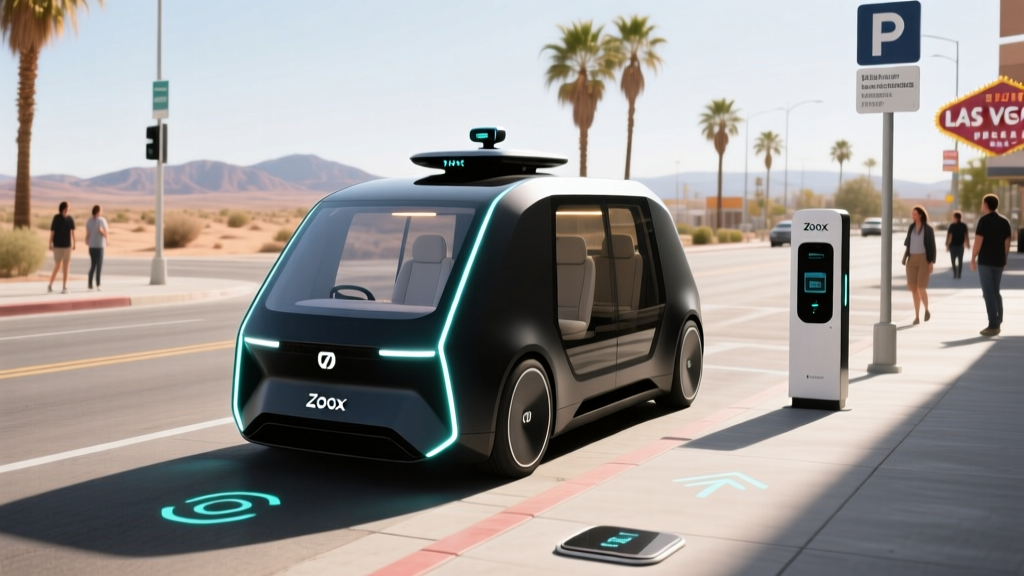
Zoox's Las Vegas service area is concentrated around the high-density tourist corridor. As of 2026, the geofence covers a roughly 4-square-mile zone encompassing key portions of the Las Vegas Strip and adjacent entertainment districts. Pick-ups and drop-offs are not curb-to-curb anywhere within that zone — they operate from designated stops, similar to a shuttle service model.
| Zone | Key Pick-Up Points | Availability |
|---|---|---|
| Central Strip Corridor | Selected resort & casino designated stops along Las Vegas Blvd S | Active — limited hours |
| Convention Center District | Las Vegas Convention Center (LVCC) approved zones | Active — event-dependent |
| Downtown / Fremont Edge | Select approved stops near Main St corridor | Limited / expanding |
Important: Zoox does not currently offer door-to-door service to arbitrary addresses. You request a ride between approved pick-up and drop-off points within the geofence. The Zoox app shows available locations in real time. Service hours are also restricted — typically daytime and early evening, not 24/7.
For the most current operational map and hours, check the official Zoox ride page or the Zoox mobile app, as geofence boundaries expand periodically with regulatory approval.
How to Request a Zoox Ride (and What It Costs)
Riding in a Zoox is not yet an open-market experience like Uber. Here's how access works in practice:
- Download the Zoox app (iOS/Android) and create an account.
- Check service availability — Zoox may operate on an invitation or waitlist basis depending on demand and fleet capacity.
- Select an approved pick-up point from the in-app map.
- Confirm your drop-off — also from the list of approved destinations.
- Wait for your vehicle — the Zoox carriage-style pod arrives without a driver.
- Verify your ride via the app (license plate/vehicle ID match) and board.
Zoox Pricing vs. Uber and Lyft in Las Vegas
Zoox has historically offered rides at no cost during its early commercial phase to build ridership data and public familiarity. As of 2026, the service has begun introducing fares in some markets, though Las Vegas pricing remains competitive with — or subsidized below — standard rideshare rates.
| Service | Avg. Fare (2-mi Strip trip) | Surge Pricing? | Tip Expected? |
|---|---|---|---|
| Zoox | $0–$8 (promotional/subsidized) | No | No (no driver) |
| UberX | $10–$18 | Yes | Yes (15–20%) |
| Lyft Standard | $10–$17 | Yes | Yes (15–20%) |
| Waymo (where available) | $8–$15 | Limited | No |
Zoox's pricing advantage is real but temporary — subsidized fares are a market-entry strategy, not a long-term business model. Expect fares to normalize as the service scales. The absence of surge pricing and tipping, however, provides genuine cost predictability that rideshare cannot match.
How Safe Are Zoox Robotaxis? The Real Data
Safety is the single most important question for any driverless service. Zoox, like all autonomous vehicle operators in California and Nevada, is required to report disengagement data, collision reports, and operational metrics to regulators.
Zoox Safety & Operations Data (Cumulative through 2025)
- Autonomous miles driven (public roads): Over 1 million driverless miles across test and commercial operations (per California DMV disengagement reports)
- Vehicle design: Purpose-built carriage with no steering wheel or pedals — designed from the ground up as a robotaxi, not a retrofitted consumer car
- Top speed: Limited to 75 mph (operational speeds in urban geofences are typically 25–45 mph)
- Reported at-fault collisions: Minimal in public reporting; Zoox vehicles operate at low speeds in controlled geofences
- NHTSA oversight: Zoox has received an exemption from NHTSA to operate its purpose-built vehicle without standard manual controls (FMVSS exemption)
For context, Waymo — the most mature robotaxi operator — has reported over 7 million driverless miles with a collision rate significantly lower than human benchmarks in comparable urban environments. Zoox's dataset is smaller, and its Las Vegas deployment is more recent, so direct statistical comparison is premature. What is clear: the vehicle's sensor suite and low operational speeds in geofenced areas create a conservative safety envelope.
Zoox also published a peer-reviewed safety case for its vehicle architecture, arguing that its bidirectional driving capability (the vehicle can travel equally well in either direction) and 360-degree sensor coverage reduce blind-spot incidents common in human driving.
Under the Hood: Zoox's Technology Stack
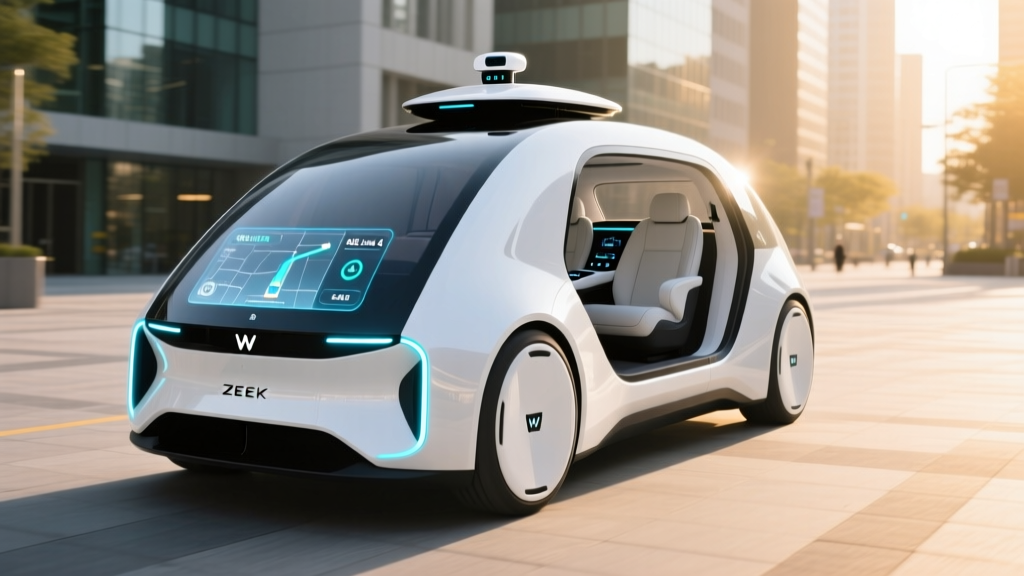
The Zoox vehicle is not a modified SUV with bolted-on sensors. It's a ground-up robotaxi — a symmetrical, carriage-style pod with four-wheel steering and bidirectional driving. Here's what powers it:
Sensor Suite & Compute
- LiDAR: Multiple solid-state and spinning LiDAR units providing a 360-degree, 3D point cloud of the environment — effective to ~150+ meters
- Cameras: High-resolution camera array covering all directions with overlapping fields of view for redundancy and object classification
- Radar: Forward and surround radar for velocity detection, adverse weather penetration, and redundancy
- Compute: Custom onboard AI processing stack handling sensor fusion, prediction, and planning in real time
- HD Maps: Pre-mapped geofence zones with centimeter-level precision, updated continuously
The key differentiator vs. Tesla's camera-only FSD approach: Zoox uses LiDAR as a primary sensor, which provides direct depth measurement independent of lighting conditions. This matters at night on the Strip, where neon reflections, pedestrian crowds, and complex intersections challenge vision-only systems. The trade-off is cost — LiDAR-equipped vehicles remain significantly more expensive to build than camera-only platforms.
Zoox's vehicle also features four-wheel steering, enabling a turning radius tight enough for U-turns in a single lane — useful in dense urban environments where three-point turns would block traffic.
The Regulatory Landscape: Who Approves Zoox Operations?
Robotaxi operations in the United States are governed by a patchwork of state and federal regulations. Zoox's ability to pick up passengers in Las Vegas depends on approvals from multiple agencies:
- Nevada DMV / Nevada Public Utilities Commission: State-level permits for commercial autonomous vehicle operation on public roads
- NHTSA (federal): Zoox received a critical FMVSS exemption allowing its vehicle to operate without a steering wheel, mirrors, or pedals — a regulatory milestone that distinguishes it from retrofitted AV platforms
- Local municipalities: City-level agreements for pick-up zones, curb access, and traffic integration in Las Vegas and Clark County
In California, Zoox holds a DMV autonomous vehicle testing and deployment permit, which requires annual disengagement reporting. Nevada's regulatory framework is generally considered more permissive for commercial AV deployment, which is why Las Vegas has become a primary market for multiple robotaxi operators.
The regulatory environment remains fluid. Federal legislation for a unified AV framework has stalled in Congress repeatedly, leaving states to set their own rules. This means Zoox's expansion to new cities requires navigating each jurisdiction independently — a significant bottleneck for scaling.
Current Limitations: What Zoox Cannot Do
Operational Constraints (2026)
- Geofence only: The vehicle will not travel outside its pre-mapped service zone. No airport runs (unless Harry Reid International is within the geofence), no suburban trips, no highway cruising beyond approved corridors.
- Weather restrictions: Heavy rain, flooding, or dust storms may trigger service suspension. LiDAR and cameras degrade in extreme precipitation, and Zoox takes a conservative approach to operational conditions.
- No arbitrary addresses: Pick-ups and drop-offs are limited to approved stops — you cannot hail a Zoox to your hotel's exact front door unless it's a designated point.
- Limited hours: Service is not 24/7. Late-night operations may be unavailable depending on fleet size and regulatory permits.
- Capacity: The Zoox pod seats up to 4 passengers. No wheelchair-accessible vehicle variant is currently in commercial service, though ADA compliance is a stated development priority.
- No luggage: The vehicle's compact, symmetrical design prioritizes passenger seating over cargo. Airport-style luggage is not practical.
- Edge cases: Construction zones, temporary road closures, and unusual events (parades, protests) may cause the vehicle to stop and request remote assistance — a "teleoperations" model where a human operator provides guidance remotely without directly driving.
These limitations are not unique to Zoox — every Level 4 robotaxi operator, including Waymo and Cruise (pre-suspension), faces similar ODD constraints. The difference is scope: Waymo's Phoenix and San Francisco geofences are significantly larger, and Waymo offers airport service in select markets. Zoox's Las Vegas footprint is comparatively compact.
Frequently Asked Questions
Where exactly can I catch a Zoox in Las Vegas?
Zoox operates from designated pick-up points within its geofenced zone along the central Las Vegas Strip corridor, near the Convention Center, and select downtown-adjacent stops. Use the Zoox app to view real-time available locations. You cannot flag one down on the street — all rides must be requested through the app.
Is Zoox truly self-driving, or is there a hidden driver?
Zoox is a true SAE Level 4 driverless vehicle. There is no steering wheel, no pedals, and no human driver in the vehicle. The vehicle navigates autonomously within its approved geofence. This is categorically different from Level 2 driver-assist systems like Tesla FSD (Supervised) or GM Super Cruise, which require a licensed, attentive driver behind the wheel at all times.
How much does a Zoox ride cost compared to Uber?
As of 2026, Zoox fares in Las Vegas are promotional or subsidized, often ranging from free to approximately $8 for a typical 2-mile Strip trip. UberX for the same route typically costs $10–$18 plus potential surge pricing and tip. Zoox does not use surge pricing and does not accept tips. Expect fares to increase as the service matures beyond its market-entry phase.
How safe are Zoox robotaxis compared to human drivers?
Zoox has accumulated over 1 million autonomous miles across its operations with minimal reported at-fault incidents. The vehicle operates at conservative speeds within a controlled geofence and uses a redundant sensor suite (LiDAR + cameras + radar). However, Zoox's total mileage dataset is substantially smaller than Waymo's 7+ million driverless miles, making definitive statistical comparisons premature. NHTSA oversees the vehicle under an FMVSS exemption.
Can I take a Zoox to Harry Reid International Airport?
As of early 2026, airport service is not confirmed as part of the Las Vegas geofence. Check the Zoox app for the current operational map — airport routes may be added as the geofence expands with regulatory approval.
What happens if the Zoox vehicle encounters a problem during my ride?
Zoox uses a remote assistance model called teleoperations. If the vehicle encounters an unfamiliar scenario (construction zone, unusual obstruction), it will stop safely and connect with a remote human operator who provides guidance. The remote operator does not directly steer the vehicle — they approve a path or strategy that the vehicle then executes autonomously.
Is Zoox available in other cities besides Las Vegas?
Zoox has tested and operated vehicles in San Francisco (its headquarters city), Foster City, California, and select other locations. However, commercial ride-hail availability varies by market and regulatory status. Las Vegas and the San Francisco Bay Area are the primary operational markets as of 2026.
The Bottom Line: Should You Try Zoox in Las Vegas?
If you're visiting Las Vegas and your hotel falls within the Zoox geofence, a ride is worth experiencing — it's one of the few ways a member of the public can ride in a true Level 4 driverless vehicle with no steering wheel or driver. The cost is low (often free during the promotional phase), the speeds are conservative, and the Strip corridor is one of the more controlled urban environments for autonomous operation.
But manage your expectations: this is not a replacement for Uber. The geofence is small, pick-up points are limited, service hours are restricted, and you can't use it for airport runs or suburban trips. Zoox in Las Vegas is best understood as a first-mile/last-mile experience within the tourist corridor — a glimpse of what urban robotaxi networks could become, not what they are today.
For the latest Zoox Las Vegas pick up locations and service updates, download the Zoox app or visit zoox.com. Regulatory approvals and geofence boundaries change frequently — always verify availability before planning your trip around the service.